How Do You Sharpen a Khukuri (Kukri)?
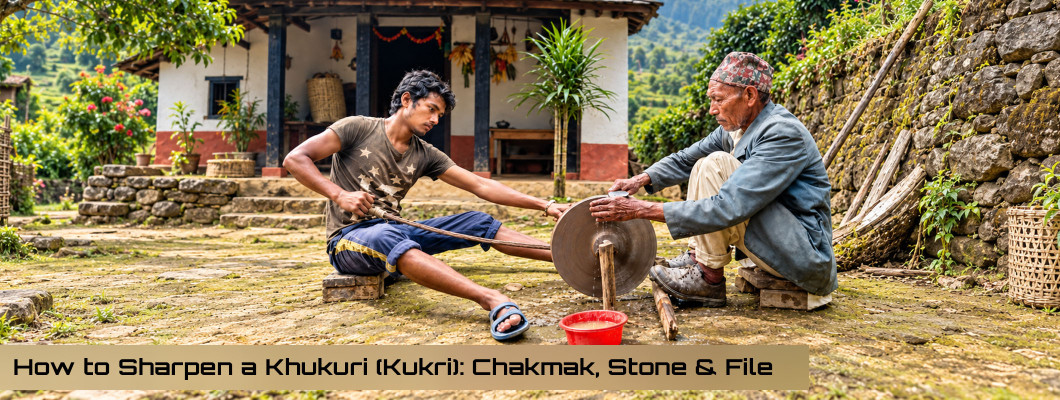
You sharpen a khukuri (kukri) in two different ways, and most guides blur them together. Day to day, you hone it with the chakmak, the small blunt steel that rides in the back of the scabbard. That realigns an edge that has rolled or folded, but it removes almost no metal. When the edge is genuinely dull or chipped, you sharpen it with an abrasive that follows the curve: sandpaper over a soft backing, a puck or round rod, or a file for real damage. The trick is working the belly, the tip and the inward curve near the cho as three separate zones, and keeping the convex edge the blade left the forge with.
Quick Answer: Sharpening a Khukuri (Kukri)
- The chakmak hones, it does not sharpen. It is a hardened, blunt steel that straightens a rolled edge and removes almost no metal.
- Use light pressure with the chakmak — five to ten sweeps per side, from the cho end to the tip.
- A dull khukuri needs an abrasive. Sandpaper on a soft backing is the best home method because it keeps the convex edge.
- Sharpen in three zones: the belly, the tip, and the inward curve near the cho, which needs a round tool.
- Grits: 320, then 600, then 1000. A working khukuri does not need to go finer.
- Chips need a file, pushed into the edge and away from you, then finished with sandpaper.
- Avoid heat. Angle grinders and dry bench grinders can ruin the edge temper permanently.
Key Terms
- Khukuri (kukri)
- The forward-curved working knife of Nepal and the service blade of Gurkha soldiers. Khukuri is the Nepali spelling; kukri is the common English one.
- Chakmak
- A small, blunt, hardened steel carried in the scabbard. It hones (realigns) the edge and can strike sparks from flint.
- Karda
- The small sharp utility knife carried alongside the chakmak.
- Cho (kaudi)
- The notch at the base of the edge, near the handle. It is not part of the cutting edge.
- Dap
- The traditional khukuri scabbard: a carved wooden core covered in leather.
- Convex edge
- An edge whose bevel curves gently to the apex, which makes it strong for chopping.
- Burr
- A thin wire of steel that forms on the opposite side of the edge while sharpening; it tells you the edge has been reached.
Why Is a Khukuri Harder to Sharpen Than a Straight Knife?
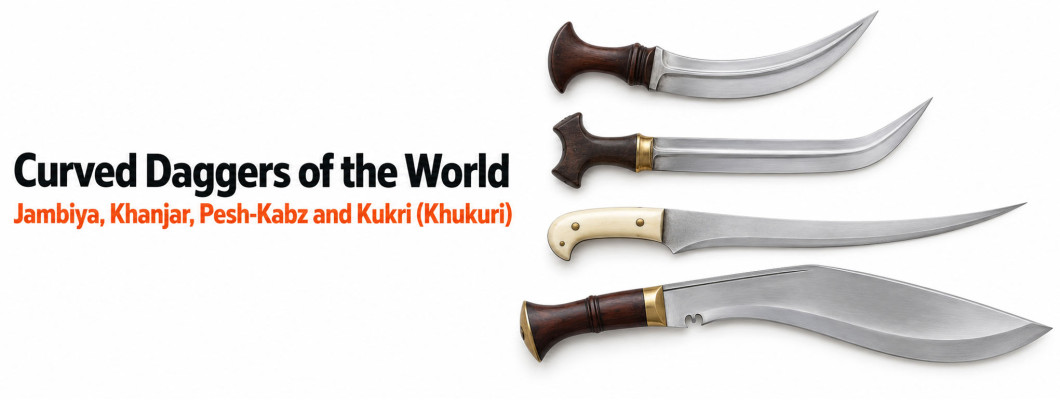
A khukuri is harder to sharpen because its edge curves both outward and inward, and because its convex, hard-tempered edge is easy to flatten or overheat. A straight knife has one edge line. A khukuri/kukri has three, and each one wants a different tool:
- The belly — the wide, forward-swelling section that does the chopping. It curves outward, so a flat stone or a pad touches it easily.
- The tip — narrow and pointed. It needs a lighter hand and a slightly raised handle to reach.
- The inward curve — the concave stretch between the belly and the cho (kaudi). A flat stone cannot reach into it at all. This is the section most people ruin or simply never sharpen.
Two more things make the khukuri different. First, its edge is convex: the bevel rolls gently to the apex rather than meeting at a flat angle, which is what lets it survive heavy chopping. Our forging process page explains why khukuris and machetes are ground this way. Second, a traditionally made khukuri is differentially hardened — the edge is quenched hard while the spine stays tougher. That hard edge is where the whole performance of the blade lives, and heat from careless sharpening can destroy it in seconds.
What Is the Chakmak Actually For?
The chakmak is the small, unsharpened companion tool that sits in a pocket on the back of a traditional dap (scabbard), beside the karda. Its job is closer to a butcher's steel than to a sharpening stone. It is a burnisher, not an abrasive.
When a khukuri bites into hardwood, bone or a hidden knot, the very thin apex of the edge does not usually break. It bends over, or "rolls". The edge then feels dull even though the metal is all still there. Drawing a hard, smooth chakmak along the edge pushes that rolled steel back upright, and the blade cuts again. That is why a Gurkha or a hill farmer could keep a working khukuri useful for days in the field with nothing else.
What the chakmak cannot do is just as important:
- It cannot restore an edge that has worn round from use. Once the metal is gone, only an abrasive brings it back.
- It cannot remove chips or nicks.
- It cannot reshape or thin an edge that has become too blunt.
The chakmak had a second job too: struck against flint, the hardened steel throws sparks for lighting a fire. For more on both companions, read The Karda and Chakmak Explained.
An honest note. A chakmak only works if it is harder than the blade it is honing. Many souvenir khukuris come with a chakmak that was never hardened, and it does nothing except scratch the flats. If yours comes away from the edge scored or notched, it is softer than your blade. A smooth ceramic rod or a small kitchen honing steel does the same job and is a sensible substitute. Not every khukuri in our range ships with both companions, either — check the product page for what is included with the model you are looking at.
How to Use a Chakmak, Step by Step
Most instructions tell you to press hard. Do the opposite. Honing is about alignment, and heavy pressure just folds the edge the other way.
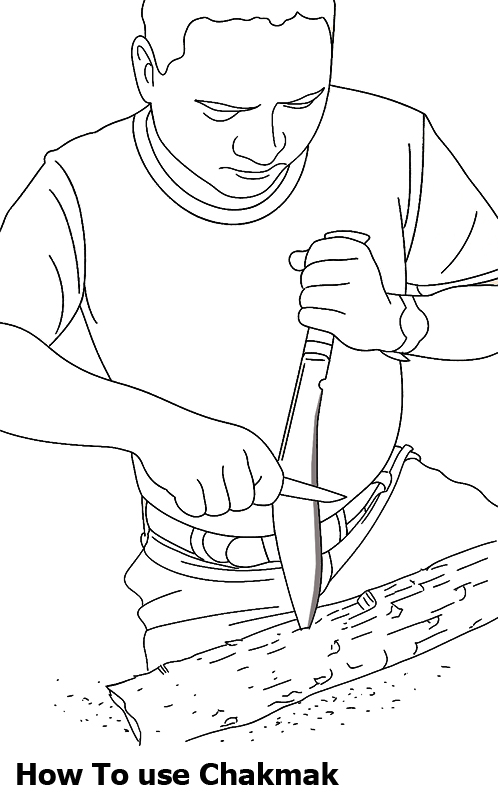
- Brace the khukuri. Hold the handle firmly and rest the tip on a piece of wood, or hold the blade edge-up with the spine against your thigh protected by a folded cloth. The edge always points away from your body.
- Find the angle. Lay the chakmak against the side of the edge, almost flat on the bevel, then raise it very slightly — a touch steeper than the bevel itself.
- Stroke along the curve. With light pressure, sweep the chakmak from the end near the cho towards the tip in one smooth pass, following the curve of the blade so it keeps contact through the inward curve and across the belly.
- Alternate sides. Do the same on the other side. Five to ten light passes per side is plenty.
- Check the edge. Tilt the blade under a light. A rolled section shows up as a thin bright line along the apex; a good edge shows almost nothing. A clean slice through a sheet of paper confirms it.
If ten careful passes do not bring the bite back, the edge is not rolled — it is worn. Move on to an abrasive.
Which Tool Should You Use?
| Tool | What it does | Use it when |
|---|---|---|
| Chakmak or honing rod | Straightens a rolled edge; removes almost no steel | After a day's chopping, or in the field |
| Sandpaper on a soft backing | Sharpens and keeps the convex edge | The edge is dull; the best all-round home method |
| Round diamond or ceramic rod | Reaches the inward curve near the cho | Touching up the concave section |
| Axe puck or small stone | Removes steel quickly on the belly | A dull belly, or field sharpening on longer trips |
| Mill bastard file | Removes a lot of steel fast | Chips, nicks, or an edge that has gone very blunt |
| Slack-belt sander | Fast convex sharpening | Only if you already know how to keep steel cool |
How to Sharpen a Dull Khukuri With Sandpaper
This is the method we recommend for most owners. It is cheap, it follows the curve naturally, and the soft backing builds the convex edge for you instead of flattening it.
You will need: wet-and-dry sandpaper in 320, 600 and 1000 grit (add 220 if the edge is very dull, and 1500 to 2000 if you want a finer finish); a firm backing such as a dense mouse pad, a piece of leather glued to wood, or a thick magazine; a rubber eraser block or a length of broom handle for the inward curve; gloves and a cloth.
- Lay the paper on the backing. Start with the coarsest grit you need. On a firm pad the paper will dip slightly under the blade, and that dip is what shapes a convex edge.
- Work edge-trailing. Lay the bevel flat on the paper and pull the blade spine first, away from the edge. Never push the edge into the paper — it will cut straight through it.
- Cover the whole bevel. Sharpen across the full width of the bevel, not just the very edge. If you only touch the apex, you slowly build a steep, blunt shoulder, and the blade stops biting.
- Go zone by zone. Do the belly first with long, curving pulls. Raise the handle slightly to reach the tip. Then wrap the paper around the eraser or dowel and work the inward curve, stopping just short of the cho. Finish with a few full-length sweeps so the three zones blend together.
- Raise a burr, then switch sides. Keep going on one side until you can feel a faint wire edge on the opposite side. Feel for it by drawing your thumb gently across the edge from the spine side — never along it. Then repeat the same number of strokes on the other side.
- Step up through the grits. Move to 600, then 1000, using fewer strokes and lighter pressure each time. Alternate sides every few strokes on the finer grits.
- Remove the burr. Finish with a few alternating light strokes on your finest paper, then three or four light passes with the chakmak or a strop.
For a working khukuri/kukri, you can stop at 600 or 1000. A slightly toothy edge grips wood better and stands up to chopping longer than a polished, hair-shaving one.
Can You Use a Sharpening Stone on a Khukuri?
Yes, with limits. A flat bench stone only reaches the belly and the tip; it cannot touch the inward curve. The easier approach is to bring the stone to the blade rather than the blade to the stone:
- Clamp the khukuri edge-up in a vice with padded jaws, or hold it firmly braced on a bench.
- Use a round axe puck on the belly in small, overlapping circles, keeping a steady angle and rolling slightly to follow the convex bevel.
- Use a round diamond or ceramic rod along the inward curve.
- Count strokes and match them on each side.
Be aware that a flat stone tends to wear a convex edge into a flat bevel over time. That is not a disaster, but it changes how the blade chops. If you want the general technique for stones and angles, see our knife sharpening guide.
How Do You Fix Chips or a Very Blunt Edge?
Use a mill bastard file to remove steel until the chip is gone, then refine the edge with sandpaper and finish with the chakmak. A khukuri that has hit a stone or a nail needs metal taken off, and a file is the traditional tool for that across Nepal and anywhere machetes are used.
- Straighten first. Run the chakmak along the damaged section to push any folded steel back into line, so you are not filing away metal that could be saved.
- Clamp the blade. Secure it edge-up in a padded vice. Wear cut-resistant gloves.
- File into the edge, away from you. A file cuts on the push stroke only, so lift it on the way back. Work at the bevel angle, not steeper.
- Blend as you go. Take extra strokes over the chipped area, then run longer blending strokes along the whole edge so the line stays smooth instead of developing a dip.
- Use the file's corner for the curve. Tilting the file so its edge meets the inward curve lets you reach the concave section.
- Finish with sandpaper. The file leaves a coarse edge. Take it through 320 and 600 grit, then hone.
Deep chips can take a lot of metal to remove. If the damage runs more than a few millimetres into the blade, it is worth asking a professional sharpener or contacting us before you start.
Should You Use a Belt Sander or Grinder?
A slack-belt sander is acceptable with care; an angle grinder or dry bench grinder is not. A slack-belt sander (a belt run without the platen behind it) is how many professionals put a convex edge on a big chopper, and it handles the curve well. It is also the fastest way to destroy the temper. Keep passes short and light, keep a pot of water beside you, and dip the blade whenever the steel feels warm. If it ever becomes too hot to hold your finger on, stop — you are already too close. Keep the tip from running off the end of the belt, and slow down near the cho.
Do not use an angle grinder or a dry bench grinder on a khukuri. Both generate heat far faster than you can feel it, and a blue or straw-coloured tint on the edge means the hardness there is already gone. No amount of later sharpening brings it back.
What Angle and How Sharp?
Most working khukuris are sharpened at roughly 20 to 25 degrees per side, and they should be sharp enough to bite into wood rather than sharp enough to shave. There is no single correct angle, because every hand-forged khukuri/kukri is ground to suit its size and job. As a rule of thumb, most working khukuris carry an edge in the region of 20 to 25 degrees per side, and the heavier the blade, the more it benefits from staying at the steeper end of that range. The best guide is the blade itself: follow the bevel you were given instead of inventing a new one.
A chopping blade does not need to shave. What it needs is an edge that bites cleanly into wood and survives a knot. If you thin the edge to razor sharpness, it will roll and chip much sooner. For the full picture of how size changes the job, see What Size Kukri (Khukuri) Should You Buy?
Why Does a New Khukuri Sometimes Roll on First Use?
A newly polished khukuri can have a slightly softer surface layer at the edge, which rolls on first use and disappears after one full sharpening. Polishing and buffing a blade creates heat at the surface. On a mirror-polished khukuri, a very thin layer of steel right at the apex can come out slightly softer than the metal underneath. It shows up as a small rolled section the first few times you chop something hard. This is normal and it is not a defect in the blade's heat treatment.
The fix is simple: do a little hard chopping at home before you take the blade on a trip, then give the edge one full sharpening session with sandpaper. That removes the surface layer and exposes the properly hardened steel beneath. After that, the chakmak will keep it going.
Common Sharpening Mistakes
- Pressing hard with the chakmak. Light pressure aligns the edge; heavy pressure bends it.
- Sharpening only the belly. The inward curve gets left dull, and the blade drags on every draw cut.
- Grinding into the cho. The cho is a shaped feature, not part of the cutting edge. Stop just before it.
- Only touching the apex. This creates a steep micro-bevel that gets blunter with every session.
- Letting the steel get hot. Heat, not wear, is what ruins a khukuri edge for good.
- Sharpening towards your body. Edges always point away from you, and wear gloves for file and sandpaper work.
- Chasing a razor edge on a chopper. Sharp enough to bite beats sharp enough to shave.
What to Do After Sharpening
After sharpening, clean the blade, dry it, oil it lightly, and make sure the scabbard is dry. Sharpening leaves fine steel dust and exposes fresh metal, which rusts faster than a seasoned blade. Wipe the blade clean, dry it completely, and give it a thin coat of oil before it goes back in the scabbard. Make sure the dap is dry inside too — its wooden core can hold moisture against the steel, which is one of the most common causes of rust on a khukuri. Our kukri maintenance guide and the khukuri (kukri) maintenance resource cover cleaning, oiling and storage in full, and The Kukri/Khukuri Scabbard (Dap) Explained shows how the scabbard is built.
Want a Khukuri Built for the Work You Do?
Every khukuri/kukri we make is hand-forged from 5160 spring steel with a convex working edge. Tell us how you will use it and we will forge the blade, the edge and the handle to suit.
Request a Custom Forge →Explore More Kukri & Khukuri Guides
Frequently Asked Questions
Is the chakmak a sharpener?
Not in the way a stone is. The chakmak is a hardened, blunt steel that burnishes the edge: it straightens steel that has rolled over during use, so the khukuri cuts again. It removes almost no metal, so it cannot restore an edge that has worn down or fix a chip. For that you need an abrasive such as sandpaper, a stone or a file.
How often should I sharpen my khukuri (kukri)?
Hone it with the chakmak whenever it starts to feel less keen, which may be after every session of hard chopping. Full sharpening with an abrasive is only needed when honing no longer brings the bite back. For a khukuri used regularly, that might be every few months; for a display or occasional-use blade, very rarely.
What is the best way to sharpen the inward curve near the cho?
Use something round. Sandpaper wrapped around a rubber eraser block or a length of dowel works well, as does a round diamond or ceramic rod. A flat stone cannot reach this section. Stop just short of the cho itself, which is a shaped feature rather than part of the cutting edge.
What grit sandpaper should I use on a khukuri?
Start at 320 for a dull edge (220 if it is very blunt), move to 600, and finish at 1000. For a working khukuri/kukri, 600 to 1000 gives a slightly toothy edge that grips wood well. Going up to 1500 or 2000 produces a finer edge, but it is not necessary for chopping.
Can I use a kitchen honing steel instead of a chakmak?
Yes. A kitchen honing steel or a ceramic rod does the same job as a chakmak: it realigns a rolled edge. Use light pressure and follow the curve of the blade. A small one is easy to carry in a pack if your khukuri did not come with a chakmak.
Why is my new khukuri going dull so quickly?
On polished blades, a very thin surface layer at the edge can be slightly softer than the steel beneath, and it rolls the first few times the blade meets hard wood. Chop with it at home, then give the edge one full sandpaper session. That exposes the properly hardened steel, and the edge will hold much better afterwards.
Can I sharpen a khukuri that was ordered blunt?
It is possible, but a blunt edge has been deliberately rounded, so bringing it back takes file work and patience rather than a quick touch-up. If the khukuri was ordered blunt for stage combat or training, keep it that way — a re-sharpened edge is no longer safe for that use. If you want a sharp blade, it is easier to order one sharp from the start.
Can sharpening ruin a khukuri?
Heat is the real danger. Angle grinders, dry bench grinders and heavy belt-sander passes can overheat the edge and destroy its hardness, which cannot be restored by sharpening. Hand methods — chakmak, sandpaper, stones and files — do not generate enough heat to cause that damage.