How Do You Fix a Tight or Loose Khukuri (Kukri) Scabbard?
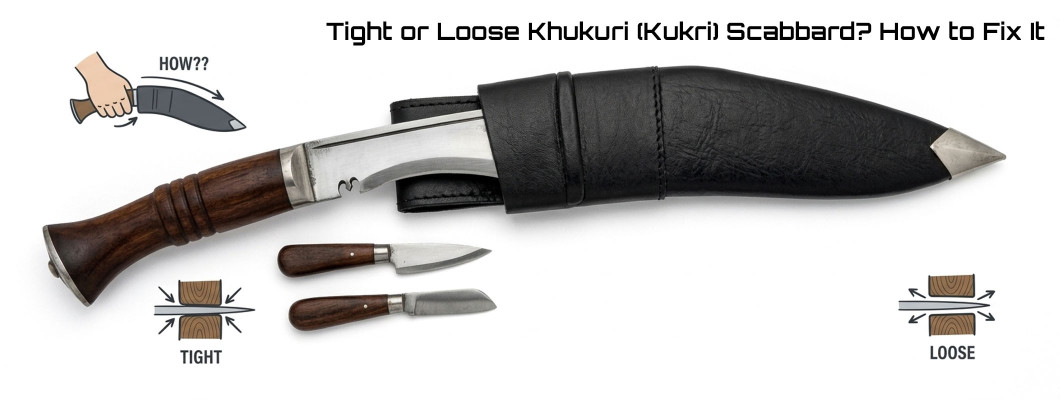
A khukuri (kukri) that sticks in its scabbard can usually be fixed in minutes, without touching the blade. First, take the karda and chakmak out of their pockets — when they are in, they press on the dap and pinch the blade. Then shake the empty dap mouth down to clear any wood chips the edge has cut from the core. If it is still tight, clean the blade, let a damp dap dry, and break a new one in with slow draws. If it still binds, find the tight spot with a marker and tap the spine side and edge side of the dap lightly with a hammer — the method we use at the forge. Stop as soon as the blade slides smoothly but still stays in when the dap is turned upside down. Never force a stuck blade, and always hold the dap by the throat with your fingers on the spine side. If the opposite is true and the khukuri slides out when the dap is tipped, the dap is too loose: a thin leather shim inside the throat or a retention strap usually fixes it, and we can make a new dap if it cannot be saved.
Quick Answer: Fixing a Tight Khukuri Scabbard
- Never force it. A stuck blade can jump free or cut through the dap.
- Take the karda and chakmak out first. When they sit in their pockets, they press on the dap and can squeeze the blade slot. Put the khukuri in first, then the karda and chakmak.
- Shake out wood chips. The edge can shave small pieces off the wood core, and they jam inside. Hold the dap mouth down, shake and tap it until nothing more falls out.
- Clean the blade. Dirt, sap and rust make a good dap feel tight.
- Dry a damp dap at room temperature for two or three days — never near a heater.
- Break in a new dap with slow, careful draws and returns.
- Find the tight spot with the marker test: where the colour rubs off, the blade is touching.
- Tap it loose: with the blade out, give the spine side and edge side of the dap light hammer taps along the tight section. This is how we ease a dap at the forge.
- Sand only as a last resort, with fine sandpaper on a thin flat stick, a little at a time.
- Stop before it gets loose. The blade should slide smoothly but stay in when the dap is held upside down and shaken gently.
- A thin rub of candle wax on a clean blade helps it slide; never use soap or pour oil inside.
Quick Answer: Fixing a Loose Khukuri Scabbard
- Test it: hold the sheathed khukuri upside down over a soft surface and shake gently. If it slides out, the dap is too loose.
- Keep the dap away from heat — a dried, shrunken wood core is the usual cause.
- Shim the throat with a thin strip of leather glued to one flat face of the wood core.
- Add a retention strap over the handle for carrying.
- Replace the dap if it cannot be saved — we can make one for your khukuri.
Try These in Order
- Take the karda and chakmak out.
- Shake the empty dap mouth down to clear wood chips.
- Clean the blade and remove any rust.
- Dry the dap if it has been damp.
- Break a new dap in with slow draws.
- Find the tight spot with the marker test.
- Tap the spine side and edge side of the dap lightly with a hammer.
- Sand inside the dap only if tapping is not enough.
Test the fit after each step, and stop as soon as it is right.
Key Terms
- Dap
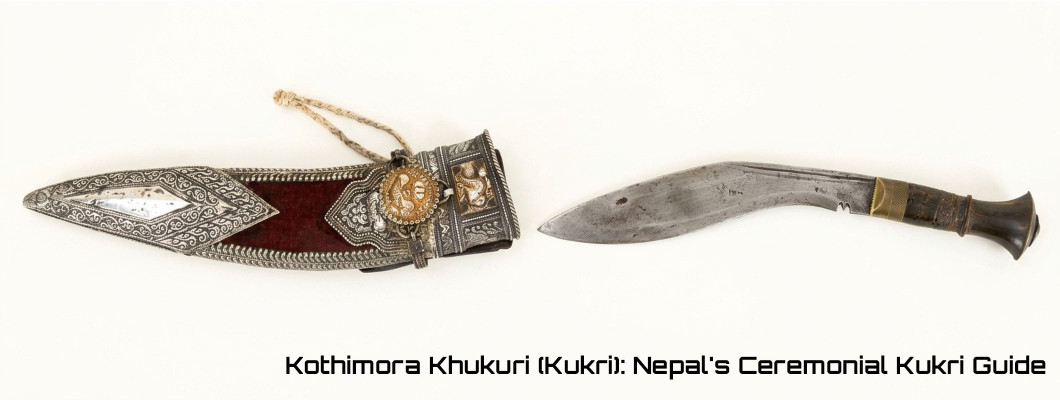
- The traditional khukuri (kukri) scabbard: a carved wooden core wrapped in leather.
- Wood core
- The two shaped wooden halves inside the dap that hold the blade.
- Throat
- The mouth of the scabbard, where the blade goes in.
- Chape
- The metal cap that protects the tip of the scabbard.
- Frog
- The leather loop or strap that carries the scabbard on a belt.
- Karda and chakmak
- The small utility knife and the honing steel carried in pockets on the back of the dap.
Why Does a Khukuri Stick in Its Scabbard?
Most tight scabbards are caused by the wooden core swelling with moisture, or by a new, hand-fitted dap that has not yet been broken in. A traditional dap is built around a wooden core, and wood takes up water from damp air, rain or a wet blade. When it swells, the slot for the blade gets narrower. The full construction is explained in The Kukri/Khukuri Scabbard (Dap) Explained.
Other common causes are:
- The karda and chakmak in their pockets. The two pockets sit on the back of the dap, right against the wood core. With the karda and chakmak in place, they press on the core and narrow the slot for the main blade.
- Wood chips cut from the core. Every time the khukuri goes in, the edge can shave tiny pieces off the wood core, especially if it goes in at an angle. Those pieces collect inside and wedge against the blade.
- A new dap. Each scabbard is fitted to its blade by hand, and a new one is often snug until it has been used.
- Dirt, sap or resin on the blade or packed inside the dap after outdoor use.
- Rust on the blade flats, which roughens the surface and makes it drag.
- Leather that has been soaked and dried, which can shrink and tighten around the core, especially at the throat.
- A move to a more humid climate, the opposite of what loosens a handle.
| What you notice | Likely cause | First thing to try |
|---|---|---|
| Tight after rain or a humid spell | Swollen wood core | Dry the empty dap for two or three days |
| Tight from the day it arrived | New, hand-fitted dap | Slow draws and returns to break it in |
| Tight only when the karda and chakmak are in | Pockets pressing on the wood core | Remove them, sheath the khukuri, then put them back |
| Suddenly tight, or stops at the same point | Wood chips cut from the core, stuck inside | Shake the dap mouth down and pick out the pieces |
| Grinding or gritty feel | Dirt or sap inside | Clean the blade and tip out the debris |
| Drags along the whole length | Rust on the blade flats | Remove rust, then oil lightly |
| Tight only at the mouth | Shrunken leather at the throat | Leather conditioner and gentle working |
| Stops at one point every time | A high spot in the wood core | Marker test, then ease that spot |
My New Khukuri Arrived Tight. Is That Normal?
Yes. A new dap is fitted to its blade by hand and is often snug at first, and a long journey through changing humidity can tighten it further. Start with the first steps below: take out the karda and chakmak, shake the dap out, let it sit at room temperature for a day or two, and slide the khukuri in and out slowly a few dozen times. Most new daps ease with that alone. If yours still will not draw safely, contact us before doing anything more.
How Do You Safely Draw a Stuck Khukuri?
Hold the dap by the throat, keep your fingers on the spine side, and pull the handle straight along the curve — never twist or yank. The khukuri's edge sits on the inner curve of the dap. If you grip the scabbard on that side and the blade jumps or cuts through the leather, it goes straight into your hand.
- Take the karda and chakmak out of their pockets first. That alone often frees a stuck blade.
- Grip the dap at the throat, with your fingers wrapped around the spine side.
- Point the khukuri away from your body and from anyone nearby.
- Pull slowly, following the curve of the blade, with steady pressure.
- If it will not move, stop. Let the dap dry for a day and try again, rather than pulling harder.
How to Fix a Tight Dap, Step by Step
Work from the gentlest fix to the most permanent one, and stop as soon as the blade slides smoothly.
1. Take Out the Karda and Chakmak
Always remove the karda and chakmak before you sheath or draw the khukuri. Their pockets sit against the wood core on the back of the dap, and with both tools inside they can press the core inward and pinch the main blade.
- Take the karda and the chakmak out of their pockets.
- Slide the khukuri into the dap.
- Only then put the karda and chakmak back in.
Draw in the reverse order: karda and chakmak out first, then the khukuri. If the blade slides freely once they are out, the dap itself is fine and this is all you need to do.
2. Shake Out Wood Chips and Clean the Dap
Check for loose wood pieces first — they are one of the most common causes of a dap that suddenly turns tight. When a khukuri is sheathed, its edge can cut small slivers from the wood core, and they stay inside and jam against the blade.
- Take the khukuri out and hold the empty dap mouth down.
- Shake it firmly and tap the side of the dap against your palm until nothing more falls out.
- If a piece is still stuck, look in with a torch and ease it out with a thin stick or a bent piece of stiff wire. Do not dig into the wood core.
- Blow into the dap, or use a can of compressed air, to clear fine dust.
Then wipe the blade clean of dirt and sap, and remove any rust. Slide the blade back in slowly — often the dap is fine again.
3. Dry It Out
If the dap has been damp, take the khukuri out, wipe and oil the blade, and leave the empty dap standing mouth down at room temperature for two or three days. Do not use a heater, a hair dryer on high, direct sun or an oven — fast drying cracks the wood core and shrinks the leather.
4. Break It In
For a new, snug dap, slide the khukuri in and out slowly, twenty or thirty times, following the curve. The wood core burnishes smooth where the blade touches, and the fit eases on its own.
5. Tap It With a Hammer
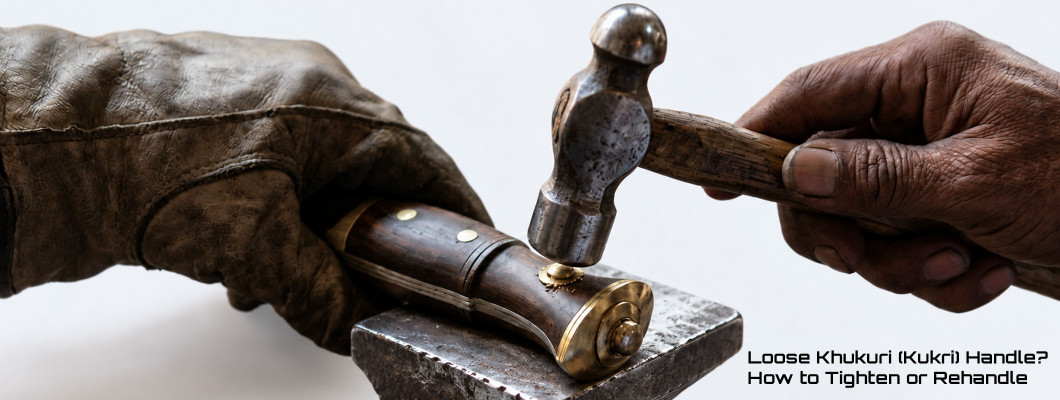
This is the method we use at the forge. Take the khukuri out of the dap. Lay the dap on a folded cloth on a firm table, then give the spine side and the edge side of the dap light, even taps with a small hammer, working along the tight section. Put a piece of leather or thick cloth between the hammer and the dap so it does not mark the leather. The taps settle the wood core and ease the leather, which opens the slot slightly. Test the fit after every few taps.
Keep the taps light. You are coaxing the scabbard, not striking it — heavy blows can crack the wood core or split the glue joint. Tap only the spine side and edge side, never the flat faces, which would squeeze the slot tighter.
Know when to stop. The blade should slide in and out smoothly, but still stay in the dap when you hold it upside down and give it a gentle shake. If it slips out, the dap has gone too loose — and a khukuri that falls out of its scabbard is dangerous.
6. Help It Slide
Rub a very thin layer of plain paraffin or candle wax on the flats of a clean, dry blade, keeping it off the edge. This lets the blade slide without leaving anything wet inside the dap. Do not use soap, which draws in moisture, and do not pour oil into the scabbard, which soaks into the wood and holds dust.
7. Ease a Tight Throat
If the blade only catches at the mouth, the leather there may have shrunk. Work a little leather conditioner into the throat, let it soak in, and gently work the leather with your fingers. Then break it in again with slow draws.
How Do You Find the Exact Tight Spot?
Colour the blade flats with a dry-wipe marker, slide the blade in and out once, and the places where the colour has rubbed off show exactly where the dap is too tight. This is the same method knifemakers use to fit a scabbard.
- Mark the blade. Colour both flats of a clean blade with a dry-wipe marker. Chalk or pencil graphite also works.
- Slide once. With the karda and chakmak removed, and holding the dap by the throat, slide the blade slowly in as far as it goes comfortably, then draw it out.
- Read the marks. Where the colour is still there, the blade is not touching. Where it has rubbed off, that is the tight spot — note how far from the tip it is.
- Tap that spot. With the blade out, give the spine side and edge side of the dap light hammer taps at the depth where the marker rubbed off, as described above. Then test again.
- Sand only if needed. If tapping does not free it, wrap fine sandpaper (180 to 240 grit) around a thin flat stick, such as a ruler or paint stirrer. Reach into the dap to the matching depth and take three or four light strokes against the wood on that side. A torch helps you see.
- Test again. Wipe the blade, re-mark it and repeat. Take a little at a time — you can always remove more wood, but you cannot put it back. Stop while the blade still stays in when the dap is held upside down.
- Finish. When the blade slides smoothly, tip the sanding dust out of the dap, clean the marker off the blade and oil it lightly.
Ease the sides, not the edge. Sand only the flat faces of the wood core where the marker shows contact. Some daps have a narrow channel cut for the edge and some do not. If yours has one, never sand it — it keeps the edge from cutting through the dap. Either way, avoid sanding the edge side of the core, and if the tight spot is there, contact us instead.
What About the Karda and Chakmak Pockets?
The karda and chakmak affect the fit in two ways: full pockets can pinch the main blade, and the pockets themselves can go tight. Always sheath the khukuri first and add the karda and chakmak last, as described above. If the pockets themselves are tight, fix them the same way as the dap: clean, dry, and work them in gently. The small pockets on the back of the dap are leather, and they can shrink after getting wet. Work a little leather conditioner into the pocket, then slide the karda or chakmak in and out a few times. A thin rub of wax on the karda's blade helps too. Read more about both companions in The Karda and Chakmak Explained.
What Should You Never Do?
Never force the blade, never heat or soak the dap, and never grind the blade to fit.
- Forcing the blade can make it jump free or cut through the side of the dap into your hand.
- Hammering hard, or hammering the flat faces of the dap, can crack the wood core or make the slot tighter.
- Hammering with the blade inside risks driving the edge into the side of the scabbard. Always take the khukuri out first.
- Heating the dap with a heater, oven or hot hair dryer cracks the wood core.
- Soaking the dap in water swells the core even more and can loosen the glue that holds it together.
- Grinding or filing the blade to fit the scabbard weakens it and ruins its finish. The dap is fitted to the blade, not the other way round.
- Using soap or pouring oil inside leaves moisture or grime against the steel.
- Storing the khukuri in a damp dap rusts the blade where you cannot see it.
What If the Khukuri Is Loose in Its Scabbard?
A loose dap is a safety problem: if the khukuri slides out when the scabbard is tipped, fix it before you carry the khukuri again. A khukuri that falls out can land edge-first or cut whoever reaches for it.
How to Test the Fit
Take the karda and chakmak out, sheath the khukuri, and hold the dap upside down over a bed or cushion, gripping it by the throat with your fingers on the spine side. Shake it gently. A good dap holds the blade; a loose one lets it slide. Test again after every fix.
Why a Dap Goes Loose
- A dried wood core. Dry air, a heater or a hot car shrinks the wood and opens the slot. This is the most common cause.
- Years of use. Every draw wears the core a little, especially at the throat.
- Too much easing. A dap that was tapped or sanded past the point of retention.
- Stretched leather at the throat, which no longer grips the blade.
How to Tighten a Loose Dap
- Stop the drying. Store the khukuri away from heaters and direct sun. A dap that loosened in a dry spell sometimes firms up again at steady room humidity. Do not soak it — water swells the core unevenly and can loosen the glue that holds it together.
- Shim the throat. Cut a strip of thin leather, about 1 mm thick, as wide as the blade flat and a few centimetres long. Glue it inside the mouth of the dap on one flat face of the wood core with contact cement, keeping it clear of the edge side. Let the glue dry fully.
- Test and adjust. Sheath the khukuri and repeat the upside-down test. If it is still loose, add a second shim on the opposite flat face. If it is now too tight, ease it with the steps above.
- Add a retention strap. For carrying, a leather strap with a snap that passes over the handle just behind the bolster keeps the khukuri in place whatever the fit. A local leatherworker can add one.
- Replace the dap if needed. If the core is cracked or worn right through, a shim will not hold. We do not stock replacement daps, but we can make one for your khukuri — contact us with a photo and the blade length.
Until it is fixed, carry the khukuri in a pack rather than on your belt, with a strap or cord around the handle and dap so it cannot slide out.
When Should You Replace the Scabbard?
Replace the dap when the wood core is cracked, the edge has cut through, the chape is loose, or it will not fit properly after the fixes above. A damaged scabbard is a safety problem, not just a cosmetic one. We do not stock replacement daps, but we can make one for your khukuri — contact us with a photo and the blade length.
How Do You Keep the Fit Right?
Keep the dap dry, keep the blade clean and oiled, and store the khukuri away from damp and heat.
- Khukuri in first, karda and chakmak last — and take them out first when drawing.
- Sheath the khukuri straight, following the curve of the dap with the edge centred, so the edge does not shave the wood core.
- Shake the dap out every so often, before chips build up.
- Never put a wet blade back in the dap. Wipe it dry and oil it first.
- If the dap gets wet, take the khukuri out and let the dap dry empty.
- Store the khukuri somewhere with steady humidity, away from heaters and bathrooms.
- Condition the leather a few times a year so it does not dry out and shrink.
For the rest of your khukuri's care, see the khukuri (kukri) maintenance guide, How to Fix a Loose Khukuri (Kukri) Handle, and How to Sharpen a Khukuri (Kukri).
A Khukuri With a Dap Fitted by Hand
Every khukuri/kukri we make is hand-forged from 5160 spring steel and fitted to its own scabbard in our Kathmandu forge. Tell us what you need and we will forge it to suit.
Request a Custom Forge →Explore More Kukri & Khukuri Guides
Frequently Asked Questions
Why is my khukuri (kukri) so tight in its scabbard?
The most common reasons are the wooden core of the dap swelling with moisture, small wood pieces cut from the core by the edge getting stuck inside, and the karda and chakmak pressing on the core from their pockets. A new dap can also be stiff until it has been used, and dirt, resin or rust on the blade makes it bind. Handmade scabbards are fitted by hand, so a new one is often snug at first.
Can the karda and chakmak make the scabbard tight?
Yes. Their pockets sit against the wood core on the back of the dap, and with both tools inside they can press the core and pinch the main blade. Take the karda and chakmak out, slide the khukuri in, and only then put them back. When drawing, remove them first.
Why are there wood pieces inside my khukuri scabbard?
The edge of the khukuri can shave small pieces off the wooden core, especially when the blade goes in at an angle. They collect inside and can make the dap tight. Take the khukuri out, hold the dap mouth down and shake it until they fall out, and pick out any stuck piece with a thin stick. Sheathing the blade straight along the curve prevents it.
Will a tight dap loosen on its own?
A new dap that is only slightly snug usually eases after a few dozen careful draws and returns. A dap that is tight because it is damp loosens as it dries. If it is still hard to draw after that, find the tight spot and ease it, stopping while the blade still stays in when the dap is held upside down.
Can I hammer a tight khukuri scabbard?
Yes, lightly. It is how we ease a tight dap at the forge. Take the khukuri out, lay the dap on a folded cloth, and give the spine side and edge side light taps with a small hammer along the tight section, with leather or cloth between the hammer and the dap. Test after every few taps. Never hammer the flat faces, never hit hard, and never hammer with the blade inside.
Can I sand the inside of the dap?
Yes, carefully, if light hammering has not freed it, and only at the tight spot. Wrap fine sandpaper around a thin flat stick, reach in to the spot shown by the marker test, and take a few light strokes. Test the fit after each small step, because wood removed cannot be put back.
Is a tight scabbard dangerous?
It can be. Forcing a stuck blade can make it jump out suddenly, or push the edge through the side of the dap into your hand. Always hold the dap by the throat, keep your fingers on the spine side, and never force it.
Why has my khukuri gone loose in its scabbard?
The wood core has probably dried and shrunk, or it has worn with use. A loose dap lets the khukuri fall out, which is dangerous. Keep the dap away from heat, glue a thin leather shim inside the throat on one flat face of the core, and add a retention strap for carrying. If it cannot be saved, we can make a new dap for your khukuri.
When should I replace the scabbard?
Replace it if the wood core is cracked, the edge has cut through the leather or the wood, the chape at the tip is loose, or the dap stays badly tight or loose after the fixes in this guide. We do not stock replacement daps, but we can make one for your khukuri — contact us with a photo and the blade length.