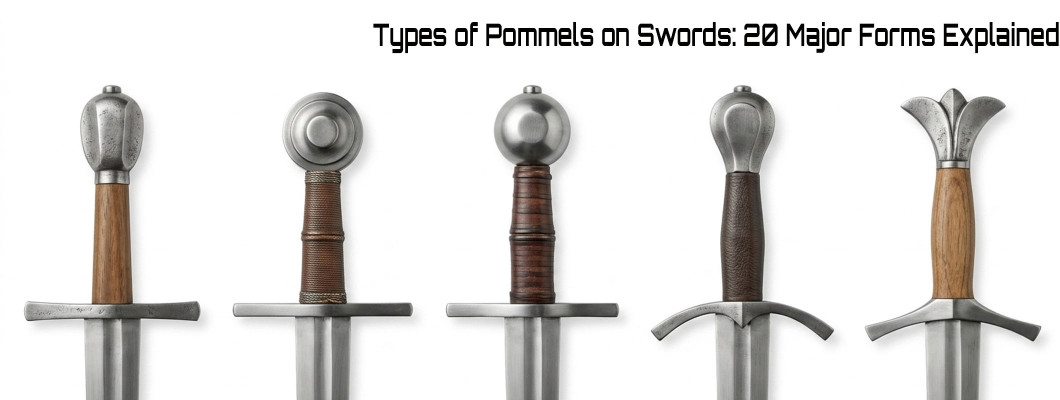
Types of Pommels on Swords: 20 Major Forms and What They Do
A pommel does three jobs at once. It stops the sword sliding out of your hand, it counterweights the blade so the balance point sits close to your grip, and it is the block that the tang is peened over to hold the whole hilt together. Every shape in the historical record is a different answer to those three demands. Ewart Oakeshott catalogued the medieval European forms in The Sword in the Age of Chivalry, assigning capital letters A to Z with numbered subtypes, and that system is still what museums, auction houses and collectors use.
Below are the twenty major types with a shape diagram for each, grouped by family rather than run alphabetically, because the families are how the typology actually developed. If you want the terminology of the rest of the hilt, our parts of a sword guide covers it, and sword guard types covers the other end of the same assembly.
The Twenty Shapes at a Glance
Profile view, as you would see the pommel from the side of the sword.
The Twenty Types in Order
| Type | Name | Roughly when | What is distinctive |
|---|---|---|---|
| A | Brazil-nut | c. 950 to 1250 | Wide low arc, derived directly from the Viking sword |
| B | Rounded brazil-nut | Same era | Shorter and rounder than A. B1 has a straight lower edge, the mushroom or tea-cosy |
| C | Cocked hat | Viking derived | Taller crown than the nut forms |
| D | Bulky cocked hat | Slightly later than C | More mass in the same silhouette |
| E | Angular-topped | Following D | A variant of D with an angular top rather than a curve |
| F | Strongly angular | Following E | A more angular variant again — the family flattening into facets |
| G | Plain disk | Disk era onward | A plain disk. G1 and G2 carry flower and shell ornament, both Italian |
| H | Chamfered disk | 10th to 15th century | Disk with the edges chamfered off. One of the most common forms of all |
| I | Wide-chamfered disk | High medieval | Wide chamfers, small inner disk. I1 is hexagonal |
| J | Hollowed wheel | High medieval | As I but with the chamfers deeply hollowed. J1 is the classic wheel |
| K | Wide flat wheel | Late medieval | A very wide and flat variant of J |
| L | Trefoil | 12th to 13th century | Tall three-lobed form, rare and probably limited to Spain |
| M | Multi-lobed | 1250 to 1350 in art | Late descendant of the lobed Viking pommel; the Cawood sword is the type example |
| N | Boat-shaped | Rare throughout | Rare in art and in surviving pieces alike |
| R | Spherical | Mostly 9th to 10th century | A rare true sphere |
| S | Cut cube | Early 14th century | A cube with the corners cut off. Rare |
| T | Scent stopper, fig or pear | From c. 1360 onward | Named for a perfume-bottle stopper. T1 to T5, running into the 16th century |
| U | Key-shaped | Later 15th century | Flattened pear with a waist, like a watch key |
| V | Fishtail | 15th century | Flared tail-like form. Variants V1 and V2 |
| Z | Square | Regional, late | Z1 and Z2b south-eastern Europe, Z3 the Venetian cat's head, Z4 Serbia and Bosnia |
The Viking Inheritance: Types A to F
Six of the twenty are one continuous story. The brazil-nut pommel is a direct descendant of the classical Viking sword, common from roughly 950 to 1250, wide and low with a shallow arch. Type B is the same idea shortened and rounded, and its B1 variant swaps the curved underside for a straight lower edge — the form German antiquarians called mushroom-shaped and Oakeshott called a tea-cosy.
The cocked hat, type C, raises the crown into something closer to a triangle. D is a bulkier and slightly later version of the same silhouette. E takes D and squares off the top; F takes E and makes it more angular again.
Watch what is happening across those six: a rounded organic form is progressively flattened into facets. That is not fashion. Facets are easier to file to a repeatable weight, they seat more predictably against the grip, and they give a flat surface to peen against. The family is drifting toward manufacturability.
The Disk and Wheel Family: Types G to K
The disk pommel is the workhorse of the high medieval sword and the family is best understood as one shape with progressively more material removed.
G is a plain disk, with G1 and G2 carrying flower-shaped and shell-like ornament, both particular to Italy. H is the same disk with the edges chamfered off, and it is one of the commonest pommels of the entire medieval period, running from the 10th century to the 15th. H1 is an oval version.
I widens those chamfers so the flat inner disk becomes much smaller, with I1 a hexagonal variant. J takes it further and hollows the chamfers into a concave dish, and J1 is the elaborated form most people picture when they hear wheel pommel. K is J made very wide and very flat, a late medieval favourite.
The mechanical logic is straightforward. A disk gives you mass concentrated close to the axis of the hand, which is exactly where a counterweight is most efficient. Chamfering and hollowing remove metal from the faces without shrinking the diameter, so you tune the weight without changing how the pommel sits in your palm. That is a genuinely elegant piece of engineering and it explains why the family lasted five centuries.
Regional and Rare Forms: L, M, N, R, S and Z
Type L is a tall trefoil, rare and probably confined to Spain in the 12th and 13th centuries. Type M is a late descendant of the multi-lobed Viking pommel, appearing frequently on tomb effigies in southern Scotland and northern England between about 1250 and 1350 but with very few surviving examples — the Cawood sword is the reference piece.
Type N is boat-shaped and rare in both art and surviving specimens. Type R is a rare true sphere, mostly seen on 9th and 10th century examples. Type S is a cube with the corners cut off, a rare early 14th century form.
Type Z is square, and it is the most regionally diagnostic pommel in the whole system. Z1 and Z2b are most common in south-eastern Europe, Z3 is the cat's head form typical of Venetian swords, and Z4 is characteristic of Serbia and Bosnia. If you can identify a Z subtype you have often located the sword geographically, which is more than most pommels will tell you.
The Late Gothic Forms: T, U and V
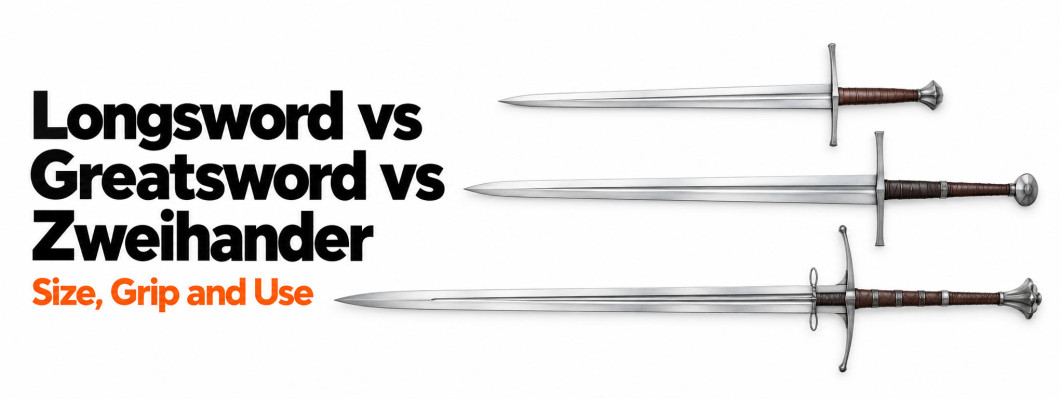
These three belong to the era of the longsword and the thrust, and all three do the same job: move mass rearward and upward to balance a longer, more sharply tapered blade.
Type T, the scent stopper, is named for its resemblance to the stopper of a medieval perfume bottle, and also called the fig or pear. It first appears in the early 14th century, becomes common only after about 1360, and spawns variants T1 to T5 that run well into the 16th century. It is the pommel of the classic longsword.
Type U is key-shaped, from the later half of the 15th century, often described as a flattened pear and named for its resemblance to a watch key. Type V is the fishtail, a 15th century form with flared tail-like extensions and two recorded variants.
All three are longer front to back than the disk family, and that is the point. A longer pommel puts the same mass further from your hand, which shifts the balance point rearward more efficiently per gram. As blades got longer and more tapered, the pommel had to work harder, and stretching it was the cheapest way to do it.
The Ones Known Only From Art
Four lettered types deserve a note of caution, because they are catalogued from depictions rather than objects.
Type O is a rare crescent. Type P is a shield-shaped form known only from a statue at Nuremberg cathedral. Type Q covers flower-shaped pommels known only from artistic depictions of swords. Type W is described simply as a misshapen wheel.
An artist working from memory, or stylising for a carving, is not a reliable witness to a shape. These types belong in a complete typology and they should not be treated as established forms in the way that H or T are. Any reproduction of one is an interpretation, and an honest maker will say so.
Pommels Outside the Oakeshott System
Oakeshott catalogued medieval Europe, and it is worth remembering that is all he set out to do. Other traditions solved the same three problems with shapes his letters do not cover, and if you work across regions the way we do, the differences are instructive.
The Japanese kashira is a cap rather than a mass. It closes the end of the grip and anchors the wrapping, and it is deliberately light. A katana is balanced through blade geometry and the length of the grip rather than by hanging weight off the back, which is why the fitting at the butt does almost none of the counterweighting a European pommel does. Same problem, different solution, and it is why a katana and an arming sword of similar weight feel nothing alike.
The Indian tulwar disc pommel is one of the most distinctive in the world: a broad flat disc, often with a raised central dome, set at an angle that traps the hand between it and the guard. It is a substantial counterweight and it also restricts the grip almost to a single position, which suits a draw-cutting style built around wrist rotation rather than around changing hand positions.
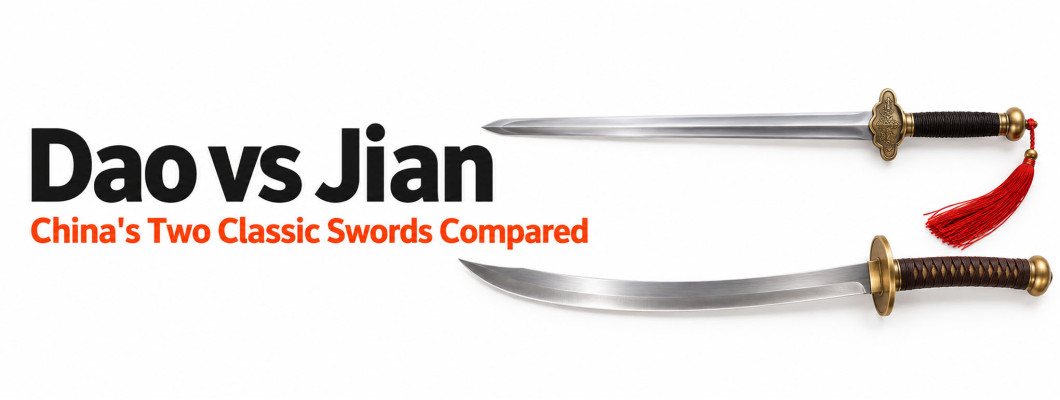
Chinese jian and dao commonly finish in a pommel plate or ring pierced for a lanyard or tassel. The tassel is not purely ornamental — its manipulation is part of some jian forms — and the pierced pommel exists to carry it.
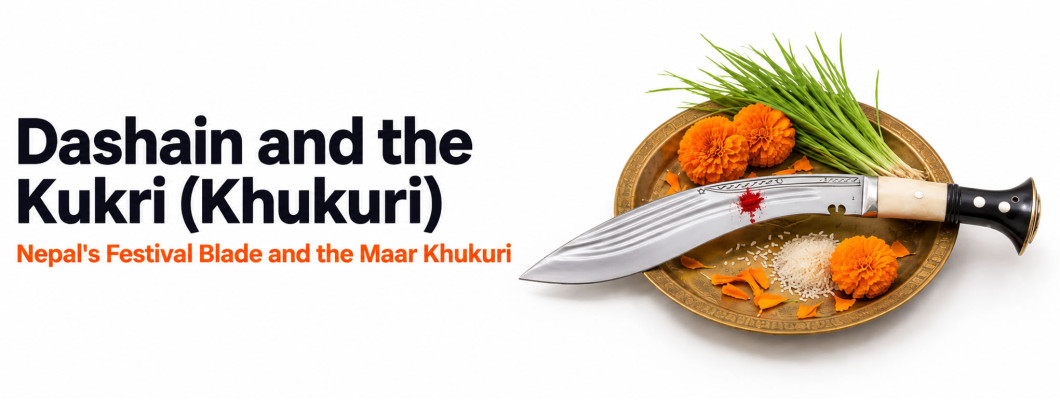
The kukri butt cap is closest to a European pommel in function. A flared butt with a metal cap and a peened tang end stops a wet hand sliding off under a heavy chopping stroke, which is exactly the original European purpose before counterweighting took over. On a forward-weighted blade like a kukri or khukuri there is no attempt to balance the mass rearward at all, because the whole point of the design is that the mass sits forward.
That last comparison is the useful one. A European sword pommel and a kukri butt cap look unrelated and do the same first job. Where they part company is the second job, and they part because one design wants the balance near the hand and the other wants it out at the belly of the blade.
What the Pommel Actually Does
Three jobs, and the shapes make sense once you know which one a given form was prioritising.
It keeps the sword in your hand. This is the original function and the oldest. Early pommels are small because that is all they needed to do — the hand cannot slip off the back of the grip if there is a lump there.
It counterweights the blade. From around the 11th century pommels became heavy enough to pull the balance point back toward the hand, which is what allows a fluid style rather than a heaving one. This is why the disk family works so well: mass close to the axis, adjustable by chamfering.
It is the anvil for the peen. The tang passes through the pommel and is hammered over the top, spreading like a rivet head to lock the grip and guard as one solid stack. That means every pommel shape has to present a flat, properly countersunk top face to peen against, or the assembly will not hold. It is a structural component, not an ornament with a hole in it.
One consequence people rarely think about: change the pommel and you change the sword. Fitting a heavier pommel to the same blade moves the point of balance back, making the sword quicker to stop and start but taking authority out of the cut. Our sword balance guide covers what that feels like in the hand.
Choosing a Pommel for a Reproduction
Three practical points if you are commissioning rather than studying.
Match the pommel to the blade type, not to taste. A scent stopper on a Viking-era blade is a costume. The pommel families track the blade families closely, and mismatching them is the single most common tell on a poorly researched reproduction.
Weight is a specification, not a side effect. Tell us where you want the balance and we work backward to the pommel mass, rather than picking a shape and accepting whatever balance results. This is the part that separates a sword that handles from a sword that merely looks correct.
Decide peened or threaded before we start. Peening is permanent and traditional; a threaded pommel allows disassembly for maintenance or shipping. Neither is inherently better, but the pommel has to be made for one or the other from the beginning. Our tang guide covers what runs through it.
Commission a Hilt to a Specific Type
Send us an Oakeshott letter, a museum photograph, or a drawing, and tell us where you want the sword to balance. We confirm pommel form, mass and fitting method before anything is forged. Every hilt is slotted, seated and peened or threaded by hand in Kathmandu.
Frequently Asked Questions
What are the main types of sword pommels?
Ewart Oakeshott catalogued the medieval European forms with capital letters and numbered subtypes. The major ones are the brazil-nut (A and B), the cocked hat and its angular descendants (C to F), the disk and wheel family (G to K), regional forms such as the trefoil (L), multi-lobed (M), boat (N), spherical (R), cut cube (S) and square (Z), and the late Gothic scent stopper (T), key shape (U) and fishtail (V).
What does a sword pommel actually do?
Three things. It stops the sword sliding out of your hand, which was its original and oldest purpose. It counterweights the blade so the balance point sits near your grip, which from around the 11th century became its main job. And it acts as the block the tang is peened over, locking the grip and guard into one solid stack. It is structural, not decorative.
What is a wheel pommel?
A disk pommel with the edges chamfered and often hollowed into a concave dish, leaving a raised rim and a smaller flat centre. In Oakeshott's system the family runs from G, a plain disk, through H and I with progressively wider chamfers, to J where the chamfers are deeply hollowed — J1 being the classic wheel — and K, a very wide flat version.
What is a scent stopper pommel?
Oakeshott's type T, named for its resemblance to the stopper of a medieval perfume bottle, and also called the fig or pear pommel. It appears in the early 14th century, becomes common after about 1360, and continues through variants T1 to T5 well into the 16th century. It is strongly associated with longswords and hand-and-a-half swords.
What is a brazil-nut pommel?
Oakeshott's type A, a wide low pommel with a shallow arched profile named for its resemblance to the nut. It descends directly from the classical Viking sword and was common roughly between 950 and 1250. Type B is a shorter, rounder version of the same idea, and its B1 variant has a straight lower edge, known as the mushroom or tea-cosy form.
How does pommel weight affect a sword?
A heavier pommel pulls the point of balance back toward your hand, which makes the sword quicker to start, stop and redirect but takes authority out of the cut. A lighter one leaves the balance further forward, giving more power in the cut and more effort in the recovery. Changing the pommel on an otherwise identical blade produces a noticeably different sword.
How many pommel types did Oakeshott identify?
He assigned capital letters with numbered subtypes in The Sword in the Age of Chivalry, and the standard published summary lists 24 lettered forms rather than a full 26 — X and Y do not appear in it. Several letters carry multiple subtypes, such as T1 to T5 for the scent stopper and Z1 to Z4 for the square. Oakeshott himself accepted that some surviving swords resist classification.
Which pommel types are known only from artwork?
Type P is known only from a statue at Nuremberg cathedral, and type Q covers flower-shaped pommels recorded only in artistic depictions. Type O, a crescent, and type W, a misshapen wheel, are also rare and thinly evidenced. Artists working from memory or stylising for carving are not reliable witnesses to shape, so reproductions of these are interpretations rather than reconstructions.
Can I order a sword with a specific Oakeshott pommel type?
Yes. We hold no stock and forge every piece after the order is placed, so the pommel form is a specification rather than a selection. Send the letter, or a photograph, along with where you want the sword to balance, and we work backward from the balance point to the pommel mass. Tell us at the same time whether you want it peened or threaded, because the pommel is made for one or the other from the start.