What Size Sword Should You Buy? A Length Guide by Type and Height
For most people buying their first sword, the answer is a blade between 28 and 32 inches, which gives a total length of roughly 34 to 38 inches once the grip and pommel are counted. That is the range a single arm can control through a full cut and still recover from. Shorter than 28 inches and you are buying a short sword, which is a different weapon rather than a small version of the same one. Longer than 32 inches and you are moving toward hand-and-a-half territory, which needs two hands, more floor space and more technique than most first buyers have.
Your height moves that range by about two inches in either direction. The type of sword moves it far more. This guide gives the length for every major type, explains what height actually changes and what it does not, and covers the two measurements that matter more than blade length but almost nobody checks.
Get Your Length in Under a Minute
The Blade Size Finder asks what the sword is for and how tall you are, then returns a length range in inches and centimetres, a grip length, the reasoning behind the number, and a physical check you can run at home before you spend anything.
Sword Length by Type
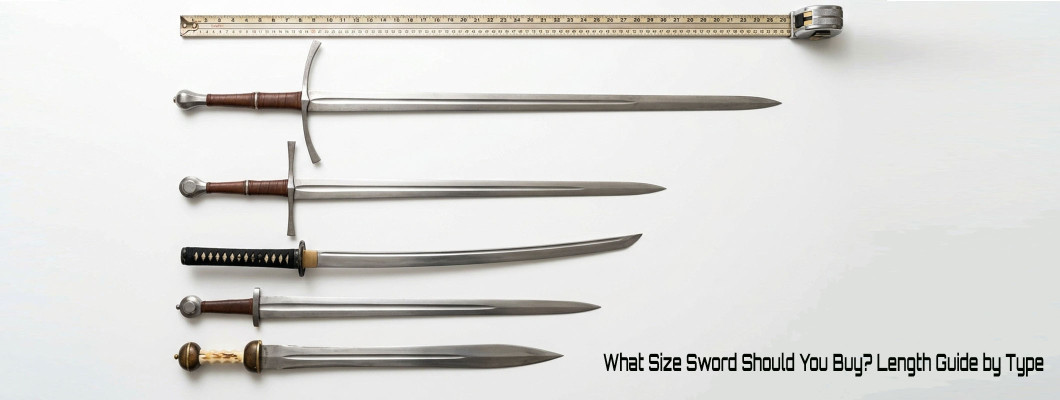
Type decides more than anything else on this page. A katana and an arming sword have almost the same blade length and completely different total lengths, because the grip on one is three times the grip on the other. This is why comparing swords by a single number misleads people so consistently.
Blade lengths below are the blade only. Total length includes grip and pommel. How each part is measured is set out on our measurements page.
| Type | Blade | Total | Grip | Hands | What it is for |
|---|---|---|---|---|---|
| Gladius, seax, short sword | 18 to 24 in | 24 to 30 in | 4 to 4.5 in | One | Close quarters, wearable all day, fast recovery |
| Arming sword | 28 to 32 in | 34 to 38 in | 4 to 5 in | One | The default first sword; balanced cut and thrust |
| Falchion, messer, falcata | 26 to 30 in | 32 to 36 in | 4 to 6 in | One | Cutting weight forward; short and authoritative |
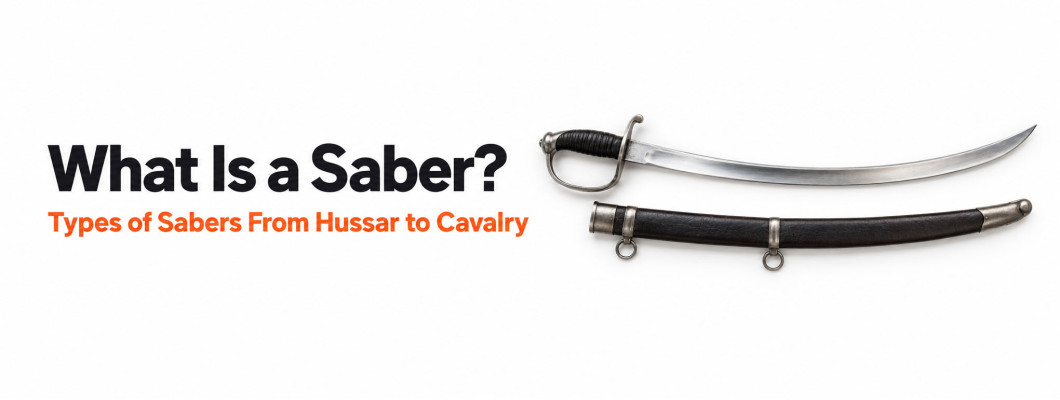
| Sabre, scimitar, curved single-edge | 30 to 34 in | 36 to 40 in | 4 to 5 in | One | Draw cuts and reach from a single hand |
| Katana and other Japanese types | 27 to 29 in | 38 to 42 in | 10 to 12 in | Two | Two hands on a short blade; the grip does the work |
| Hand-and-a-half, bastard sword | 33 to 36 in | 42 to 46 in | 7 to 9 in | One or two | Optional second hand for power when needed |
| Longsword | 33 to 37 in | 44 to 50 in | 9 to 11 in | Two | Two-handed technique, leverage, binding |
| Greatsword, zweihander | 40 in and up | 55 in and up | 12 to 18 in | Two | Display, formation work, serious floor space |
Read the katana row against the longsword row. The blades differ by six to eight inches. The totals differ by six as well — but in the opposite direction from what people expect, because the katana puts a long grip on a short blade and the longsword puts a long grip on a long one. If you buy on total length alone you will get this backwards.
What Your Height Actually Changes
Height matters for swords and for almost nothing else we make. A kukri or a machete is sized by the task, and the vegetation does not care how tall you are. A sword is different for two specific reasons, and it is worth knowing what they are rather than trusting a chart.
Ground clearance on the draw
Held at your side in a relaxed grip, the tip needs to clear the floor. If it does not, you cannot draw or carry the sword without lifting your shoulder, and every movement starts from a compromised position. This is a hard limit set by the distance from your hand to the floor, which is roughly your height minus your torso — and it is why a 34-inch blade genuinely does not work for someone of 160 cm no matter how much they want it to.
The arc of the cut
A cut travels along an arc whose radius is your arm plus the blade. A longer arm gives a longer arc at the same blade length, so a taller person generates more tip speed from the same sword. Give a shorter person the longer blade to compensate and you have added mass and inertia to an arm that is already working harder, which is the opposite of help.
The practical adjustment is small. Take the range for your sword type and move it about two inches down if you are under roughly 165 cm, or two inches up if you are over 180 cm. Between those, use the range as written.
| Your height | Arming sword blade | Longsword blade | Short sword blade |
|---|---|---|---|
| Under 5ft 5in (165 cm) | 26 to 30 in | 31 to 35 in | 18 to 22 in |
| 5ft 5in to 5ft 11in | 28 to 32 in | 33 to 37 in | 18 to 24 in |
| 6ft and over (180 cm) | 30 to 34 in | 35 to 39 in | 20 to 24 in |
Grip Length Matters More Than People Check
Blade length gets all the attention. Grip length is what you will actually notice every time you pick the sword up, and it is the measurement most often wrong on cheap swords.
A one-handed grip needs to take your whole hand with no overhang, which for most adults is 4 to 5 inches between guard and pommel. A hand-and-a-half grip needs room for a second hand to join partially, which is 7 to 9. A true two-handed grip needs both hands with a gap between them, which is 9 inches and up. Hands vary far more usefully than heights do, and this is the measurement worth taking on yourself rather than guessing.
Wrap your hand around a broom handle in the grip you intend to use, mark either side, and measure. If you are buying two-handed, do it with both hands and a working gap. Then compare that number to the grip length on the product page, not to the total length. A grip an inch too short is more annoying, day to day, than a blade two inches too long.
What Changes When a Sword Gets Longer
This is the part that happens at the anvil rather than in the catalogue, and it explains several things that look like pricing quirks from the outside.
Weight climbs faster than length
A sword ten per cent longer is not ten per cent heavier. A longer blade flexes more under the same load, so it needs extra spine thickness or a more aggressive distal taper to stay rigid through a cut. Add thickness and you add weight along the whole blade, not just the extra inches. Take it out with taper instead and you remove stiffness from the last third, which is the part that meets the target. Every extra inch is a negotiation between those two, and there is no length where you get both for free.
Recovery time is the real cost
The number that matters in the hand is not weight but how long the blade takes to stop and come back after a cut. Mass sitting far from your grip resists being redirected. Two swords of identical weight feel completely different depending on where that weight sits, which is why a short heavy falchion feels lively and a long light sword can feel dead. If you have handled a friend's sword and found it exhausting, length was probably the reason rather than the steel. Our sword balance guide covers distal taper and point of balance properly.
Long blades warp in the quench
A short knife goes into the oil and comes out where you put it. A 36-inch blade has far more length across which uneven cooling can pull the steel sideways, and it has to be straightened while it is still hot enough to move and cool enough not to lose the hardening. That is skilled work with a real failure rate, and it is why price per inch is not a straight line. The step from 30 to 36 inches costs more than the step from 18 to 24.
Where 5160 sets a limit
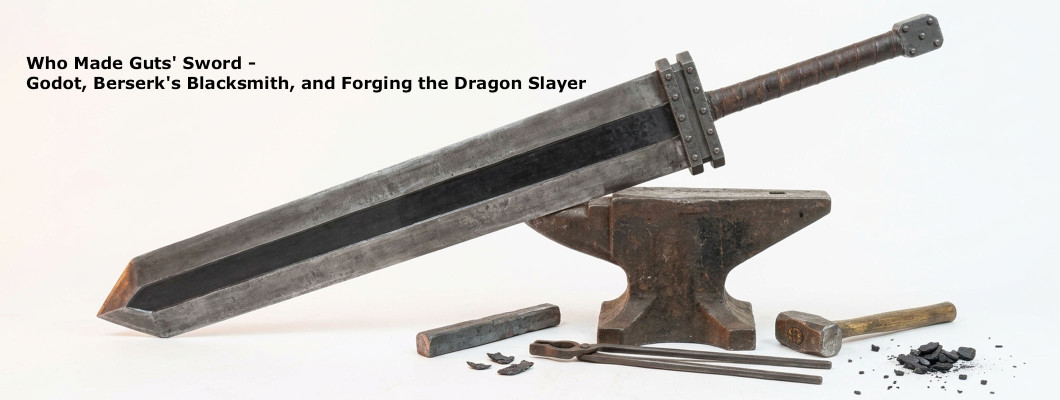
We forge from 5160 spring steel reclaimed from leaf springs, oil quenched and tempered by hand. It is tough and shrugs off impact, which is exactly what a sword needs. What it does not do is take the very high hardness some buyers want for extreme edge retention, and on very long thin blades a tough steel will flex where a harder, more brittle one would stay rigid. If your priority is a glass-hard 40-inch blade, we are honestly not the forge for it. If your priority is a sword that survives being used, we are. Every length we make meets the Battle Ready Standard.
Two Hands Is Not More Sword
The most common upgrade instinct is to go from an arming sword to a longsword because it seems like more for the money. It is a different discipline, not a bigger version of the same one.
A longsword needs both hands, a clear circle wider than most garages, and technique built around leverage and binding rather than single-arm cuts. It is heavier at the point of balance, slower to recover, and far less forgiving of the grip errors every beginner makes. People who start on one usually spend the first year fighting the sword rather than learning it.
If you want the option without the commitment, a hand-and-a-half at 33 to 36 inches with a 7 to 9 inch grip does both jobs adequately and neither perfectly. That is a real compromise rather than a marketing one, and it is the honest recommendation for someone genuinely torn.
Buying for Display Is a Different Problem
Display is the one case where longer genuinely reads better, because nothing has to be controlled in the hand. The constraint moves from your arm to your wall, and the numbers that matter become fixing spacing, clearance at both ends, and the sight line from where people will stand.
Measure the wall first, including the scabbard if it is displayed with one, and add clearance at both ends. Mark it in masking tape and leave it for two days before ordering. A number on a screen is abstract; 46 inches of tape across your living room wall is not, and a surprising number of people revise downward at that point. If it is going on a stand rather than a wall, check the footprint against the surface, since display stands take more depth than people expect.
What you should not do is buy display length and assume you can also cut with it. If you want both, buy for the hand and accept that it looks smaller on the wall than the photograph promised.
Three Checks Before You Order
All three take five minutes and are worth more than any specification, ours included.
The floor clearance check
Cut a broom handle to blade plus grip and hold it at your side in a relaxed grip. The tip should clear the floor by a couple of inches without you lifting your shoulder. If it does not, the sword is too long for you regardless of what any chart says.
The arc check
Swing that same broom handle where you actually intend to handle the sword. You need a clear circle wider than the total length plus your arm span, in every direction, including above you. Most people discover their room is smaller than they thought, and they discover it with a broom handle rather than with sharpened steel.
The grip check
Measure your own hand as described above and compare it to the grip length on the product page. This is the check almost nobody runs and the one that causes the most quiet disappointment.
Where Buying in a Shop Beats Ordering to Size
We should concede this plainly. We hold no stock. Every sword is forged after the order is placed, which means you cannot pick it up, feel where it balances and change your mind at the counter. If you are genuinely unsure about length, a shop that lets you hold three sizes gives you something we cannot give you over the internet, and you should use it, even if you come back to us for the piece itself.
What forging to order gives you is the opposite trade. You are not choosing from whatever lengths a factory decided to produce. Most patterns carry a length option, the configurator prices your chosen length live, and anything outside those ranges is quoted through custom forge. If the sword you want does not exist at the length that fits you, that is a solvable problem here and an unsolvable one in a shop.
Any Length, Because Nothing Is Pre-Made
Settle the size first with the Blade Size Finder, then build it. We hold no stock at all, so the length that fits you is something we forge rather than something you have to find.
Frequently Asked Questions
What size sword should I get for my height?
Take the range for your sword type and adjust by about two inches. For an arming sword, that means roughly 26 to 30 inches of blade under 5ft 5in, 28 to 32 inches between 5ft 5in and 5ft 11in, and 30 to 34 inches at 6ft and over. The physical check matters more than the chart: held at your side, the tip should clear the floor by a couple of inches without you lifting your shoulder.
How long is a typical sword?
It depends entirely on type. A short sword or gladius runs 18 to 24 inches of blade, an arming sword 28 to 32, a katana 27 to 29, a longsword 33 to 37, and a greatsword 40 inches and up. Total lengths differ even more because grips vary from 4 inches on a one-handed sword to 12 inches or more on a two-hander.
What is a good sword length for a beginner?
An arming sword with a 28 to 32 inch blade and a 4 to 5 inch grip. It is one-handed, forgiving of technique errors, fits in a normal room, and teaches the fundamentals that transfer to everything else. The most common beginner mistake is starting on a longsword because it looks more impressive, then spending a year fighting the sword instead of learning it.
Is a longer sword better?
Rarely. Length buys reach and momentum and costs you control. Weight also climbs faster than length, because a longer blade needs a thicker spine or a more aggressive taper to stay rigid. The bigger cost is recovery time — mass far from your hand takes longer to stop and redirect, and that is what actually tires people out over a session.
What length is a katana?
Around 27 to 29 inches of blade, with a total length of 38 to 42 inches. The blade is shorter than most people assume; what makes a katana feel long is the grip, which runs 10 to 12 inches to allow two hands with a gap between them. Comparing a katana to a European sword on total length alone gives you the wrong picture.
How do I measure a sword?
Blade length runs from the guard to the tip. Grip length runs from the guard to the pommel. Total length is the two combined plus the pommel itself. Sellers quote different ones without always saying which, so check before comparing two swords by number.
What size sword do I need for cutting practice?
Longer than a general-purpose sword, because cutting rewards reach and momentum at the point of contact — roughly 30 to 36 inches of blade depending on discipline. The constraint is usually your space rather than your arm. You need a clear circle wider than the total length plus your arm span in every direction, including above you, plus somewhere to put targets.
Can I order a sword in a length that is not listed?
Yes. We hold no stock and forge every sword after the order is placed, so length is a build decision rather than a stock lookup. Most patterns carry a length option, the configurator prices your chosen length live, and anything outside those ranges is quoted as a custom piece. Tell us the length and we will tell you honestly whether it works in 5160 at that geometry.
Does grip length matter as much as blade length?
Day to day, more. A one-handed grip should take your whole hand with no overhang, which is usually 4 to 5 inches; a two-handed grip needs both hands with a gap, which is 9 inches or more. Measure your own hand around a broom handle rather than guessing. A grip an inch too short is more annoying every single time you pick the sword up than a blade two inches too long.