Short Sword vs Longsword: Which Should You Buy?
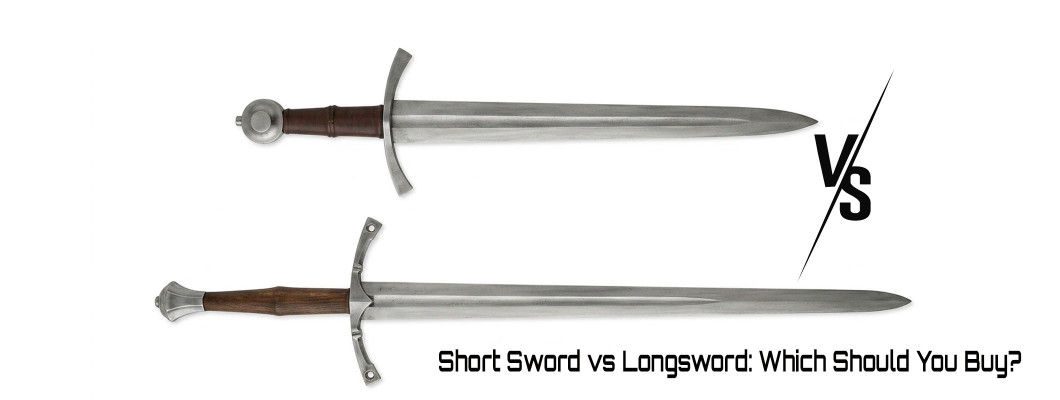
A short sword has a blade of roughly 16 to 24 inches and a grip that takes one hand. A longsword has a blade of 33 to 37 inches and a grip long enough for two hands — though it can still be used in one, which is why it is also called a hand-and-a-half sword. That length difference decides everything else: the short sword is faster to draw, easier to carry and works in a room; the longsword puts its point close to two feet further out and adds leverage when you put the second hand on.
For a first sword, buy the short one. It fits your space, forgives mistakes and costs less. Buy the longsword when you have handled one, have the floor space, and want the deeper martial system.
The Comparison
| Short sword | Longsword | |
|---|---|---|
| Blade | 16 to 24 in (12 in the Japanese tradition) | 33 to 37 in |
| Grip | 4 to 4.5 in — one hand only | 7 to 11 in — takes two hands, usable in one |
| Total length | 21 to 30 in | 42 to 50 in |
| Edge | Single or double, depending on the type | Double-edged — single-edged long blades are a different family |
| Also called | Shortsword | Hand-and-a-half, bastard sword |
| Free hand | Always — shield, buckler, dagger, reins | Optional. Two hands most of the time, one when you want reach or a free hand |
| Strength | Speed, close quarters, carry | Reach and leverage |
| Space needed | Works in a corridor | A clear circle wider than your arm span |
| Learning curve | Shallow and forgiving | Steep and unforgiving |
| Cost to forge | Lower, disproportionately so | Higher — see below |
What the Extra Length Actually Buys
Two things, and they are worth separating because only one of them is obvious.
Reach. Measured from your shoulder rather than from the guard, a longsword puts the point close to two feet further out than a short sword — roughly 23 inches comparing typical examples of each. In a fight where both people are trying not to be hit, that decides a great deal.
Leverage, when you want it. The longer grip takes two hands with a gap between them, and two hands separated on a lever can push with one and pull with the other. That moves an opposing blade aside with a fraction of the force one hand would need, and it is the foundation of longsword fencing. A short sword cannot do it at any blade length, because there is nowhere to put the second hand. The longsword offers the choice — hand on for leverage, hand off for reach, a shield or the reins — and that choice is made moment to moment, not when you buy it.
What you give up is a permanently free hand. A short sword guarantees one, which is why it pairs with a shield or buckler — in a shield system the sword can be small precisely because the shield does the defending. A longsword lends you the hand back when you need it, but most of the time it wants both.
The cost of reach is that it only helps at reach. Once someone is closer to you than the effective part of your blade, a long weapon is a liability — which is exactly the distance the short sword was built for.
Two Things the Simple Version Misses
A short sword can be two-handed. The rule is that the grip decides how many hands, not the blade — and the clearest proof is the wakizashi, a Japanese blade squarely in the short-sword range whose grip is long enough for two hands and which is regularly used that way. European short swords are one-handed because European short swords were given short grips, not because a short blade forbids it. If you want a compact blade with two-handed control, that combination exists and we can forge it.
Where the short sword ends and the dagger begins is disputed. You will often see the category given as starting at 12 inches. That figure comes from the Japanese tradition, where a wakizashi is defined as one to two shaku and a shaku is about 11.9 inches. In European terms a 12-inch blade is a dagger or a long knife, not a sword — real European short swords start around 16 inches, and the gladius, xiphos and seax all sit well above the line. If a listing calls a 13-inch blade a short sword, it is not wrong exactly, but it is using a Japanese measure for a European object.
Edge count varies, and it is not what separates these two. Short swords come both ways: the gladius, xiphos and kindjal are double-edged, the seax and wakizashi single-edged. The European longsword is double-edged by definition — that is part of what the word means. But plenty of long blades are single-edged, and they are a different family rather than longswords: the katana, the grosse messer, the sabre. If someone offers you a single-edged longsword, ask which of those they actually mean. Our post on single-edged versus double-edged swords covers what the spine buys you.
Longsword, Hand-and-a-Half, Bastard Sword
These are three names for the same weapon: a double-edged European sword with a grip long enough for two hands that can still be used in one. They are not three points on a scale, and a shop listing them as separate categories is shelving stock rather than making a historical distinction.
Within the family, proportions vary. A shorter example with a 7-inch grip genuinely rewards one-handed use; a large one with an 11-inch grip is two-handed in practice. Judge the specific dimensions, not the label.
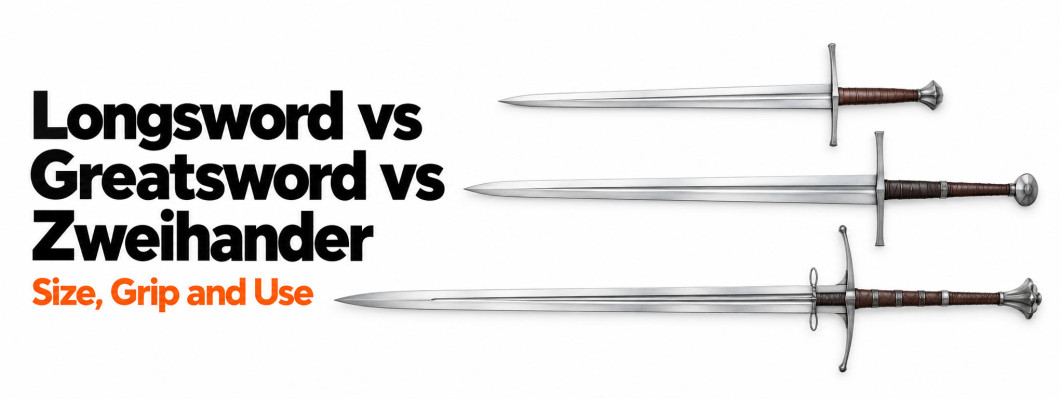
The genuinely different weapon is the greatsword — Zweihander, montante, spadone — with blades past 45 inches and total lengths of 60 inches or more. Those cannot be used one-handed by anyone. When someone pictures an enormous two-hander, that is the weapon, and it is not what this page is comparing.
Two Things People Get Wrong
Longswords are not slow. A short sword is faster to draw and to get on target from a standing start. But a longsword changes direction faster once blades are in contact, because leverage beats muscle. Short sword is faster to start; longsword is faster to change.
Longswords are not heavy. The ten-pound longsword is a myth. What is true is that a longsword carries its mass further from your hands, so it feels heavier than the scales say and the pommel has to work hard to bring the balance back. Judge either sword by where it balances, not by its stated weight — our sword balance guide covers why.
Why the Longsword Existed
Armour. As mail gave way to plate in the fourteenth century, cutting stopped working — you can hit good plate very hard with no result. What worked was a point driven into a gap, or a strike with enough leverage to damage through the steel, and both need two hands. Half-swording, where you grip the blade itself to shorten the lever, is only possible on a long grip.
When plate left the battlefield the longsword went with it, and swords became one-handed again. The type is an answer to a specific problem, and it faded when the problem did.
What Changes at the Forge
Long blades warp in the quench and short blades mostly do not. A 20-inch blade comes out of the oil close to where you put it; a 35-inch blade has far more length across which uneven cooling can pull the steel sideways, and it has to be straightened while still hot enough to move and cool enough to keep the hardening. That is skilled work with a real failure rate, on a blade already fully forged.
Distal taper also matters far more on a long blade — without it the sword feels dead and whips in the cut — and a 10-inch grip loads the tang and the peen harder than a 4-inch one.
So the price gap is wider than the steel difference. If a maker's pricing scales neatly with blade length, they are either subsidising the long blades or not doing the straightening properly.
Which Should You Buy?
Short sword if it is your first, if your space is limited, if you are drawn to Roman, Greek or Viking periods, or if you want the option of a shield. It is also the most sword per pound spent. It disappoints in one way: mounted on a wall it looks smaller than it feels in the hand, and there is no fixing that.
Longsword if you have handled one, have the floor space, or are interested in historical fencing — the surviving treatises are overwhelmingly longsword sources, so there is far more to study. It disappoints anyone without space or patience, and it is not a beginner's cutting sword.
Torn? Buy a longsword at the smaller end — a 33-inch blade with a 7 to 8-inch grip. Same weapon, specified to reward one-handed use when you want it.
Before ordering either, mark the total length in masking tape on your floor and leave it two days. Most people discover a 46-inch sword reaches the ceiling light. It is the cheapest advice here and the most likely to save you money.
We Hold No Stock. Either One Is Built for You.
Every blade is forged after the order is placed, so blade length, grip length, balance and fittings are yours to specify. Tell us which way you are leaning and what you want it for, and we will tell you honestly whether it suits you — including when the answer is the other one.
Frequently Asked Questions
Which is better, a short sword or a longsword?
Neither. A short sword is one-handed, fast to draw, easy to carry and works in confined space, and it leaves a hand free for a shield. A longsword puts its point close to two feet further out and lets you use two hands for leverage. For a first sword most people are better served by the short one; for depth of study the longsword rewards more.
What is the difference between a short sword and a longsword?
Blade length and grip length. A short sword runs roughly 16 to 24 inches of blade with a 4 to 4.5 inch grip for one hand. A longsword runs 33 to 37 inches with a grip of 7 to 11 inches, long enough for two hands with a gap between them. That gap is what creates the leverage the longsword system is built on.
Can a longsword be used with one hand?
Yes, and that capability is part of what the word means. Longsword, hand-and-a-half sword and bastard sword all describe the same weapon. The treatises show it used two-handed most of the time because that is where the leverage is, with a hand coming off to reach further, to grapple, or when mounted. A greatsword, with a blade past 45 inches, genuinely cannot be used one-handed.
Is a hand-and-a-half sword the same as a longsword?
Essentially yes — three names for one weapon, alongside bastard sword. They are not three points on a scale. Within the family, proportions vary: a 7-inch grip rewards one-handed use, an 11-inch grip is two-handed in practice. Judge the specific blade and grip lengths rather than the label a shop has used.
Is a 12-inch blade a short sword or a dagger?
In European terms, a dagger or a long knife. The 12-inch figure comes from the Japanese tradition, where a wakizashi is defined as one to two shaku and a shaku is about 11.9 inches. European short swords realistically start around 16 inches — the gladius, xiphos and seax all sit well above 12. The boundary is genuinely disputed, and honest sources disagree at the edges.
Can a short sword be used with two hands?
Yes, if its grip allows it. The grip decides how many hands, not the blade. The wakizashi is a Japanese blade in the short-sword range with a grip long enough for two hands, and it is regularly used that way. European short swords are one-handed because they were given short grips, not because a short blade prevents it. A compact blade with a two-hand grip is a perfectly buildable combination.
Are short swords and longswords single or double edged?
Short swords come both ways — the gladius, xiphos and kindjal are double-edged, the seax and wakizashi single-edged. The European longsword is double-edged by definition. Single-edged long blades do exist in quantity, but they belong to other families rather than being longswords: the katana, the grosse messer and the sabre are the main ones.
Is a longsword slower than a short sword?
Only in the first movement. A short sword is quicker to draw and get on target from standing, with less mass and one hand to organise. But a longsword changes direction faster once blades are in contact, because two hands on a long grip form a lever and leverage beats muscle.
Are longswords heavy?
Far less than their reputation. They were hand weapons carried all day by people who then had to fight in them. What is true is that a longsword carries its mass further from your hands, so it feels heavier than the scales say. Judge either sword by where it balances rather than by weight.
Which sword is better for a beginner?
A short sword, or an arming sword if you want more length. It fits a normal room, forgives the grip and timing errors everyone makes early, and costs less. The common mistake is buying a longsword first because it looks more impressive, then spending a year fighting the sword instead of learning it.
Why do longswords cost more?
Time and risk rather than steel. Long blades warp in the quench and must be straightened while still hot enough to move and cool enough to keep the hardening — skilled work with a real failure rate on a blade already fully forged. Distal taper must also be managed far more carefully. The price gap is wider than the material difference explains.
How much space do I need for a longsword?
A clear circle wider than the total length plus your arm span, in every direction, including above you. A longsword runs 42 to 50 inches overall, and most living rooms cannot provide that once you account for the ceiling light and the doorframe. Mark it in masking tape and leave it two days before ordering.