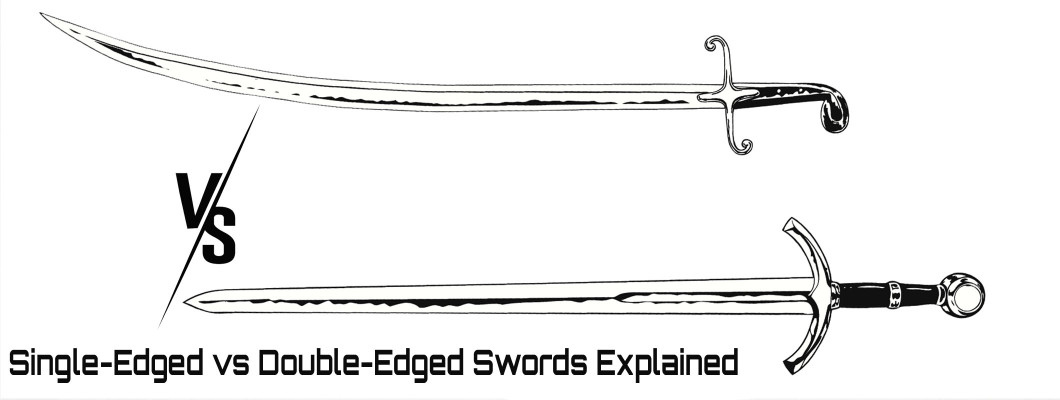
Single-Edged vs Double-Edged Swords: What the Geometry Actually Does
The difference is not really the number of edges. It is the spine. A single-edged sword keeps a thick, unsharpened back, which means the whole blade can be one deep asymmetric wedge — stiff, heavy behind the cut, and able to carry a longer bevel down to a keener edge. A double-edged sword has no spine to keep, so its steel must taper away from a centre line in both directions, and it has to win back its stiffness some other way: a fuller, a mid-rib, a diamond section. Every advantage each type has, and every compromise, follows from that one fact. This is what that means at the anvil, in the hand, and on the sharpening stone.
The Real Difference Is the Spine
Take a cross-section through a blade, halfway along, and look at the shape.
A single-edged blade is a wedge with an offset. Thick at the back, thinning steadily to the edge on one side only. The spine is structural — it carries stiffness and mass, and it does not have to be thin because nothing is being cut with it.
A double-edged blade is symmetrical. Its thickest point is a line down the middle, and the steel falls away to two edges. There is no reservoir of thickness anywhere except that centre line, which is why double-edged blades so often have a fuller — a groove that removes weight from the flats while leaving the centre rigid — or a raised mid-rib doing the same job in reverse.
That is the whole trade, and it produces two very different objects even at the same length and weight.
What the Spine Buys You
Stiffness where you want it. Mass in the back of the blade resists bending in the plane of the cut. That is why heavy choppers — the falchion, the kukri, the machete — are single-edged almost without exception. You cannot build that kind of blade symmetrically without making it absurdly heavy.
A longer, shallower bevel. This is the point most articles miss. Because the steel has the whole width of the blade to descend across, a single-edged blade can carry a very long primary bevel — which means the edge can be made thinner and sharper at the apex while still having plenty of material behind it. A double-edged blade has to reach its edge in half the distance, twice.
Somewhere to put your other hand. The spine is safe to touch. Historically this matters more than it sounds: on a big single-edged blade you can press with the off hand to drive a cut, and it is a real technique in several traditions. On a double-edged sword you cannot, and that is precisely why half-swording exists as a specialised skill with its own grip.
Simpler edge alignment. A single edge always faces the same way, and the spine tells your hand where it is. On a double-edged sword the blade is symmetrical, so nothing in the grip tells you which way the edge is pointing except training. This is why single-edged blades are consistently described as easier to learn, and the reason is ergonomic rather than mystical.
Half the sharpening. One edge to maintain, not two.
What the Centre Line Buys You
A true thrust. A symmetrical point sits on the blade's axis, so thrusting force runs straight down the centre of the blade into the target. On a curved single-edged sword the point sits off-axis and a thrust wants to deflect. Straight backswords solve this; curved sabres largely do not.
Two edges, and therefore two attacks. You can cut, and on the recovery you can cut back with the other edge without repositioning your hand. Against an opponent who has read your first cut, that second edge arrives from a direction they were not defending.
No wrong side. There is no orientation in which the sword cannot immediately cut. A single-edged sword held wrong is briefly a club.
Symmetry in the bind. When two blades meet and press, a symmetrical blade behaves the same whichever way it is turned. This makes the sophisticated binding and winding of European longsword systems practical in a way they would not be with an offset blade.
Better against armour, in one specific way. A narrow symmetrical point backed by a rigid mid-rib is the geometry for finding gaps in mail and plate — which is exactly the direction European swords evolved as armour improved.
What Happens at the Forge
Here is the part you will not find on a reseller's blog, because it only shows up if you make the things.
Single-edged blades warp in the quench, and that is not always a problem. When a blade goes into the quenchant, the thin edge cools faster than the thick spine. It hardens first, and hardening steel expands slightly. On a symmetrical blade this happens equally on both sides and mostly cancels out. On an asymmetric blade it does not — the edge side transforms and expands while the spine lags, and the blade bends.
Every smith who has ever forged a single-edged blade has had one come out of the oil with a curve nobody drew. Managing that is a real skill. And in one tradition it stopped being a defect and became the design: the distinctive curve of a Japanese blade is substantially a product of exactly this effect, controlled deliberately with clay. We cover the mechanism in our guide to heat treatment and tempering.
Double-edged blades are less forgiving of asymmetry in the grind. They cool evenly only if they are ground evenly. A double-edged blade with a fractionally heavier bevel on one side will pull in the quench just as an asymmetric one does, and there is no design story to absorb it — it is simply a bent sword.
Double-edged blades cost more to make. Twice the bevel to grind, twice the edge to finish, more steel removed, and a symmetrical distal taper that has to be right in two axes rather than one. Historically this fed directly into which swords ordinary soldiers carried, and it is one reason single-edged blades spread as armies got larger.
Living With One: Sharpening and Care
An ownership difference that matters more day to day than any battlefield argument.
A single-edged blade is genuinely easier to maintain. One edge, one angle, and you can rest the blade flat on its spine while you work. If the edge picks up a nick, you dress it without having to keep a second edge true at the same time.
A double-edged blade doubles the work and adds a real hazard: while you sharpen one edge, the other is under your hands. It also has to be kept symmetrical, because an uneven double edge looks wrong from every angle and cuts unpredictably.
Neither is difficult. But if you own one sword and intend to actually use it, the single-edged blade will ask less of you.
The False Edge: the Compromise Everyone Reached
Swordmakers all over the world arrived independently at the same middle answer: sharpen part of the back.
The false edge, also called the back edge or swedge, is a sharpened section along the spine near the point — typically the last few inches. It buys you a genuine back-cut and a more penetrating point while keeping the spine's thickness and stiffness along most of the blade.
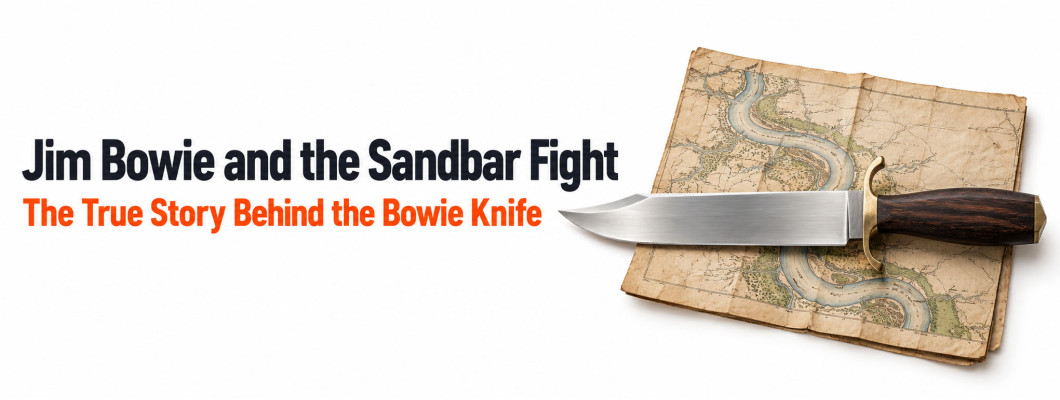
You see it everywhere once you look. On the clipped point of a falchion or a Bowie knife. On the yelman, the flared and often sharpened back section of an Ottoman kilij. On cavalry sabres across Europe. It is not a modern shortcut; it is a solution people found repeatedly because it works.
Our hand-forged Ottoman kilij and our medieval falchion with a clipped point are both examples of this thinking in different traditions, four thousand kilometres apart.
Why Armies Ended Up Single-Edged
The historical drift is real and it is worth explaining rather than just noting.
Double-edged swords dominated early, from the Bronze Age through the Viking age and into the high medieval period. Then, from roughly the sixteenth century onward, military swords across most of the world became overwhelmingly single-edged, and by the age of the cavalry sabre the double-edged military sword was nearly extinct.
Four reasons, in rough order of weight:
Cavalry. A horseman's cut adds the horse's momentum to his own, and it is delivered in passing rather than in an exchange. That favours a curved single edge that slices and releases cleanly rather than a straight blade that can bind and be torn from the hand.
Cost and volume. Cheaper to make, at a time when states were arming tens of thousands rather than hundreds.
Training. Easier edge alignment, easier to teach a conscript in weeks.
Armour left the field. The double edge's great advantage — a rigid symmetrical point for finding gaps in plate — mattered less every decade as firearms made plate armour pointless.
The same logic, in miniature, explains why the Chinese jian gave way to the single-edged dao as the standard military sword, and why the messer and falchion proliferated in late medieval Europe alongside the longsword.
Why the Double Edge Never Died
And yet it did not disappear, which tells you it was doing something the sabre could not.
Where thrusting mattered most, the double edge stayed: the rapier and smallsword of the duelling tradition are double-edged, narrow, and built almost entirely around the point. Where symbolism mattered, it stayed too — the straight cruciform sword carries a weight of meaning across European culture that no sabre ever acquired.
And in martial arts practice today it is thriving, because the systems that survive in the historical manuals are largely longsword systems, and the longsword is double-edged.
Compared
| Single-edged | Double-edged | |
|---|---|---|
| Cross-section | Asymmetric wedge, thick spine | Symmetrical, tapers from a centre line |
| Stiffness from | The spine itself | A fuller, mid-rib or diamond section |
| Cutting | Deeper; longer bevel, more mass behind | Good, but less mass behind the edge |
| Thrusting | Weaker if curved; fine if straight | Stronger; point sits on the axis |
| Edge alignment | Easier — the spine tells your hand | Harder — nothing orients you but training |
| Second edge attacks | Only with a false edge | Always available |
| Cost to forge | Lower | Higher — twice the bevel work |
| Sharpening | One edge, rest it on the spine | Two edges, one always under your hand |
| Historical trend | Rose with cavalry and mass armies | Dominant early; survived in thrusting swords |
Which Should You Actually Buy?
For cutting practice: single-edged. More mass behind the edge, easier alignment, and forgiving of the imperfect technique everyone has at the start. A falchion or a langes messer will cut tatami better than a longsword of the same weight in the same hands.
For a first sword: single-edged, for the same reasons plus easier maintenance and a lower price for equivalent quality.
For HEMA-adjacent interest: depends entirely on the system. Longsword is double-edged. Messer, dussack and sabre traditions are single-edged, and the messer has a real and growing following. Buy for the system, not for the shape.
For display and collecting: whichever speaks to you. But single-edged blades photograph better in profile because the silhouette is asymmetric and reads instantly, while double-edged blades reward being seen from the point where the cross-section shows.
For historical accuracy: follow the period. A Viking impression wants a double-edged sword. A fifteenth-century German impression can have a grosses messer. A nineteenth-century cavalry impression wants a sabre.
What We Forge
Our single edge sword collection runs to 88 blades and spans most of the traditions that arrived at the single edge independently:
- Late medieval Germany — the grosses messer and langes messer, the great knives that sat beside the longsword
- Medieval Europe — the falchion, broad, forward-weighted, and unapologetically a cutter
- The Ottoman world — the kilij with its flared yelman
- The steppe and the Caucasus — the Cossack shashka, guardless and built for the draw-cut
- China — the dao, the sword that displaced the jian
- The Northwest Frontier — the Khyber sword
- The Maghreb — the nimcha
- Migration-era northern Europe — the long seax with its broken-back blade
- Iberia — the falcata, forward-curving and famously feared by Rome
All forged in Tokha-3, Kathmandu from 5160 high-carbon spring steel, oil-quenched, tempered, full tang, and sharpened. Our double-edged ranges — xiphos, gladius, Viking and medieval, Celtic leaf — are built to the same battle ready standard.
Or Have the Geometry Built to You
Blade geometry is the one thing you cannot change after the fact. Grind angle, distal taper, spine thickness, whether a false edge is cut and how far it runs — all of it is decided at the anvil, and none of it can be added later.
So if you know what you want the sword to do, specify it. Through custom forge you can commission a single-edged blade with a false edge of a given length, a particular spine thickness, a specific curve, or a historical profile we do not currently make. Tell us the tradition, the length, and what the blade is for.
88 Single-Edged Blades, Hand-Forged in Nepal
Messers, falchions, kilij, dao, shashka, nimcha, khyber, seax and falcata — all forged from 5160 high-carbon spring steel, oil-tempered, full tang and sharpened. Or commission the geometry you want built from scratch.
Frequently Asked Questions
Which is better, a single-edged or double-edged sword?
Neither, and the honest answer is that they are optimised for different things. A single-edged blade keeps a thick spine, so it can be a stiff asymmetric wedge with more mass behind the cut and a longer bevel down to a keener edge. A double-edged blade taps a symmetrical point on the blade's axis for stronger thrusts and offers a second edge for backcuts. For cutting, single-edged. For thrusting and versatility, double-edged.
What is the real difference between single and double-edged swords?
The spine, not the edges. A single-edged blade keeps a thick unsharpened back that carries stiffness and mass, so the steel can descend across the full width of the blade in one long bevel. A double-edged blade has no spine to keep, so its steel tapers away from a centre line in both directions, and it must recover stiffness through a fuller, a mid-rib or a diamond cross-section.
Why are most single-edged swords curved?
Two reasons. A curve suits the draw-cut, where the edge slices through as it passes rather than chopping straight in, which is why cavalry swords are almost universally curved. And single-edged blades naturally want to curve in the quench, because the thin edge cools and hardens faster than the thick spine and expands as it does. Japanese smiths turned that effect into a deliberate design feature using clay.
Do double-edged swords cut better than single-edged?
Generally no. A single-edged blade of the same weight has more mass behind its edge and a longer primary bevel, both of which help a cut. That is why heavy chopping blades — falchions, kukris, machetes — are almost always single-edged. What the double edge gives you instead is a symmetrical point for thrusting and a second edge available without repositioning your hand.
What is a false edge on a sword?
A sharpened section along the spine near the point, usually the last few inches, also called a back edge or swedge. It gives a genuine back-cut and a more penetrating point while keeping the spine's thickness and stiffness along the rest of the blade. It appears independently across cultures: on the clipped point of a falchion or Bowie, on the yelman of an Ottoman kilij, and on European cavalry sabres.
Why did armies switch to single-edged swords?
Four reasons together. Cavalry favoured a curved single edge that slices and releases cleanly at speed. Single-edged blades were cheaper to make at a time when states were arming tens of thousands. They were easier to teach, because the spine tells the hand where the edge is pointing. And as firearms made plate armour obsolete, the double edge's main advantage — a rigid symmetrical point for finding gaps in armour — stopped mattering.
Is a single-edged sword easier to sharpen?
Yes, noticeably. There is one edge and one angle to maintain, and the blade can rest flat on its spine while you work. A double-edged blade doubles the work, requires keeping both edges symmetrical, and puts a live edge under your hands while you sharpen the other. If you own one sword and intend to use it, the single-edged blade asks less of you.
Which is easier to learn to use?
Single-edged, and the reason is ergonomic rather than mystical. A single edge always faces the same way and the spine tells your hand where it is, so edge alignment — the most common beginner problem — largely solves itself. On a symmetrical double-edged blade nothing in the grip tells you which way the edge is pointing except training.
Are messers and falchions swords or knives?
Both names literally mean knife — messer is German for knife, and the grosses messer is a "great knife" — but they are built and used as swords. The naming reflects late medieval guild and legal distinctions about who was permitted to make and carry what, rather than anything about the object. A langes messer with a 25-inch blade is a sword by any functional measure.