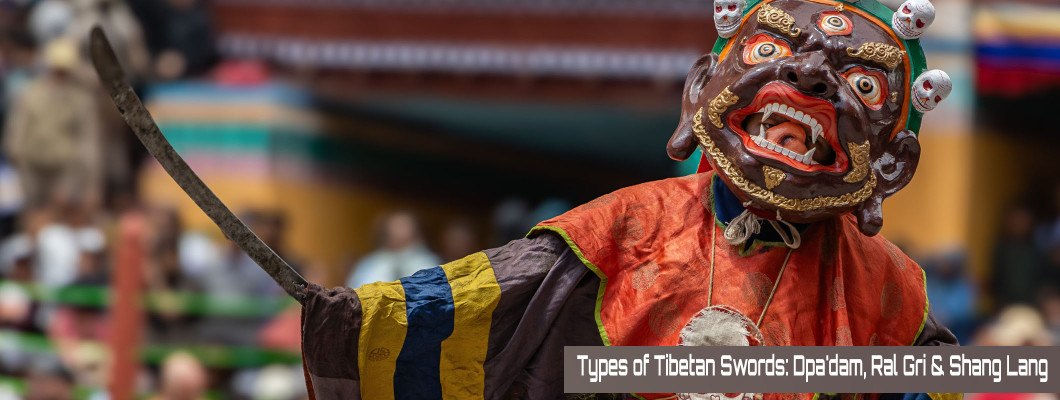
Types of Tibetan Swords: The Dpa'dam, Ral Gri and Shang Lang
Tibetan swords fall into three named types. The dpa'dam is the long sword — straight, single-edged, with an oblique angled tip — and it is the one most people picture. The ral gri is generally shorter and comes to an acute tapering point. The shang lang is the curved-bladed sword, and it is rare in a Tibetan context because most curved blades there were imported. Closely related but separate is the Bhutanese patag, which has its own tradition and at least eleven recognised sub-types of its own.
Those three names come from the glossary in Donald LaRocca's Warriors of the Himalayas, the Metropolitan Museum catalogue that remains the standard reference on Tibetan arms. They matter because the market is full of pieces labelled with terms that do not appear in any scholarly source, and knowing the real vocabulary is the fastest way to tell a researched seller from one repeating what they read elsewhere.
A Short History of the Tibetan Sword
Swords were the primary handheld weapon in Tibet from at least the seventh century to the early twentieth, and surviving examples date largely from the thirteenth to the nineteenth. They sit at a crossroads. Tibet's material culture in this period absorbed Mongol, Chinese, Nepalese and other Himalayan influences while producing forms that exist nowhere else, and the swords show all of it — Chinese blade profiles, Mongol-influenced fittings, and iron openwork with Buddhist iconography that is entirely Tibetan.
What makes the subject unusual is that Tibetans wrote about swords analytically. A small number of surviving texts deal with the connoisseurship of blades — how to judge quality, what patterns in the steel signify, which named categories a blade belongs to. LaRocca published a study of one such early text, and the canonical types it describes can in some cases be matched to surviving swords. Very few cultures produced a written framework for evaluating blades; Tibet is one of them, and it is why Tibetan swords can be discussed with a precision that is not available for most regional traditions.
The sword was also a dress item, not only a weapon. A long sword worn through the belt marked status, and the quality of the fittings — the gilding, the coral, the pierced ironwork — signalled rank as clearly as the blade signalled a smith's competence. That dual role is why so many surviving pieces are elaborately mounted, and why the finest examples come from the households of chieftains and nobility rather than from common service.
The Types, and What Distinguishes Them
Three sword types are named in the arms literature, and they sit alongside a short sword, a working knife and a spear that belong to the same kit. The distinction between the first two swords is the tip, not the length, though length tends to follow. Get the tip right and you have the type right.
| Type | Blade | Tip | Character | How it was worn |
|---|---|---|---|---|
| Dpa'dam (also pa tam) | Long, straight, single-edged | Oblique, angled or chisel-like — not a point | The standard long sword and dress sword of Tibet | Thrust through the belt or sash rather than hung from it |
| Ral gri | Generally shorter, straight, single-edged | Acute, tapering to a true point | Compared by LaRocca to an old Scots highland dirk in tip form | Belt-worn; a practical sidearm |
| Shang lang | Curved | Follows the curve | Rare in Tibet; most curved blades seen were imports | Belt-worn where present |
| Short sword | About a cubit — elbow to fingertip | Often acute | Carried alongside the long sword by Khampa men, not instead of it | At the belt, with the long sword |
| Gri | Short, single-edged | Working point | The utility or meat knife; the blade actually used every day | At the belt, often in a paired set with the sword |
| Bhutanese patag (patang) | Straight, single-edged, thick at hilt and thin at tip | Sharp arc tip | Separate Bhutanese tradition with at least eleven named sub-types | Worn across the body; a national and ceremonial form |
| Mdung | Spear, not a sword | — | Plain iron heads for fighting; highly decorated heads for ceremony | Carried; the shaft strengthened with a coiled iron band |
Dpa'dam — the long sword
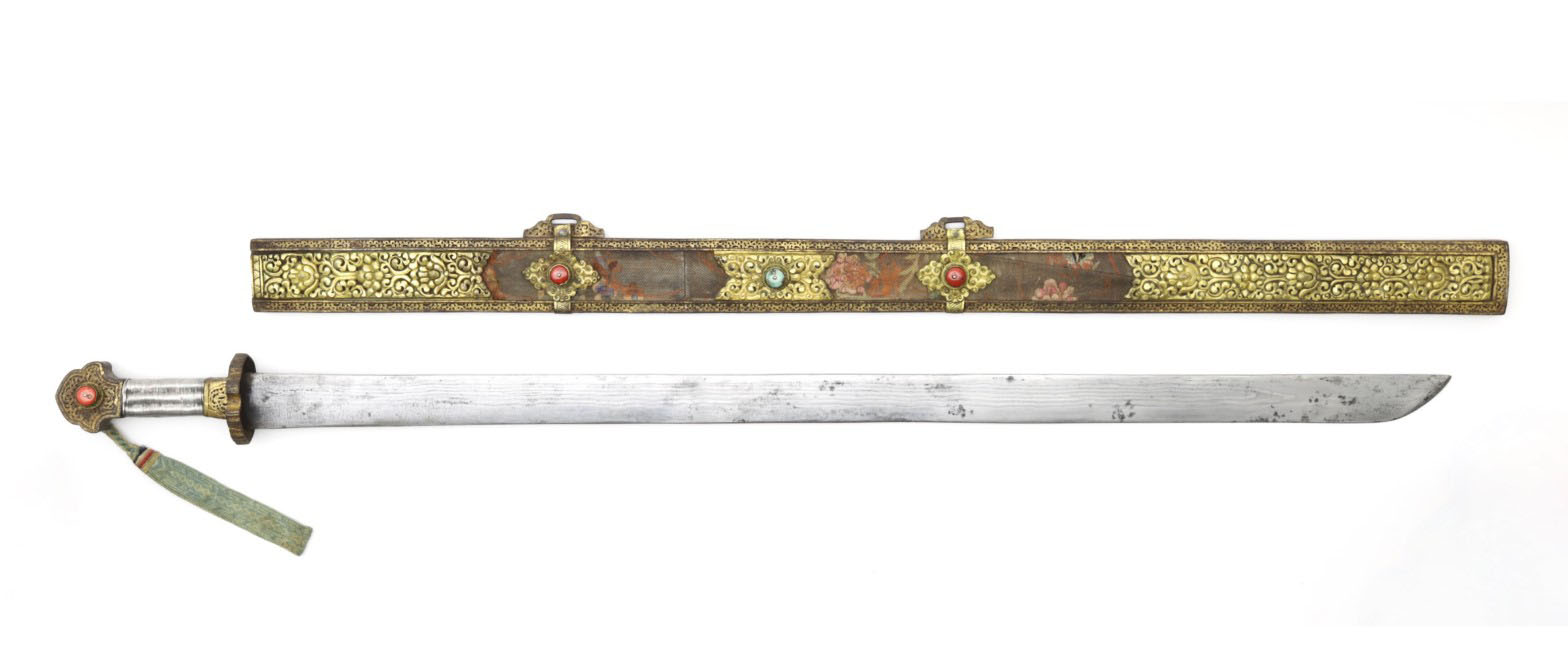
This is the archetype. A long, straight, single-edged blade ending in an oblique angled tip rather than a point, mounted with a wooden grip wrapped in silver or iron wire, and finished with a trefoil or lobed pommel that frequently holds a coral cabochon. Coral was highly prized in landlocked Tibet, which is precisely why it appears on high-status fittings.
The scabbard is as characteristic as the blade: two wooden plates covered in leather and held in an iron U-frame, often pierced and gilt, sometimes with silver braided mounts on eastern Tibetan examples. Many surviving pieces retain a braided leather wrist lanyard, the dpa'lung.
Ral gri — the shorter sword
Ral gri is also the general Tibetan word for sword, which causes endless confusion, but in the arms-and-armour sense it denotes the type with a shorter blade and an acute tapering point. That point is the whole distinction. A dpa'dam ends in a chisel; a ral gri ends in a spike. One is optimised for cutting alone, the other retains a thrust.
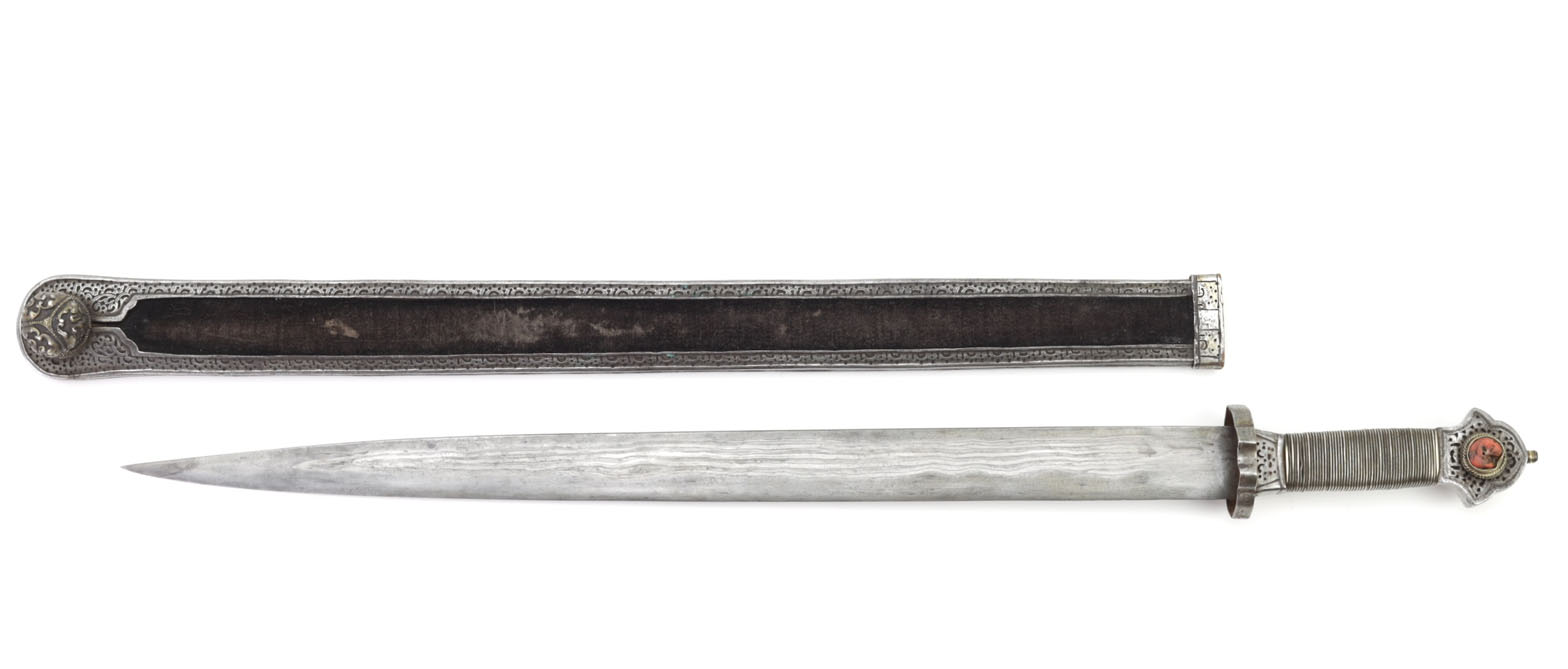
Shang lang — the curved sword
Worth naming for completeness and worth being honest about: curved blades are uncommon in a Tibetan context, and the majority of examples encountered appear to be imports rather than local work. If someone offers you a curved sword as a classic Tibetan type, that framing is wrong even if the object is genuine.
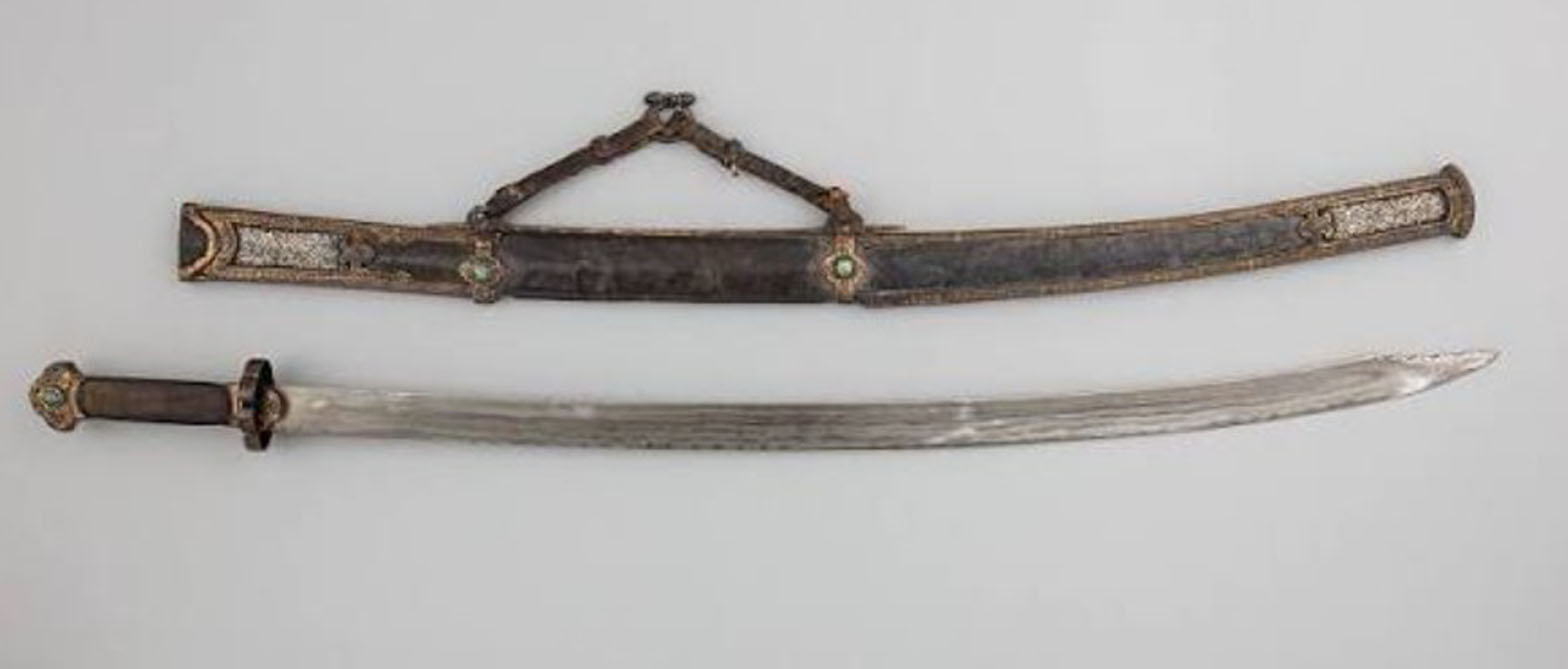
Bhutanese patag — the related tradition
Straight, single-edged, with a sharp arc tip, noticeably thicker at the hilt than at the tip — roughly six millimetres tapering to about two. Blades commonly run between 60 and 70 centimetres. Most patags carry fine longitudinal grooves known as washo. At least eleven types are recognised, named variously after the smith who first forged them, the locality, the appearance or the intended use. It is a genuine typology in its own right and it is not the same thing as a Tibetan dpa'dam, though the two are constantly conflated online.
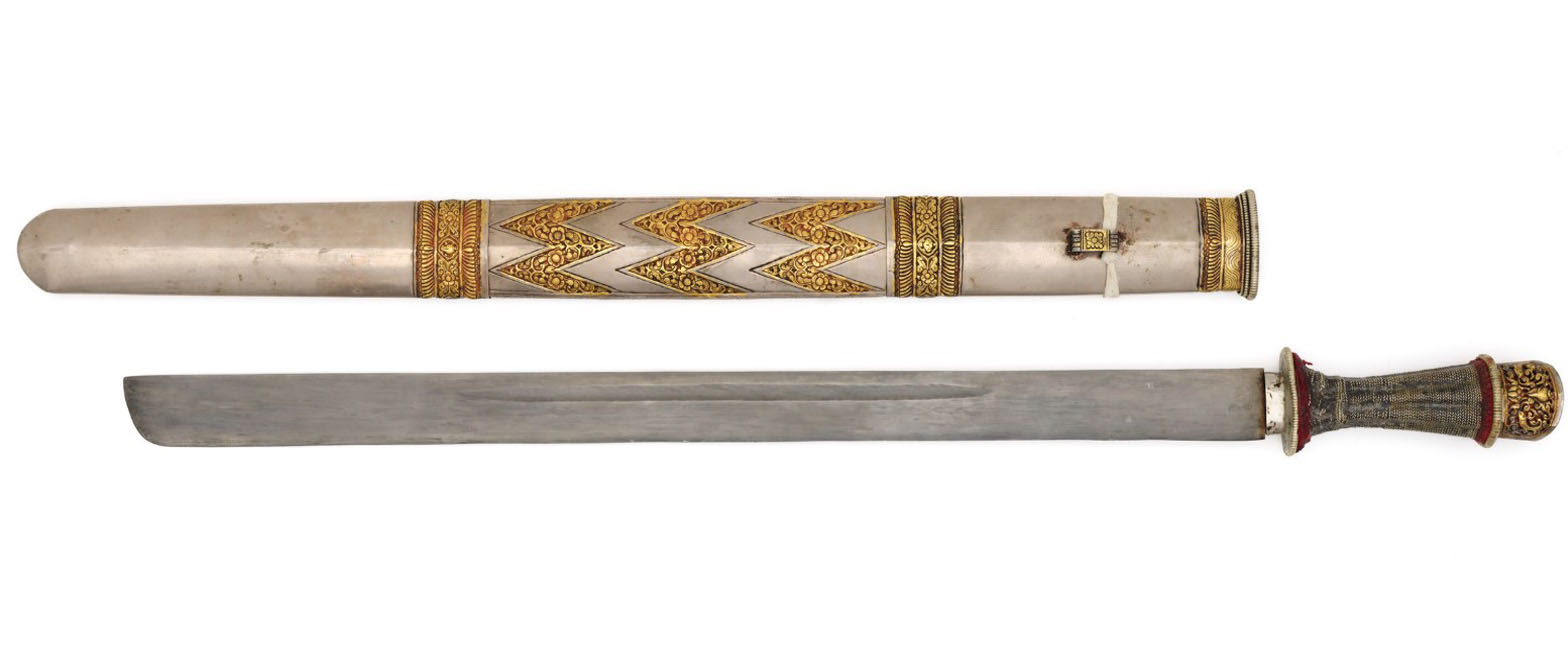
What a Khampa Actually Carried
Discussions of Tibetan swords usually stop at the long sword, which misses how these blades were really worn. Among the Khampa of eastern Tibet, a man commonly carried three at once.
A long sword — the dpa'dam. A short sword of about a cubit, the length from elbow to fingertip, which is a body measurement rather than a fixed number and therefore varies with the man. And a gri, the utility or meat knife, which is the blade that actually got used every day.
That set tells you more about Tibetan arms than any single object does. The long sword is dress and status, the short sword is the practical weapon, and the knife is the tool. They were not alternatives to one another; they were a kit, and a well-off man wore all three with matching fittings.
It also explains why the sword survived so long as an object. Among the Khampa the sword was, and to a degree still is, an essential part of male dress. That is a different relationship from a weapon that goes into an armoury between wars, and it is why nineteenth and even twentieth-century examples are common while comparable European swords had long since become museum pieces.
Hairpin Forging: The Thing That Makes Them Tibetan
The blades are the interesting part, and the reason is altitude.
Tibetan smiths worked at high elevation with low oxygen and limited fuel, which made it hard to bring a large forge to the temperatures a folded blade demands. Rather than folding steel repeatedly, they welded it with the minimum possible heat, stacking rods of differing iron side by side instead. The rods were bent back on themselves, and the resulting cross-section shows as a series of hairpin-shaped bands running the length of the blade — the pattern that gives the technique its English name.
The two irons had names. Pho lcags, male iron, was the harder, higher-carbon material that formed the edge and the working parts. Mo lcags, female iron, was the softer, tougher material that absorbed shock and kept the blade from breaking. That is the same problem every sword-making culture has faced, solved with a method shaped by a constraint no other culture had to work around.
The patterns had names, and dealers and collectors still use them. A double hairpin blade carries two sets of bands rather than one and is markedly harder to forge. Rolled hairpin laminations show the bands curling in section. And ce rong, "open ravines", describes a pattern of zig-zag lines running through the steel. Some eastern Tibetan blades also carry an inserted hardened edge plate with a serrated join, a Chinese technique described as "horse-tooth", which is a reminder of how much crossed that border.
For a buyer this matters more than any fitting. The banding on a genuine hairpin-forged blade is structural — it goes through the steel, because it is the steel. Etched-on or acid-drawn patterns applied to a monosteel blade to imitate it are surface decoration. Any seller who cannot tell you which they are selling is telling you something.
The Sword of Wisdom
No account of Tibetan swords is complete without this, and it is the part most weapon guides leave out entirely.
In Tibetan Buddhism the sword carries a specific and important symbolic meaning: the Sword of Wisdom, which cuts through spiritual ignorance. It is an attribute of a number of deities, most famously Manjushri, the bodhisattva of wisdom, who is almost always depicted holding a flaming sword raised above his head. The word used is ral gri — the same word that denotes a real sword type in the arms literature.
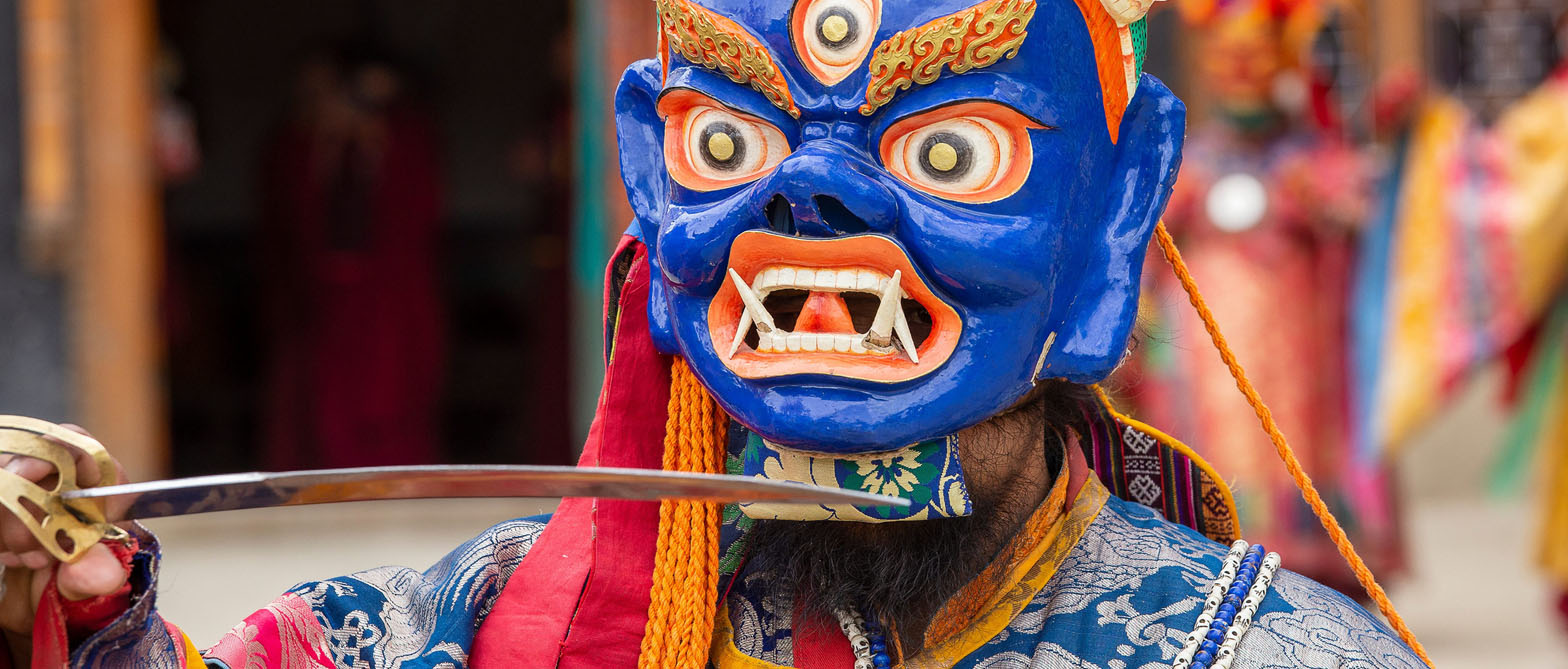
That double meaning is not a coincidence and it is not decorative. In a culture where the sword is a religious symbol of insight as well as a weapon and a mark of rank, the object carries a weight that a purely military account misses. It is also why swords appear so constantly in Tibetan painting and sculpture, and why iron fittings on real swords carry Buddhist iconography rather than martial imagery.
For anyone commissioning a reproduction, this is worth knowing for a practical reason too. A flaming sword in the Manjushri form is an iconographic object, not a weapon type, and a piece made to that description is a devotional or artistic commission rather than a historical reproduction. Both are legitimate; they are simply different things, and it is worth being clear which you are asking for.
Regional Work and the Eastern Borderlands
Tibetan swords were not made in one place to one standard, and the differences between regions are visible enough that experienced collectors use them for attribution.
Eastern Tibet — Kham and the Sichuan borderlands — produced a large share of the surviving pieces, and work from that region often shows silver braided scabbard mounts and blades with visible etching that brings out the laminated structure. Derge in particular was a centre of metalworking whose reputation extended well beyond weapons, and the standard of ironwork on pieces attributed there is consistently high.
Central Tibetan work tends toward the fittings-heavy style most people picture: pierced and gilt iron, coral and turquoise in raised box settings, swastika fretwork and floral scrollwork damascened in silver. The swastika here is the Buddhist symbol, ancient and entirely unconnected to twentieth-century European use, and it appears constantly on Tibetan metalwork.
Several variant forms are worth knowing because they turn up regularly. An archaic type with a circular guard and pommel appears occasionally and is uncommon enough to be notable. A rarer variety carries a hilt influenced by the Nepalese kora and the Indian talwar, which is exactly what you would expect at a southern border. Work attributed to the royal workshops of Lhasa represents the top of the quality range. And collectors following Richardson distinguish broadly between ornate and plain types, the plain ones traditionally though not certainly associated with Bhutan.
The finest ironwork on surviving pieces dates largely from the fifteenth and sixteenth centuries, and the quality of the pierced work is one of the clearest indicators of both period and status. Later pieces are not necessarily worse blades, but the fittings tend to be simpler.
The Sword as a Written Subject
One detail worth dwelling on, because it changes how the whole category should be approached.
Tibetan literature includes texts on the connoisseurship of swords — how to evaluate a blade, what the patterns in the steel indicate, which named category a given sword belongs to. LaRocca published a study of one early example, and scholars have been able to match some of the canonical types described in those texts to surviving objects.
Very few sword-making cultures produced a written analytical framework of that kind. It means Tibetan swords can be discussed with a vocabulary that comes from within the tradition rather than one imposed on it afterwards by collectors, and it is why using the correct terms matters more here than it does for regions where the naming was invented in the auction house.
How to Tell a Serious Piece From a Tourist One
Five things worth checking, in the order that eliminates the most quickly.
The tip. An oblique angled tip on a long blade is right for a dpa'dam. A long straight sword ending in a European-style point is not a Tibetan form, whatever the fittings look like.
The terminology used to sell it. If the listing uses a Tibetan-sounding name that does not appear in LaRocca's glossary, the seller has taken it from another listing rather than from a source. This is common enough that it is a genuinely useful filter.
Whether the pattern is structural. Ask whether the banding is forge-welded or applied. A straight answer either way is fine — an evasive one is not.
The scabbard construction. Two wooden plates in an iron U-frame is the traditional form. A moulded or single-piece scabbard is a modern shortcut.
The stone settings. Coral and turquoise on Tibetan mounts are set in raised box or bezel settings with visible metalwork. Glued-in cabochons in shallow recesses are a decorative-import signature.
What We Can and Cannot Reproduce
We should be straight about this, because the honest limits are the reason to trust the rest.
We forge from 5160 high-carbon spring steel reclaimed from leaf springs — one steel, oil quenched and tempered by hand, full tang. In that material we can reproduce the form of a dpa'dam, a ral gri or a Bhutanese patag accurately: the profile, the oblique tip, the distal taper, the blade length and cross-section, the grip and pommel construction, the scabbard in wood, leather and iron.
What a 5160 blade is not is a hairpin-forged blade. Multi-bar construction from two different irons is a different process, not a finish, and we will not etch a pattern onto monosteel and call it Tibetan lamination. If the banded structure is the point of the piece for you, say so at the enquiry stage and we will tell you honestly what is and is not possible rather than selling you a look.
What we will not make at all is a phurba. The phurba, or kīla, is a consecrated ritual implement in Tibetan Buddhism and Himalayan practice, not a weapon and not a decorative blade, and it does not belong in a sword catalogue. If you have seen it listed as a Tibetan dagger type elsewhere, that is a category error worth knowing about.
Commission a Tibetan Sword to Your Specification
Send us a reference — a museum photograph, an auction listing, a drawing, or a written description. We confirm blade length, profile, tip geometry, grip and scabbard construction before anything is forged, and we tell you plainly where a reproduction differs from the original. Hand-forged in Kathmandu, in the Himalayan tradition, by smiths who work the same way their grandfathers did.
Where Tibetan Swords Sit Among Himalayan Blades
It is worth placing these against their neighbours, because the region produced several distinct traditions and they are routinely muddled together.
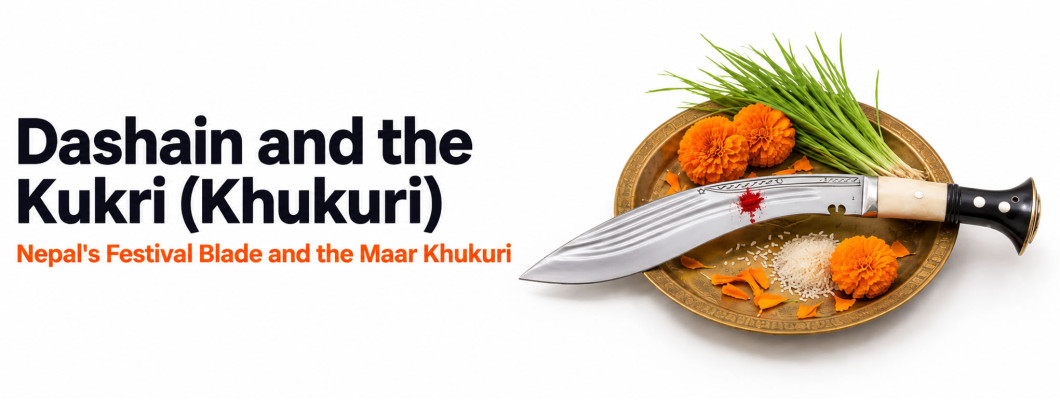
The Nepalese kora is forward-curved with a heavy widened tip, built for cutting power, and carries Hindu iconography — a different weapon from a different religious and material context. The kukri or khukuri is the Nepalese working blade, forward-cranked and belt-worn, and shares nothing structurally with a dpa'dam beyond both being single-edged. The Bhutanese patag is the closest relative of the Tibetan long sword and still a separate tradition.
If you want the wider regional picture, our Eastern and Himalayan swords guide covers the neighbouring types, and the sword size guide covers how blade length is chosen across all of them.
Frequently Asked Questions
What are the types of Tibetan swords?
Three named types appear in LaRocca's glossary of Tibetan arms. The dpa'dam is the long straight single-edged sword with an oblique angled tip. The ral gri is generally shorter and ends in an acute tapering point. The shang lang is the curved-bladed sword and is rare in Tibet, since most curved blades there were imports. The Bhutanese patag is a related but separate tradition.
What is a dpa'dam?
The standard Tibetan long sword and dress sword. It has a long, straight, single-edged blade ending in an oblique or angled tip rather than a point, a wire-wrapped grip, and commonly a trefoil pommel set with coral. It was worn thrust through the belt or sash rather than suspended from it. The spelling pa tam is also used for the same word.
What is the difference between a dpa'dam and a ral gri?
The tip. A dpa'dam ends in an oblique angled chisel-like tip suited to cutting. A ral gri comes to an acute tapering point, which LaRocca compares to an old Scots highland dirk, and retains a thrust. Ral gri blades are generally shorter as well, but the tip is the defining difference. Confusingly, ral gri is also the general Tibetan word for sword.
What is hairpin forging on a Tibetan blade?
A construction method in which rods of harder and softer iron are stacked side by side and bent back on themselves, then welded at low heat rather than folded. Tibetan smiths worked at high altitude with low oxygen and limited fuel, making high forge temperatures difficult, and this technique achieved a laminated blade with minimal heat. The bands appear as hairpin shapes running along the blade.
What are pho lcags and mo lcags?
The Tibetan terms for the two irons used in a laminated blade. Pho lcags, male iron, is the harder higher-carbon material that forms the edge and hard working parts. Mo lcags, female iron, is the softer tougher material that adds resilience and prevents catastrophic failure. Combining the two gives a blade that is hard where it cuts and tough where it must survive impact.
Is a Bhutanese patang the same as a Tibetan sword?
No, though they are related and frequently confused. The patag or patang is Bhutan's own tradition — straight, single-edged, with a sharp arc tip, noticeably thicker at the hilt than the tip, and usually carrying fine longitudinal grooves called washo. At least eleven recognised types exist, named after the originating smith, the locality, the appearance or the use.
What is the Tibetan Sword of Wisdom?
A Buddhist symbol rather than a weapon type. The Sword of Wisdom represents the ability to cut through spiritual ignorance and is an attribute of several deities, most famously Manjushri, the bodhisattva of wisdom, who is usually shown holding a flaming sword above his head. The Tibetan word used is ral gri, which is also the name of a real sword type in the arms literature.
How many blades did a Tibetan man carry?
Among the Khampa of eastern Tibet, commonly three at once: a long sword or dpa'dam, a short sword of about a cubit — the length from elbow to fingertip — and a gri, the utility or meat knife that actually got used daily. They were a kit rather than alternatives, and a well-off man wore all three with matching fittings.
Is a phurba a Tibetan sword or dagger?
Neither. The phurba, also called kīla, is a consecrated ritual implement in Tibetan Buddhism and Himalayan practice, with a three-sided blade that is not sharpened for cutting. It is used in ceremony, not in combat, and it is regularly miscategorised as a dagger type in weapon guides and sales listings. It should not be treated or sold as a weapon.
Can you make a custom Tibetan sword?
Yes. We can reproduce the form of a dpa'dam, ral gri or Bhutanese patag accurately in 5160 spring steel — profile, oblique tip, distal taper, blade length, grip and pommel construction, and a scabbard in wood, leather and iron. Send a museum photograph, auction listing, drawing or written description and we confirm the specification before forging. We will also tell you plainly where a reproduction differs from an original.
Can a modern reproduction have a real hairpin pattern?
Not in monosteel. Hairpin lamination is a construction method using two different irons welded together, not a surface treatment, so a single-steel blade cannot have one — any banding on such a blade has been etched or applied. We forge in 5160 and do not etch patterns onto it and call it lamination. If the laminated structure is essential to what you want, raise it at the enquiry stage.