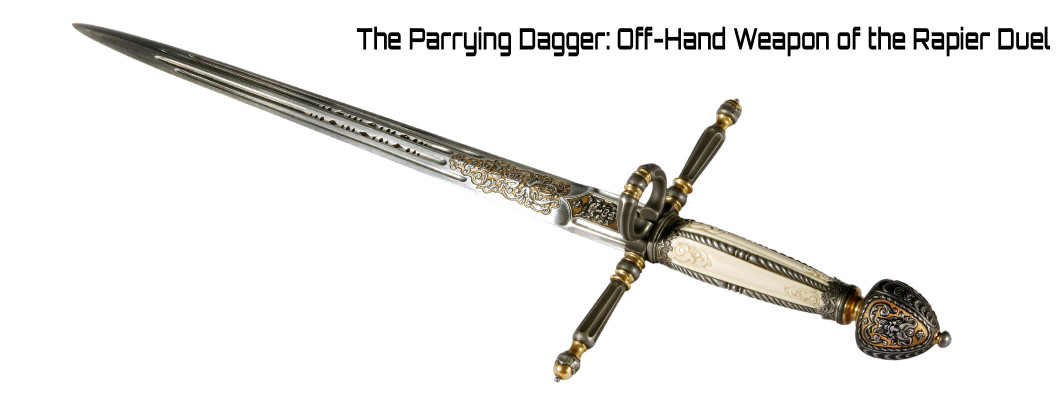
The Parrying Dagger: The Off-Hand Weapon of the Rapier Duel
A parrying dagger is not a sidearm. It is a companion weapon, held in the left hand while a rapier works in the right, and its job is defence rather than attack. Renaissance rapier fencing was a two-weapon system — the dagger was not a backup for when the sword failed, it was half the method.
That is why it looks the way it does. Long slim quillons, side rings, sometimes a knuckle bow: a parrying dagger carries far more hand protection than a dagger of the same size needs, because it is going to meet an opposing blade edge-on again and again. It is closer in purpose to a small shield than to a knife.
Why the Off Hand Needed a Weapon
For most of European history the left hand held a shield, and the shield did the defending. That arrangement lasted a very long time and it worked.
Then two things changed at once. Armour stopped being worn in civilian life, and the sword became lighter, faster and thrust-centred — the rapier. Duels were now fought in ordinary clothes, at extended distance, with the sword hand held forward as the leading target. The shield had gone, the armour had gone, and the fight had become a matter of controlling a single opposing point.
Two solutions appeared, and they are worth seeing as a pair. One was to armour the sword hand itself, which is why rapier hilts grew side rings, swept bars and eventually full cups — the story our guide to sword guard types traces. The other was to put a second weapon in the empty hand.
Most fencers of the period did both. A swept-hilt rapier in the right hand, a parrying dagger in the left, and every incoming thrust had two possible answers.
What Makes It Different From an Ordinary Dagger
Held side by side with a plain dagger of the same blade length, the differences are all in the furniture.
| Ordinary dagger | Parrying dagger | |
|---|---|---|
| Purpose | Attack, and utility use | Defence first; attack when the opening comes |
| Quillons | Short, or none at all | Long and slim, reaching well beyond the hand |
| Hand protection | Minimal | Side rings, often a knuckle bow, sometimes a shell |
| Blade | Sized for the wearer | Longer than a standard dagger, shorter than a sword — commonly 12 to 18 in |
| Stiffness | Whatever suits the job | High. It has to hold a bind without flexing |
| What it meets | Its target | Another blade, repeatedly, edge-on |
The quillons are the giveaway. On an ordinary dagger a crossguard stops your hand sliding forward. On a parrying dagger it does that too, but its real job is to catch an incoming blade and hold it — which means it needs length, and it needs to not bend when something arrives against it hard.
How It Was Used
The popular image is a dramatic block, blade held flat above the head. The reality is smaller and far more efficient.
The dagger operates in the space close to your body, where the rapier cannot easily reach. A thrust coming in is met with a short displacement — a beat, or a deflection of a few inches, just enough to send the point past you rather than stopping it dead. Once contact is made, the dagger can hold the opposing blade in a bind while the rapier answers, which is the whole point of carrying two: one weapon occupies, the other kills.
The quillons and rings come into play in the bind. A blade caught between quillon and blade can be pinned, levered aside or controlled for the moment it takes to riposte. The fencing treatises document this in detail — blade opposition, binds, beat-parries — and it is a genuinely technical system rather than improvisation.
What it is not is a second attacking weapon used simultaneously. Attacking with both hands at once is a film convention. The historical method is division of labour: one hand controls, the other strikes.
The Family
Parrying dagger is the category. Three named forms sit inside it, and they differ by how aggressively they try to control the opposing blade.
The main-gauche is the common one and the one most people mean. A smooth blade, wide quillons, a hand guard. It parries by displacement and holds by pressure. Nothing mechanical about it, and it is the form that saw the most actual use.
The sword breaker adds deep teeth or comb-like serrations along a thickened spine, designed to seize a blade and lever it. Actually snapping a tempered sword was rare; the real value was disarming and control. We have written about it at length — our post on how the sword breaker was used in combat covers the technique, and it has its own history piece.
The trident dagger is the most elaborate: spring-loaded side blades that fold open into a three-pronged catcher when triggered. A remarkable object and a rare one.
Worth noting the proportions here. The main-gauche was by far the most common, and the sword breaker and trident are the exotic specialists — the ones that get written about most and were carried least.
Why It Disappeared
The parrying dagger did not fail. Its conditions changed, and one national school talked itself out of it.
As the rapier gave way to lighter and shorter weapons through the seventeenth century, the sword itself became fast enough to defend with. A blade you can move that quickly does not need a second weapon covering for it, and carrying one costs you a hand you could use for balance.
The French school moved first, increasingly favouring the empty left hand over the dagger, and eventually the sword alone. The German tradition held on longer — masters such as Joachim Meyer integrated the parrying dagger into a broad system taught alongside the longsword and rapier — but the direction of travel was the same everywhere.
The principles survived the weapon, which is the interesting part. Controlling the opponent's blade, and using the free hand in defence, both carried through into later fencing. The dagger went; the ideas it taught did not.
What a Parrying Dagger Asks of the Maker
This is the part that separates it from every other dagger we forge, and it is not visible in a photograph.
It takes repeated edge-on impact, which no ordinary dagger does. A knife meets soft material. A parrying dagger meets hardened steel, at speed, over and over. That changes the heat treatment brief: it is treated toward toughness rather than maximum hardness, because a blade hard enough to hold a razor edge indefinitely is also a blade that chips when another blade lands on it.
The quillons are structural and they have to spring back. Long slim quillons are the defining feature and the most demanding part of the build. They must be stiff enough to hold a blade under pressure and tough enough to flex and return rather than taking a permanent set. Quillons welded onto a guard are a weak point exactly where the load arrives; forged as one piece with the guard block, they are not.
The guard carries load into the tang. On most daggers the guard is a stop for your hand. Here it is the working surface, so the seating against the blade shoulders and the peen at the pommel have to be right or the whole assembly loosens under exactly the use it was built for.
The practical consequence: if you intend to actually spar with one, say so when you order. A display piece and a piece that will take repeated bind work are the same shape and not the same build.
Choosing One
Match it to the sword. A parrying dagger is half of a pair, and the pair should agree. A 16-inch dagger against a short rapier is unbalanced; so is a small dagger against a long sword. If you already own the rapier, give us its blade length and we will size the dagger to it.
Decide how much hand protection you want. Side rings alone are the lighter, faster, more historically common answer. A knuckle bow or shell adds protection and adds weight to the off hand, which some fencers dislike. Neither is more correct.
Be honest about use. For display or costume, any of the three forms is a striking object and the sword breaker or trident will draw more attention. For handling and for sparring, the plain main-gauche is what most people actually want, and it is the one that was actually carried.
Parrying Daggers, Sized to Your Rapier
We hold no stock — every blade is forged after the order is placed, so blade length, quillon length, side rings and guard configuration are yours to specify. Send the blade length of the sword you are pairing it with and we will size the dagger to match. Sword breakers and trident daggers are quoted through custom forge.
Frequently Asked Questions
What is a parrying dagger?
A companion weapon held in the off hand while a sword works in the dominant hand, used to defend rather than to attack. It carries far more hand protection than an ordinary dagger — long quillons, side rings, sometimes a knuckle bow — because it is built to meet an opposing blade repeatedly. It appeared in the late Middle Ages and belongs mainly to Renaissance rapier fencing.
What does main-gauche mean?
French for "left hand". It is used two ways: for the specific smooth-bladed parrying dagger with wide quillons and a hand guard, which was the most common form, and loosely for the whole category of off-hand parrying weapons. Parrying dagger is the broader and less ambiguous English term.
How is a parrying dagger different from a normal dagger?
The furniture rather than the blade. A parrying dagger has long slim quillons reaching well beyond the hand, side rings and often a knuckle bow, because its job is to catch and hold another blade rather than to stab. It is also stiffer and usually longer — commonly 12 to 18 inches of blade, longer than a standard dagger and shorter than a sword.
How was a parrying dagger actually used?
In the close space where the rapier cannot easily reach. An incoming thrust is met with a short displacement — a beat or a deflection of a few inches to send the point past you — and once contact is made the dagger holds the opposing blade in a bind while the rapier answers. One weapon occupies, the other strikes. Attacking with both hands simultaneously is a film convention, not a historical method.
What is the difference between a main-gauche and a sword breaker?
The main-gauche has a smooth blade and parries by displacement and pressure. The sword breaker adds deep teeth or comb-like serrations along a thickened spine to seize and lever an opposing blade. Actually snapping a tempered sword was rare; the real value was disarming and control. The main-gauche was by far the more common weapon in period.
Why did parrying daggers stop being used?
Their conditions changed. As the rapier gave way to lighter, shorter swords through the seventeenth century, the sword became fast enough to defend with on its own, and a second weapon cost you a hand. The French school moved first toward the empty left hand and then the sword alone. The principles survived — controlling the opponent's blade, and using the free hand in defence.
How long should a parrying dagger be?
Commonly 12 to 18 inches of blade, and it should be matched to the sword it accompanies. A dagger at the top of that range against a short rapier is unbalanced, and so is a small one against a long sword. If you already own the sword, size the dagger to its blade length rather than choosing in isolation.
Can a parrying dagger be used on its own?
It can, but it is not what the design is for. Everything distinctive about it — the long quillons, the side rings, the stiffness — exists to serve a two-weapon system. Used alone it is a heavy, over-guarded dagger. If you want a single blade for the belt, an ordinary dagger form will suit you better.
Can you forge a custom parrying dagger?
Yes. We hold no stock and forge after the order is placed, so blade length, quillon length, side rings and guard configuration are all specification rather than selection. Send the blade length of the sword you are pairing it with and we will size the dagger to match. If you intend to spar with it rather than display it, say so — the build differs even though the shape does not.