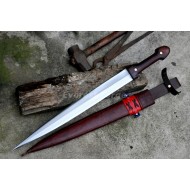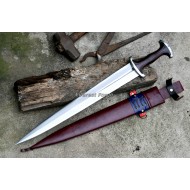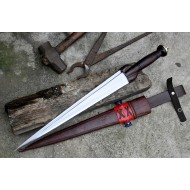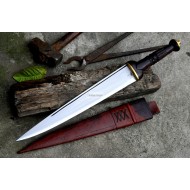
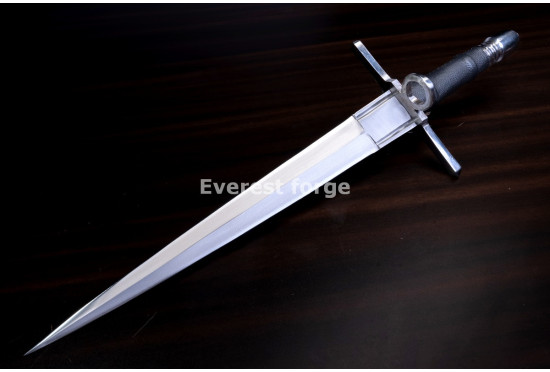
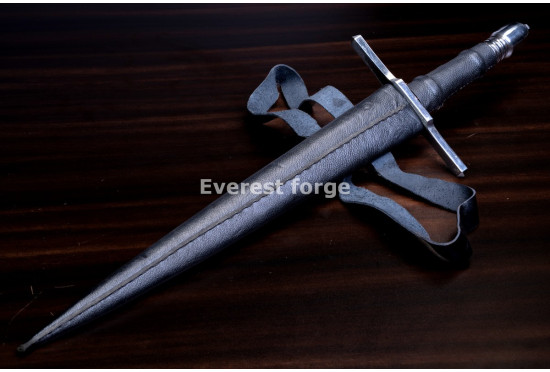
- Model: Hand forged Dagger
- Product Code: DAGGER16KO
- Location: Kathmandu,Nepal
Available Options
A Hand-Forged Parrying Dagger With a Side Ring Guard and Faceted Ricasso
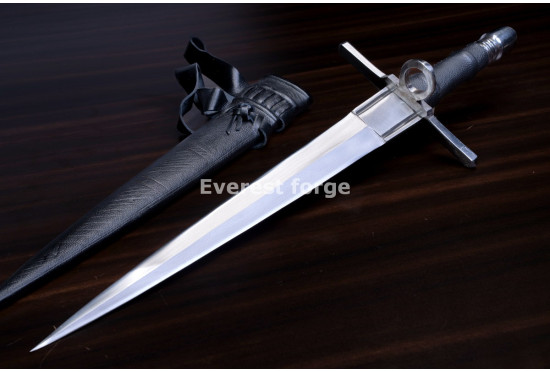
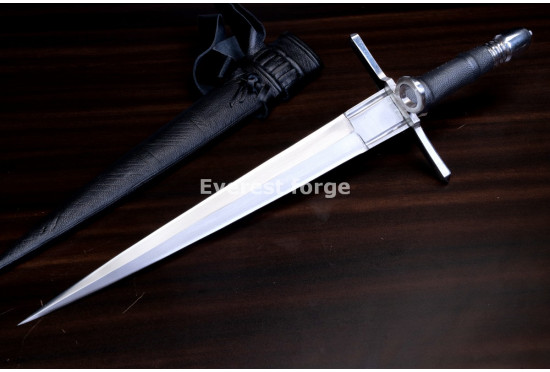
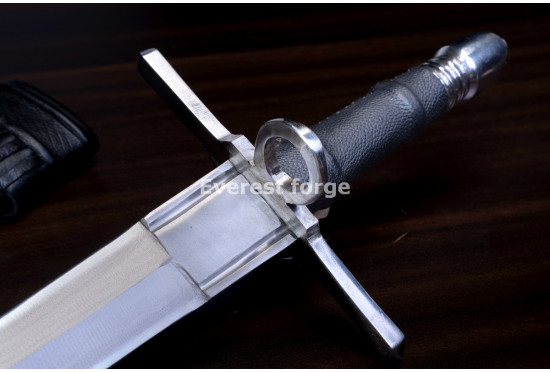
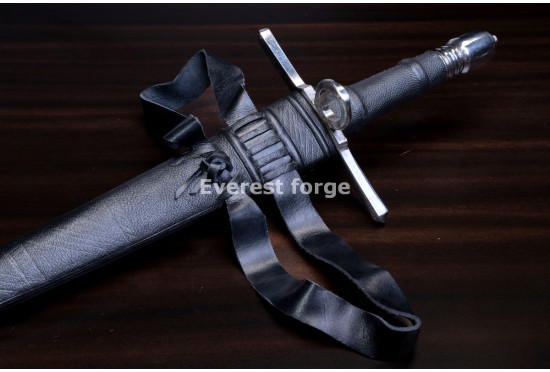
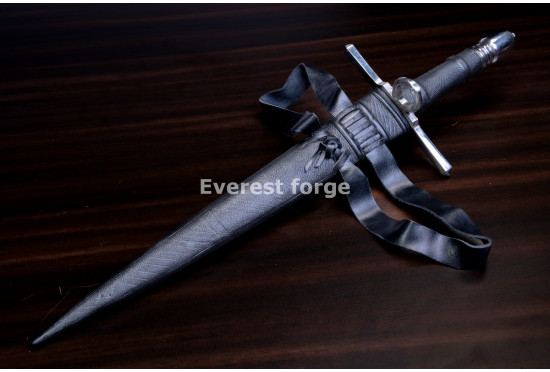
This is a 16 inch hand-forged parrying dagger, the companion weapon carried in the off hand alongside a rapier in the sixteenth and seventeenth centuries. The blade is double-edged with a raised medial ridge, tapering evenly to a very acute point, and runs back into a long faceted ricasso at the guard. The hilt carries straight square-section quillons with plain cut ends, a steel side ring set above the cross on one face, a leather-covered grip banded in steel and a heavy turned pommel. Overall length is 23 inches and it weighs approximately 910 grams. Forged from 5160 high-carbon steel in Tokha-3, Kathmandu, and supplied in a black leather scabbard on long hanging straps.
An honest note. This dagger is heavier than the historical average and it is worth knowing why that matters on this particular weapon. A parrying dagger is held in the off hand for the whole length of an engagement while the rapier does the attacking, so surviving examples generally run between four hundred and seven hundred grams. A tired off hand stops covering properly. At 910 grams this one is robust and it will take a hard bind, but it is at the top of the range rather than in the middle of it. If you intend to actually drill with it, ask us for the lighter build and our smiths will take it down through the blade and the pommel without changing anything you can see. Second point: the side ring sits on one face only, which is how these were made. See the answer below on which way it should face.
Have This Dagger Forged Your Way
Blade length, weight, guard form and which face the side ring sits on are all decided at the forge. Send a description or a photograph of a museum piece and our smiths will quote it.
Start a Custom Forge Order →Why This Dagger Is Built the Way It Is
Specifications
Build Options
Is This the Right Dagger for You?
Buy This If You Want
- The rapier-era companion dagger with the guard geometry actually correct
- A stiff blade that will hold under another sword's weight rather than flexing
- A ricasso you can grip above the cross for point control
- A piece that reads instantly as sixteenth or seventeenth century
- Something to pair with a rapier, built to match it
Look Elsewhere If You Want
- A light dagger for sustained drilling — ask for the lighter build rather than this one
- A medieval dagger; the quillon and knightly forms are two hundred years earlier and we build those separately
- A utility or camp knife, since a stiff double-edged blade is the wrong tool for cutting anything
- A sparring or HEMA trainer, which needs rolled edges and a rebated point from the first heat
- A stainless blade needing no care, since 5160 is carbon steel and will rust if left wet
Rapier and Dagger, Built as a Pair
Matching a dagger to a rapier — same quillons, same pommel, same grip treatment — is straightforward for us and almost nobody offers it. Ask us to quote the pair.
Talk to the Forge →How to Order
Who This Dagger Is For
- Collectors of rapier-era arms who want the guard built correctly rather than approximated
- Historical fencers and students of the sources wanting a sharp for handling and reference
- Re-enactors and living history groups covering the sixteenth and seventeenth centuries
- Anyone who already owns a rapier and wants the companion piece dressed to match it
What Is Included
- One hand-forged parrying dagger, sharpened and ready
- Fitted black leather scabbard on hanging straps
- Certificate of hand-forging from the workshop
- Everest Forge manufacturer warranty against defects in forging and heat treatment
Explore the Collection
Shipping, Returns and Care
Every piece is prepared at the forge in seven to ten days, and shipping adds a further seven to ten days. Orders to the USA and Canada travel with FedEx; everywhere else ships on a DDP service, which means duties and taxes are settled before the parcel moves so there is nothing to pay on delivery. Every piece carries the Everest Forge manufacturer warranty against defects in forging and heat treatment.
Double-edged blades are restricted in some countries and in some states and provinces within them, and the rules for a double-edged dagger are often stricter than for a single-edged knife of the same length. It is your responsibility to check that this piece may lawfully be imported and possessed where you live before ordering, because a parcel seized by customs cannot be returned to us and cannot be refunded. Ask us before you buy if you are unsure and we will tell you what we know about your destination.
5160 is a high-carbon steel and it will rust if left wet or stored damp. Wipe the blade dry, keep a light film of oil on it, and pay attention to the inside of the side ring and the angles of the ricasso, which are the two places on this hilt a cloth will not reach. Do not store the dagger in the scabbard for long periods, because leather holds moisture against steel.
Frequently Asked Questions
What is a parrying dagger for?
It is the second half of a two-weapon system. From the middle of the sixteenth century the rapier became long enough that a fencer could no longer easily defend with the same blade he attacked with — a thrust launched with a long weapon leaves you committed, and recovering the point to cover yourself takes time you do not have. The answer across Europe was to fill the off hand: with a cloak, a small shield called a buckler, and most effectively with a dedicated dagger. The dagger covers, deflects and controls the opponent's blade while the rapier does the killing, and once an exchange closes to arm's length it becomes the offensive weapon in its own right. That division of labour is why the parrying dagger is built the way it is. It is stiff rather than sharp, it has far more hand protection than a sidearm needs, and its guard is designed around catching another blade rather than around cutting.
Which way round should the ring face?
Outward, away from your body, and this is worth getting right when you order. The side ring sits on one face of the guard only, which is how these were made, so the dagger is built for one hand rather than being symmetrical. Held with the ring facing outward, it closes the gap above the cross where an opposing point would otherwise slide through onto your fingers. Held the other way round, the ring is doing nothing useful and is sitting against your forearm. So tell us in the order comments which hand you will hold it in and we will set the ring on the correct face before it is forged. Mirrored builds cost nothing extra and take no longer. If you would rather not think about it, ask for a ring on both faces, which some historical examples carry and which makes the dagger usable either way.
What is the ricasso for?
Holding. The ricasso is the long unsharpened section of blade immediately above the guard, and on this dagger it is faceted rather than round so it sits square in the fingers. Its purpose is to let you put a finger or a thumb over the cross and onto the blade itself, which shortens your effective grip and gives you far finer control of where the point goes. That matters enormously on a defensive weapon: you are steering the point into a bind and holding a line rather than swinging. It also means the dagger can be gripped closer to the balance point when an exchange gets very close. Every parrying dagger of this period has one, and if a listing shows a blade sharpened all the way to the cross, the maker has not understood what the weapon is. Ours is left properly blunt and finished square.
Why is it heavier than the historical range?
Because it is forged robustly rather than to a target weight, and we would rather say so than let you find out. Surviving parrying daggers commonly weigh four to seven hundred grams. This one is 910. The reason it matters more here than on most weapons is the job: the off hand holds this thing up for the entire length of an engagement while the sword hand does the work, and a tired off hand stops covering properly. That is not a theoretical concern, it is the first thing anyone notices after twenty minutes of drilling. As a collector's piece, a display item or a robust sharp for handling, 910 grams is fine and it will take a very hard bind without complaint. If you are going to use it, order the lighter build. Our smiths take the weight out of the blade and the pommel, nothing visible changes, and it costs no more.
What are the other kinds of parrying dagger?
There are four worth knowing and sellers mix them up constantly. The plain form, which is this one, has quillons and one or two side rings and nothing else. The sword-breaker has deep slots cut into one edge of the blade, intended to catch an opponent's blade and either trap it or snap it; whether it ever worked as advertised is argued over, and surviving examples are rare enough that it may have been more of a curiosity than a fighting tool. The trident dagger, sometimes called a swordbreaker too, has two spring-loaded side blades that fly open at the press of a catch to make a three-pronged trap. And the Spanish daga de vela has a very broad triangular blade, a large shell guard and a full knuckle bow, and is the heaviest and most protective of the family. If you want any of those, we will forge them; the plain form is the one that was actually carried in numbers.
Is it the same thing as a main gauche?
In ordinary English usage, yes, and we use both terms because that is what people search for. The term comes from French and in English it has come to mean the rapier's companion dagger generally, which is exactly what this is. Used strictly, though, particularly by Spanish arms scholars, it refers to the daga de vela specifically — the broad shell-guarded form described above — rather than to the whole family. So both are defensible: this is a main gauche in the sense nearly everyone means, and not one in the narrow sense a specialist might. Since the strict usage is not the common usage, and since being told your dagger is not a main gauche by one person in fifty is a small price for being findable by the other forty-nine, we describe it as both and explain the distinction here rather than pretending it does not exist.
How is this different from your medieval daggers?
Two centuries and a completely different job. Our Medieval Dagger and our Quillon Dagger, Ring Pommel are knightly sidearms of the fourteenth and fifteenth centuries: a cross, a grip and a pommel, worn on the same belt as an arming sword, used when a sword was lost or an opponent was on the ground. They have no hand protection beyond the cross because they were never expected to meet another blade deliberately. This dagger is a sixteenth and seventeenth century fencing weapon designed from the start to catch a rapier, which is why it has a side ring, a proper ricasso and a blade stiff enough to hold under load. Same word, different weapon. If you want the medieval sidearm, take one of those; if you want the rapier's partner, take this.
What steel is it, and how is it heat treated?
5160 high-carbon spring steel, brought to temperature in the forge, quenched in oil and tempered back so the edges are hard while the body stays springy. On this weapon the tempering matters more than usual, because a parrying dagger takes lateral load from another blade rather than the straightforward impact a cutting weapon sees, and a blade tempered too hard would be brittle exactly where it is being asked to flex and return. It is not stainless, deliberately: stainless grades that genuinely resist rust give up toughness, and this blade is designed to be leant on.
How sharp does it arrive?
Sharp and ready, with both edges put on a stone by hand at the forge and the ricasso left properly blunt. If you would prefer it shipped unsharpened — for display, for a gift, for a group where a live edge is not permitted, or because of the rules where you live — say so in the order comments and we will do it at no extra cost, and rebate the point as well if you need it. What we cannot do is turn a sharp into a safe training weapon after the fact: a proper trainer needs thicker rolled edges and a flared blunt tip designed in from the first heat, and that is a different forging.
How was it carried?
Behind the back, on the same belt as the rapier and usually pushed round to sit at the small of the back or on the right hip, hilt canted so the off hand falls onto it naturally. That is why the scabbard on this one hangs on long straps rather than sitting in a fixed frog: the dagger needs to be reachable across the body and to swing out of the way when you sit or ride. It is also why the historical blade lengths are shorter than this one. If you want the piece to hang correctly for wearing rather than for display, order twelve to fourteen inches, and tell us how you want the straps set and we will make them up to suit.
Can you build a matching rapier?
Yes, and it is how these were bought. A rapier and its dagger were made as a garniture, sharing quillon profile, pommel form, grip treatment and any decoration, so that the pair read as one object rather than two purchases. We will match a dagger to a rapier you already own from photographs and measurements, or build the pair together from scratch. Tell us which and send whatever reference you have. It adds to the lead time and it is the single thing that most changes how a set like this looks on a wall or in the hand.
Where is this made, and by whom?
In our own workshop in Tokha-3 on the northern edge of Kathmandu, Nepal, by around ten smiths, most from families that have forged blades for generations. Everest Forge has operated since 2010, and we forge, grind, heat treat, fit the hilts and cut the leather in the same building. A European fencing weapon made in Nepal deserves the same word we give our bowie and our seax: this is not our own tradition and we do not pretend it is. It is worked from the record, which is why this page tells you what the originals weighed and where ours differs from them.
| Specification | |
| Blade: | 16 inches. Hand forged from 5160 carbon steel |
| Total Length: | 23 inches |
| Handle: | 7 inches (4 inch grip). Leather over a shaped core, steel bands, turned steel pommel |
| Weight: | approx 910g dagger, 1050g with scabbard |
| Note: | Some variation in weight, dimensions and finish may occur as each piece is hand forged. Keep the blade lightly oiled when not in use |