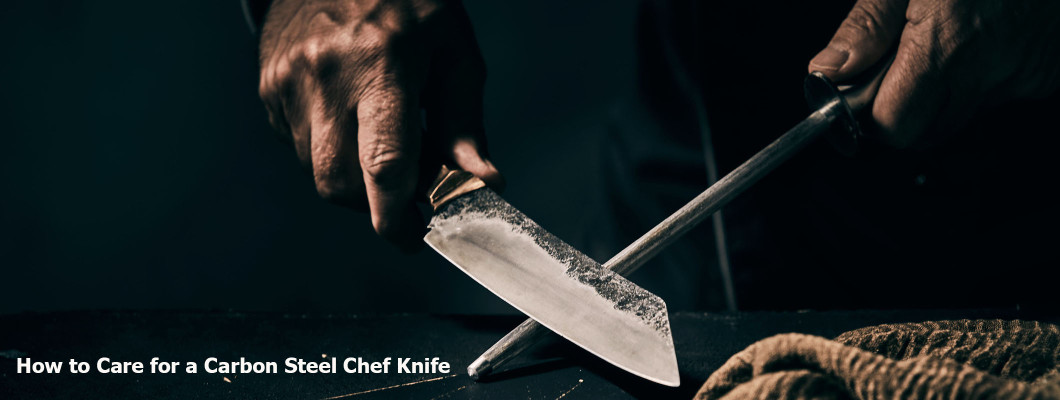
How to Care for a Carbon Steel Chef Knife
A carbon steel chef knife rewards you with a keener edge and easier sharpening than any stainless blade — and asks one thing in return: keep it dry. That is genuinely most of it. Wash it by hand, dry it straight away, and give it a wipe of oil before it goes in the drawer, and a hand-forged carbon steel knife will outlast you. Neglect it in a wet sink overnight and it will rust. This guide covers the whole routine: daily care, the patina that protects the blade, how to remove rust if it appears, sharpening, and long-term storage.
Everything here applies to any high-carbon kitchen knife, and specifically to the 5160 spring steel blades we hand-forge at Everest Forge — the same tough, easily-sharpened steel we use for our Gurkha kukris.
Carbon Steel Knife Care — At a Glance
- Hand-wash in warm, soapy water
- Dry completely and immediately
- Wipe on a thin film of food-safe oil
- Cut on wood or soft composite boards
- Let a grey-blue patina build — it protects the blade
- Put it in the dishwasher
- Leave it wet or soaking in the sink
- Cut on glass, stone or steel surfaces
- Scrub off the patina to keep it shiny
- Store it damp or in an airtight humid space
The 10-second routine after every use: wash → dry → oil. Do those three things and a carbon steel knife will never rust.
Why Carbon Steel Needs Care in the First Place
Carbon steel and stainless steel make a straight trade. Stainless adds chromium to resist rust, but that same chromium makes the steel harder to sharpen and quicker to lose a fine edge. Carbon steel leaves the chromium out: it takes a sharper edge, holds it well, and comes back to keen in a few strokes on a stone — but with nothing to protect it, it reacts with water, acids and air.
That reaction is not a flaw. It is the reason chefs and smiths have preferred carbon steel for centuries. You are simply trading two minutes of care after cooking for a better blade to cook with. Once the routine below becomes habit, you stop thinking about it.
The Daily Routine — Three Steps After Every Use
This is the whole of it. Do these three things every time and rust will never get a foothold.
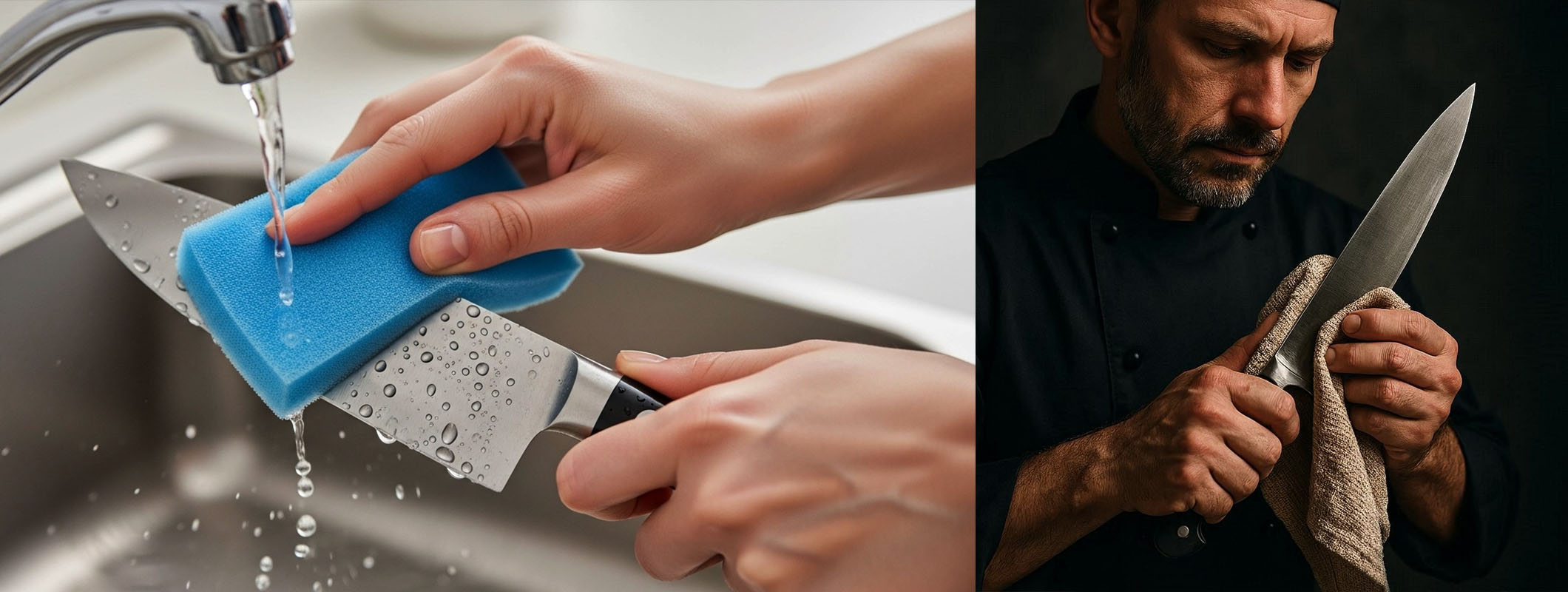
- 1. Hand-wash, never the dishwasher. Warm water, a little mild dish soap, a sponge or cloth. A dishwasher is the single worst thing you can do to a carbon steel knife — the prolonged wet heat and harsh detergent will rust the blade and can crack the handle. Wash the knife on its own, not buried in a tub of soaking dishes.
- 2. Dry it immediately and completely. Do not leave it on the draining board. Towel it dry the moment it is washed — blade, spine, and especially the join where the blade meets the handle, where water hides. Use paper towel or a clean, dry cloth; a damp, already-used tea towel just re-wets the blade. Standing water is what rusts a blade; a dry blade cannot rust.
- 3. Wipe on a thin film of oil. A few drops of food-safe oil on a paper towel, wiped down the blade, seals it from the air. This matters most in humid kitchens and before the knife is stored. It takes ten seconds.
A note on acidic foods. Cutting onions, tomatoes, citrus or other acidic ingredients will react with a bare blade faster than water does — often leaving a grey or blue tint within minutes. That is harmless (it is patina, see below), but if you want to keep the blade bright, wipe it down partway through prep rather than letting the juice sit.
What to Oil a Carbon Steel Knife With
Use any food-safe oil that will not go rancid: food-grade mineral oil is the standard choice, and camellia oil (tsubaki) is the traditional one used on Japanese carbon blades. Avoid ordinary cooking oils like olive or vegetable oil for long-term storage — they can turn sticky and rancid over time. A small bottle of mineral oil lasts years.
Seasoning a New Carbon Steel Knife
Just unboxed a new carbon steel knife? You do not have to do anything special before using it — but a little first-day care sets it up well. Our knives ship lightly oiled to protect them in transit, so the first step is simply to wash that shipping oil off with warm soapy water, dry the blade, and it is ready to cut.
Beyond that, "seasoning" a carbon knife just means beginning its patina deliberately rather than letting it happen at random. It is optional, but many owners like to start with an even base layer rather than the blotchy pattern that first onions and tomatoes leave behind. Two easy methods:
- The mustard coat. Wipe a thin, even layer of ordinary yellow mustard over the clean blade, leave it 20 to 30 minutes, then rinse and dry. The mild acid brings up a uniform grey-blue tone. Repeat once or twice for a deeper finish.
- The vinegar or potato method. Wipe the blade with white vinegar, or push it into a raw potato or apple and leave it several minutes, then rinse and dry. Both react gently and evenly with the steel.
Whichever you use — or if you skip it entirely and just cook — finish by drying the blade and wiping on a thin film of oil. From there, ordinary use and the daily routine do the rest.
Patina — Your Blade's Natural Armour
Within a few uses, a carbon steel blade starts to change colour — first a faint grey, then a deeper blue-grey or even a mottled bronze. This is patina, a thin layer of stable oxidation that forms as the steel reacts with food and air. New owners sometimes panic and try to scrub it off. Do not.
Patina is not rust — it is the opposite. It is a passive, stable layer that actually protects the steel beneath it from the active red rust that eats into a blade. A well-used carbon knife develops a dark, even patina that is both handsome and functional; many cooks deliberately encourage it. The rule is simple: even grey or blue discolouration is good; flaky orange-red spots are not. One is armour, the other is damage.
Different foods pull the patina in different directions, which is part of the character — the blade ends up recording what you cook:
- Cooked meats tend to bring up a pleasant blue tone.
- High-acid vegetables — onions, cabbage, artichokes, rhubarb — push it toward a deep blue-black.
- Acidic fruits — lemon, strawberry, pineapple — mark a grey-black almost immediately.
You can let patina develop naturally through use, or force an even one deliberately — a common method is to coat the clean blade in mustard or leave it in vinegar or a bath of apple slices for an hour, which produces a uniform grey rather than a patchy one. This is optional. Ordinary cooking will patina the blade on its own.
How to Remove Rust If It Appears
If a knife does get left wet and orange rust spots appear, do not worry — surface rust comes off easily and the blade underneath is almost always fine. Work from the gentlest method up:
- Cork and baking soda. The classic kitchen fix. Dip the cut end of a wine cork in a little baking soda and rub the rust spots — the cork is just abrasive enough to lift rust without scratching the blade. Rinse, dry, and re-oil.
- Baking soda paste. For more stubborn spots, mix baking soda with a few drops of water into a paste, spread it on the rust, leave it a few minutes, then scrub gently with a non-scratch pad or cloth.
- A fine abrasive, if needed. For heavier rust, a very fine (2000-grit or higher) wet sandpaper or a rust eraser used gently along the blade will clear it. Go lightly — you are removing rust, not steel.
Once the rust is gone, always dry the blade completely and re-oil it. Rust that keeps returning in the same spot usually means moisture is being trapped there in storage — check how and where you keep the knife.
Sharpening a Carbon Steel Knife
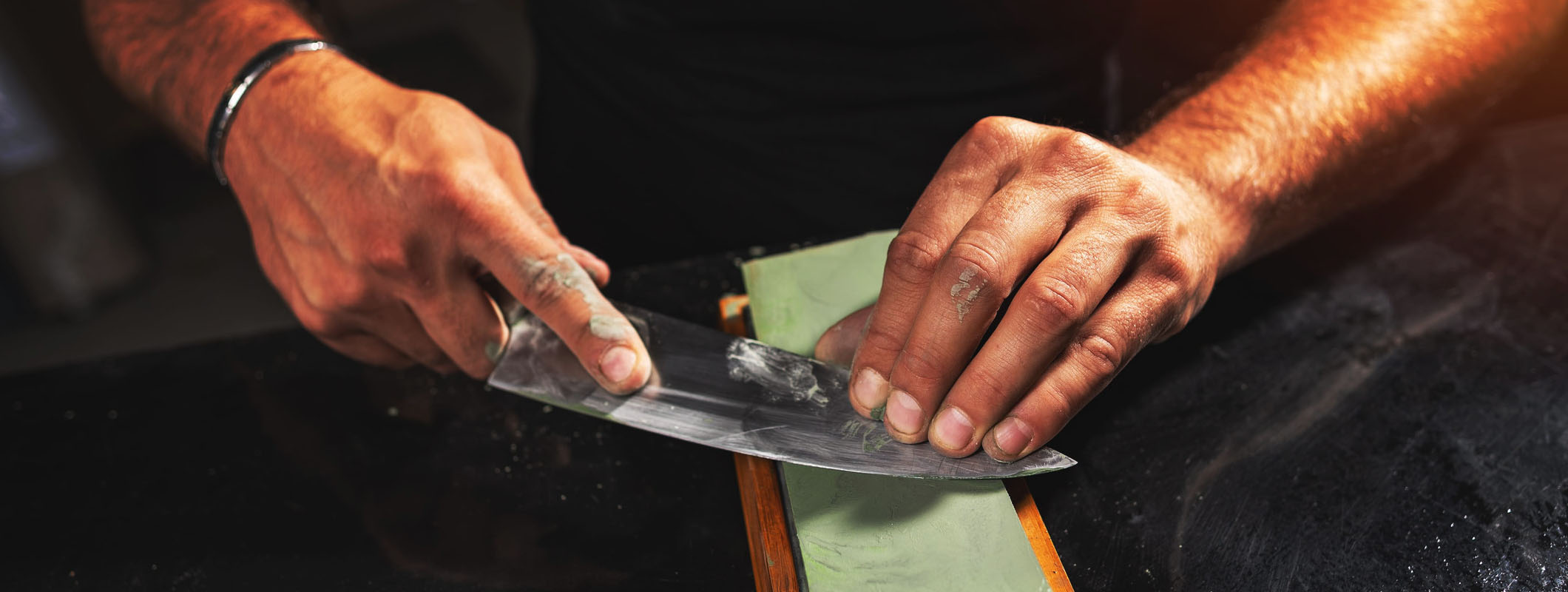
Here is where carbon steel gives back. Because it is not loaded with chromium, it sharpens faster and finer than stainless, and it responds to simple tools — you do not need diamond plates or powered systems.
- A whetstone is all you need. A combination stone (a coarser side around 1000 grit for setting the edge, a finer 3000-6000 side for finishing) will keep a 5160 blade shaving-sharp. Soak the stone, hold a consistent angle of roughly 15 to 20 degrees, and work each side until you feel a fine burr, then finish with light alternating strokes.
- A honing rod between sharpenings. A few passes on a honing steel realigns the edge and delays the need for full sharpening. This is maintenance, not sharpening — it straightens the edge rather than removing steel.
- Strop to finish. A few strokes on a leather strop polishes the edge to keen. Our blades are finished on a strop before they ship.
Dry and lightly oil the blade after sharpening, since you have exposed fresh, unpatinated steel that will be briefly more reactive.
Storing a Carbon Steel Chef Knife
Storage is where neglected knives quietly rust, so it is worth getting right.
- Store it clean, dry and oiled. Never put a damp knife away. The film of oil from your daily routine is what protects it between uses.
- Avoid sealed, humid spaces. A knife shut in a damp drawer or an airtight box in a humid kitchen can sweat and rust. Air circulation helps.
- Protect the edge. A magnetic strip, a knife block, an edge guard or a wooden saya (sheath) keeps the edge from knocking against other tools — and knocking is what chips a fine edge. Many of our kitchen knives are offered with a wooden scabbard for exactly this.
- Don't store blades touching each other. Two different metals left in contact over time can set off galvanic corrosion. Keep each knife separated — in its own slot, sheath or a set place on the strip.
- For long storage, a heavier coat of oil and a check every few weeks will keep a knife you are not using in perfect condition.
Cutting Boards — the Care Step Most People Miss
Blade care is not only about rust; it is about the edge, and the surface you cut on matters as much as anything you do at the sink. The rule is simple: cut on something softer than steel.
- Best: end-grain wooden boards. The fibres part around the edge and close again, which is gentle on the blade and self-healing for the board.
- Good: edge-grain wooden boards and soft plastic or composite boards. Perfectly fine for daily use.
- Never: glass, granite, marble, ceramic or metal. These are harder than your edge and will roll, dull and chip it with every cut — no amount of sharpening keeps up with a glass board.
A good board does more for your edge over a knife's life than frequent sharpening does. Pair it with the wash-dry-oil routine and you are covering both halves of knife care — the blade and the edge.
What Not to Do
- Never the dishwasher. Worth saying twice. It is the fastest way to ruin a carbon steel knife.
- Do not leave it wet — not in the sink, not on the draining board, not in a damp cloth.
- Do not cut on glass, stone or steel boards. Use wood or a soft composite; hard surfaces roll and chip the edge. This is edge care as much as blade care.
- Do not scrub off the patina or use harsh abrasive cleaners to keep the blade mirror-bright — you are removing the very layer protecting it.
- Do not pry, twist or baton with a chef knife. It is a slicing tool; lateral force chips edges and stresses the tang.
- Use the right knife for the task. Don't chop bone with a knife that isn't built for it — reach for a cleaver or bone knife instead. Forcing a thin chef's edge through bone is the fastest way to chip it.
The Knives This Guide Is For
Every kitchen knife we forge is 5160 high-carbon steel and cared for exactly as above. A few from the range:
Browse the full hand-forged chef & kitchen knife collection — 30+ knives, each with free personalisation. New to forged blades? Read why hand-forged chef knives outperform factory-made ones first. And for the forging process behind every blade, see how your blade is made.
Commission a Chef Knife Built to Your Hand
Want a specific blade length, profile, handle material or finish the catalogue doesn't carry? Our smiths forge kitchen knives to your exact specification from 5160 spring steel, full tang, with free engraving. Send a sketch or a description for a free quote within 24 to 48 hours.
Order a Custom Chef Knife →Frequently Asked Questions
How do I care for a carbon steel chef knife day to day?
Three steps after every use: hand-wash with warm water and mild soap, dry it completely and immediately with a towel, and wipe on a thin film of food-safe oil before storing. Never put it in the dishwasher and never leave it wet. That routine takes under a minute and prevents rust entirely.
Do carbon steel knives rust?
They can, if left wet or stored damp, because carbon steel lacks the chromium that makes stainless rust-resistant. But rust is entirely preventable with the wash-dry-oil routine, and if surface rust does appear it wipes off easily with a cork dipped in baking soda. The trade-off for that bit of care is a sharper edge that's far easier to sharpen.
What is the grey or blue colour forming on my blade?
That's patina — a thin, stable layer of oxidation that forms as the steel reacts with food and air. It is not rust; it actually protects the blade from rust. Even grey or blue discolouration is good and normal. Only flaky orange-red spots are rust to be removed. Many cooks deliberately encourage a dark, even patina.
Can I put a carbon steel knife in the dishwasher?
No — never. The prolonged wet heat and harsh detergent will rust the blade and can crack or loosen the handle. It's the single most damaging thing you can do to a carbon steel knife. Always hand-wash and dry immediately.
How do I remove rust from a carbon steel knife?
Start gentle: dip the cut end of a wine cork in baking soda and rub the spots, then rinse, dry and oil. For stubborn rust, use a baking soda paste, or a very fine 2000-grit-plus wet sandpaper or rust eraser used lightly along the blade. Surface rust lifts off easily and the steel underneath is almost always fine.
What oil should I use on a kitchen knife?
A food-safe oil that won't go rancid. Food-grade mineral oil is the standard, and camellia (tsubaki) oil is the traditional Japanese choice. Avoid olive or vegetable oil for storage, as they can turn sticky and rancid over time. A thin film is all you need.
How do I sharpen a 5160 carbon steel knife?
A whetstone is ideal — a 1000-grit side to set the edge and a 3000-6000 side to finish. Hold about 15 to 20 degrees, work each side to a fine burr, then finish with light alternating strokes and a few passes on a leather strop. Carbon steel sharpens faster and finer than stainless and needs no special abrasives. A honing rod between sharpenings keeps the edge aligned.
Should I remove the patina to keep my knife shiny?
No. The patina is a protective layer — scrubbing it off exposes bare, more reactive steel. If you prefer a bright blade you can keep it wiped down during acidic prep, but a dark, even patina is desirable and functional, not a defect. Only remove active orange rust, never patina.
Do I need to season a new carbon steel knife before using it?
Not strictly. Our knives ship lightly oiled, so just wash off the shipping oil, dry, and start cutting. If you want an even patina from the start rather than a blotchy one, you can season it by wiping the blade with mustard or vinegar for 20 to 30 minutes, then rinsing, drying and oiling. It's optional — ordinary cooking will patina the blade anyway.
What cutting board should I use with a carbon steel knife?
Wood or soft composite. End-grain wooden boards are best, edge-grain and soft plastic are good. Never cut on glass, stone, granite, marble, ceramic or metal — they're harder than the edge and will dull and chip it with every cut. Your choice of board protects the edge more than frequent sharpening does.
How should I store a carbon steel chef knife?
Clean, dry and lightly oiled, with the edge protected by a block, magnetic strip, edge guard or wooden sheath. Avoid damp drawers and airtight humid spaces where the blade can sweat. For a knife you won't use for a while, apply a heavier coat of oil and check it every few weeks.
Shop Hand-Forged Kitchen Knives
5160 Carbon Steel, Forged by Hand in Nepal
Over 30 hand-forged chef knives, cleavers, hatchets and boning knives — full tang, free personalisation, free worldwide shipping. Cared for as this guide describes, they last decades.
Browse Chef & Kitchen Knives →