
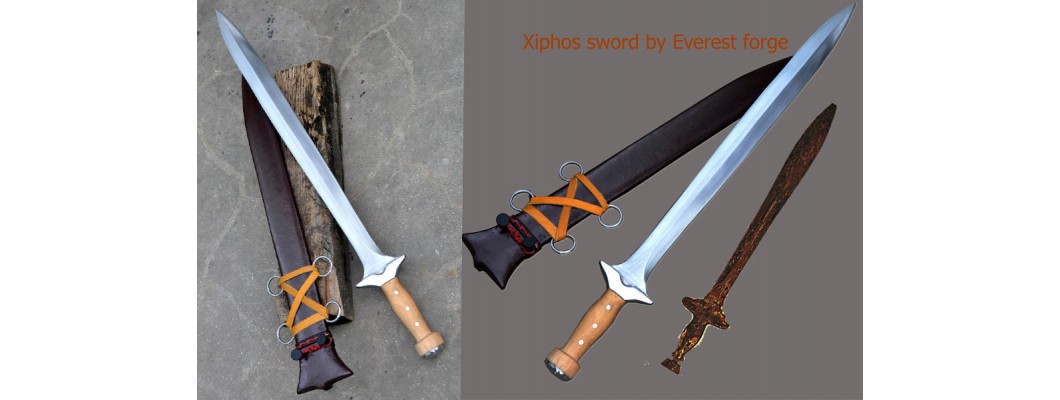
Xiphos Meaning & Definition — What Is a Xiphos Sword? Hand-Forged Greek Blade by Everest Forge
Last updated: May 2026 — by Everest Forge, Kathmandu, Nepal
If you've searched "xiphos meaning", "what does xiphos mean", or "xiphos definition", this guide gives you the complete answer — plus a look at how Everest Forge hand-forges modern functional Xiphos swords in Kathmandu, Nepal. The Greek word Xiphos meant simply "sword," but in modern usage it refers to a very specific weapon: the iconic leaf-shaped, double-edged short sword of the ancient Greek hoplite. Read on for the meaning, pronunciation, etymology, and how to commission your own custom-forged Xiphos.
Everest Forge — Custom Xiphos Commissions
Want a Xiphos Forged to YOUR Exact Specifications?
Our Custom Forge program builds one-of-a-kind Xiphos blades to the dimensions, steel grade, handle material, blade finish, and engraving you specify. Whether you need a historically accurate hoplite reconstruction, a mythological showpiece, or a working modern combat blade — we forge it by hand in Kathmandu from your specifications. Free engraving included on every commission.
See Custom Forge Options → Browse 12 Stock Xiphos Swords →Xiphos Meaning — Quick Answer
Xiphos (noun)
An ancient Greek one-handed, straight, double-edged, leaf-shaped short sword carried as a sidearm by classical Greek hoplites. From the Greek word for "sword" (transliterated as xiphos). The Xiphos served as the trusted secondary weapon to the long thrusting spear (the dory) in Greek phalanx warfare from roughly the 8th century BCE through the 4th century BCE.
Standard Dimensions
Blade: 18–24 inches (45–60 cm)
Handle: 5–7 inches (12–18 cm)
Overall: 24–30 inches (61–76 cm)
Weight: 700–1,300 grams (1.5–2.8 lbs)
Blade profile: Double-edged, leaf-shaped
What Does Xiphos Mean? Full Definition
The word xiphos (sometimes spelled xyphos in modern phonetic transliteration) comes from ancient Greek and literally means "sword." In Classical Greek literature and inscriptions, xiphos was used as the most common general term for any kind of sword — much like the English word "sword" today covers many different blade types.
However, in modern academic and collector usage, the word "Xiphos" has narrowed to refer specifically to one particular type of ancient Greek sword:
- The classical Greek hoplite short sword — straight, one-handed, double-edged
- Distinguished by its leaf-shaped blade — broad at the middle, tapering toward both the point and the hilt
- Carried as a secondary weapon by Greek heavy infantry soldiers (hoplites) when the long thrusting spear (dory) was broken, lost, or impractical in tight close-quarters combat
- Used from approximately the 8th century BCE through the 4th century BCE — across the Archaic, Classical, and early Hellenistic periods of ancient Greek history
So when someone today asks "what does xiphos mean?" the answer depends slightly on context:
- In Classical Greek language: simply "sword" (any sword)
- In modern English / academic / collector usage: the specific leaf-bladed Greek hoplite short sword described above
How to Pronounce Xiphos
The pronunciation of xiphos varies depending on which Greek pronunciation tradition you follow:
- Modern English / Anglicised pronunciation (most common in collector circles): ZEE-fos — the "x" pronounced as a "z" sound
- Classical Greek reconstruction pronunciation (more academic): KSEE-fos — the "x" pronounced as "ks" (like the start of "extra")
- Modern Greek pronunciation: KSEE-fos — similar to the classical reconstruction
Both ZEE-fos and KSEE-fos are widely accepted in English-speaking collector communities, reenactment groups, and academic contexts. The plural is xiphe (KSEE-fay or ZEE-fay) in classical Greek, though "xiphoses" or "xiphos swords" is more common in modern English.
Xiphos Etymology & Word Origin
The word xiphos has deep roots in the Indo-European linguistic tradition. The Classical Greek word may share a common ancestor with similar sword-related words in other ancient languages. Some etymological connections proposed by linguists:
- Possible connection to the Egyptian word sefet (sword) — suggesting cross-Mediterranean cultural exchange
- Related to Mycenaean Greek qi-si-pe-e (recorded in Linear B tablets from around 1400 BCE) — one of the earliest documented Greek words for sword
- The word predates the classical Greek hoplite era — it was already in use in Bronze Age Mycenaean Greece when the sword type itself was still evolving
The earliest surviving written records of the word "xiphos" appear in Linear B tablets from Mycenaean palace centres like Pylos and Knossos, dating back to roughly 1450–1200 BCE — meaning the word "xiphos" has been used to describe Greek swords for over 3,000 years.
What a Xiphos Looks Like — Visual Features
If you've never seen a Xiphos in person, here are the visual characteristics that distinguish it from other ancient swords:
The Blade
Leaf-shaped silhouette — broad at the middle, narrowing toward both the point and the hilt. This gave the blade its iconic look and concentrated cutting weight forward.
Double-edged — both edges sharpened, allowing the warrior to cut on the back-stroke as well as the forward stroke.
Pointed tip — tapered for precise thrusts through gaps in enemy armour.
The Hilt
One-handed grip — typically 5–7 inches long, fitted to a single hand.
Minimal crossguard — most authentic Xiphos blades had no flared quillions, just a simple base guard. Hand protection came from the hoplite shield, not the sword hilt.
Pommel — usually a simple cap, sometimes more ornate on officer or ceremonial Xiphos blades.
Materials & Construction
Historically — bronze (Mycenaean Bronze Age, c. 1600–1100 BCE), then iron and early steel (Iron Age onwards from 1100 BCE).
Modern hand-forged — Everest Forge uses 5160 high carbon leaf spring steel, water-tempered for the right balance of edge holding and toughness.
Full-tang construction — solid steel running through the entire handle, riveted through hand-carved hardwood, horn, or bone.
The Scabbard
Wooden core — contoured to fit the blade individually.
Leather wrap — hand-stitched genuine leather covering the wooden core.
Worn on a baldric — hanging from a leather strap across the right shoulder, the scabbard hung beneath the left arm so the hoplite could draw the Xiphos quickly while still holding the shield.
Xiphos Sword — The Everest Forge Hand-Forged Tradition
At Everest Forge, we hand-forge functional, historically faithful Greek Xiphos swords using traditional Nepalese blacksmithing techniques passed down through generations of master forgers in Kathmandu. Every Xiphos we make honours the ancient Greek tradition while applying the proven steel-working expertise of Himalayan craftsmen.
Every Everest Forge Xiphos is:
- Hand-forged from 5160 high carbon leaf spring steel — salvaged from heavy-duty vehicle suspension and reforged into blades. Chosen for shock resistance, edge retention, and toughness.
- Water-tempered to working hardness
- Full-tang construction — solid steel running through the entire handle
- Sharpened to a working edge before shipping — battle-ready, not display-only
- Fitted with a hand-stitched leather scabbard over a wooden core
- Engraved free of charge with your chosen text, family motto, Greek inscription, custom logo, or photograph
- Shipped worldwide via DHL Express or FedEx International with full tracking
- Backed by 30-day satisfaction guarantee and 6-month warranty
See The Making for the full hand-forging process documented and meet our master blacksmiths on Meet the Maker. Our Battle Ready Standard explains exactly what we mean when we say a blade is forged for real use.
Custom Forge — Build Your Own Xiphos to YOUR Specifications
While our stock Xiphos collection covers 12 distinct historical lanes from Bronze Age Mycenaean heroic blades to the 28-inch Royal officer's flagship, our Custom Forge program goes further. If you want a Xiphos forged to your exact specifications — outside our standard catalogue — we'll build it from scratch.
Common Custom Forge Xiphos requests we've completed:
- Custom blade lengths outside our standard range — anywhere from 8" miniature display blades to 40"+ ceremonial swords beyond the documented historical range
- Specific historical reconstructions — period-accurate Mycenaean Bronze Age forms, archaeological reconstructions of specific recorded finds, fictional/literary Xiphos blades from named historical or mythological figures
- Alternative steel grades — 1095 high carbon (popular with traditionalists), 1075 (more flexible), Damascus pattern-welded steel for showpieces, stainless steel for low-maintenance display, period-appropriate iron for strict reenactment
- Custom handle materials — exotic hardwoods (ebony, snakewood, ironwood), genuine ivory alternatives (camel bone, deer antler), hand-wrapped leather, sterling silver fittings, brass fittings, bronze fittings for Bronze Age period-correct builds
- Engraved family crests, military insignia, and dedications — included free on all custom orders, executed by hand by our engravers
- Inlaid pommels and guards — gemstone inlay, hand-carved relief work, mythological figures, Greek key patterns
- Bespoke scabbards — exotic leather, embossed designs, period-accurate hardware, ceremonial sash mounts
- Movie / film replica commissions — accurate reproductions of named Xiphos blades from films, TV series, video games, or literature
- HEMA training blunts — purpose-built training versions of any Xiphos design
- Gift commissions — milestone birthday, wedding, retirement, anniversary, military commission gifts with full personalisation
Everest Forge — Custom Xiphos Commissions
Your Xiphos. Your Specifications. Hand-Forged in Kathmandu.
Custom blade length 8"–40"+, your choice of steel grade (5160 spring steel, 1095, 1075, Damascus pattern-welded), handle materials including exotic hardwoods, bone, horn, leather wrap, antler. Custom pommels, guards, and scabbards. Free engraving with family crest, military insignia, or dedication. Shipped worldwide with tracking, 30-day guarantee, 6-month warranty.
Start Your Custom Forge → Contact for Quote →How the Custom Forge Process Works
From your initial enquiry to the finished sword in your hands, our Custom Forge process follows these steps:
- Step 1 — Enquiry. Tell us what you want. Describe the Xiphos you're imagining: blade length, blade profile (standard leaf vs. specific variant), handle material, finish, fittings, engraving, scabbard preferences. Send reference images if you have them — historical finds, art, movie stills, anything.
- Step 2 — Quote & Design Discussion. We'll come back with a detailed quote covering materials, labour, shipping, and timeline. For complex commissions we'll send rough sketches or annotated reference photos showing exactly what we plan to forge.
- Step 3 — Deposit & Forging Begins. Once specifications are locked in and deposit is paid, our master blacksmiths begin the actual forging process. Custom Xiphos commissions typically take 2–6 weeks depending on complexity.
- Step 4 — Progress Photos. For commissions over a certain price threshold, we send progress photos at key milestones — blade roughed out, heat treatment complete, handle fitted, scabbard built. You can request adjustments at each stage.
- Step 5 — Quality Check & Final Payment. Final inspection, sharpening, engraving, scabbard fitting, photography. Final payment due before shipping.
- Step 6 — Shipping & Delivery. DHL Express or FedEx International with full tracking. Total delivery typically 5–10 business days after dispatch from Kathmandu.
- Step 7 — Warranty. Every Custom Forge piece is backed by our 6-month manufacturing warranty against defects.
Visit the Custom Forge page to start your enquiry, or contact us directly if you have specific questions about a commission idea.
Browse the Everest Forge Xiphos Collection
If a Custom Forge isn't what you need, our stock Xiphos collection covers 12 distinct historical and design lanes — each available for immediate customisation in dropdown options (length, blade finish, handle material, scabbard colour, engraving) without going through the full Custom Forge process. Sample selection:
21" Greek Xiphos Sword
Our most popular Xiphos at the standard classical hoplite length. Rosewood handle, 5160 spring steel, full-tang. See product →
18" Spartan Hoplite Short
The shorter Xiphos in the Spartan tradition. Horn handle standard, the "closer to the enemy" Plutarch quote. See product →
24" Bronze Age Hero Xiphos
The heroic-era Xiphos with polished cap-style steel pommel. The legendary hero's sword. See product →
28" Royal Xiphos
Extra-large 28-inch Xiphos at officer's / royal proportions. The flagship of our collection. See product →
Browse the complete Xiphos sword category to see all 12 products with full specifications, photography, and customisation options.
Want the Full History? Read Our Comprehensive Xiphos Guide
This blog focuses on the meaning, pronunciation, and Custom Forge commissioning of the Greek Xiphos. For the complete history of the Xiphos sword — including the full Spartan vs Athenian tradition, the Mycenaean Bronze Age origins, the Xiphos vs Kopis comparison, classical Greek mythology, and detailed dimensional analysis — see our comprehensive deep-dive:
Everest Forge Blog — Companion Article
The Greek Xiphos Sword — Complete History, Dimensions & Hand-Forged Leaf Blade Guide
Our comprehensive Xiphos history article covering Mycenaean Bronze Age origins, classical Greek hoplite warfare, the Spartan vs Athenian short-sword debate, Plutarch's King Agis quote, the Xiphos vs Kopis tactical comparison, Greek sword names and etymology, mythology and heroic tradition, and a detailed walkthrough of all 12 hand-forged Xiphos products in our collection.
Read the Full History →Worldwide Shipping & Trust
Every Everest Forge Xiphos — whether stock or Custom Forge — ships from Kathmandu, Nepal via DHL Express or FedEx International with full tracking. Total typical timeline: 8–15 business days for stock orders, 2–6 weeks for Custom Forge commissions depending on complexity.
- Shipping & Returns — DHL/FedEx delivery, tracking, customs guidance
- Warranty & Returns Policy — 30-day satisfaction, 6-month manufacturing warranty
- Secure Shopping — SSL checkout, PCI-compliant payment
- The Making — full hand-forging process documented
- Meet the Maker — our master blacksmiths in Kathmandu
- Battle Ready Standard — what we mean by battle-ready
- Personalized Blades — free engraving and custom logo upload details
- Custom Forge — bespoke commission program
Frequently Asked Questions — Xiphos Meaning & Definition
What does "xiphos" mean?
The Greek word "xiphos" literally means "sword". In Classical Greek language, "xiphos" was the most common general word for any kind of sword. In modern English, academic, and collector usage, "Xiphos" specifically refers to the iconic leaf-bladed, double-edged short sword carried by ancient Greek hoplites as a sidearm. The word has been used to describe Greek swords for over 3,000 years, dating back to Mycenaean Linear B tablets from around 1450 BCE.
How do you pronounce "xiphos"?
Two pronunciations are widely accepted: ZEE-fos (Anglicised, most common in English-speaking collector communities) and KSEE-fos (classical Greek reconstruction and modern Greek pronunciation, where the "x" is pronounced as "ks" like the start of "extra"). Both are correct depending on context. The plural in classical Greek is "xiphe" (ZEE-fay or KSEE-fay), though "xiphoses" or "xiphos swords" is more common in modern English.
What is the xiphos definition in English?
In English usage, a xiphos is defined as: an ancient Greek one-handed, straight, double-edged, leaf-shaped short sword carried as a sidearm by classical Greek hoplites. Blade length typically 18–24 inches, overall length 24–30 inches, weight 700–1,300 grams. Used from approximately the 8th century BCE through the 4th century BCE across the Archaic, Classical, and early Hellenistic periods.
What is the difference between "xiphos" and "xyphos"?
They refer to the same weapon. "Xiphos" is the standard academic spelling (the direct transliteration from Greek). "Xyphos" is an alternative phonetic spelling that some writers and online sources use. Both refer to the iconic leaf-bladed ancient Greek hoplite short sword. In academic and collector usage, the spelling "Xiphos" is preferred.
What does the xiphos look like?
The xiphos has a distinctive leaf-shaped, double-edged blade that is broad at the middle and tapers toward both the point and the hilt. The blade is typically 18 to 24 inches long. The hilt is a one-handed grip (5–7 inches) with minimal crossguard. Most authentic xiphos blades had a simple cap pommel; ornate variants used decorative pommels. The scabbard was a wooden core wrapped in leather, worn on a baldric under the left arm so the warrior could draw the sword quickly while holding the shield.
Can I commission a custom xiphos sword?
Yes. Everest Forge offers a Custom Forge program where we hand-forge Xiphos blades to your exact specifications — custom blade lengths from 8" to 40"+, your choice of steel grade (5160 spring steel, 1095, 1075, Damascus), exotic handle materials (ebony, snakewood, ivory alternatives, sterling silver fittings), custom pommels, custom scabbards, and free engraving. See our Custom Forge page for details and to start your commission.
How much does a Custom Forge Xiphos cost?
Custom Forge Xiphos commissions vary significantly based on materials, complexity, and finishing work. A basic custom-length Xiphos in 5160 spring steel starts around our standard stock prices ($135–$375). Damascus pattern-welded blades, exotic hardwood handles, sterling silver fittings, gemstone inlay, and complex engraving add to the cost. Contact us through the Custom Forge page or by email for a personalised quote on your specific commission.
How long does a Custom Forge Xiphos take?
Custom Forge Xiphos commissions typically take 2 to 6 weeks from deposit to dispatch from Kathmandu, depending on complexity. Standard custom-length commissions complete in 2–3 weeks. Damascus pattern-welded blades take 3–4 weeks. Complex commissions with custom inlay, silver fittings, or elaborate engraving may take 4–6 weeks. International delivery via DHL or FedEx adds 5–10 business days. Rush options available for time-sensitive gift commissions.
What is the xiphos used for today?
Modern hand-forged Xiphos swords serve several purposes: historical reenactment kit for Greek hoplite portrayal, HEMA (Historical European Martial Arts) training and cutting practice, museum-quality display, gift commissions for milestone occasions, cosplay and theatrical productions of Greek tragedy or mythology, and collector pieces for serious historical-arms collections. Every Everest Forge Xiphos is forged battle-ready with a working edge, not as a wall-hanger.
Where can I buy an authentic hand-forged Xiphos?
Everest Forge offers 12 distinct hand-forged Greek Xiphos swords at our online store, all forged in Kathmandu, Nepal from 5160 high carbon leaf spring steel. Our collection covers Bronze Age Mycenaean heroic blades, Spartan short swords, classical hoplite bestsellers, archaeological Museum Reproductions, full-length Athenian Hoplite blades, decorative Angel Wings, and the 28-inch Royal officer's flagship. Plus our Custom Forge program for bespoke commissions. Free personalised engraving on every order. Worldwide tracked shipping.
Leave a Comment