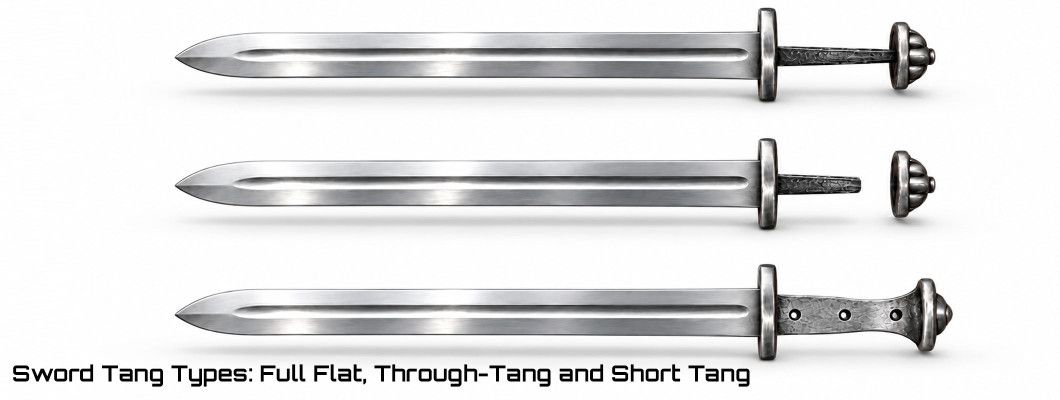
Sword Tang Types: Full Flat, Through-Tang and Short Tang Shown Without the Grip
Every sword hides its most important part. The tang is the steel inside the grip, and it decides whether the hilt stays on the blade. Take the grip away and three swords that looked identical turn out to be built three different ways. Put the grip back and two of them look the same again, right down to the button on the pommel.
What is the tang of a sword? The tang is the part of the blade that continues past the guard into the hilt. It is forged from the same bar of steel as the blade, and the guard, grip and pommel are all fitted onto it. How long it is and how it is fixed at the end is what the different sword tang types are about.
This guide shows what sits under the grip of each common sword tang type, how the guard and pommel are held on, why the same word means different things on different blades, and how to work out what you are holding. For the failure side of the subject — welded rods and why they break — our guide to full tang vs rat-tail tang goes into depth.
Sword Tang Types Under the Grip: Three Swords With the Grips Taken Away
The three constructions below can share the same blade, the same guard and the same style of pommel. Only the steel inside the grip is different. Look at where the tang goes, where it stops, and what the pommel is attached to. Those three things decide whether the hilt survives a hard cut.
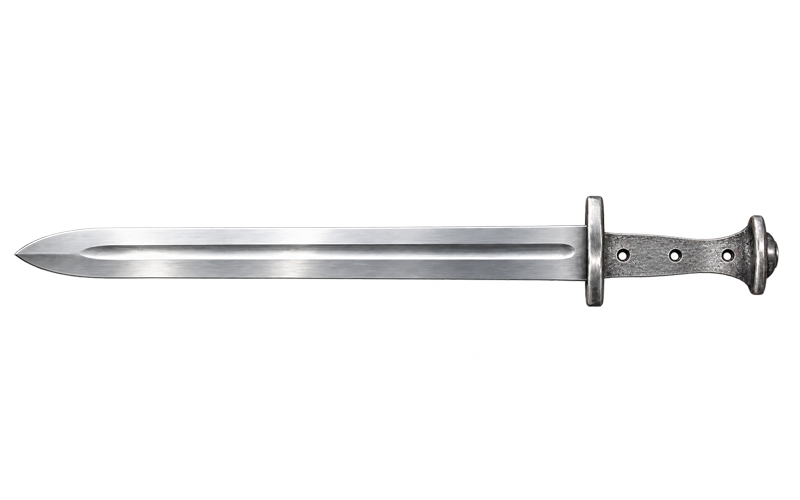
Full Flat Tang
The steel is the grip. Past the guard, the tang stays almost as wide as the grip and runs its full length to the pommel. The shape you hold is already there in steel before anything covers it.
Scales riveted through. Wood, horn or micarta scales sit on either side and are held by rivets through the holes along the tang. Each rivet ties the grip to the blade along its length, not only at the ends.
The pommel sits on the end of solid steel. There is no narrow section anywhere between the blade and the pommel, so there is no weak point for the pommel to hang from.
What that means in use. The strongest of the three and the easiest to verify, because the steel shows along the edges of the finished grip. The trade-off is weight in the hand, which moves the balance back towards you. On a short sword that can suit; on a long blade it tends to feel dead.
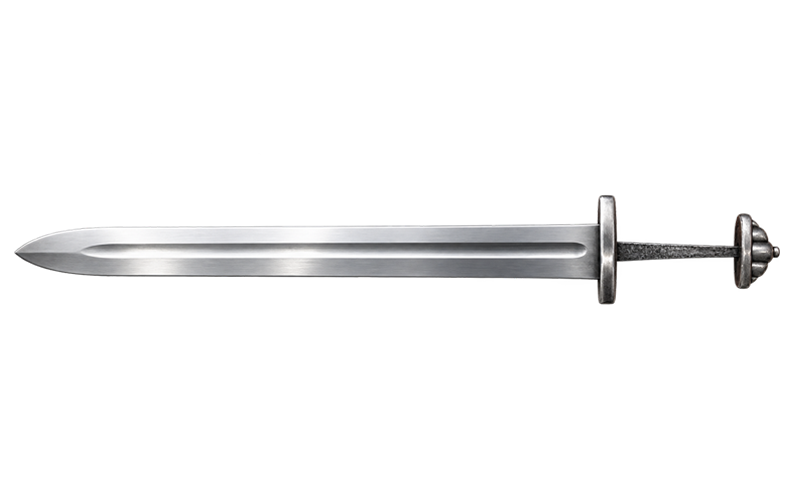
Through-Tang, Peened
A tapering bar all the way through. Past the guard, the tang narrows and runs the full length of the grip. The grip is a solid piece bored through and slid over it.
It passes through the pommel. At the far end the tang goes right through the pommel and the protruding tip is peened — hammered over into a small rivet head. That button on top of the pommel is the end of the blade itself.
The whole hilt is clamped. The guard is pressed against the blade shoulders, the peened pommel presses back from the other end, and the grip is squeezed between them. Nothing is relying on glue; the hilt is held together by the steel of the blade.
What that means in use. Less steel in the hand keeps the sword light at the hilt and lets the blade do the work, which is why European swords were built this way for a thousand years. It is the historical standard, and still the right answer for a sword that will be swung.
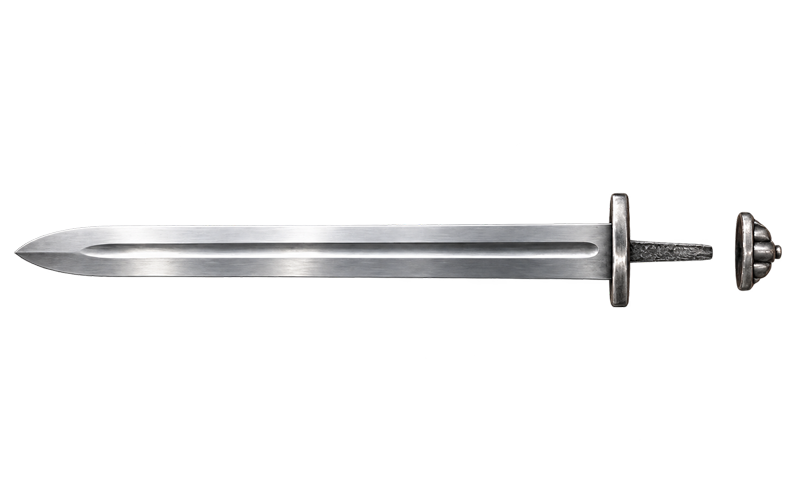
Short Tang (Partial or Stick Tang)
A short stub, then a gap. The tang leaves the guard, tapers, and stops partway along the grip. The rest of the grip has no steel in it.
The pommel is on its own. With the grip off, there is an empty space between the end of the tang and the pommel. The pommel is fixed into the end of the grip, not to the blade. Its button looks exactly like a peened tang end, but there is no tang underneath it to peen.
Adhesive does the work. The blade is held in the grip by whatever is packed around that short stub. Every cut tries to lever the stub out of its hole, and the only thing resisting it is the bond.
What that means in use. Light, quick to make and fine on a wall. On a sword that is swung, the stub works loose, and the pommel can stay perfectly tight on a grip that has already started to move on the blade.
Once the grips go on, the through-tang and the short tang look the same. Same guard, same grip, same pommel, same button on top. One has steel running all the way to that button; the other has a gap you cannot see. Everything else in this guide follows from that.
A Note on the Word "Rat Tail"
Few terms cause more confusion, because the same words describe different things depending on who is using them.
On swords, "rat-tail" usually means the bad construction. Most sword buyers use it for a thin rod — often round, often threaded — welded to the base of the blade. That weld sits at the shoulder, the point of greatest leverage, and it is where these swords break. Our full tang vs rat-tail tang guide explains why.
On kukris, "full rat tail" usually means a good one. The Nepali paro is a narrow tang forged from the blade, running the full length of the handle and peened over the butt cap. It is much closer to a sword through-tang than to a welded rod, as our kukri tang types guide shows.
So ignore the label and ask two questions. Is the tang forged from the same piece of steel as the blade? Does it run the full length of the grip and get fixed mechanically at the end? A narrow tang that passes both is sound. A wide one that fails either is not.
The Guard and the Pommel: What Holds Each Hilt Together
A sword hilt is a stack of parts — guard, grip, pommel — threaded onto the tang. How that stack is held tight is where the three constructions really differ.
Through-tang: held by the peen. The guard slides down to the blade shoulders, the grip follows, the pommel goes on last, and the tang tip is hammered over. The peen locks the stack under compression from end to end. It cannot unscrew, because there is nothing to unscrew. Taking it apart means grinding or drilling the peen off.
Full flat tang: held along the grip. The rivets do most of the work, clamping the scales to the tang along its length. The guard is fitted over the tang at the shoulders, and the pommel sits on the end of solid steel. There is no single fixing that everything depends on.
Short tang: held by adhesive at two separate points. The blade stub is set into one end of the grip and the pommel into the other. Nothing connects them except the grip itself. A tight-looking pommel tells you nothing about whether the blade is tight.
Other ways a pommel goes on. A through-tang can also end in a thread, with the pommel screwed on or held by a nut. That is repairable but can work loose under repeated impact. On Japanese swords the full-length tang is held by pegs through the handle instead of at the end. The different pommel fixings — peened, threaded, welded and others — are covered in our sword pommel attachment guide.
Sword Tang Types Compared
| Full flat tang | Through-tang, peened | Short tang | |
|---|---|---|---|
| Tang reaches the pommel | Yes, full width | Yes, narrowing | No. Stops partway |
| Grip | Two scales, riveted | Solid, bored through | Solid, bored partway |
| Pommel held by | Solid steel of the tang | The peened tang end | Adhesive in the grip |
| Blade joined to pommel by steel | Yes | Yes | No |
| Visible from outside | Yes — steel edges and rivets | No | No |
| Strength | Highest | High | Lowest |
| Weight in the hand | Most | Less | Least |
| Balance | Back towards the hand | Forward, as historically intended | Forward, but for the wrong reason |
| Historical | Rare on swords, standard on knives | The European standard | Not a historical construction |
| Suits | Short swords, hard use, heavy cutting | Any sword that will be swung | Display only |
Read the last row rather than the strength row. A through-tang is not a weaker version of a full flat tang. It is the construction that gives a sword its handling, and it is strong enough for the job it was designed for. A full flat tang is stronger again, but the weight it puts in the hand is not always what a sword wants.
How to Tell Which Tang Your Sword Has
Five checks, in order of how much they tell you.
Look at the grip edges. A line of steel along both edges with rivet heads through the sides means a full flat tang. That settles it.
Look at the pommel button — and do not trust it alone. A peened tang leaves a small hammered dome, often slightly irregular, sometimes a different colour from the pommel. But a short-tang pommel can carry a decorative button that looks almost identical. A button tells you what the maker wanted you to see, not necessarily what is inside.
Hold the blade and try to twist the grip. No movement, no click. Any rotation means the tang is not held, whatever the construction is claimed to be.
Feel the balance. A sword with very little steel in the grip can feel oddly hollow at the hilt. It is not conclusive on its own, but combined with a vague answer from the seller it is telling.
Ask for a photograph of the bare blade before the grip is fitted. The definitive test, because it shows exactly what the photographs above show. A forge working to order has that blade in front of it before the hilt goes on. A reseller never sees it.
Our guide on how to test a sword covers the rest of the inspection before any cutting.
Which Sword Tang Should You Choose?
Choose a through-tang if you want a sword that handles like a sword — light at the hilt, lively in the hand — and will be swung, cut with or trained with. For most European and historical patterns, including our Viking and medieval swords, it is the correct construction.
Choose a full flat tang if the sword is short, the work is heavy, or you want to see the construction rather than take it on trust. Accept that the hilt will carry more weight.
Choose a short tang only if the sword is for display and will never be swung. There is nothing wrong with a decorative piece, provided you know that is what you are buying.
On our own swords, if the construction matters for how you intend to use a piece, ask us to confirm it for that specific sword before you order — we would rather answer than have you assume. If you want a pattern in a construction it is not normally offered in, that is a custom forge request.
Hand-Forged Swords, Construction Confirmed on Request
Every sword is forged to order from 5160 spring steel in our Kathmandu workshop. Ask us how any sword is built — tang, guard, pommel fixing — and we will tell you plainly. If you want a specific pattern in a specific construction, send it through custom forge.
Frequently Asked Questions
What are the main types of sword tang?
Three are common. A full flat tang stays full width through the grip, with scales riveted on. A through-tang narrows, runs the full length of the grip and is peened over the pommel. A short tang stops partway into the grip and is held by adhesive, with the pommel fixed separately. Two further types exist: the Japanese pegged tang, and the welded rat-tail rod found on cheap swords.
What is the tang of a sword?
The tang is the part of the blade that continues past the guard into the hilt, forged from the same bar of steel as the blade. The guard, grip and pommel are all fitted onto it. Because it is hidden inside the grip it is the one part of a sword you cannot inspect, which is why its length and the way it is fixed at the pommel matter so much.
Is a through-tang as strong as a full tang on a sword?
It is strong enough for any sword that is properly made, and it has been the European standard for a thousand years. A full flat tang has more steel and is stronger again, but it puts that weight in the hand and moves the balance back. What matters is that the tang runs the full length of the grip and is peened over the pommel, locking the hilt under compression.
What is a short tang or partial tang sword?
A sword whose tang stops partway along the grip rather than reaching the pommel. The pommel is fixed into the end of the grip on its own, and the blade is held only by adhesive around the short stub. It is light and cheap to make and suits display pieces, but under repeated cutting the stub works loose, often while the pommel still looks tight.
Can a fake peen button hide a short tang?
Yes. A short-tang pommel can carry a round button on top that looks almost exactly like the hammered end of a through-tang, even though no steel reaches it. That is why the pommel button alone is not proof of construction. Twist-test the grip, and ask the seller for a photograph of the bare blade before the grip was fitted.
What does peened mean on a sword?
The tang passes through the pommel and the protruding tip is hammered over into a small rivet head. That locks guard, grip and pommel together under compression between the blade shoulders and the peen. It cannot unscrew because there is no thread, and taking the hilt apart means grinding or drilling the peen off.
Is a rat-tail tang the same as a through-tang?
Not as the terms are usually used on swords. A sword rat-tail normally means a thin rod welded to the base of the blade, which breaks at the weld. A through-tang is forged from the same steel as the blade and narrows gradually. Confusingly, on kukris a full rat tail is a good construction, close to a through-tang. Ask whether the tang is forged or welded, and whether it runs full length.
How can I tell what tang my sword has?
Visible steel along both edges of the grip with rivets means a full flat tang. Otherwise, look at the pommel button, but do not rely on it, because a decorative button can mimic a peen. Twist the grip against the blade: any movement means the tang is not held. For certainty, ask the maker for a photograph of the bare blade before the hilt was assembled.
Why do most historical swords not have a full flat tang?
Because a sword wants its weight in the blade, not the hand. A full-width tang adds steel to the grip and drags the balance back, making a long blade feel sluggish. A narrowing through-tang keeps the hilt light while the peened pommel keeps it secure, which is the combination historical smiths settled on.
Which sword tang is best for cutting practice?
A through-tang peened over the pommel, or a full flat tang on a shorter, heavier sword. Both run the full length of the grip and are fixed mechanically. Avoid a short tang or a welded rod for anything you intend to swing. Check the grip for movement before every session and stop the moment it moves or clicks.
My sword grip has come loose. Can it be fixed?
Usually, if it is a through-tang: a smith can re-set and re-peen the hilt, and a threaded pommel can often be tightened. A full flat tang with loose scales can be re-riveted. A short tang that has worked loose is rarely worth repairing, because there was never a steel connection to the pommel to restore. Stop using any sword whose grip moves.