Short Swords: What They Are, Why They Dominated, and How to Choose One
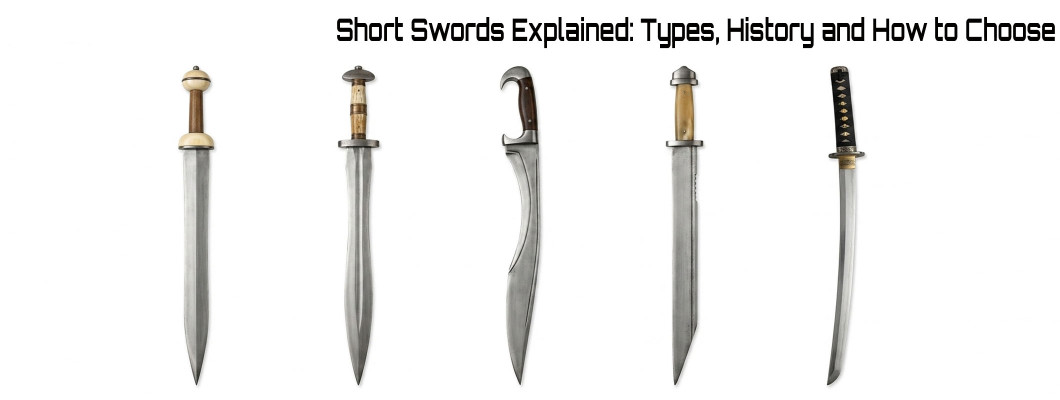
A short sword is any sword with a blade roughly between 12 and 24 inches — long enough to be a sword rather than a large knife, short enough to be used in a crowd without room to swing. They were not compromises or backup weapons. For most of recorded warfare the short sword was the primary killing tool of the best armies in the world, and it dominated for one reason: it is the only sword that works behind a shield in formation.
When shields and close formations ruled the battlefield, short swords ruled with them. When formations opened up and armour changed, short swords faded within a few generations. Understanding that relationship explains the whole category, and it explains why a short sword still handles better than most people expect the first time they hold one.
This page covers the category. For individual types we have deeper guides on the Roman gladius, the Greek xiphos, and a direct xiphos versus gladius comparison.
Where "Short" Begins and Ends
There is no committee that ruled on this, and the boundaries are conventions rather than laws. But they are consistent conventions, and they exist for physical reasons rather than arbitrary ones.
Below about 12 inches of blade you are in dagger territory: the weapon is used with the hand close to the target and the arm does little travelling. Above about 24 inches you need room to bring the blade to bear, which means space around you, which means you are no longer shoulder to shoulder with anyone. Between those two the blade is long enough to reach past your own shield and short enough to be driven forward in a space barely wider than your body.
The edges are genuinely blurred, and honest sources admit it. A 19-inch seax is called a sword by some catalogues and a long knife by others. A wakizashi at 20 inches sits comfortably in the category while being defined in its own tradition by a different measure entirely. Do not let anyone tell you there is a precise cutoff; there is a useful range, and the range exists because of how bodies and battlefields work.
Why the Short Sword Dominated
This is the part most sword content skips, and it is the whole story.
Picture a shield wall, a phalanx, or a Roman line. Men stand close enough that their shields overlap. There is no room to your left or right, because that room is occupied by someone on your side. A long blade in that position cannot be swung — the arc hits your neighbour before it reaches the enemy. What you can do is thrust, straight forward, through the narrow gap where the shields meet.
Now add the second factor. Behind a large shield, most of your body is covered and so is most of theirs. The targets are small and they appear briefly — a face over a rim, a thigh below one, an armpit as an arm rises. Hitting a small target that appears for half a second rewards a stiff point you can place accurately, not a heavy edge you have to wind up.
Put those together and the short sword is not a lesser sword. It is the correct answer to a specific, extremely common tactical problem, and the armies that solved that problem best were the ones that standardised on it.
The Major Short Swords
Blade lengths are archaeological ranges for each type rather than the size of any one find.
| Type | Origin | Blade | Edge | Built for |
|---|---|---|---|---|
| Gladius | Rome, via Iberia | 18 to 27 in | Double, tapered point | Thrusting in disciplined close formation |
| Xiphos | Greece | 18 to 24 in | Double, leaf-shaped | Hoplite sidearm when the spear failed |
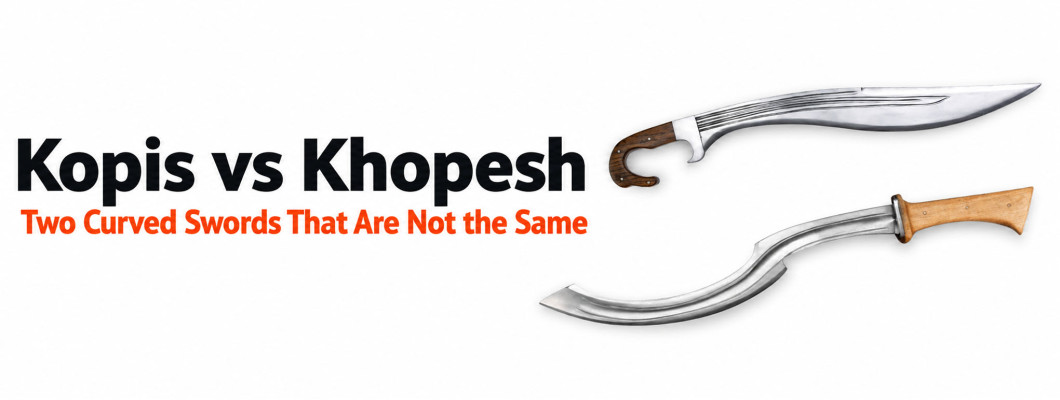
| Kopis | Greece | Around 20 in | Single, forward-curved | Cutting from horseback and open order |
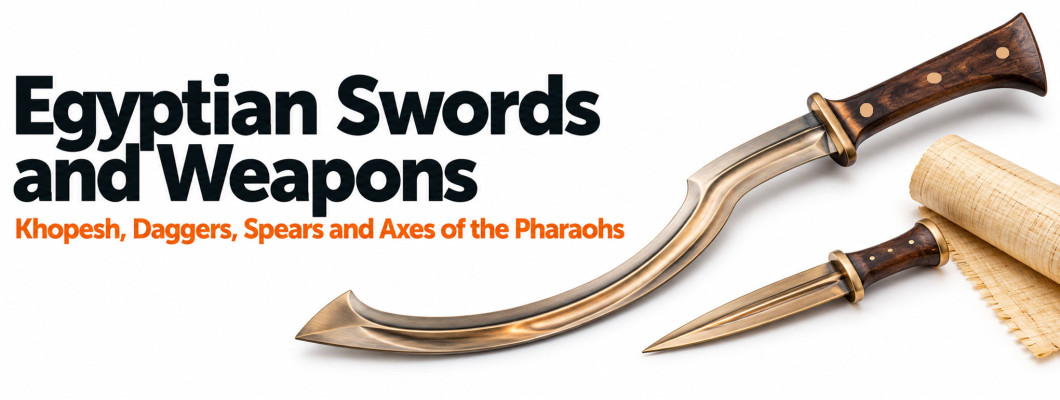
| Khopesh | Egypt | Around 20 in | Single, sickle-curved | Hooking shields and cutting; also a status object |
| Seax | Germanic and Anglo-Saxon | 12 to 20 in | Single, straight or broken-back | Sidearm and tool in one; worn daily |
| Baselard | Medieval Europe | 14 to 20 in | Double, straight | Civilian sidearm bridging dagger and sword |
| Wakizashi | Japan | Around 12 to 24 in | Single, curved | Companion blade; indoors and close quarters |
| Cinquedea | Renaissance Italy | 10 to 18 in | Double, very broad at hilt | Civilian carry; display of wealth as much as defence |
Read the Edge column against the Built for column. Every double-edged entry belongs to a formation tradition and points forward. Every single-edged entry belongs to a tradition fighting in looser order, on horseback, or carrying the blade as a daily tool. The blade geometry follows the tactics, every time.
Blade Shapes and What They Tell You
Four profiles cover most of the category, and each announces its intended use before you know anything else about the piece.
Leaf-shaped widens through the middle and narrows again to a point. That widening puts mass forward of the grip, so the blade cuts harder than its length suggests while keeping a usable point. The xiphos and the Celtic leaf blades are the classic examples, and it is the most versatile profile in the category.
Parallel-edged keeps a constant width for most of its length before turning into a point. It is stiff, predictable, easy to make consistently, and it thrusts extremely well. Later gladius patterns move in this direction, and there is a strong argument that they did so partly because a parallel blade is faster to produce in quantity.
Tapered narrows steadily from hilt to point, concentrating stiffness at the base and lightness at the tip. It recovers quickly and points naturally, at the cost of some cutting authority.
Single-edged puts all the steel behind one edge and leaves a thick straight spine on the other. That spine makes a shorter blade far stiffer than a double-edged one of the same weight, which is why single-edged short swords are so often the ones that doubled as tools. A seax splits kindling in a way a xiphos never could.
The Sidearm Problem
One thing gets said constantly about short swords and it is only half right: that they were secondary weapons. They often were. That does not make them minor.
A Greek hoplite fought with a spear, and the xiphos came out when the spear broke or the lines closed too tightly to use it. A Roman legionary threw pila and then closed with the gladius. In both cases the sword is the weapon you reach for at the moment the fight has become most dangerous — when your primary is gone and the enemy is at arm's length. That is not a minor role, it is the one where the outcome is decided.
It also explains the design priorities. A sidearm has to be worn all day without getting in the way, drawn instantly from a position you may not be able to look at, and used in the worst possible conditions of space and footing. Every one of those requirements pushes toward a shorter blade. The seax was carried daily across the Germanic world and doubled as a working knife; the baselard was worn in ordinary clothes in medieval towns; the wakizashi stayed on the person indoors where a longer blade could not be drawn at all.
Read the category that way and the pattern is obvious. Short swords cluster wherever the sword's job is to be present and ready rather than to be the reason you came.
Single Edge or Double Edge
This is the choice most buyers face once they have settled on a length, and the two answers come from genuinely different places.
A double-edged blade is symmetrical, points naturally, and can cut on the return without repositioning the wrist. It also has no thick spine, so stiffness has to come from a central ridge or a diamond section rather than from mass on one side. That works well at short lengths and is why the formation swords — gladius, xiphos, baselard — are almost all double-edged.
A single-edged blade puts every bit of that steel behind one edge and keeps a thick straight spine on the other. At the same weight it is markedly stiffer, it survives impact better, and it can be batoned, pried with and generally abused in ways a double-edged blade cannot. That is why the daily-carry blades — seax, wakizashi, and the working single-edged sidearms of half the world — went that way.
The honest trade: a double edge gives you more options in the hand, a single edge gives you more durability and more uses outside a fight. Our post on single-edged versus double-edged swords goes into the spine argument properly.
Why Short Swords Disappeared
They did not lose a contest with longer swords. Their conditions vanished.
Massed shield formations declined as pike and later firearm tactics reshaped how lines were held. Once soldiers stood further apart, the lateral space that had constrained the sword returned, and there was no longer any penalty for length. At the same time the sword itself was becoming a sidearm and a civilian status object rather than a primary battlefield weapon, which shifted the design brief toward duelling and toward carrying in ordinary clothes.
The one place the short sword survived longest is exactly where you would predict: as a personal sidearm carried daily, where portability mattered more than reach. The seax, the baselard, the cinquedea and the wakizashi are all fundamentally answers to the question of what you wear rather than what you carry to a battle.
What a Short Sword Is Like to Own
Three practical things that surprise people, and one of them is the reason we recommend short swords to first-time buyers more often than anything else.
They fit in real rooms. A 20-inch blade with a 5-inch grip needs a swing arc most homes can actually provide. A 36-inch longsword does not, and the gap between wanting to handle a sword and having somewhere to handle it is where a lot of collections quietly stall.
They are far livelier than the numbers suggest. Mass close to the hand means quick starts and quick stops. People who have only handled long blades usually describe their first short sword as feeling almost weightless, which it is not — it is simply balanced where the hand can control it.
They are the honest value in hand-forging. This is the maker's point and it deserves saying plainly. A short blade is dramatically less likely to warp in the quench than a long one, needs far less straightening, wastes less steel, and takes less time at the anvil per finished piece. The failure rate on a 20-inch blade is a fraction of the failure rate on a 34-inch one. That is why a short sword from a real forge costs what it does, and why the price gap between our short swords and our longswords is wider than the difference in steel would suggest.
The corollary, said honestly: if what you want is presence on a wall, a short sword will disappoint you. It looks smaller mounted than it feels in the hand, and there is no fixing that. Buy a short sword to handle it.
Choosing One
Start with what the sword is for. For handling and learning, a leaf or parallel blade around 20 inches with a 4 to 5 inch grip is the most forgiving thing in the category. For reenactment, let the event's period and rules decide the type before taste does. For display, buy the type whose story you actually want to tell, since that is what you will be explaining to visitors.
Match the profile to the tradition, not to preference. A leaf-bladed gladius or a parallel-edged xiphos is a mismatch that anyone who knows the subject will spot immediately. The types earned their shapes.
Check the grip, not just the blade. Short sword grips run 4 to 5 inches for one-handed use. Measure your hand around a broom handle and compare it to the specification, because on a compact sword a badly sized grip ruins the handling far faster than an inch of blade either way. Our sword size guide covers this across every type.
Any Length, Because Nothing Is Pre-Made
We hold no stock. Every short sword is forged after the order is placed, so blade length, grip length, profile and fittings are all yours to specify. Many patterns are customisable across a range, and anything beyond it is quoted as a custom piece.
Frequently Asked Questions
What counts as a short sword?
Conventionally a blade between roughly 12 and 24 inches. Below 12 inches you are in dagger territory, where the arm barely travels. Above 24 inches you need lateral room to bring the blade to bear. The boundaries are conventions rather than rules, and honest sources disagree at the edges — a 19-inch seax is called a sword by some catalogues and a long knife by others.
Why were short swords so common in ancient armies?
Because they are the only swords that work in close formation. When shields overlap there is no lateral space to swing, so the effective attack is a straight thrust through the gap where shields meet. Add that most of both bodies are behind shields, leaving small targets that appear briefly, and a stiff accurate point beats a heavy edge. The short sword was the correct answer, not a compromise.
What is the most famous short sword?
The Roman gladius, which was the standard sidearm of the legions and is the sword most people picture when they think of Rome. The Greek xiphos predates and parallels it, the seax was carried daily across the Germanic world, and the wakizashi is the best-known example outside Europe. Each belongs to a different tactical tradition rather than being a variation on one idea.
Are short swords good for beginners?
Yes, and better than most alternatives. A 20-inch blade needs a swing arc a normal room can provide, carries its mass close to the hand so it starts and stops quickly, and is forgiving of the grip and technique errors everyone makes early on. The most common regret among first-time sword buyers is going longer than their space and experience allowed.
What is the difference between a short sword and a dagger?
Mainly how the arm is used. A dagger, under about 12 inches of blade, works with the hand close to the target and very little travel. A short sword has enough length to reach past your own guard or shield and to be used with a full arm action, while still working in confined space. Some blades sit genuinely on the line, which is why the seax and the baselard get classified both ways.
Why did short swords stop being used?
Their conditions disappeared rather than their design failing. Massed shield formations declined as pike and firearm tactics reshaped how lines were held, and once soldiers stood further apart the lateral constraint that favoured short blades was gone. The sword also shifted toward being a civilian sidearm and status object, which pushed design toward duelling weapons instead.
Are short swords cheaper to make than long swords?
Genuinely, yes, and by more than the difference in steel. A short blade is far less likely to warp in the quench, needs much less straightening afterwards, and has a much lower failure rate than a 34-inch blade. That is real time at the anvil rather than material cost, which is why the price gap between a short sword and a longsword from a real forge is wider than the raw materials would explain.
What blade shape should a short sword have?
It depends on the tradition and what you want it to do. Leaf-shaped blades widen through the middle, putting mass forward so they cut harder than their length suggests. Parallel-edged blades are stiff and thrust extremely well. Tapered blades recover quickly and point naturally. Single-edged blades gain stiffness from a thick spine, which is why they so often doubled as tools.
Can I order a short sword in a custom length?
Yes. We hold no stock and forge every blade after the order is placed, so length is a build decision rather than a stock lookup. Many of our short sword patterns are customisable across a range, and anything outside it is quoted as a custom piece. Tell us the type and what you want it for and we will tell you honestly whether the length suits it.