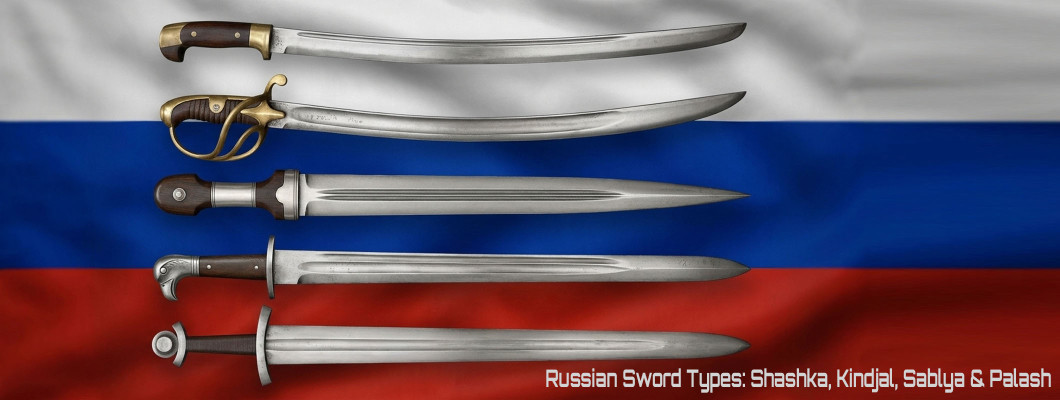
Russian Sword Types: Shashka, Kindjal, Sablya and Palash
Russian bladed weapons are not one tradition but three, colliding. Straight double-edged swords came from the north with the Rus and their Norse connections. The curved sabre came from the east, from centuries of contact with steppe horsemen. And the shashka and kindjal came from the south, out of the Caucasus mountains — adopted by the Russian Empire during the very war it fought to conquer the people who made them.
That last fact is the most interesting thing about Russian swords and it is usually skipped. Russian troops met the shashka fighting Circassian highlanders between 1817 and 1864, decided it was better than their own issue sabres, and ended up making it the official sword of the empire. Few armies have ever adopted an enemy's weapon so completely.
The Main Types
| Type | Russian | Form | Era | What it was for |
|---|---|---|---|---|
| Mech | меч | Straight, broad, double-edged | Kievan Rus, roughly 9th to 13th c. | Cutting sword used with a shield; the northern inheritance |
| Konchar | кончар | Very long, straight, stiff, diamond or rhomboid section | From the 14th c.; common in the 1600s | Punching through mail with a thrust from horseback |
| Sablya | сабля | Curved, single-edged | From steppe contact; dominant by the early modern period | Cutting from horseback at speed |
| Palash | палаш | Straight, heavy, guarded, usually single-edged | 18th and 19th c. | Heavy cavalry charging in close order |
| Shpaga | шпага | Long, thin, straight; varied section and guard | From Peter the Great onward | Officer and court sword; the Westernising reform in blade form |
| Shashka | шашка | Gently curved, single-edged, no guard | Caucasian origin; Russian patterns from 1834 | Draw and cut as one motion from horseback |
| Kindjal | кинжал | Straight, double-edged, central ridge | Caucasian; widespread 18th and 19th c. | Everyday belt sidearm in mountain country |
| Bebut | бебут | Curved, double-edged short dagger | Early 20th c. Russian issue | A blade for crews working around equipment |
| Kortik | кортик | Slim straight dirk, often diamond section | Imperial navy onward; still worn today | Naval officer's dirk; dress and status |
| Rogatina | рогатина | Broad leaf-shaped spear head with a crossbar | Recorded from the 12th c.; in use to the late 1600s | Bear hunting and infantry fighting |
| Berdysh | бердыш | Long crescent axe blade on a shaft | 16th and 17th c. | Streltsy infantry weapon |
| Sulitsa | сулица | Light short javelin | Medieval Rus | Thrown before contact |
Read the Era column top to bottom and you can watch the geography of Russian power move. Northern forms first, then eastern, then southern — each one arriving as Russia expanded into contact with the people who made it.
The Mech: The Northern Inheritance
The earliest swords of the Kievan Rus are straight, broad and double-edged, and they belong recognisably to the same family as the Viking-age swords of northern Europe. That is not a coincidence — the Rus polity was founded in the trade and raiding world that ran from Scandinavia down the river systems to Byzantium, and its weapons came with it.
These are cutting swords for a man with a shield, and everything about them follows from that. A broad blade, a shallow taper, a wide fuller to keep the weight down, a short guard because the shield does the defending, and a heavy pommel to bring the balance back to the hand.
The mech faded as Russian warfare shifted toward mounted archery and mobile cavalry against steppe opponents. A straight cutting sword designed to be used alongside a shield on foot is the wrong tool against horsemen who will not close with you, and Russian arms changed accordingly.
The Konchar: The Anti-Armour Answer
One of the least known and most extreme Russian blades, and a good illustration that a sword is a response to what it has to defeat.
The konchar is a very long, very stiff straight sword with a diamond or rhomboid cross-section and almost no cutting ability worth the name. It developed from the mech and it exists for one purpose: to punch through mail with a thrust. Against a mail-armoured opponent a cut is often survivable and a stiff point driven at speed is not, so the blade was made to do that and nothing else.
It appears in Russian records from the fourteenth century, is associated with the Battle of Kulikovo in 1380, and was most common through the 1600s. Lengths are remarkable — sources describe blades of around 130 cm rising to 160 cm and, in extreme cases, approaching 185 cm. Carried by a horseman, often alongside a sabre, it was drawn for one job and then swapped away from.
It is the closest thing Russia produced to the western estoc, and like the estoc it disappeared when the armour it was designed to beat left the battlefield. Peter the Great's reforms replaced it with the shpaga.
The Sablya: The Eastern Inheritance
The sabre arrived from the steppe. Centuries of contact, conflict and exchange with Turkic and Mongol horsemen brought the curved single-edged blade into Russian use, and it displaced the straight sword for the same reason it did across half of Eurasia: on horseback, a curve cuts better.
The mechanism is simple. A curved edge meeting a target at speed slices along its length rather than chopping straight in, and a rider's cut is delivered while both horse and target are moving. A straight edge tends to bind; a curved one draws through. Every mounted tradition that fought at speed arrived at some version of this independently.
Russian sabres of the early modern period sit within the wider Eastern European sabre family, alongside Polish and Hungarian forms, and the borrowing runs in all directions. The Russian sabre is not an isolated national type so much as one dialect of a language spoken from Budapest to Bukhara.
The Palash: The Straight Sword Returns
Then, in the eighteenth century, straight blades come back — and it is worth understanding why, because it looks like a step backwards and is not.
The palash is a heavy straight sword, usually single-edged, with a substantial guard, and it was carried by cuirassiers and heavy cavalry. Its job was different from the sabre's. Heavy cavalry existed to charge in close order and break a formation, and in that role the weapon is used mostly point-first at speed, with the rider's arm locked and the horse supplying the energy. A straight blade delivers that better than a curved one.
Light cavalry kept sabres for skirmishing, pursuit and the melee. Heavy cavalry carried straight blades for the charge. The two coexisted because they were doing different jobs, which is the same principle behind every apparent contradiction in sword history.
The Shpaga: Reform in Blade Form
The shpaga is what happens when a state decides to become European, and it is the most political sword on this list.
Long, thin and straight, with a blade of about a metre or more, it followed the western smallsword and rapier tradition rather than any Russian one. The cross-section varies between examples — single-edged, double-edged, or multi-faceted — and so does the guard, which can carry a knuckle bow and shell in the French manner. It arrived with Peter the Great's westernising reforms and it displaced the konchar.
What matters about it is what it signalled. A shpaga is not a cavalry weapon and was not really a battlefield weapon at all. It was worn by officers and nobility as a mark of rank and of belonging to European court culture. Russia adopted the form at the same time it adopted European uniforms, court manners and a new capital facing west.
Set the shpaga beside the shashka and you have the whole tension of Russian arms in two objects: a thin western court sword worn in St Petersburg, and a guardless mountain sabre from the southern frontier that ended up outlasting it in service by a century.
The Shashka: The Sword With No Guard
This is the sword most people mean when they say Russian sword, and almost everything about it runs against the European grain.
It originated among Circassian and other North Caucasian mountain peoples, and its name comes from an Adyghe word meaning roughly long knife. It is single-edged, gently curved, and it has no guard at all — on the Caucasian form the hilt sits so deep in the scabbard that the pommel is nearly all you see.
The guardless hilt and the edge-up carry work together. A conventional sabre hangs edge-down with a guard that must clear the scabbard mouth before the blade can be brought to bear — draw first, then cut. A shashka is worn edge-up and has nothing projecting, so the draw and the cut are one continuous motion. On horseback, where the opportunity lasts a fraction of a second and you get one pass, that half-second is the whole argument.
What it gives up is obvious and was accepted deliberately. There is no hand protection whatsoever, which makes it a poor weapon for a prolonged fencing exchange. It was not built for one. Our post on sword guard types traces how European guards grew steadily larger as armour disappeared; the shashka is the great counterexample, and it works because it answers a different question.
How it became Russian
Russian troops encountered the shashka during the conquest of the Caucasus between 1817 and 1864 and preferred it to their own issue sabres. The Caucasian Corps took it up in the 1830s, the first officially regulated Russian pattern appeared in 1834, and through the nineteenth century it displaced the sabre across the cavalry, with the hussars the notable holdout.
In 1881 it became official issue for Russian troops and police, and two patterns were regulated at once. The Cossack pattern kept the guardless form. The dragoon pattern added a brass knuckle bow — because less experienced conscript cavalry needed hand protection that Cossacks raised to the weapon did not. The blades of the two were essentially identical; only the hilt differed. That single design split tells you everything about who the weapon was originally for.
It outlasted the empire. The shashka served through the Russo-Japanese War and the First World War, became the standard edged weapon of the Red Army, and remained with Soviet cavalry into the Second World War — a guardless mountain sword still in service in the age of the tank.
The Kindjal: The Blade Everyone Wore
The kindjal — also qama or khanjali — is the other great Caucasian contribution, and in daily life it was more common than any sword. Straight, double-edged, usually with a strong central ridge, it sits somewhere between a large dagger and a short sword depending on the example, and it was worn horizontally at the front of the belt as ordinary dress rather than as a weapon carried for a purpose.
The form is well suited to mountain conditions, which is presumably why it took hold there. In broken ground, in a house, on a narrow path, a long blade is a liability and a short stiff double-edged one is not. It thrusts hard, it cuts adequately, and it never gets in the way.
Russians and Cossacks adopted it alongside the shashka, and the two were commonly worn together — the shashka on a shoulder strap or belt, the kindjal across the front. Our hand-forged kindjal follows the traditional double-edged form in 5160 spring steel.
The Bebut and the Late Patterns
One more worth naming. The bebut is a curved double-edged short dagger regulated for Russian service in the early twentieth century and issued to artillerymen, machine-gun crews and others for whom a full-length blade was simply in the way around equipment.
It is a good illustration of a general point: by this period edged weapons were being issued for specific practical roles rather than as a soldier's primary armament. The bebut exists because someone worked out that a gun crew needed a knife and not a sword.
Zlatoust and the Making
Any serious discussion of Russian blades reaches Zlatoust eventually. The state arms works in the southern Urals became the centre of Russian edged-weapon production, and its marks appear on service blades across the imperial period — regimental markings and a Zlatoust stamp with a date is the standard signature on a genuine issue shashka.
Zlatoust is also known for decorated blades: etched, gilded and blued work of a very high standard, developed in the nineteenth century under German influence and continued as a distinct Russian tradition. If you are commissioning a presentation piece in this style, that decoration is the reference point, and our post on engraving a crest or coat of arms covers what can be done on a modern blade.
The Kortik: The One Still Worn
The kortik is the Russian naval dirk — a slim, straight dagger, commonly of diamond section, carried by naval officers as part of dress uniform. It is the only blade on this list still worn in service today, and it has survived empire, revolution and the Soviet Union without much changing.
That longevity is the interesting part. Its practical role ended long ago; what kept it is what it means. A dirk on a dress belt says the same thing a sword said for a thousand years, in a form small enough that nobody has ever needed to justify it. When people ask why we still make swords, the kortik is the answer in miniature.
Beyond the Sword
Three more weapons belong in any honest account of Russian blades, because in most centuries they were more common on a battlefield than any sword.
The rogatina is the great Slavic spear, and it is not a normal spear. Where a typical European spear head weighed a few hundred grams, the rogatina carried a broad leaf-shaped head that could approach a kilogram and nearly half a metre in length, with a crossbar below it. The crossbar exists because the weapon was built to take a bear: a wounded animal drives itself further onto the blade, and the bar is what stops it reaching the man holding the shaft. Russian chronicles record it in warfare from the twelfth century and in hunting from the thirteenth, and its design was so well suited to unmounted fighting that it stayed essentially unchanged for five centuries, still in use into the late 1600s.
The berdysh is a long crescent-bladed pole-axe associated with the streltsy, the musket-armed infantry of the sixteenth and seventeenth centuries. It is a heavy cutting weapon on a shaft, and it belongs to the period when a foot soldier needed something to do at close quarters after his firearm had been discharged.
The sulitsa is the light throwing javelin of the medieval Rus, carried in numbers and thrown before contact. It is the least glamorous weapon here and probably killed more people than the konchar ever did.
None of these are swords, and all three are more representative of how Russian warfare was actually fought than the sabres that get the attention.
The Gurda and the Running Wolf
One last thing, because it is a story about trust in blades that has not changed at all.
The best Caucasian shashka blades were not all made in the Caucasus. Some were, and were prized. Others came from Russia. And a substantial number were imported from Solingen in Germany — and carried imitations of the running wolf mark of Passau, a maker's mark from a different city entirely, applied because the mark itself carried a reputation.
The most sought-after blades acquired their own names. Gurda and Volchok — the latter meaning little wolf, after the mark — were the blades a Caucasian warrior wanted, and men paid extraordinary prices for them.
So the premium market in Caucasian blades involved German steel wearing a copied Austrian mark, sold on a reputation earned by neither. Anyone who thinks blade provenance became murky in the age of internet retail is a few centuries late. The lesson then is the lesson now: judge the object, not the stamp on it.
What a Guardless Hilt Asks of the Maker
This is the part that matters at the anvil, and it is why a shashka is not simply a sabre with the guard left off.
On a conventional sword the guard is a structural component. It slots onto the tang, seats hard against the blade shoulders, and the whole stack of guard, grip and pommel is locked together by peening or a threaded nut. The shoulders carry load, and the guard is part of what holds everything in place.
Remove the guard and all of that has to be done by the grip alone. The hilt is riveted through the tang, and retention in the hand comes entirely from the shape — the swell of the grip, the flare and hook of the pommel, and how well the whole thing fills a closed fist. There is nothing to stop against at the front, so if the shape is wrong your hand travels, and on a sword with no guard a hand travelling forward has somewhere unpleasant to go.
The consequence for anyone commissioning one: on a shashka the grip is not a comfort decision, it is a safety one. Send a hand measurement. It matters more here than on any other sword we make, and it cannot be corrected after forging. Our guides to guard types and pommel forms cover the rest of the assembly.
The Shashka Outside the Battlefield
One more thing sets Russian blades apart, and it is not metallurgical.
The shashka never became purely a museum object. It carried into Cossack cultural life as a performance and identity object — the Circassian art of spinning and twirling the blade, adopted by the Cossacks along with the weapon itself, sits alongside dzhigitovka trick riding as a living tradition rather than a reconstructed one. Russia is one of very few places where a sword still appears in national dance and is handled by people who learned it from someone who learned it from someone else.
That continuity is worth knowing if you are buying. A reenactor of a medieval European sword is reconstructing something from documents. Someone learning shashka handling in a Cossack community is joining a line that never fully broke. It changes what the object is, and it is a reason the shashka attracts a different kind of buyer from most historical swords — people who intend to use it in a practice, not hang it.
Owning One Today
Three practical notes if you are buying rather than reading.
The shashka handles unlike anything else. Guardless means your grip has nothing to stop against, so the hilt shape and the pommel are doing all the retention work. It feels alarming for about five minutes and then makes sense. Anyone used to a guarded sabre should expect to adjust.
Decide which shashka you mean. The Caucasian form with the hilt seated deep in the scabbard, the Cossack pattern, and the dragoon pattern with its knuckle bow are three different objects sharing a blade. Say which when you order, because they are not interchangeable.
The kindjal is the more usable piece for most people. Shorter, stiffer, easier to store, legal in more places, and it does not need a horse to make sense of it. If the Caucasian tradition appeals but a cavalry sabre does not fit your life, this is the blade to start with.
Twelve Types on This Page. We Stock None of Them.
We hold no stock at all, so every blade is forged after the order is placed. The shashka and kindjal are in our range as patterns. The other ten — konchar, palash, shpaga, kortik, rogatina and the rest — are commission work, and that is not a limitation but the whole point: send a museum reference, an auction photograph or a set of dimensions, and we confirm the specification before anything is forged.
Frequently Asked Questions
What are the main types of Russian swords?
Six matter most. The mech is the straight double-edged sword of the Kievan Rus. The sablya is the curved sabre that came from steppe contact. The palash is a heavy straight sword for cuirassiers. The shashka is the guardless Caucasian sabre that became standard imperial issue. The kindjal is a straight double-edged short sword worn at the belt. The bebut is a curved short dagger issued in the early twentieth century.
Why does the shashka have no guard?
Because it is carried edge up and drawn straight into a cut. A conventional sabre hangs edge down with a guard that must clear the scabbard mouth first, making the draw and the cut two motions. With nothing projecting from the hilt, the shashka comes out already cutting. On horseback that saved half a second, and the trade — no hand protection at all — was accepted deliberately.
Is the shashka Russian or Caucasian?
Caucasian in origin, Russian by adoption. It came from Circassian and other North Caucasian mountain peoples, and its name derives from an Adyghe word meaning long knife. Russian troops met it during the conquest of the Caucasus between 1817 and 1864, preferred it to their issue sabres, and the empire eventually made it official issue — an unusual case of an army adopting the weapon of the people it was fighting.
When did the shashka become the official Russian sword?
In 1881, when it became official issue for Russian troops and police. The path there was gradual: the Caucasian Corps adopted it in the 1830s, the first regulated Russian pattern came in 1834, and through the nineteenth century it displaced the sabre across the cavalry, with the hussars the main exception.
What is the difference between a Cossack and a dragoon shashka?
The hilt. Both patterns were regulated in 1881 with essentially identical blades. The Cossack pattern kept the traditional guardless form. The dragoon pattern added a brass knuckle bow, because conscript cavalry needed hand protection that Cossacks raised to the weapon did not. There is also a Caucasian form in which the hilt sits so deep in the scabbard that little more than the pommel shows.
What is a kindjal?
A straight double-edged blade from the Caucasus, also called qama or khanjali, sitting between a large dagger and a short sword depending on the example. It usually has a strong central ridge and was worn horizontally at the front of the belt as everyday dress. Cossacks and Russian officers adopted it alongside the shashka, and the two were commonly worn together.
What is the difference between a shashka and a sabre?
A sabre has a guard and is carried edge down; a shashka has no guard and is carried edge up. The shashka is also generally less curved. The difference is purpose rather than degree — a sabre is built to be drawn and then fought with, a shashka to be drawn as the cut itself. That is why the shashka displaced the sabre across most of the Russian cavalry.
Did Russian cavalry use swords in the Second World War?
Yes. The shashka remained the standard edged weapon of the Red Army after 1917 and stayed in service with Soviet cavalry into the Second World War. Cavalry units retained real roles in reconnaissance and in terrain that defeated vehicles, and the shashka went with them — a guardless mountain sword still in issue in the age of the tank.
Can you forge a custom shashka or kindjal?
Yes. Both are in our range in 5160 spring steel, and because we hold no stock and forge after the order is placed, blade length, curvature, fittings and scabbard are all specification rather than selection. If you want a particular historical pattern — Caucasian, Cossack or dragoon — say which, since they differ mainly in the hilt and are not interchangeable.
What is a konchar sword?
A very long, very stiff straight Russian sword with a diamond or rhomboid cross-section and almost no cutting ability. It existed to punch through mail with a thrust, usually from horseback, and was often carried alongside a sabre. It appears from the fourteenth century, was common through the 1600s, and disappeared with the armour it was designed to defeat.
What is a shpaga?
A long thin straight sword following the western smallsword and rapier tradition, introduced with Peter the Great's westernising reforms and replacing the konchar. Blades run about a metre or more, with varied cross-sections and guards. It was worn by officers and nobility as a mark of rank rather than as a battlefield weapon.
What is a rogatina?
The great Slavic spear, and not a normal one. It carried a broad leaf-shaped head that could approach a kilogram and nearly half a metre in length, with a crossbar below the blade to stop a charging animal driving itself up the shaft. Built for bear hunting and used in war, it is recorded from the twelfth century and stayed essentially unchanged for five hundred years.