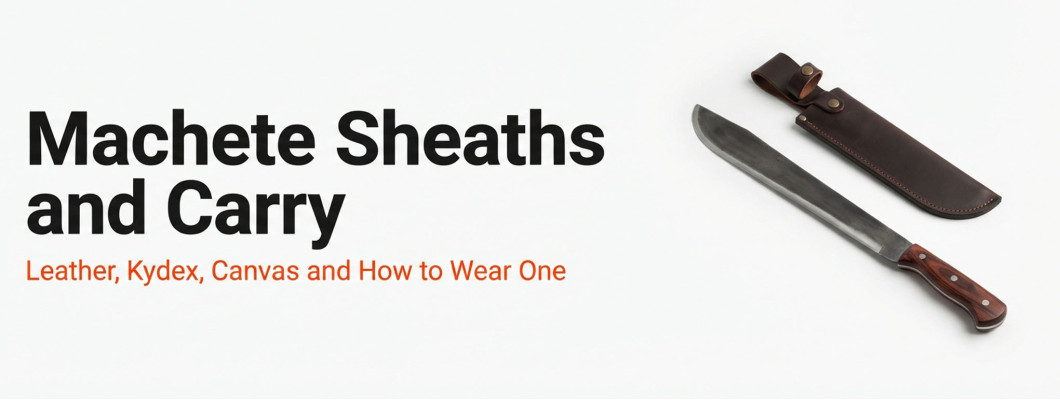
A Machete Sheath Has Three Jobs: Cover the Edge, Hold the Blade Upside Down, and Let Go With One Hand
A good machete sheath covers the whole edge so it cannot cut you or your pack, holds the blade firmly enough that it stays put when you turn the sheath upside down, and releases with one hand so you can draw without fumbling. Leather, Kydex and canvas can all do this, and each fails in a different way when it is made badly. This guide compares the three materials, explains the carry positions that actually work for a blade of 40 to 70 cm (belt, baldric and pack), shows how to draw and re-sheath safely, and sets out what an Everest Forge machete ships with and what can be changed at order time.
If you are still choosing the blade itself, start with the machete buying guide, which covers length, shape, steel and handle; this post picks up where it stops, at the sheath. On the naming question, sheath or scabbard explains why a machete wears a sheath and a sword wears a scabbard.
Why the Sheath Matters More on a Machete Than on a Knife
A machete is long, thin and sharp along most of its length, and it is carried into exactly the places where you fall over: steep ground, wet rock, dense brush. A knife sheath that is slightly loose costs you a knife. A machete sheath that is slightly loose puts 50 cm of edge against your thigh during a stumble. The sheath is also the part most makers cut corners on, because buyers compare blades and rarely compare sheaths. Three failures account for almost every bad machete sheath: a mouth that does not grip, so the blade slides out when you bend; a thin welt or no welt, so the edge cuts through the stitching from inside; and a belt loop placed so the handle sits at the wrong height for the draw. Everything below is about avoiding those three.
The Parts of a Machete Sheath
Throat. The mouth of the sheath, usually reinforced with a second layer or a metal or leather collar. It takes the most wear because the blade passes through it every draw, and it is where a tight fit is set.
Welt. A strip of leather sandwiched between the two faces of the sheath along the edge side. The edge rides against the welt, never against the stitching. A sheath without a welt will have its stitches cut from inside, usually within a few months of field use.
Retention. A strap and snap over the handle, a thong, or simply the friction of a well-fitted throat. For a machete the strap is the most reliable, because friction fit loosens as leather wears and a thong is slow.
Belt loop or loops. One loop at the top gives a vertical hang. A second loop lower down, or a D-ring, lets the sheath be tied to the thigh or hung from a dangler so the handle sits lower and the tip clears the ground when you sit.
Drain hole. A small hole at the tip so water, mud and plant sap run out instead of sitting against the steel.
Leather, Kydex and Canvas Compared
| Material | Retention | Edge protection | Wet weather | Noise | Weight | Life and care | Best for |
|---|---|---|---|---|---|---|---|
| Leather (vegetable-tanned, buffalo or cow) | Strap and snap, or friction; good when fitted to the blade | Excellent with a welt; poor without one | Absorbs water; must be dried slowly away from heat, never stored wet | Quiet | Medium | Decades if conditioned once or twice a year; do not store the blade inside long-term in a damp climate | Traditional carry, hunting, farm and bush work, display |
| Kydex (thermoformed plastic) | Moulded click-fit; very secure, can be too tight for a long thin blade | Excellent; the blade cannot cut it | Unaffected by water; grit inside will scratch the blade | Loud; the blade clacks on draw and re-sheath | Light | Indefinite; rinse out grit; can crack in extreme cold | Tactical and wet-climate use, kayak and canoe carry, pack mounting |
| Canvas or Cordura nylon | Strap and snap or hook-and-loop; loosens with wear | Needs a plastic or leather insert; bare fabric is cut through quickly | Dries fast, but holds water in the weave if there is no drain | Quiet | Lightest | A few seasons of hard use; cheap to replace | Issue-pattern and budget sheaths, agricultural work, spare sheath in the pack |
| Wood-core leather (dap style) | Friction fit set by the wood core; very positive when made right | Excellent; a rigid channel the edge cannot reach | Leather outer absorbs; wood core resists bending when wet | Quiet | Heaviest | Decades; same leather care | Kukri and khukuri scabbards, heavy choppers, historical builds |
The wood-core type is how Nepal has always carried the kukri and khukuri, and our guide to the kukri and khukuri scabbard, the dap, explains the construction in detail. For a long straight machete the flexible leather sheath is the better choice: it is lighter, it bends with the body when you crouch, and a 60 cm rigid scabbard on the belt is awkward to sit down in.
An honest note. Everest Forge makes leather sheaths. We do not thermoform Kydex, so if you want a Kydex sheath for one of our machetes it is a third-party job; the blade profiles are consistent enough that a Kydex maker can mould to the delivered blade. Most of our customers who go that route keep the leather sheath for carry and use the Kydex for storage in the pack or the boat.
How to Carry a Machete: Belt, Baldric and Pack
The right carry depends almost entirely on blade length. Anything under about 45 cm of blade carries comfortably on the belt; between 45 and 60 cm the belt still works if the sheath hangs low; above 60 cm, and for any two-handed machete, the belt is the wrong place and a baldric or the pack is the answer.
Belt, strong-side vertical. The default. The sheath hangs from the belt on your dominant side, handle up, tip pointing down and slightly back. The handle should sit at or just below the hip bone so the hand falls onto it naturally. Too high and the draw is a shoulder-wrenching upward pull; too low and the tip drags in brush and bangs your calf. A second, lower loop or a leg tie stops the sheath flapping.
Belt, cross-draw. The sheath sits on the weak-side hip, handle forward, and you draw across the body. It keeps the blade away from your dominant leg while walking and suits people who also carry a knife or axe on the strong side. The downside is a slower, more exposed draw, and the handle catches on pack straps.
Baldric or shoulder sling. A strap over one shoulder with the sheath hanging across the back or under the opposite arm. This is the historical carry for long blades and the right one for big machetes: the weight sits on the shoulder rather than pulling the belt down, the tip clears the ground when you sit, and the draw is over the shoulder or across the chest. It is slower to put on and off and it rides over a pack badly, so it suits the walk-in rather than a loaded carry.
Pack-mounted. The sheath is lashed to the side or back of the pack, usually through webbing or a MOLLE panel, handle up. The machete is out of the way, the weight is on your hips through the pack frame, and nothing is swinging against your leg. The draw needs a second hand or taking the pack off, so this is the carry for the approach, not for cutting trail. A Kydex sheath or a leather sheath with a stiff back lashes best; a floppy canvas sheath twists.
What not to do. Do not tuck a machete into a belt without a sheath, do not carry it horizontally across the small of the back (the edge faces your spine when you fall), and do not use a sheath with the tip open because the blade is "too long for the sheath". A sheath should be made for the blade it carries.
Set blade length, finish and handle for the machete you want to carry, and the forge builds that exact combination with a sheath fitted to it.
Build Your BladeDrawing and Re-Sheathing Safely
Most machete cuts to the owner happen at the sheath, not in the brush. The habits that prevent them take a week to learn.
Drawing. Undo the retention strap with the thumb, grip the handle, and draw straight up along the line of the sheath with the spine of the blade toward your body. Do not twist the blade on the way out; a twist is what wedges a long blade in the throat and leads to the yank that ends with the edge somewhere unplanned. Once the tip is clear, let the blade swing out and away from the leg.
Re-sheathing. Look at the throat. Put the tip in with the edge toward the welt side and the spine toward you, then slide it home in one smooth push, keeping your free hand clear of the sheath mouth. With a long blade, steady the sheath with the free hand on the body of the sheath, well below the throat, never on the throat itself. Snap the strap. If the blade is wet or muddy, wipe it first; mud in the sheath is what scratches the finish and holds moisture against the steel.
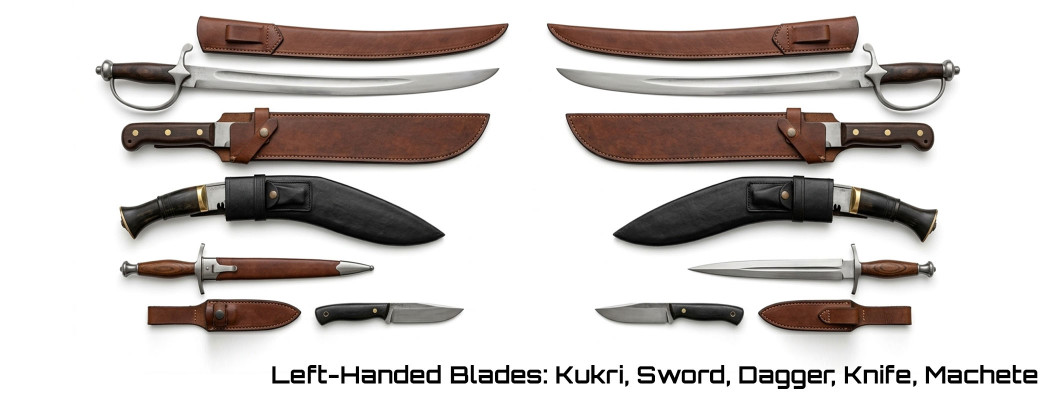
With a left-handed blade. A left-handed machete needs a mirrored sheath so the belt loop sits on the correct side and the welt still lies on the edge side. Order both together: write "Left Handed" in the order note and the forge mirrors the sheath to match the blade.
Our beginner's guide to using a machete covers the cutting side of the same safety habits.
Sheath Care
Leather. Condition with a neutral leather balm or a thin coat of mink oil once or twice a year, more in dry heat. If the sheath gets soaked, stuff it loosely with paper and dry it at room temperature; heat shrinks and cracks leather. Never store a blade in a leather sheath for months in a humid climate: vegetable-tanned leather holds moisture and the tannins will etch the steel. Store the blade oiled and separate, and the sheath empty. The 5160 blade care guide covers the steel side.
Kydex. Rinse out grit and sap under a tap, dry, and check the rivets or eyelets. If the fit loosens, a hair dryer on the throat for thirty seconds and a squeeze will re-tighten it; do not use a heat gun.
Canvas. Wash in cold water, air dry, and check the insert. Replace when the insert is cut through or the strap no longer holds.
All types. Check the retention before every outing by holding the sheathed blade upside down and shaking it once. If it moves, fix the strap before you walk.
What an Everest Forge Machete Ships With
Every machete in the hand-forged machete collection is forged on demand from mono-steel 5160 spring steel, full tang, and ships in a flexible buffalo-leather sheath fitted to that blade, with a belt loop and a retention strap. The sheath is cut and stitched after the blade is finished, so it fits the blade it ships with rather than a generic pattern; our scabbard and sheath types page describes the two constructions we build.
At order time you can change the sheath along with the blade. A second belt loop or leg tie, a dangler, a baldric strap, a wood-core scabbard instead of the flexible sheath for a heavy chopper, or a mirrored left-handed sheath are all order-note or custom machete request items. Catalogue builds dispatch in 2 to 3 business days; custom builds take 4 to 6 weeks at the forge; shipping is DHL or FedEx, tracked, 7 to 14 business days worldwide.
Related Guides
Commission a Machete and the Sheath Built for How You Carry It
Blade length and profile, handle, sheath construction, belt or baldric carry, left or right hand. The forge quotes it, builds it in 4 to 6 weeks, and ships it tracked worldwide.
Start a Custom Forge RequestFrequently Asked Questions
What is the best material for a machete sheath?
Leather with a welt is the best all-round choice: quiet, long-lived and kind to the blade. Kydex is better in constant wet or for pack mounting. Canvas is the lightest and cheapest but needs an insert and wears out fastest.
How should a machete sheath fit?
Hold the sheathed machete upside down and shake it once. It should not move. The throat should grip the blade near the handle, the retention strap should snap closed without stretching, and the tip should sit against a closed end with a drain hole.
Where should I carry a machete on my belt?
On the dominant side, vertical, handle at or just below the hip bone, tip pointing down and slightly back. Add a leg tie or second loop so the sheath does not swing. For blades over about 60 cm, use a baldric or mount the sheath on your pack instead.
What is a baldric?
A strap worn over one shoulder with the sheath hanging across the back or under the opposite arm. It puts the weight of a long blade on the shoulder rather than the belt and keeps the tip off the ground when you sit. It is the traditional carry for long machetes and swords.
Can I store my machete in its leather sheath?
For a few days, yes. For months in a humid climate, no. Vegetable-tanned leather holds moisture and its tannins will etch carbon steel. Store the blade oiled and separate, and the sheath empty.
Why does my sheath have a strip of leather along the edge side?
That is the welt. The edge rides against it instead of against the stitching, so the blade cannot cut the sheath open from inside. A sheath without a welt is a sheath that will fail.
Does Everest Forge make Kydex sheaths?
No. Everest Forge sheaths are leather, flexible or wood-core. A Kydex sheath for one of our machetes is a third-party job; the blade profiles are consistent enough for a Kydex maker to mould to the delivered blade.
Can I get a left-handed machete sheath?
Yes. Write "Left Handed" in the order note and the forge builds the blade and a mirrored sheath together, so the belt loop and welt sit on the correct sides.
What sheath comes with an Everest Forge machete?
A flexible buffalo-leather sheath with a welt, belt loop and retention strap, cut and stitched to fit that blade after it is finished. A wood-core scabbard, extra loops, a dangler or a baldric strap can be added at order time.
How do I re-sheath a long machete safely?
Wipe the blade, look at the throat, put the tip in with the spine toward you and the edge toward the welt, steady the sheath by its body well below the mouth, and push home in one smooth motion. Then snap the strap.