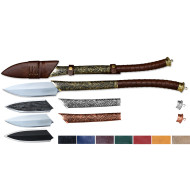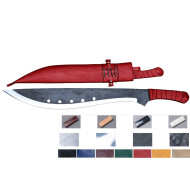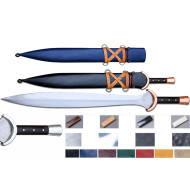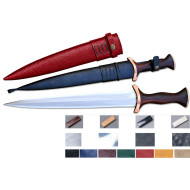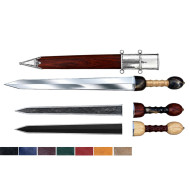
- Model: Greek Xiphos Sword
- Product Code: OWNXIPHOS
- Location: Kathmandu,Nepal
A Hand-Forged Greek Hoplite Xiphos, Built the Way You Want It
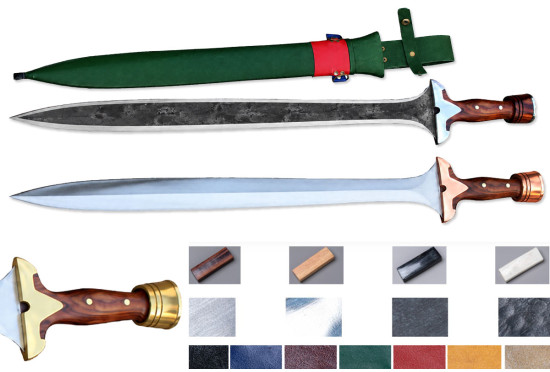
Choose the blade finish, the handle, the hilt fittings, the scabbard colour and the chape metal — then we forge that exact sword. Every selection updates the preview on screen. There are 648 possible builds, each one a piece our smiths in Kathmandu make routinely, and you can add a wooden display stand.
Underneath every combination is the same sword: a 21-inch double-edged, leaf-shaped xiphos blade hand-forged from 5160 spring steel, on a full tang with forged steel guard and pommel, carried in a wooden-core scabbard wrapped in leather. This is the classical hoplite sidearm — the sword a Greek citizen-soldier drew when the spears were gone and the lines closed.
Your Five Choices
Blade length and construction are fixed on this pattern. For another length or anything outside these options, use our custom forge service.
The Xiphos of the Hoplite
The hoplite fought first with the dory, a long thrusting spear. The xiphos was what he wore at his side for the moment the spear broke or the formation closed to arm's length. It is a short, double-edged sword whose blade swells into a leaf shape before narrowing to a point, so it carries weight forward for the cut while keeping a point strong enough to drive through gaps in armour.
Surviving classical blades run roughly 45 to 60 centimetres, about 18 to 24 inches, so our 21-inch blade sits in the middle of the documented range. The Spartans were remembered for carrying shorter blades than their allies, a reputation Greek writers turned into a joke about how close a Spartan meant to stand. Read more in our Greek xiphos history guide.
Which Blade Finish Suits a Xiphos?
Handle, Fittings and Chape
Rosewood is our standard handle: dense, dark and warm in the hand, and the strongest contrast against bright fittings. Whitewood is the pale timber, closer to the light woods found on ancient hilts — if you want that look as a complete build, our Museum Reproduction Xiphos is built around it. Buffalo horn is glossy black and takes a deep polish, though it is the least forgiving of very dry heated rooms.
The fittings are the forged guard and pommel at the hilt; the chape is the metal tip of the scabbard. Each comes in silver-tone, a bright white metal that stays bright longest, brass, warm gold and the classical choice, or copper, the warmest and the fastest to darken. You choose the hilt fittings and the chape separately, so you can match them or set a quiet contrast.
Scabbard Colour
Every scabbard is a carved wooden core shaped to the blade and wrapped in hand-stitched leather, which keeps both edges clear of the leather. Black is the most formal and the standard build; brown is the most period-plausible; red suits a Spartan-themed display; green and blue give a Hellenistic feel; white is the most striking and shows wear soonest.
Want a Xiphos We Do Not List Here?
A longer or shorter blade, a Greek inscription or name engraved on the blade, a bone hilt, or a blunt trainer built to your reenactment group's standard — anything outside this option list goes through our custom forge service, where we quote your design individually.
Request a Custom Forge →Why This Xiphos Works
Standard Build Specification
Blade, handle and overall length are fixed in this configurator and do not change with your selections. Weight varies slightly with handle material. Because every piece is hand-forged, small variation in weight, dimensions and finish is normal.
An Honest Note on This Xiphos
An honest note. Three things worth saying plainly. First, the length is well within the documented range, but the weight is not: surviving Greek swords of this size are generally under a kilogram, and ours is around 1130 grams, because the blade keeps more steel toward the point than an ancient one did. It is slower to recover in the hand than the original would have been, which matters for drilling and not at all for display. If you want it lightened, ask for the distal taper to be taken down through custom forge. Second, the silver-tone fittings are a bright white metal, not sterling silver. Third, 5160 is not stainless. It will rust if left wet or stored in its scabbard; keep it lightly oiled.
This Xiphos Suits
- Classical history collectors who want the hoplite sidearm in real forged steel
- Reenactors and theatre productions set anywhere in the Greek world
- Gift buyers with a classics or Greek-heritage connection
- Buyers who want to see their exact combination before it is forged
Look Elsewhere If
- You want the pale archaeological look as standard — see the Museum Reproduction Xiphos
- You want a longer blade — see the 24-inch Athenian or the 28-inch Royal Xiphos
- You want a decorative winged guard — see the configurable Angel Wings Xiphos
- You spar or drill — order a blunt trainer through custom forge
How Your Order Is Made
Caring for Your Xiphos
Wipe the blade dry after handling — skin acid marks carbon steel quickly — and keep a light film of oil on it; any mineral or machine oil works. Pay attention to the line where the blade meets the guard, which a cloth drawn along the flat never reaches. Store the sword out of its scabbard, ideally on a stand, because a close-fitting wooden core holds damp against steel and dries slowly. Brass and copper fittings patina with handling and polish back with any metal polish. Oil a timber or horn grip once or twice a year.
Shipping, Returns and Warranty
Every piece is prepared at the forge in seven to ten days, and shipping adds a further seven to ten days. Orders to the USA and Canada travel with FedEx; everywhere else ships on a DDP service, which means duties and taxes are settled before the parcel moves so there is nothing to pay on delivery. Every piece carries the Everest Forge manufacturer warranty against defects in forging and heat treatment. Because a configured sword is made to your specification, it falls outside our standard returns window except where the blade is faulty — full terms are on our shipping and returns page. Owning, carrying and importing a sword are three separate legal questions; check all three for your own address before ordering.
Explore More Everest Forge Blades
Questions About the Greek Hoplite Xiphos
What is a xiphos?
The xiphos was the short, double-edged sword carried by Greek hoplites as a sidearm behind the spear. Its blade swells into a leaf shape before narrowing to a point, which puts weight forward for the cut while keeping a strong thrusting point. It is the sword of the classical Greek battle line.
Is a 21-inch blade historically right?
Yes. Surviving classical xiphos blades run roughly 45 to 60 centimetres, about 18 to 24 inches, so 21 inches sits in the middle of the documented range. Spartan blades were remembered as notably shorter than those of their allies. For a longer classical sword, see our 24-inch Athenian Hoplite Xiphos.
How is this different from the Museum Reproduction Xiphos?
Positioning and standard build. This page is the configurable one: you choose the finish, handle, fittings, scabbard and chape and see the result live, with a rosewood handle and black scabbard as the standard. The Museum Reproduction Xiphos is built as an archaeological reconstruction around a pale whitewood hilt. Both are 21-inch swords with forged steel fittings.
How is this different from the Angel Wings Xiphos?
By the hilt. This one carries a plain forged guard and pommel in the classical manner. Our configurable Angel Wings Xiphos puts a swept, ornate winged guard on a similar blade, which is a fantasy hilt rather than a Greek one. Choose this page for the historical look and that page for the dramatic one.
Which handle should I choose?
Rosewood is our standard: dense, dark and the strongest contrast against bright fittings. Whitewood is the pale timber, closer to the light woods on ancient hilts. Buffalo horn is glossy black and takes a deep polish, but can develop fine checks over years in very dry heated rooms. All three are fitted to the same full tang.
Do the hilt fittings and the chape have to match?
No, you choose them separately. Matching metals give a unified, formal look; contrasting them gives a subtle accent. Brass is the most classical tone, silver-tone the brightest and copper the warmest. The preview shows the combination before you order.
Are the silver fittings real silver?
No. The silver-tone option is a bright white metal chosen for a silver look. It stays bright longer than brass or copper and needs no special care. Sterling silver fittings can be quoted through our custom forge service.
Why is it heavier than an ancient xiphos?
Surviving Greek swords of this size are generally under a kilogram; ours is around 1130 grams. Part of that is the modern spring steel, but most of it is distal taper: an ancient blade thins in thickness as well as width toward the point, so the last third carries less steel. Ours keeps more mass forward, which is felt in how quickly the sword recovers. Ask for the taper to be taken down through custom forge if you want it to handle like the original.
Can I have a Greek inscription engraved on the blade?
Yes, but not through this configurator, which has no engraving field. Send us the text — a name, a motto, a line of Greek, a date — through our custom forge service or our personalised blades page, and we will quote it with your build.
Is it sharp, and can I get it blunt for reenactment?
Both edges ship sharpened and the point is acute, so no reenactment group or fencing club will allow it on a field as it comes. Do not blunt it yourself: a training sword is a different build from the forge up, with thick edges and a rolled tip. Send us your group's standard through custom forge, or add "Stage combat build — rebated edge, rounded tip." in the order note, and read our stage combat standard.
Will 5160 steel rust?
Yes, if you let it. 5160 is a high-carbon spring steel, not stainless, and that is a deliberate trade: it is far tougher than the stainless steel used in most display swords, at the cost of needing care. Wipe it dry after handling, keep a light film of oil on it and store it out of the scabbard. Black coated reduces the upkeep.
Can I order a different blade length?
Not in this configurator, which keeps the blade at 21 inches. We make xiphos swords from 14 to 28 inches as separate products — see the full xiphos range — and any other length can be quoted through our custom forge service.