Longsword, Greatsword and Zweihänder Are Three Steps Up the Same Ladder, and Each One Changes How the Sword Is Held and Used
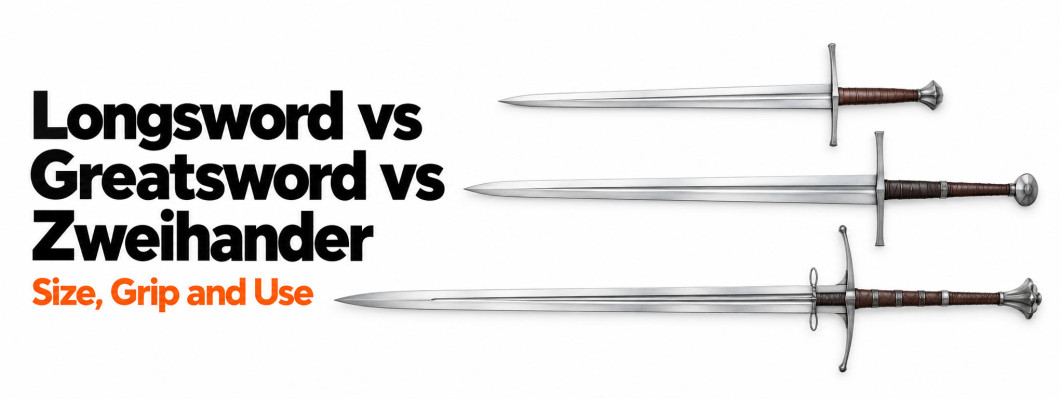
A longsword is a straight double-edged sword with a grip long enough for two hands, typically 105 to 130 cm overall and 1.1 to 1.8 kg, used one- or two-handed in the fifteenth-century fencing traditions. A greatsword is the bigger fourteenth- and fifteenth-century "sword of war", 120 to 145 cm and up to about 2.4 kg, always used with two hands. A zweihänder is the sixteenth-century German two-hander, 140 to 180 cm and 2 to 3.5 kg, with a blunt ricasso and side lugs so the hand can choke up on the blade. The surprise for most people is the weight: none of them is anywhere near as heavy as films suggest. This guide compares the three side by side with their real dimensions, explains the terms (bastard sword, hand-and-a-half, Oakeshott types) and covers how each was used and by whom.
For the sword in the middle of this family, the one that can be used with one hand or two, our complete guide to hand-and-a-half and bastard swords goes into its design and handling. This post sets it against its bigger relatives.
Have Your Longsword or Greatsword Built to Your Height
Two-handed swords should be sized to the person who swings them. Give us your height, arm length and the type you want, and the forge quotes a build in 5160 spring steel, made in 4 to 6 weeks and shipped tracked worldwide.
Start a Custom Forge RequestThe Three Side by Side
| Feature | Longsword | Greatsword | Zweihänder |
|---|---|---|---|
| Period | c. 1350 to 1550 | c. 1300 to 1500 | c. 1500 to 1600 |
| Total length | 105 to 130 cm | 120 to 145 cm | 140 to 180 cm |
| Grip (incl. pommel) | 20 to 30 cm | 25 to 35 cm | 35 to 50 cm, plus a 15 to 25 cm ricasso |
| Weight | 1.1 to 1.8 kg | 1.4 to 2.4 kg | 2 to 3.5 kg (parade swords heavier) |
| Hands | One or two | Two | Two, with one hand often on the ricasso |
| Guard | Simple cross, sometimes side rings | Long simple cross | Very long cross, side rings, and parrying lugs (Parierhaken) at the ricasso |
| Typical Oakeshott types | XV, XVIIIa, XVIIIb, XX | XIIa, XIIIa | Outside the scheme; a Renaissance form |
| Who used it | Knights and men-at-arms; the sword of the German and Italian fencing manuals | Mounted and dismounted men-at-arms, often as a battlefield sword | Landsknecht Doppelsöldner; guards; civic and princely bodyguards |
| Carry | At the hip | At the hip or saddle | Over the shoulder; no practical scabbard |
| Main use | Versatile cut-and-thrust fencing, in and out of armour | Heavy cuts and thrusts on the battlefield | Front-rank and formation fighting; guarding banners and gaps |
The Terms: Longsword, Bastard Sword, Hand-and-a-Half, Greatsword
Much of the confusion is in the names, so it is worth separating the historical words from the modern ones.
Longsword is the German langes Schwert of the fifteenth-century fencing manuals in the tradition of Johannes Liechtenauer, and the Italian spada a due mani or spada longa of Fiore dei Liberi. It means a sword fenced with two hands, though it can be used with one. Bastard sword is a period term too, from the French espée bastarde, for a sword between the one-handed arming sword and the true two-hander; in practice it overlaps heavily with the longsword. Hand-and-a-half sword is a Victorian collectors' coinage for the same thing, describing a grip with room for one hand and part of another. Greatsword translates the medieval English grete swerde or "sword of war": a larger two-hander carried by men-at-arms in the fourteenth and fifteenth centuries. Zweihänder, "two-hander", is the German name for the specialised sixteenth-century form, also called Bidenhänder or Doppelhänder.
Ewart Oakeshott's typology, which sorts medieval swords by blade shape rather than size alone, gives collectors a more precise vocabulary. The great war swords of the fourteenth century fall mostly into his types XIIa and XIIIa; the classic fifteenth-century longswords into XV, XVIIIa, XVIIIb and XX. Our Oakeshott typology explained covers the full scheme, and the arming sword post covers the one-handed sword at the bottom of this ladder.
The Longsword: The Fencer's Sword
The longsword is the most versatile of the three and the best documented, because it is the sword of the great fifteenth-century fencing manuals. It is long enough to keep an opponent at a distance and to use with two hands for power, light enough to fence quickly, and balanced well toward the hilt. Against armour, the same sword was used in the half-sword technique, one hand on the grip and one on the blade, to guide the point into the gaps of plate. Out of armour it is a cut-and-thrust sword of great subtlety. It is also the sword most modern historical fencers train with. If you want one sword from this family to learn, it is this one.
The double-fuller medieval longsword is our standard longsword build, and the hand-forged bastard sword sits at the shorter, one-hand-capable end of the range.
The Greatsword: The Sword of War
The greatsword of the fourteenth and fifteenth centuries is a bigger, heavier longsword: a longer grip, a longer and broader blade, and more mass for heavy cuts and powerful thrusts. These were battlefield swords, carried by men-at-arms who fought on foot as often as mounted, and many surviving examples have the wide, flat blades of Oakeshott's type XIIa and XIIIa, made for cutting through mail and padded armour. They are still single swords for one fighter, used with two hands, and at 1.4 to 2.4 kg they remain quick in the hand. The weight myth hits this type hardest: a sword of war is a big sword, not a heavy one.
The Zweihänder: The Landsknecht's Two-Hander
The zweihänder belongs to a different world: the infantry battles of the early sixteenth century, and the Landsknechte, the German mercenary foot soldiers. Within a Landsknecht company, men who took on the most dangerous positions were paid double, the Doppelsöldner, and some of them carried the great two-hander. Their usual role was in the front ranks of a pike formation and around the company's banner, cutting and thrusting at the enemy's pikes and the men behind them, and guarding the gaps when formations met. The popular story of zweihänders "chopping off pike heads" is mostly exaggeration; the reach, the weight and the ability to sweep a space were what mattered.
The form shows what that job needed. The blade often has a long ricasso, an unsharpened section above the guard wrapped in leather, with a pair of side lugs, the Parierhaken, at its end. The fighter could move a hand onto the ricasso to shorten the lever and fight close, with the lugs protecting that hand. Blades were often flamberge, with a wavy edge on some examples, and the very long cross-guards often carry side rings. The zweihänder was carried over the shoulder, since a scabbard was impractical. Ceremonial versions, carried by city guards and princely bodyguards, could be much heavier than fighting swords, and some of the very heavy museum pieces people quote are these parade swords, not the weapons men fought with. The largest swords post looks at those extremes.
The Weight Myth
The single most common misconception about all three is weight. Films, games and early twentieth-century books gave medieval swords weights of five, ten or even fifteen kilograms. Surviving fighting swords tell a different story: a longsword typically weighs about as much as a bag of sugar, a greatsword a little more, and even a big zweihänder rarely passes 3.5 kg. A sword is a lever, and its weight is distributed along its length with the balance near the hand, so what you feel when you swing it is the distribution, not the number on the scale. A good two-hander feels lively, not heavy. Our guide to what size sword to buy explains how length and balance should be matched to your height and use.
Which One Should You Choose?
Choose a longsword if you want one sword to learn with, to cut with, or to train historical fencing. It is the most versatile and the most forgiving of the three. Our short sword vs longsword guide helps if you are also weighing a one-handed sword.
Choose a greatsword if you want the presence and cutting power of a big medieval war sword without the specialised handling of a zweihänder. The custom hand-and-a-half sword can be built up to greatsword proportions.
Choose a zweihänder if you want the full Renaissance two-hander for display, re-enactment or specialised training. Height matters more here than with any other sword: as a rule of thumb, a zweihänder stood on its point should reach somewhere between your chest and your chin. The two-handed greatsword is our big two-hander build, and a historical zweihänder with ricasso and lugs is a custom forge commission.
All of these are in the medieval European swords collection, forged on demand from mono-steel 5160 spring steel with a full tang. Nothing is held in stock; every sword is forged after the order is placed. Any of them can be ordered left-handed by writing "Left Handed" in the order note, or to stage-combat and training specification with a blunt edge and rounded tip the same way. Catalogue builds dispatch in 2 to 3 business days; custom builds take 4 to 6 weeks at the forge; shipping is DHL or FedEx, tracked, 7 to 14 business days worldwide. A two-hander ships in a long box, so check any carrier length limits for your address.
An honest note. Everest Forge forges mono-steel 5160 only and does not make Damascus, pattern-welded, folded or laminated steel. The longswords, greatswords and zweihänders of the period were homogeneous steel or iron-and-steel blades, so a 5160 build is close to the originals in character, and tougher than most of them.
Related Guides
Commission a Two-Handed Sword Sized to You
A fifteenth-century longsword, a XIIa sword of war, or a full zweihänder with ricasso and Parierhaken: tell us the type, your height and your use, and the forge quotes it, builds it in 4 to 6 weeks from 5160 spring steel, and ships it tracked worldwide.
Start a Custom Forge RequestFrequently Asked Questions
What is the difference between a longsword and a greatsword?
Size and handling. A longsword is typically 105 to 130 cm and 1.1 to 1.8 kg and can be used with one or two hands. A greatsword is 120 to 145 cm and up to about 2.4 kg, always two-handed, with a longer grip and a broader blade for heavy battlefield cuts.
What is the difference between a greatsword and a zweihänder?
The zweihänder is a later, larger and more specialised two-hander of the sixteenth century, 140 to 180 cm, with a blunt leather-wrapped ricasso and side lugs so a hand can grip the blade. Greatswords are medieval, smaller and have a plain blade from guard to point.
How heavy is a zweihänder?
Fighting zweihänders typically weighed 2 to 3.5 kg. Some ceremonial parade swords were much heavier, which is where the very large weights sometimes quoted come from.
Is a bastard sword the same as a longsword?
Largely. Bastard sword, from the French espee bastarde, described a sword between the one-handed arming sword and the true two-hander, which overlaps heavily with the longsword. Hand-and-a-half sword is a later collectors' term for the same thing.
Who used the zweihänder?
Mainly the Landsknechte, the German mercenary infantry of the sixteenth century, especially the double-paid Doppelsöldner who fought in the front ranks and around the banner. City guards and princely bodyguards carried ceremonial versions.
What is a ricasso and what are Parierhaken?
The ricasso is an unsharpened section of blade above the guard, often wrapped in leather, so the fighter can grip it to shorten the sword. Parierhaken are the side lugs at the end of the ricasso that protect that hand.
Did zweihänders cut off pike heads?
That story is mostly exaggeration. Their real value against pikes was reach, the ability to sweep and beat pikes aside, and the protection a skilled two-hander gave the banner and the front rank.
How long should a two-handed sword be for my height?
As a rough rule, a longsword stood on its point reaches about to your navel or the bottom of your ribs, and a zweihänder between your chest and chin. A custom build can be sized exactly to your height and arm length.
Which is best for a beginner?
The longsword. It is the most versatile, the most documented in historical fencing manuals, and the easiest of the three to learn and handle.
Can I order a blunt longsword or zweihänder for training?
Yes. Write it in the order note for a blunt edge and rounded tip, or specify it in a custom forge request. Left-handed builds are ordered the same way.