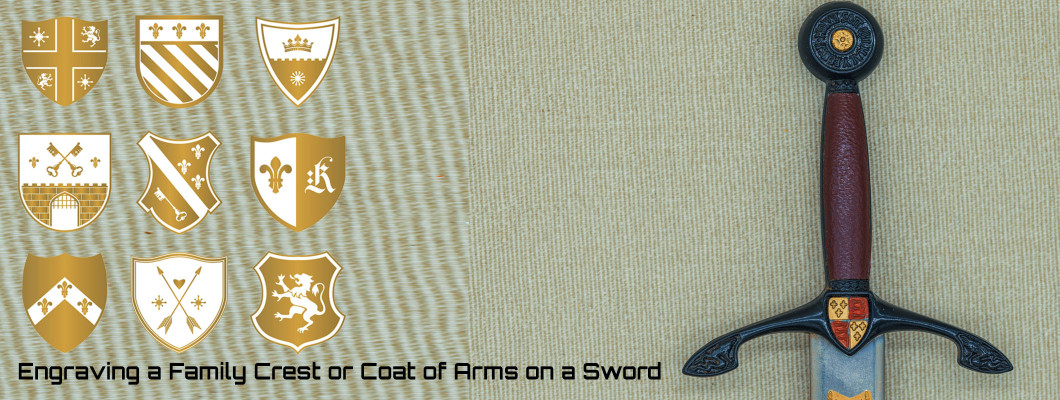
Engraving a Family Crest or Coat of Arms on a Sword
Yes, a crest or coat of arms can be engraved onto a blade, guard, pommel or scabbard, and it makes one of the most personal objects you can commission. But before you order, there is one thing worth knowing that most sellers will not tell you: a coat of arms belongs to a person and their descendants, not to a surname. There is no such thing as "the coat of arms for the Smith family."
That is not a reason to abandon the idea. It is a reason to get it right, because a sword engraved with arms you are actually entitled to — or with a personal device you designed yourself — means something, and one bought from a surname database does not. This page covers the heraldry, the engraving methods, where on a sword the work can go, and what to do if you have no arms of your own.
Crest, Arms, Achievement: Three Different Things
The words get used interchangeably in advertising and they are not interchangeable. Getting them right matters when you are commissioning, because what you ask for is what you will get engraved.
The arms are the design on the shield. This is the core of the thing and the part that is actually granted.
The crest is only the figure sitting on top of the helm — a beast, a bird, an arm holding something. When someone says "my family crest" they almost always mean the shield or the whole assembly, not the crest.
The achievement is everything together: shield, helm, mantling, crest, motto, and in some cases supporters standing either side.
This matters practically. A full achievement engraved at 40 mm on a ricasso becomes an unreadable smudge. A crest alone, or a shield alone, reads clearly at that size. Knowing which element you actually want is the first design decision, not a detail.
The Surname Problem
Search for your surname and you will find sites selling a coat of arms for it, usually with a scroll of invented family history attached. Those exist in large numbers and they sell a great deal of merchandise.
Here is the mechanism, stated plainly so you can judge for yourself. Arms are granted to an individual person by a heraldic authority. They then pass down that person's line of descent under rules that vary by country. They are not attached to a name. Two unrelated families with the same surname do not share arms, and in most cases neither of them has any. A surname database works by finding some historical grant to somebody with that surname and selling it to anyone who shares the name.
What that means for a sword: if the engraving is meant to represent your family, arms pulled from a surname lookup do not do that. They represent a stranger who happened to share your name. For a gift or an heirloom — which is what most people commissioning this are making — that is the opposite of the intended effect.
It also has a legal edge in one place. In Scotland the Court of the Lord Lyon regulates arms and using arms you are not entitled to is a matter for that court rather than a question of taste. If you or the recipient are Scottish, this is worth checking properly before ordering anything.
How to Find Out What You Are Entitled To
Three honest possibilities, and most people land in the third.
You may already have arms by descent. If a direct ancestor was granted arms, you may be entitled to bear them, sometimes with a mark of difference. This is a genealogical question with a documented answer, and the relevant authority for your country can confirm it — the College of Arms for England, Wales and Northern Ireland, the Court of the Lord Lyon for Scotland, the Chief Herald for the Republic of Ireland, and equivalent bodies elsewhere.
You can petition for a grant. New arms are granted to living people who qualify, and this happens far more often than most people realise. It costs money and takes time, but the result is genuinely yours and genuinely inheritable.
You can design a personal device. In countries with no regulating authority — the United States among them — anyone may assume arms, and the practice is long established. Even in regulated countries, a personal badge or device that does not claim to be a granted coat of arms is simply your own symbol. This is the route we would suggest to most people, and it produces something more meaningful than a database lookup, because you chose every element of it.
What Else Is Worth Engraving
If arms are not the right answer, several other things engrave beautifully and carry real weight.
A motto, in Latin, English or any language with a script we can reproduce. Mottoes are the most commonly requested engraving after names, and a line that means something to the recipient outlasts any heraldry.
A cypher or monogram — interlaced initials, sometimes with a date. Compact, elegant, and it reads clearly at small sizes where a full achievement would not.
Regimental or unit insignia, with a service name and dates. This is one of our most frequent requests for presentation pieces, and for good reason: it records something that actually happened.
A date and a dedication. A wedding date, a retirement date, a line of dedication along the fuller. Understated and durable.
A device you designed. A single charge that means something — an animal, a tool, a mountain, a symbol from your work or your history — rendered cleanly. The best engraved swords we make are usually these, not the reproduced achievements.
Where the Engraving Can Go
A sword offers several surfaces and they are not equivalent. Size, curvature and hardness all differ.
The ricasso — the unsharpened section just above the guard — is the traditional home for a maker's mark and the best place for a compact device. It is flat, thick, and away from the edge.
The fuller runs down the blade and suits text far better than images. A motto or a dedication sits naturally along it, reading as part of the sword rather than applied to it.
The blade flat gives the most room and takes an etch particularly well, which is what you want for a larger achievement or an elaborate design.
The guard and pommel are thicker, often curved, and suited to bolder, simpler work — a single charge, initials, a small crest. Fine detail gets lost on a curved surface.
The scabbard locket is the most overlooked option and frequently the best one for a full achievement. It is a flat plate, it can be worked in brass or silver rather than hardened steel, and it carries fine detail without any of the constraints a blade imposes.
Engraving Methods and What Suits What
| Method | How it works | Best for | Limits |
|---|---|---|---|
| Hand engraving | Steel is cut away with a graver, leaving a bright V-cut line | Fittings, scabbard mounts, small crests, anything in brass or silver | Slow, and hardened blade steel is difficult to cut cleanly |
| Acid etching | The blade is masked and acid bites the exposed design into the surface | Large designs and full achievements on the blade flat; fine detail | Shallow by nature; sits in the surface rather than cut deep |
| Laser marking | A beam darkens or ablates the surface to a set depth | Precise repeatable text, small logos, exact reproductions of a supplied file | Can read as machine-made, which some buyers dislike on a hand-forged blade |
| Stamping | A hardened punch is struck into the steel | Maker's marks and short simple marks | One shape per punch; displaces steel rather than removing it |
| Recessed and filled | Cut deeper, then filled with gold or silver | Ceremonial and presentation pieces where the engraving must carry across a room | The most work, and the most expensive |
For most crest and arms work the answer is a combination: etched on the blade where there is room, hand-cut on the fittings where there is not.
What a Forge Will Tell You That a Retailer Cannot
Two constraints that come from the steel rather than the design, and they change what you should ask for.
Depth near the edge is a structural question. A blade is hardened and under stress every time it is used. A deep cut acts as a stress riser — a place where flex concentrates rather than distributing along the blade. On the flat, on the ricasso, or in the fuller, that is not a concern at engraving depths. Close to the edge or across the tang shoulders, it can be. This is why we place engraving where we place it, and why we will push back if you ask for a deep cut in the wrong spot on a blade you intend to use. On a pure display piece the constraint relaxes, but you should decide which you are buying.
Engraving happens after heat treatment, and that sets the method. The blade is hardened and tempered before it is finished, so by the time anything is engraved the steel is at working hardness. That is why hand-cutting a 5160 blade is difficult and why etching is usually the right answer on the blade itself, while the softer fittings and the brass or silver scabbard mounts take a graver beautifully.
The practical upshot: send us the design early. Placement, method and size are one decision, not three, and they are much easier to get right before the sword is forged than after.
Send Us the Design, and We Will Tell You Honestly What Works
Every Everest Forge blade can be engraved — blade, guard, pommel or scabbard. Send an image, a sketch, a blazon or a description, and we will come back with placement, method and size before anything is forged. Deeper recessed engraving with gold or silver fill is available for presentation pieces.
Before You Order
Send the best image you have. A clean line drawing beats a photograph of a wall plaque every time. If you have a blazon — the written description in heraldic language — send that too, since it removes ambiguity that images introduce.
Decide which element you want. Full achievement, shield alone, or crest alone. At sword scale, less is almost always more legible.
Know that engraved blades cannot be resold. A personalised blade is specific to you, which means it falls outside our standard returns window unless the blade itself is faulty. Check the spelling, the dates and the design carefully before you approve them, because after forging there is no undoing it.
Allow for the design conversation. Engraving adds a step before forging rather than after, since we confirm the artwork with you first. If the sword is for a specific date, work backwards from it and leave room.
Frequently Asked Questions
Can I put my family crest on a sword?
Yes, a crest, coat of arms or personal device can be engraved on the blade, guard, pommel or scabbard. The one thing worth checking first is whether the arms are actually yours. Coats of arms are granted to individuals and inherited by descent, not attached to surnames, so a design pulled from a surname database usually belongs to an unrelated person who shared your name.
Is there really no coat of arms for a surname?
Correct. Arms are granted to a person and pass down that person's line of descent under rules that vary by country. Two unrelated families sharing a surname do not share arms, and in most cases neither has any. Sites selling a coat of arms by surname find a historical grant to someone with that name and sell it to everyone who shares it.
What is the difference between a crest and a coat of arms?
The arms are the design on the shield, and that is what is actually granted. The crest is only the figure above the helm — a beast, a bird, an arm holding something. The whole assembly of shield, helm, mantling, crest and motto is called an achievement. Most people who say family crest mean the shield or the whole achievement rather than the crest itself.
What can I engrave if I do not have a coat of arms?
A motto, a monogram or cypher of interlaced initials, regimental or unit insignia with service dates, a wedding or retirement date with a dedication, or a personal device you design yourself. In countries with no heraldic authority anyone may assume arms, and a personal badge that does not claim to be a granted coat of arms is simply your own symbol anywhere.
Where is the best place on a sword to engrave a crest?
The ricasso for a compact device, the fuller for text, the blade flat for larger designs, and the guard or pommel for bold simple work. The most overlooked option is the scabbard locket — a flat plate that can be made in brass or silver rather than hardened steel, which carries fine detail far better than a blade can.
Does engraving weaken a sword blade?
Not at engraving depths in the right places. On the blade flat, the ricasso or in the fuller it makes no meaningful difference. A deep cut close to the edge or across the tang shoulders is a different matter, because it can act as a stress riser where flex concentrates rather than distributing. That is why placement is a structural decision and not only an aesthetic one.
What engraving method is best on a hand-forged blade?
Usually a combination. The blade is hardened and tempered before finishing, so by engraving time the steel is at working hardness and difficult to hand-cut. Acid etching suits the blade flat and carries fine detail well. Hand engraving with a graver suits the softer fittings and the brass or silver scabbard mounts. Laser is precise but can read as machine-made on a hand-forged piece.
Can engraving be filled with gold or silver?
Yes. The design is cut deeper than normal and the recess is filled, which makes it legible from across a room. It is the traditional treatment for ceremonial and presentation swords. It is also the most labour-intensive option and priced accordingly, so it suits pieces that will be displayed or presented rather than used.
Can I return an engraved sword?
An engraved blade is personal to you and cannot be resold, so it falls outside our standard returns window unless the blade itself is faulty. Check spelling, dates and artwork carefully at the approval stage. We confirm the design with you before anything is forged precisely so that nothing reaches the steel unchecked.