At Dashain the Khukuri Is Worshipped, Not Just Carried: How Nepal's Greatest Festival Uses the Blade
Dashain is Nepal's biggest festival, fifteen days in late September or October that celebrate the goddess Durga's victory over the buffalo demon Mahishasura, and it is the one time of year when the kukri (khukuri) moves from tool to sacred object. On Maha Navami, the ninth day, households, army units and workshops clean their khukuris, mark them with red tika and flowers, and worship them alongside every other tool and weapon in the house. For families who still keep the old rite, the khukuri is also the blade of the offering, and a long, heavy form called the maar khukuri exists for exactly that purpose: one clean stroke. This guide explains where the khukuri appears in the festival day by day, what makes a maar khukuri different from a working kukri, how the Gurkha regiments kept Dashain, and how the sacrifice question is changing in Nepal today.
For the wider body of belief around the blade, including the "must taste blood" myth and the single-stroke tradition in brief, start with our khukuri (kukri) myths, beliefs and cultural reality. This post takes the Dashain part of that story and gives it the room it needs.
Dashain in Brief: Fifteen Days and Where the Khukuri Comes In
Ghatasthapana (day 1). A kalash, a sacred water vessel, is set up in the prayer room and barley is sown in sand beside it. The yellow shoots that grow over the next nine days, the jamara, are given with tika on the tenth day.
Phulpati (day 7). Sacred flowers, leaves and the royal kalash were traditionally carried from Gorkha to Kathmandu; the Nepal Army fires a salute at Tundikhel. In homes, the items for the coming days' worship are brought together.
Maha Ashtami and Kalratri (day 8). The "black night". Offerings to Durga and her fierce forms begin in temples and, in the families that keep the rite, in homes. In the Hanuman Dhoka palace in Kathmandu the Kot Puja is held, the army's offering to Durga, historically in the presence of the king.
Maha Navami (day 9). The day of weapons and tools. Khukuris, rifles at army posts, sickles, ploughs, workshop tools and now cars and motorbikes are cleaned, marked with red tika and garlanded, and worshipped as instruments of Durga's power. It is the one day of the year the khukuri in a Nepali home is treated as a sacred object rather than a tool.
Vijaya Dashami (day 10). The day of victory. Elders give tika and jamara to younger relatives with a blessing, and the visiting of family that follows runs on to the full moon, Kojagrat Purnima, on the fifteenth day.
Navami: The Worship of the Khukuri
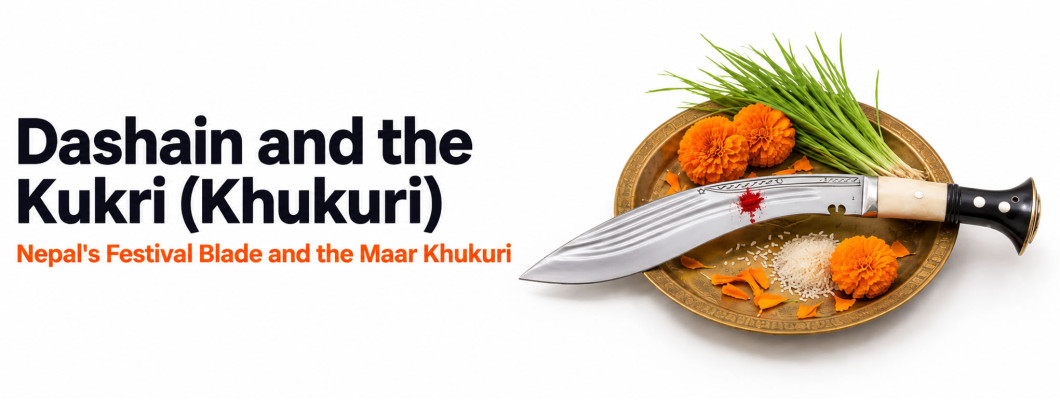
On Navami the khukuri is taken out, cleaned and oiled, set on a clean cloth or a brass plate with the karda and chakmak beside it, and given red tika, rice, flowers and incense. In many households the head of the family performs the puja; in army units it is done for the unit's weapons together. The idea is not that the blade is a god but that Durga's power to destroy evil works through the instruments people use, so the instrument is honoured on her day. It is also the day a new khukuri is often first used or presented, which is why the weeks before Dashain are, for a Nepali forge, a busy season.
Worship is the same whether the household offers a sacrifice or not. Families who have given up animal offerings, which is now a large and growing number, still clean and honour the khukuri on Navami.
Kot Puja and the Single Stroke
The sacrifice is the part of Dashain outsiders find hardest to understand, so it is worth saying plainly what it is. In the traditional rite, animals, most often goats, ducks and, for larger institutions, buffaloes, are offered to Durga on Ashtami and Navami, and the meat is then eaten by the family as prasad, a blessed meal. At the Kot Puja in Hanuman Dhoka and at army barracks across Nepal, buffaloes are offered on behalf of the state and the unit.
The offering is made with a single stroke, the maar, and the belief that it must be one clean cut is very strong: a second stroke is taken as an ill omen for the household or the unit for the year ahead. The practical reason under the belief is that one stroke is the quickest and least cruel death the method allows, which is also why the blade used for it is heavier and longer than a working khukuri, and why the person who wields it is chosen for strength and skill. Our guide to the cho (kaudi) notch touches on how the blade's own form is tied up with these beliefs.
An honest note on the sacrifice. Animal sacrifice at Dashain is changing. Many families now offer an ash gourd (kubhindo), a pumpkin or a coconut in place of an animal, cutting it with the same single stroke; many temples and community groups encourage it; and debate over the practice in Nepal is open and public. The festival also differs widely between communities, and some groups have never sacrificed at all. We describe the traditional rite because the maar khukuri cannot be understood without it, not to promote it. Everest Forge sells the maar khukuri as a traditional Nepali blade, and most of our maar khukuris are bought by collectors, Gurkha families abroad and people who want the ceremonial form for display.
What Makes a Maar Khukuri Different
A maar khukuri, also called a bali or sacrificial khukuri, is not a separate profile so much as a working khukuri scaled up and re-balanced for one job. It is longer, so the stroke has reach and speed; heavier, especially toward the belly, so the blade carries its own momentum through the cut; and usually straighter in the first half of the blade, with a deep, broad belly near the point where the strike lands. The spine is thick at the bolster and tapers well toward the tip so that the weight sits forward. Handles are long enough for two hands. In many households the maar khukuri is kept for Dashain alone and not used for everyday chopping.
| Blade | Main use | Size and weight | Profile | When it is used |
|---|---|---|---|---|
| Working kukri (khukuri), e.g. Bhojpure or Sirupate | Farm, kitchen, firewood, everyday carry in the hills | Compact to medium; light enough to use all day | Bhojpure broad and chunky; Sirupate slim and elegant | Every day; worshipped on Navami |
| Kothimora khukuri | Presentation and ceremony | Medium; the weight is in the decorated scabbard | Standard profile; ornate silver or brass kothimora scabbard | Gifts, retirements, weddings, display; often presented in the Dashain season |
| Maar khukuri | The Dashain offering | Long and heavy, weight forward, two-hand handle | Straighter first half, deep broad belly, thick spine at the bolster | Ashtami and Navami; kept aside the rest of the year in many homes |
| Khunda | Larger offerings, temple and institutional rites | Larger again; a cleaver-like sacrificial blade | Broad, often with an upturned or hooked tip and an "eye" motif | Temple and army offerings, including the Kot Puja tradition |
The khunda deserves its own explanation and will get one; until that post is live, the khukuri myths and beliefs guide is the place to start. For the presentation blade, our Kothimora khukuri (kukri) guide covers the scabbard, the silverwork and the occasions it is given.
Choose the blade length, finish and handle for a working or ceremonial kukri (khukuri), and the forge builds that exact combination for you.
Build Your BladeDashain in the Gurkha Regiments
Gurkha soldiers carried Dashain with them into the British and Indian armies, and for most of the twentieth century it was the most important day of the regimental year. Units held their own Kot Puja, with a buffalo offered to Durga on Navami and a soldier chosen to make the single stroke with a large khukuri or khunda; a clean cut was celebrated across the battalion, and a failed one was remembered for years. The regimental khukuris and the unit's weapons were worshipped together, and the festival ended with tika given by the commanding officer and the senior Gurkha officers.
The practice has changed with time and place. Sacrifice is not carried out by British Army Gurkha units in the United Kingdom, where Dashain is now marked with puja, the worship of weapons and khukuris, tika, music and the dashain feast; units serving elsewhere have followed their own arrangements. The Nepal Army continues the Kot Puja at Hanuman Dhoka. For the wider story of the blade in service, see the kukri (khukuri) and stories of the Gurkhas collection of guides.
Tika, Jamara and Giving a Khukuri at Dashain
Vijaya Dashami is the day of blessing. Elders put red tika, a paste of rice, yoghurt and vermilion, on the foreheads of younger family members, tuck jamara behind their ears, and give a blessing and a little money, dakshina. Families travel across the country, and from abroad, to receive tika from their parents and grandparents.
Because it is a season of giving and of blessing new things, Dashain has long been a time to give a khukuri: to a son leaving for the army or for work abroad, to a returning soldier, to a new household. A blade given at Dashain is often first worshipped on the following Navami. The kothimora is the traditional presentation blade for this, and a working Bhojpure or Sirupate kukri (khukuri) is the practical one.
Hand-Forged Dashain Blades From Everest Forge
All of these are in the authentic kukri (khukuri) collection, forged on demand in our Kathmandu workshop from mono-steel 5160 spring steel, the same leaf-spring steel family that village kamis have long forged from salvaged vehicle springs. Nothing is held in stock; every blade is forged after the order is placed.
- The Dashain maar khukuri: the long, forward-weighted blade built for the single stroke, with a full-tang rosewood handle long enough for two hands.
- The maar kukri (khukuri): the same ceremonial type in a second traditional pattern.
- The traditional Nepali khunda: the broad sacrificial blade of the temple and army rites.
- The Kothimora ceremonial khukuri: the presentation blade with the decorated scabbard, the traditional Dashain gift.
Any of these can be ordered left-handed by writing "Left Handed" in the order note, or with a blunt edge and rounded tip for display and stage use the same way. Catalogue builds dispatch in 2 to 3 business days; custom builds take 4 to 6 weeks at the forge; shipping is DHL or FedEx, tracked, 7 to 14 business days worldwide. If you are ordering for Dashain, order early: the festival is our busiest season and international transit needs its full window.
An honest note on the steel. Everest Forge forges mono-steel 5160 only. We do not make Damascus, pattern-welded, folded or laminated steel, and no traditional khukuri was ever made that way either.
Related Guides
Commission a Dashain Khukuri for Your Family
A maar khukuri to your family's traditional pattern, a kothimora with an engraved scabbard as a Dashain gift, or a khunda for a temple. Tell us the pattern and the occasion; the forge quotes it, builds it in 4 to 6 weeks, and ships it tracked worldwide.
Start a Custom Forge RequestFrequently Asked Questions
How is the khukuri used during Dashain?
In two ways. On Maha Navami, the ninth day, khukuris are cleaned, marked with red tika and worshipped with other tools and weapons as instruments of the goddess Durga's power. In families and institutions that keep the traditional rite, a khukuri is also the blade used for the offering on Ashtami and Navami.
What is a maar khukuri?
A long, heavy, forward-weighted kukri (khukuri) made for the Dashain offering, where the cut must be made in a single stroke. It is straighter in the first half of the blade, has a deep belly near the point and a handle long enough for two hands. Many families keep it for Dashain alone.
What does "maar" mean?
In this context, the strike or killing blow of the offering. The maar khukuri is the blade made for that single stroke.
Why must the Dashain offering be made in one stroke?
A clean single cut is considered auspicious, and a second stroke an ill omen for the coming year. It is also the quickest death the method allows, which is why the maar khukuri is heavier and longer than a working blade.
What is the Kot Puja?
The army's offering to the goddess Durga during Dashain, held at the Hanuman Dhoka palace in Kathmandu and at army barracks across Nepal. It traditionally includes the worship of weapons and the offering of buffaloes.
Do all Nepali families sacrifice animals at Dashain?
No. Practice varies between communities, some have never done it, and many families now offer an ash gourd, pumpkin or coconut instead, cut with the same single stroke. The worship of the khukuri on Navami continues either way.
Do Gurkha regiments still celebrate Dashain?
Yes. Gurkha units mark Dashain with puja, the worship of weapons and khukuris, tika and a feast. Sacrifice is not carried out by British Army Gurkha units in the United Kingdom.
What is the difference between a maar khukuri and a khunda?
The maar khukuri is a scaled-up kukri (khukuri) with the usual curved profile. The khunda is a broader, cleaver-like sacrificial blade, often with an upturned tip and an eye motif, used for larger temple and institutional offerings.
Is a khukuri a good Dashain gift?
Yes, it is a traditional one. A kothimora is the classic presentation blade, and a working Bhojpure or Sirupate kukri (khukuri) is the practical choice. A blade given at Dashain is often first worshipped on the following Navami.
When should I order a khukuri for Dashain?
Early. Dashain falls in late September or October and is the forge's busiest season. Catalogue builds dispatch in 2 to 3 business days and shipping takes 7 to 14 business days, so order at least three weeks ahead, or six to eight weeks for a custom build.