The Jian Is China's Straight Double-Edged Sword; the Dao Is Its Curved Single-Edged Sabre, and for Two Thousand Years They Did Different Jobs
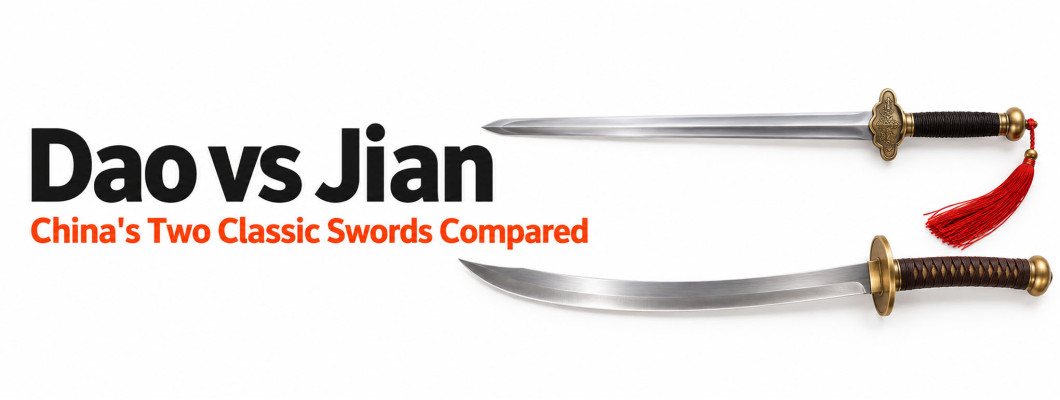
The jian (剑) and the dao (刀) are the two classic swords of China, and the difference between them is simple to state: the jian is straight and double-edged, with a diamond cross-section and a long tapering point, built for precise thrusts and cuts; the dao is curved or straight-backed and single-edged, with a thick spine behind a wedge-shaped blade, built for powerful cuts. Chinese tradition calls the jian "the gentleman of weapons" and the dao "the general of weapons", and the names capture how they were used. From the Han dynasty onward the dao was the soldier's sword and the jian became the sword of officials, scholars, Daoist practice and martial arts. This guide compares them side by side, covers the main dao and jian forms, and ends with how to choose between them.
For the full history of the straight sword, our jian sword history is the place to start; for the curved one, the main dao sword variants covers the broad-headed dao, the horse-cutter and the officer's dao. This post is where the two meet.
The Difference at a Glance
| Feature | Jian (剑) | Dao (刀) |
|---|---|---|
| Blade | Straight, double-edged, tapering to a long point | Single-edged; straight-backed in early forms, curved from the Tang onward |
| Cross-section | Diamond or flattened hexagon with a central ridge | Wedge, with a thick spine behind the edge |
| Typical blade length | 70 to 80 cm for the Ming and Qing jian; shorter Bronze Age examples | 60 to 80 cm for the common sabres; far longer for the two-handed forms |
| Weight and balance | Light, balance close to the guard; point-controlled | Heavier, balance further forward; cut-driven |
| Guard | Short cross-guard, often turned toward the blade | Disc or oval guard (pan), sometimes a cross-guard on early forms |
| Grip | One-handed, often with a tassel at the pommel | One-handed for most sabres; long two-handed grip on the dadao and zhanmadao |
| Main use | Thrust, precise cuts, edge alignment, footwork | Strong cuts from horse or foot; blocking on the spine |
| Who carried it | Bronze Age nobles, Han officers, later officials, scholars, Daoist priests, martial artists | Soldiers and cavalry from the Han onward; the standard Ming and Qing military sword |
| Traditional epithet | "The gentleman of weapons" | "The general of weapons" |
| Learning curve | Long; precision is the whole art | Shorter; forgiving and robust |
| Everest Forge page | Hand-forged jian sword | Hand-forged dao sword |
Why the Dao Replaced the Jian on the Battlefield
The jian is the older sword. Bronze jian were made in the Spring and Autumn and Warring States periods, and the finest, such as the Sword of Goujian found in Hubei in 1965, are still sharp and almost uncorroded today. In the early Han dynasty the jian, now in iron and steel and much longer, was still the main sword of the army.
That changed in the first and second centuries AD. Han cavalry fighting the Xiongnu on the steppe needed a sword that cut hard from horseback and stood up to blows, and the single-edged, ring-pommelled huandao did both better than a long double-edged jian. A thick spine meant the blade could be thinner at the edge without breaking; one edge meant the forging was simpler and the sword cheaper to make in large numbers; and the dao could take a parry on its back without damaging an edge. By the end of the Han the dao was the soldier's sword, and it stayed that way for the next seventeen hundred years.
The curve came later. Tang dynasty dao were still mostly straight; the curved sabre forms arrived from the steppe in the Song, Yuan and Ming periods, so the dao that most people picture, the curved willow-leaf sabre, is a Ming and Qing sword.
Gentleman and General: How the Jian Became a Civil Sword
Once the jian left the battle line it found a new home. It became the sword of officials and the educated, worn at court and in ceremony; the sword of Daoist ritual, where it is used to command spirits and features in temple iconography; and the sword of the literati, appearing in poetry and painting as a mark of refinement. That is the sense of the Chinese saying that the jian is the gentleman of weapons (君子之器) while the dao is the general of weapons, the fighting man's tool.
Martial artists inherited both. A traditional saying in Chinese martial arts runs: "a hundred days for the dao, a thousand days for the spear, ten thousand days for the jian." The dao rewards strength and commitment and can be used well quickly; the jian depends on edge alignment, distance and footwork, and takes far longer to master. Another describes the dao as moving like a fierce tiger and the jian like a flying phoenix. Wudang and Taiji jian forms, which developed largely in the Ming and Qing periods and later, are where most people meet the jian today.
Main Forms of the Dao
Dao is a whole family rather than one sword. The forms most worth knowing are these.
- Huandao (环首刀), ring-pommel dao. The straight, single-edged Han and early medieval military sword with a ring at the pommel. The dao that replaced the jian.
- Yanmaodao (雁翎刀), goose-feather sabre. A Ming and Qing sabre with a mostly straight blade and a curve only near the point. Good for both cutting and thrusting.
- Liuyedao (柳叶刀), willow-leaf sabre. The most common Ming and Qing military dao, with a moderate curve along the whole blade. The classic "Chinese sabre".
- Piandao (片刀), slicing sabre. A deeply curved sabre built for slicing, close in feel to steppe sabres.
- Niuweidao (牛尾刀), oxtail sabre. A late Qing civilian sabre with a blade that flares broadly near the tip. Much of the "kung fu broadsword" look comes from it.
- Dadao (大刀), big knife. A long, heavy, two-handed chopping blade, famous in the hands of Chinese troops in the 1930s.
- Zhanmadao (斩马刀), horse-cutter. A long two-handed dao associated with the Song and earlier, used against cavalry.
The dao variants guide looks at several of these in more depth. The guandao, the "reclining moon" polearm, takes the dao name but is a pole weapon, and will have its own post.
Main Forms of the Jian
- Bronze Age jian. Short, 45 to 60 cm, often with a widened section toward the point and a distinctive guard. The Sword of Goujian is the famous example.
- Han iron jian. Long military jian, often 80 cm or more in the blade, with a simple guard and ring or disc pommel. The last jian made in large numbers for war.
- Ming and Qing jian. The jian as it is usually pictured: 70 to 80 cm of blade, a short guard turned toward the blade, a decorated pommel and a tassel. Civil and martial-arts swords.
- Wudang and Taiji jian. Modern training jian, lighter and more flexible, made for forms practice rather than cutting.
Our jian history covers the parts of the sword (point, edge, ridge, guard, grip, pommel and tassel) and how it is forged.
Single Edge vs Double Edge: The Mechanics
The choice between one edge and two is the core of this comparison, and it applies well beyond China. Two edges and a diamond section give a stiff blade that thrusts straight and cuts on the back-stroke as well as the forward one, but the blade has to stay fairly thin across its width, so it relies on good edge alignment to cut deeply. One edge and a wedge section let the smith put metal behind the edge, so the blade is heavier at the point of impact, tougher in a hard parry and more forgiving of an imperfect cut. Our guide to single-edged vs double-edged swords works through the geometry in detail.
For neighbouring Himalayan traditions, the Tibetan straight sword shares more with the jian's single-handed style than with the dao's sabres; see types of Tibetan swords.
Which Should You Choose?
Choose a jian if you practise Taiji, Wudang or another traditional system with jian forms, if you want a sword for precise cutting and thrusting drills, or if the jian's place in Chinese culture is the reason you want a Chinese sword at all. The hand-forged jian is the classic Ming-Qing form; the Wudang jian follows the martial-arts tradition.
Choose a dao if you want a sword that cuts hard, forgives mistakes and stands up to heavy backyard cutting, or if your interest is military history rather than the civil and martial-arts tradition. The hand-forged dao is a willow-leaf style sabre; the large dao is the heavier chopping form for those who want the weight of a niuweidao or dadao.
Both are in the East Asian swords collection, forged on demand from mono-steel 5160 spring steel with a full tang. Nothing is held in stock; every sword is forged after the order is placed. Blade length, finish and handle are selectable on each, and the blade configurator shows the build before you order. Any jian or dao can be ordered left-handed by writing "Left Handed" in the order note, or to stage-combat specification with a blunt edge and rounded tip the same way, which suits forms practice. Catalogue builds dispatch in 2 to 3 business days; custom builds take 4 to 6 weeks at the forge; shipping is DHL or FedEx, tracked, 7 to 14 business days worldwide.
An honest note. Many historical Chinese blades were laminated: a hard steel core wrapped in softer iron, or the folded "hundred-refined" steel (百炼钢) of the best workshops. Everest Forge does not make laminated, folded or pattern-welded steel. Our jian and dao are mono-steel 5160, hardened and tempered for toughness, which is the practical choice for a sword that will be cut with. They are faithful to the historical shapes, not to the historical metallurgy.
Related Guides
Commission a Jian or Dao to Your Own Pattern
A Han ring-pommel dao, a yanmaodao, a niuweidao, a Ming jian in your blade length, or a Taiji training jian with a blunt edge: send a reference, and the forge quotes it, builds it in 4 to 6 weeks from 5160 spring steel, and ships it tracked worldwide.
Start a Custom Forge RequestFrequently Asked Questions
What is the difference between a dao and a jian?
The jian is a straight, double-edged sword with a diamond cross-section, built for precise thrusts and cuts. The dao is a single-edged sword, usually curved, with a thick spine and a wedge cross-section, built for powerful cuts. The jian became a civil and martial-arts sword; the dao was the standard military sword from the Han dynasty onward.
Why is the jian called the gentleman of weapons?
After the dao replaced it on the battlefield, the jian became the sword of officials, scholars and Daoist practice, associated with refinement and self-cultivation. The dao, the soldier's sword, was called the general of weapons.
Which is better, dao or jian?
Neither is better in general. The dao cuts harder, is more forgiving and is quicker to learn; the jian is more precise and better at the thrust but takes much longer to master. Choose by what you want to do with the sword.
Is a dao a sabre?
Most later dao, such as the willow-leaf liuyedao and the piandao, are sabres: curved, single-edged and one-handed. Early dao such as the Han ring-pommel huandao were straight single-edged swords.
Why did the Chinese army switch from jian to dao?
During the Han dynasty, cavalry fighting on the steppe needed a sword that cut hard from horseback and survived heavy blows. The single-edged ring-pommel dao did both, was simpler to forge and cheaper to make in quantity, and could take a parry on its spine.
What is a willow-leaf dao?
The liuyedao, the most common Ming and Qing military sabre, with a moderate curve running the length of the blade. It is the form most people picture when they think of a Chinese sabre.
What is the tassel on a jian for?
Mainly decoration and tradition. In forms practice it shows the flow of a movement. In real cutting it is often removed, because it can catch or distract.
Is the guandao a type of dao?
It carries the dao name, but the guandao is a polearm: a heavy curved blade on a long shaft, associated with the general Guan Yu. It is not a hand sword.
Can I use a jian or dao for Taiji or Wudang practice?
Yes. For forms practice a stage-combat build with a blunt edge and rounded tip is safer and is available on any Everest Forge jian or dao by order note. For cutting practice, order the standard sharpened build.
Are Everest Forge jian and dao folded steel?
No. They are mono-steel 5160 spring steel, hardened and tempered for toughness. Many historical Chinese blades were laminated or folded; ours follow the historical shapes, not the historical metallurgy.