Damascus Steel vs 5160 Spring Steel: Which Is Better for a Blade?
They are not competing grades. 5160 is a steel. Modern Damascus is a process — two steels forge-welded and folded together, then acid etched so one layer darkens and the other stays bright. The pattern you are paying for is a construction method made visible, and on a modern blade it is decorative rather than structural. That is not an insult to Damascus. It is the reason a Damascus knife can be extraordinary and a Damascus sword can be a poor bargain.
We should declare our position up front: we do not forge Damascus. Everything we make is mono-steel 5160, and this article explains why we made that choice rather than trying to talk you out of a material we sell alongside it. Judge the reasoning, not the seller.
What Modern Damascus Actually Is
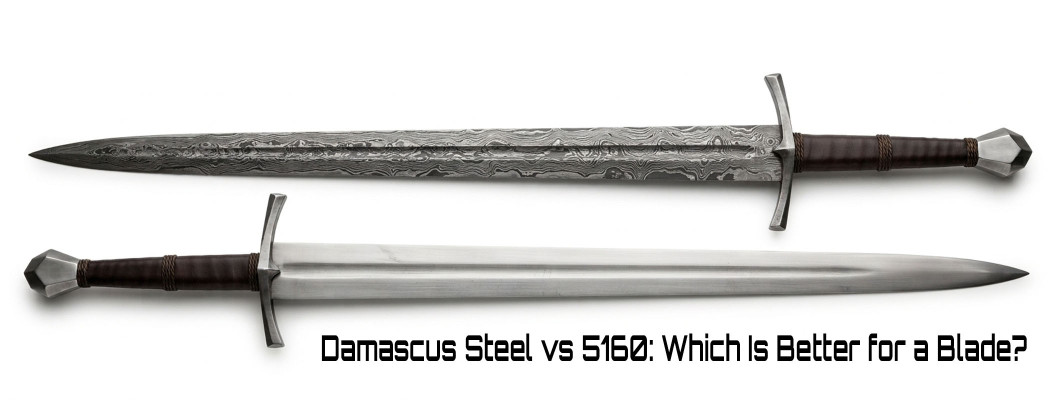
A smith stacks bars of two different steels — commonly a high-carbon steel paired with a nickel-bearing steel such as 15N20 — forge-welds them into a single billet, then draws it out, folds it, and welds it again. Each fold doubles the layer count, so a handful of folds produces hundreds of layers. The billet is then forged into a blade, heat treated, and etched in acid. The nickel-bearing layers resist the acid and stay bright while the carbon layers darken, and that contrast is the pattern.
The layers run through the whole blade. That is the important part and it is what separates real pattern welding from imitation: the pattern is a cross-section of the construction, not a finish applied to the surface.
Historical Damascus was something else entirely. Wootz was a crucible steel — a single material, melted and slowly cooled, whose flowing pattern came from carbide banding inside the steel itself rather than from stacked layers. The technique was lost, and the modern usage borrowed the name. Even the Wikipedia article on pattern welding notes that blades made this way are often wrongly called Damascus steel.
Why Pattern Welding Was Invented
This is the part that decides the whole argument, and it is historical rather than metallurgical.
Pre-industrial smiths could not produce steel with evenly distributed carbon. A single bloom came out inconsistent — some regions high in carbon and brittle, others low and soft. A blade forged from it would be hard in one place and soft in another, and would fail unpredictably. Stacking, folding and welding was the fix. It homogenised the material by averaging those inconsistencies across hundreds of thin layers, and the pattern was a side effect of solving a real problem.
Modern steel arrives from the mill homogeneous, clean, and to a specified composition. Every bar of 5160 has the same carbon content as every other bar, distributed evenly throughout. The problem pattern welding solved no longer exists.
So what remains when you fold modern steel? The appearance. That is a genuine thing to want, and there is nothing wrong with wanting it — but it should be bought as what it is.
What the Cross-Section Tells You
Three blades can look similar in a photograph and be completely different objects.
That third case is common enough to be worth naming. Acid-printed and laser-marked patterns on plain mono-steel are sold as Damascus at every price point, and photographed from directly above they are indistinguishable from the real thing.
The check takes two seconds. Look at the edge bevel, where the blade has been ground back after the pattern was applied. On a genuine pattern-welded blade the layers continue right into the bevel and along the cutting edge, because the layers are the steel. On a printed blade the pattern stops dead at the shoulder of the bevel, leaving a clean unpatterned strip along the edge. Ask any seller for a close photograph of the edge, straight on. An honest one will send it.
The Comparison
| 5160 mono-steel | Pattern-welded Damascus | |
|---|---|---|
| What it is | A single spring steel with chromium and manganese | Two steels forge-welded, folded and etched |
| Why the appearance | Plain. The finish is the finish | The pattern is the construction made visible |
| Toughness under flex | Excellent — the property it was designed for | Depends entirely on the component steels and weld quality |
| Edge retention | Good, not class-leading | Roughly that of its harder component steel |
| Failure modes | Bending, chipping if over-hardened | The same, plus delamination at a bad weld |
| Corrosion | Rusts if neglected; a plain surface is easy to oil | Rusts more readily — etching opens the surface |
| Cost | Lower; one material, one operation | Higher; many hours before the blade is even forged |
| Best at | Long blades, hard use, anything that flexes | Knives, presentation pieces, anything where the pattern is the point |
Read the toughness row carefully, because it is where most marketing goes wrong. Damascus is not tougher by virtue of being Damascus. A pattern-welded blade performs approximately as its component steels perform. If those are good steels, well welded and well heat treated, the result is a good blade. If they are not, the pattern hides it perfectly.
Why 5160 for a Sword
5160 is spring steel. It contains chromium and manganese and it exists because industry needed a material that could flex under load, millions of times, without fatiguing and breaking. That is what leaf springs do, and that is where ours comes from — reclaimed from vehicle suspension.
Ask what a long blade actually experiences. It flexes on every cut. It takes impact at unpredictable angles. It stores and releases energy along its length. The thing most likely to end a sword is not a dull edge — it is a bend that does not come back, or a crack that starts somewhere and travels. Toughness and fatigue resistance are the properties that matter, and edge retention is a distant third.
That is the argument for 5160, and it is why we build everything from it. Our fuller guide to the material is in why 5160 spring steel suits hand-forged blades.
The honest limitation: 5160 will not take the very high hardness that some knife steels reach, so it will not hold a hair-splitting edge as long as a properly heat-treated high-carbon or powder steel. For a kitchen knife or a dedicated slicer that matters. For a blade that gets hit, it does not.
The Weld Interface
This is the maker's objection to pattern welding on a long blade, and it is a real one rather than a marketing point.
Every layer boundary in a pattern-welded billet is a forge weld. A clean weld is as strong as the parent material and behaves as one piece. An imperfect weld — a trapped scale inclusion, a spot that did not reach welding heat, a flux pocket — is a plane of weakness sitting inside the blade where nobody can see it.
On a knife, that risk is small and the loads are low. On a 30-inch sword that flexes hard on every cut, a hidden inclusion is exactly the kind of defect a stress cycle finds. A mono-steel blade simply has nowhere for that to happen.
None of which means pattern-welded swords are bad. Excellent ones exist and always have — the Viking-age smiths who pattern-welded blades were extremely good at it. It means the quality of the weld is doing a great deal of work, and you cannot inspect it after the fact. With mono-steel there is one less thing to get right.
Where Damascus Genuinely Wins
We should be even-handed, because a page that only argues one way is not worth reading.
It is beautiful, and that is a legitimate reason. A well-made pattern-welded blade with a twist or feather pattern is one of the most striking objects in the craft, and no mono-steel blade will ever match it visually. If you want that, buy it, and do not let anyone tell you the want is frivolous.
It carries the maker's skill visibly. Forge welding hundreds of layers cleanly is difficult, and a good pattern is evidence of competence in a way a plain blade is not. For a collector, that is real information.
For knives, the trade-offs are mild. Short blades flex less, take lower impact loads, and put the weld interfaces under far less stress. A pattern-welded chef's knife or hunting knife from a good maker is an excellent object with no meaningful compromise.
Historical accuracy sometimes requires it. If you are reproducing a migration-period or Viking-age sword faithfully, pattern welding is not decoration — it is what the original was. A mono-steel version is a different object, and for a serious reenactor that difference matters.
On that last point we are straightforwardly the wrong forge. We do not pattern-weld, so if a genuine pattern-welded reproduction is what you need, buy it from a smith who does. We would rather say that than sell you an approximation.
The Viking Question
Anyone who reads about pattern welding runs into Viking-age swords, and it is worth being clear about what they show, because it is often used as an argument for modern Damascus and it does not quite work as one.
Migration-period and Viking-age smiths pattern-welded extensively, and some of those blades are astonishing. But they were doing it for the reason above: the iron available to them was inconsistent, and stacking and welding thin rods averaged out the problem while producing a stiff core with harder edges welded on. The pattern was evidence of a solution, and a visible sign that the smith had done the work.
What happened next is the telling part. As European steel production improved through the medieval period, pattern welding declined and largely disappeared from sword making. It was not outlawed or forgotten — it stopped being necessary. Smiths who could get consistent steel simply made blades from consistent steel, because it was faster, cheaper and had fewer ways to go wrong. The high medieval sword, the one most people picture, is a mono-steel blade.
So a Viking sword is a genuine argument for pattern welding in the ninth century. It is not, on its own, an argument for it in the twenty-first, and the smiths of the intervening centuries voted with their hammers.
What Actually Determines Blade Quality
If neither the pattern nor its absence tells you much, it is fair to ask what does. Four things, in roughly this order.
Heat treatment. The same bar of steel can produce a blade that survives abuse or one that snaps, depending entirely on how it was hardened and tempered. This is the single largest variable in blade performance and it is completely invisible in a photograph, which is exactly why sellers talk about steel names and patterns instead.
Geometry. Distal taper, cross-section and edge angle decide how a blade cuts and how it handles far more than the alloy does. A well-shaped blade in an ordinary steel outperforms a badly shaped one in an exotic steel every time.
Construction. Full tang or not, how the guard is seated, whether the assembly is properly peened or threaded. This is where cheap blades fail, and it has nothing to do with the steel at all.
The steel itself. Genuinely last. It matters, and it sets an upper limit on what the other three can achieve, but it is not the variable most buyers think it is.
A pattern is not on that list. Neither is a grade number by itself. If a seller leads with the material and says nothing about heat treatment, geometry or construction, they have told you what they know.
How to Buy Either One Well
If you are buying Damascus: ask which two steels, ask for the layer count, and ask for a straight-on photograph of the edge bevel. Those three answers separate a real maker from a reseller instantly. Be wary of any listing that says "Damascus steel" with no composition named at all, and be especially wary of unusually cheap ones — genuine pattern welding is many hours of work before the blade is even forged, and that time has to appear in the price somewhere.
If you are buying mono-steel: ask which grade, ask how it was heat treated, and ask about the tang. A named steel, an oil quench and a hand temper, and a full tang tell you more about how a blade will perform than any surface treatment. Our Battle Ready standard sets out what we hold ourselves to.
Either way, be sceptical of strength claims tied to appearance. Neither a pattern nor its absence makes a blade strong. Heat treatment does, geometry does, and construction does.
One Steel, Chosen on Purpose
Every Everest Forge blade is 5160 spring steel reclaimed from leaf springs, oil quenched and tempered by hand, full tang. We hold no stock and forge after you order, so length, fittings and finish are yours to specify. We will also tell you plainly when what you want is not something we should make.
Frequently Asked Questions
Is Damascus steel better than 5160?
Neither is better in general, because they are different kinds of thing. 5160 is a specific spring steel; Damascus is a construction method using two steels welded together. A pattern-welded blade performs roughly as its component steels perform. For long blades that flex and take impact, 5160's toughness and fatigue resistance are the properties that matter most.
Is Damascus steel stronger?
Not by virtue of being Damascus. The strength comes from the component steels, the heat treatment and the quality of the forge welds, exactly as it does for any blade. Pattern welding originally solved a real problem — uneven carbon distribution in pre-industrial steel — but modern steel arrives homogeneous, so that problem no longer exists and the pattern is now aesthetic.
How can I tell if Damascus steel is real?
Look at the edge bevel straight on. On a genuine pattern-welded blade the layers continue into the bevel and along the cutting edge, because the layers are the steel itself. On an acid-printed or laser-marked imitation the pattern stops at the shoulder of the bevel, leaving a clean unpatterned strip along the edge. Ask the seller for a close photograph of the edge before buying.
What is the difference between Damascus and pattern-welded steel?
In modern usage they mean the same thing. Historical Damascus was wootz, a crucible steel whose flowing pattern came from carbide structures inside a single material rather than from stacked layers, and that technique was lost. What is sold today as Damascus is pattern welding, and the two are frequently conflated even in otherwise careful sources.
Why is 5160 used for swords?
Because it is spring steel, designed to flex under load repeatedly without fatiguing. A long blade flexes on every cut and takes impact at unpredictable angles, and the failure that ends a sword is usually a bend that does not come back or a crack that travels, not a dull edge. Toughness and fatigue resistance matter far more than edge retention on a blade of that length.
Does Damascus steel rust more easily?
Generally yes. The acid etching that reveals the pattern opens up the surface, and most pattern-welded blades use carbon steels with no corrosion resistance. A plain mono-steel blade with a smooth finish is easier to oil and wipe down. Neither is stainless, and both need care, but an etched surface is less forgiving of neglect.
Do you make Damascus blades?
No. Everything we forge is mono-steel 5160, oil quenched and tempered by hand. That is a deliberate choice rather than a limitation we are working around, and it is why this comparison is written from the outside. If you want a genuine pattern-welded blade, buy it from a smith who pattern-welds — we would rather say that than sell you an approximation.
Is Damascus worth it for a knife?
Often, yes. Short blades flex less and take lower impact loads, so the weld interfaces are under far less stress than on a sword, and the trade-offs largely disappear. A pattern-welded knife from a good maker is an excellent object, and the visual result is something no mono-steel blade can match. The questions to ask are which steels, how many layers, and what the edge looks like.
Why is Damascus steel expensive?
Because of labour rather than materials. Forge welding a billet, drawing it out, folding it repeatedly and welding cleanly each time is many hours of skilled work before the blade itself is forged, and a failed weld can waste the whole billet. That time has to show up in the price, which is why an unusually cheap Damascus blade is worth a second look at the edge bevel.