The Shotel Is a Deeply Curved, Double-Edged Ethiopian Sword Made to Reach Around a Shield
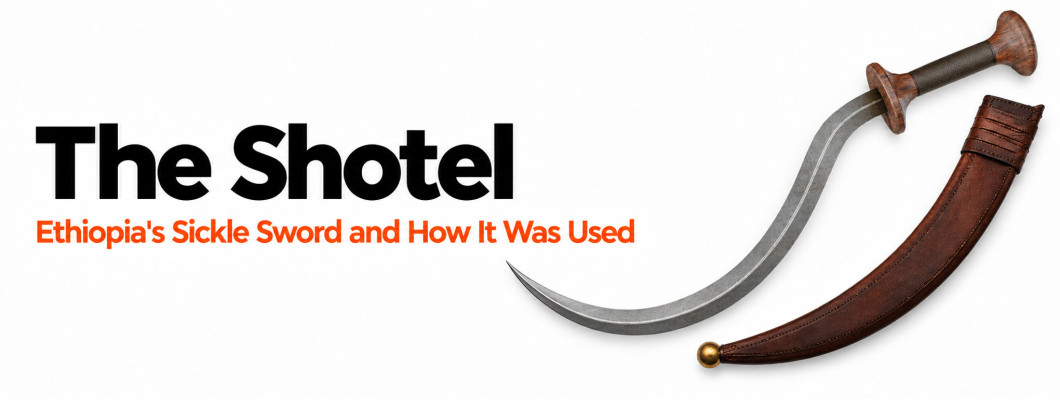
The shotel (Amharic ሾተል) is the sickle-shaped sword of the Ethiopian highlands: a thin, flat, double-edged blade bent into a curve so deep it is almost a half-moon, on a simple guardless hilt of horn or wood. Its shape is usually explained by the shields of the region. A straight sword striking a large hide shield stops on it; a shotel, swung around the shield's edge, can reach the man behind it or hook the shield aside. Shotels are best known from the nineteenth and early twentieth centuries, when Ethiopian nobles and warriors were photographed with them at their sides around the time of the Battle of Adwa in 1896. This guide explains the blade, how it was meant to be used and how much of that is certain, how it was carried, how it differs from the Egyptian khopesh and the Nepali kora, and how to commission a hand-forged shotel today.
The shotel sits in a wider African tradition of blades; our guide to the best African swords every collector should know covers the Central African forms, and the shotel is the eastern counterpart that guide could not include.
A Hand-Forged Shotel Is Made to Order
There is no catalogue shotel yet, so every one we make is a custom build: blade curve and length, hilt material and scabbard to your reference. The forge quotes it, builds it in 4 to 6 weeks from 5160 spring steel, and ships it tracked worldwide.
Request a Custom ShotelWhat a Shotel Looks Like
The blade. Flat and fairly thin, double-edged, with a diamond or lenticular cross-section and no fuller on most examples. It runs straight out of the hilt for a short distance, then bends into a deep, even curve that carries the point round toward the wielder's side. Measured along the curve, blades commonly run to roughly 75 to 100 cm (about 30 to 40 inches), though the straight-line distance from hilt to point is much shorter because of the bend. Because the blade is thin for its length it is surprisingly light.
The hilt. A simple grip of rhinoceros horn, other horn or hardwood, with no cross-guard and often a slightly swelling pommel. The hand is protected by the shield, not the sword.
The scabbard. A close-fitting leather sheath that follows the full curve of the blade, usually finished at the tip with a metal ball or knob, often silver or brass on finer pieces. The sheath was worn at the right hip on a belt or sash, the curve hanging forward, and the ball protected the thin point.
How the Shotel Was Meant to Be Used
Ethiopian warriors fought with spear and shield, and the round or oval hide shields of the highlands were large and stiff. Against a man behind such a shield, a straight sword spends its energy on the shield's face. The standard account of the shotel is that its curve lets the wielder strike around the shield instead: the blade passes the shield's rim and the point or the forward part of the edge lands on the shoulder, back or side of the defender. The same curve could hook the shield's rim and pull it out of the way for a following spear thrust. Some accounts add that riders could use it to pull an opponent from the saddle.
It is worth being honest about the evidence. The shield-reaching explanation is logical and widely repeated, but detailed first-hand descriptions of shotel technique are scarce, and much of what is written about it, including some of our own earlier material, leans on reconstruction rather than record. What is certain is the shape, the carry, the date range of surviving examples and the fact that it was a status weapon as well as a fighting one. The shotel was a sword of nobles and their retainers as much as of ordinary soldiers, and in the late nineteenth century it was worn as much for rank as for use.
Mechanically, the deep curve has costs as well as advantages. It is a poor thrusting weapon in the ordinary sense, because the point does not lie along the line of the arm, and it is awkward to parry with. It rewards a wielder who keeps the shield up and uses the sword for opportunistic reaching cuts, which fits a spear-and-shield fighting style where the sword is the secondary weapon. Our guide to curved vs straight swords sets out the general trade-off the shotel takes to its extreme.
The Shotel in Ethiopian History
The shotel's origins are not well documented. It is often said to be very old, going back to the Aksumite or early medieval Ethiopian state, but surviving examples and reliable images date mostly from the eighteenth century onward, and the weapon is best known from the nineteenth and early twentieth. We would rather say that plainly than repeat a date we cannot support.
What is well attested is the shotel's place in the Ethiopian empire of the late nineteenth century. Portraits and photographs of nobles, governors and their retinues from the reigns of Tewodros II, Yohannes IV and Menelik II often show the shotel worn on the right side in its ball-tipped scabbard alongside a shield and spear or a rifle. Ethiopia's victory over Italy at Adwa in 1896 was won chiefly with rifles and artillery, but traditional arms were still carried by many of the warriors who fought there, and the shotel remained part of the dress of rank into the twentieth century and the Second Italo-Ethiopian War of 1935 to 1936. Today it survives as a ceremonial and heritage weapon and as a collector's sword.
Shotel vs Khopesh vs Kora
The shotel is regularly confused with two other curved blades, and the differences are worth fixing.
| Feature | Shotel | Khopesh | Kora |
|---|---|---|---|
| Origin | Ethiopian highlands; best known from the 18th to early 20th centuries | Egypt and the Levant, c. 1600 to 1100 BC | Nepal; a traditional heavy chopping sword |
| Material of originals | Iron and steel | Cast bronze | Steel |
| Curve | Very deep, almost a half-moon | Straight section, then a crescent | Forward-angled, flaring to a broad tip |
| Edges | Double-edged | Single edge on the outside of the crescent | Single edge on the inside (concave) side |
| Blade section | Thin, flat, diamond or lenticular | Thick cast section | Heavy, wide toward the tip |
| Guard | None | None or minimal | None or a small disc |
| Main use | Reaching around a shield; hooking; status | Slashing and hooking; royal symbol | Heavy chopping; ceremony and sacrifice |
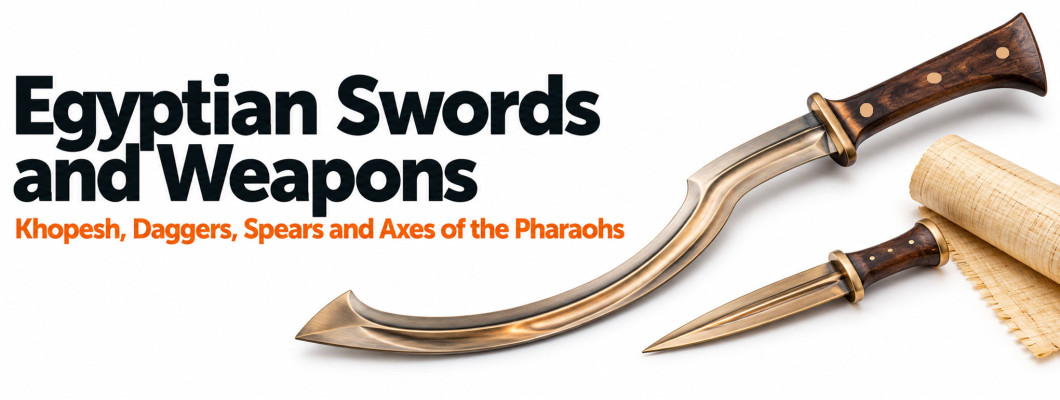
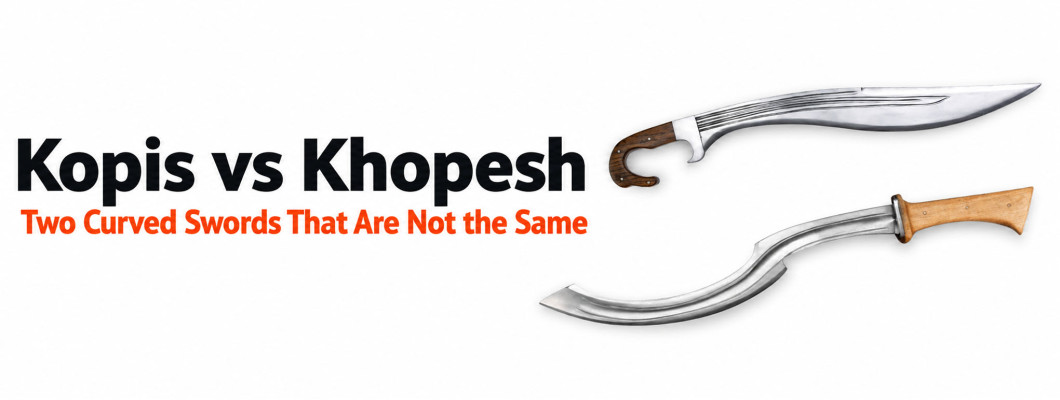
The khopesh and the shotel are separated by more than two thousand years and share only the general idea of a sickle-shaped blade; our khopesh vs shotel comparison covers that pairing, and our guide to Egyptian swords and weapons places the khopesh in its own world. The kora curves the other way, edge inside, with the weight thrown to a flared tip for chopping; see is the kora a sword or a machete? for that blade.
Commissioning a Hand-Forged Shotel
Everest Forge does not yet list a shotel in the catalogue, so a shotel from us is a custom forge build. That is not a drawback for this sword in particular: shotels vary a good deal in curve, length and hilt, and most collectors want one that matches a specific reference. What we need from you is a photograph or drawing of the shotel you want, the overall length along the curve, the hilt material (hardwood, horn or a horn-look composite) and whether you want the traditional ball-tipped leather scabbard.
Each shotel is forged from mono-steel 5160 spring steel with a full tang, hardened and tempered so that a thin, deeply curved blade keeps its shape. Custom builds take 4 to 6 weeks at the forge; shipping is DHL or FedEx, tracked, 7 to 14 business days worldwide. A shotel can be ordered left-handed, with the curve and scabbard mirrored, by writing "Left Handed" in the request, or blunt with a rounded tip for display and re-enactment. While you decide, the African swords collection and the southeast African swords show the blades we already forge, and the hand-forged khopesh is the nearest catalogue sword in feel.
An honest note. Historical shotels were made from local iron and steel, sometimes of uneven quality. Everest Forge forges mono-steel 5160 only, and does not make Damascus, pattern-welded, folded or laminated steel. Our shotel is a steel interpretation of the historical form, faithful in shape, curve and carry, and tougher than most originals.
Related Guides
Commission Your Shotel
Send a reference photo or drawing, the length along the curve and the hilt you want. We quote it, forge it from 5160 spring steel with a ball-tipped leather scabbard if you choose, and ship it tracked worldwide.
Start a Custom Forge RequestFrequently Asked Questions
What is a shotel?
A deeply curved, double-edged sword from the Ethiopian highlands, with a thin flat blade, a guardless horn or wood hilt and a close-fitting leather scabbard ending in a metal ball. It is best known from the eighteenth to early twentieth centuries.
Why is the shotel so curved?
The usual explanation is that the curve lets the sword reach around the edge of a large hide shield to strike the man behind it, or hook the shield aside. The logic is sound, but detailed historical descriptions of shotel technique are scarce.
Is the shotel double-edged?
Yes. Most shotels are sharpened on both edges, with a flat diamond or lenticular cross-section and no fuller.
How long is a shotel?
Measured along the curve, blades commonly run to roughly 75 to 100 cm (about 30 to 40 inches). The straight-line distance from hilt to point is much shorter because of the bend.
How old is the shotel?
Its origins are not well documented. It is often said to be very old, but most surviving examples and reliable images date from the eighteenth century onward, and it is best known from the nineteenth and early twentieth centuries.
Was the shotel used at the Battle of Adwa?
Shotels were carried by many Ethiopian warriors and nobles of the period and appear in photographs from around 1896, but the battle was won chiefly with rifles and artillery. The shotel was more a sidearm and mark of rank by then.
Is a shotel the same as a khopesh?
No. The khopesh is an Egyptian Bronze Age sickle-sword with a single edge on the outside of its crescent. The shotel is an Ethiopian steel sword, double-edged, much thinner, and more than two thousand years younger.
How was the shotel carried?
In a close-fitting leather scabbard that follows the curve, usually tipped with a silver or brass ball, worn at the right hip on a belt or sash with the curve hanging forward.
Does Everest Forge sell a shotel?
Not as a catalogue item yet. A shotel is available as a custom forge build from a reference photo or drawing, in 5160 spring steel with a full tang, typically in 4 to 6 weeks plus shipping.
Can a shotel be made left-handed or blunt?
Yes. A left-handed shotel has the curve and scabbard mirrored; a blunt build with a rounded tip suits display and re-enactment. Both are specified in the custom forge request.