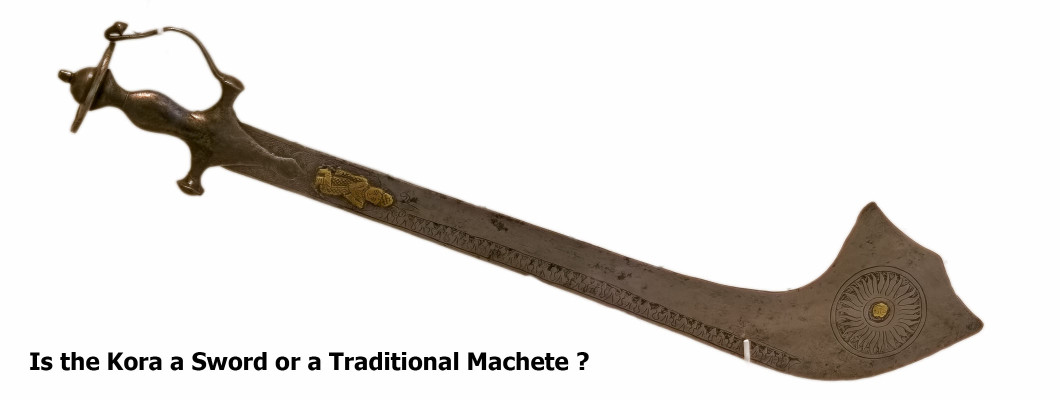
Is the Kora a Sword or a Traditional Machete?
The Kora is one of those blades that immediately sparks debate. Some people look at its wide, forward-heavy tip and say, “That’s basically a machete.” Others insist it is a sword — and not just any sword, but a traditional Himalayan weapon with deep cultural roots.
So which is it?
The truth is simple once you separate function from history. The Kora is historically a sword — but mechanically, it shares similarities with certain traditional machete designs.
The Kora as a Sword
In historical terms, the Kora is classified as a sword. It originates from Nepal and nearby regions, where it was used in martial and ceremonial contexts. Unlike a traditional machete, which developed primarily as an agricultural tool, the Kora was built and carried as a weapon.
Its construction reflects that purpose. A proper Kora sword features a defined hilt, guard elements, and balance suited for powerful combat strikes. It appears in historical accounts and religious traditions, especially within Hindu ceremonial use.
From a cultural and academic standpoint, the Kora belongs firmly in the sword category.
Why It Looks Like a Machete
The confusion comes from the blade’s shape.
The Kora has a wide, flared tip and a strong forward-weighted profile. That design concentrates mass toward the front of the blade, increasing chopping force. If you compare it to a bolo-style traditional machete, the mechanical similarity becomes obvious.
Both blades:
- Emphasize forward momentum
- Deliver strong downward chopping power
- Perform well against thick material
- Rely on weight distribution rather than speed alone
Because of this, many modern observers casually refer to the Kora as a machete. In terms of cutting behavior, it does feel closer to a heavy chopping machete than to a slim European-style sword.
The Difference Between a Sword and a Machete
Classification is not only about shape — it is about origin and intent.
A traditional machete developed as a farming tool. Its primary role was clearing vegetation, harvesting crops, and managing land. Over time, some machetes were used defensively, but that was secondary.
A sword, on the other hand, was developed first as a weapon. Even if it can perform cutting tasks, its identity is martial.
The Kora was designed and recognized as a weapon. That is why historians and collectors refer to it as a sword rather than a machete.
Functionally, It Chops Like a Heavy Blade
If you judge purely by performance, the Kora behaves like a powerful forward-weighted cutting blade. The widened tip increases impact energy during a strike, making it extremely effective for deep cuts.
This is where comparisons to traditional machete designs come from. In practical cutting tests, a properly forged Kora sword can generate chopping force similar to certain heavy-duty machetes .
But similar performance does not change historical classification.
Everest Forge Perspective
At Everest Forge , we classify the Kora as a sword because that is historically accurate. However, we also acknowledge its functional similarity to certain traditional machete designs, especially forward-weighted chopping blades.
When forged from high-carbon steel and properly oil tempered, a Kora sword becomes a serious cutting instrument — not just a ceremonial piece.
It carries the identity of a sword, but the power of a heavy chopping blade.
Final Answer
The Kora is a sword by history, tradition, and classification.
It may resemble a traditional machete in shape and chopping performance, but its origins and cultural role place it firmly in the sword category.
Understanding that distinction helps appreciate the Kora for what it truly is — a forward-weighted Himalayan sword with extraordinary cutting authority.

Traditional Kora Sword – Forward-Weighted Himalayan Power
This Everest Forge Kora Sword represents one of Nepal’s most striking historical blade designs. With its dramatic forward curve and flared tip, the Kora is engineered for powerful downward strikes and commanding presence.
Hand forged from high-carbon steel and oil tempered for durability, this Kora is built not as decoration, but as a functional blade inspired by Himalayan martial tradition. The wide tip concentrates mass toward the front, delivering serious cutting authority with every swing.
If you are looking for a traditional sword that combines history, strength, and forward-weighted performance, this Kora stands apart.