Can a Blade Be Left-Handed?
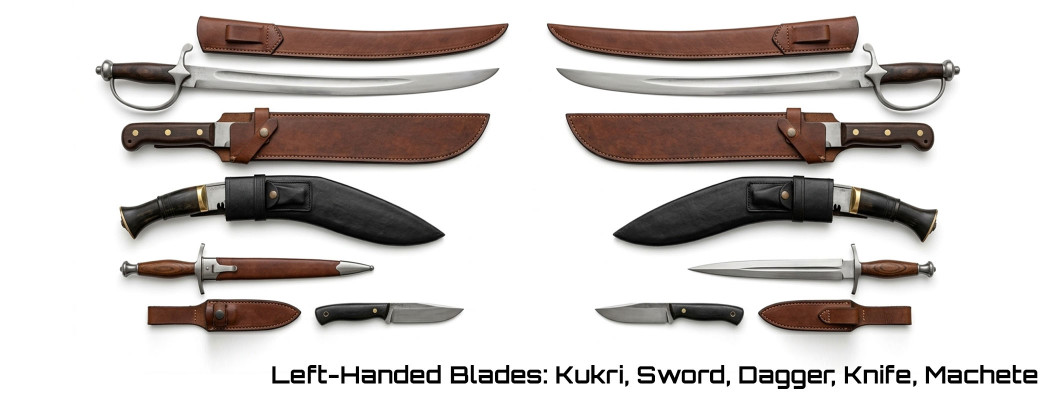
Yes — but on most blades, the edge itself is not the part that is left- or right-handed. A kukri (khukuri), sword, dagger, knife or machete is usually ground on both sides and cuts the same in either hand. What makes a blade handed is everything around the edge: the sheath or scabbard and the hip it hangs from, the belt fittings and retention strap, the shape of the grip and guard, the side that shows the engraving, and, on a few knives, a single-bevel grind sharpened on one side only. At Everest Forge, every blade is forged to order, so getting it made for your left hand is simple: write "Left Handed" in the order note at checkout, and we take care of the rest.
Quick Answer: Left-Handed Blades
- Most edges work for either hand. Kukris, swords, daggers and machetes are usually double bevel.
- The sheath is the main handed part. Which hip it hangs on, how the belt loop sits, and which way the strap closes.
- Grips and guards can be handed when they have a side guard, a side ring, finger grooves or a shaped profile.
- Single-bevel knives are truly handed, because the edge is sharpened on one side only.
- On a kukri (khukuri), the dap is handed: the karda and chakmak pockets, the frog, and the engraved side.
- To order: choose your blade, then write Left Handed in the order note. We confirm by email before forging.
Key Terms
- Ambidextrous
- Works equally well in either hand.
- Double bevel
- An edge ground on both sides. Most blades are made this way.
- Single bevel (chisel grind)
- An edge ground on one side only, with the other side flat. It is made for one hand.
- Show side
- The side of a blade that faces outward when it is worn or displayed, and usually carries the engraving or etching.
- Frog
- The leather loop or hanger that carries a scabbard on a belt.
- Retention strap
- A strap with a snap that holds the handle in the sheath.
- Cross-draw
- Carrying a blade on the opposite hip to the drawing hand, with the handle facing forward.
What Makes a Blade Left- or Right-Handed?
A blade is handed when any part of it — the grind, the grip, the guard or the sheath — is shaped to suit one hand better than the other. On most blades, that is the sheath and its fittings rather than the steel.
| Part | Is it handed? | Why it matters |
|---|---|---|
| Double-bevel edge | No | Ground on both sides, so it cuts the same either way |
| Single-bevel edge | Yes | Cuts straight for one hand and steers off-line for the other |
| Sheath or scabbard | Yes | Decides the hip, the draw angle and how the blade sits against you |
| Belt loop, frog or hanger | Yes | Sets the carry side and the tilt of the handle |
| Retention strap | Yes | The snap should open easily with your drawing hand |
| Grip shape | Sometimes | Finger grooves, thumb rests and shaped profiles can favour one hand |
| Side guard | Yes | Sits on one side of the grip, over the back of the hand |
| Side ring | Yes | Sits at the centre of the guard and stands out from one face of the blade |
| Engraving or etching | Yes | The design should face outward on the side you wear it |
Left-Handed Kukri (Khukuri): What Changes?
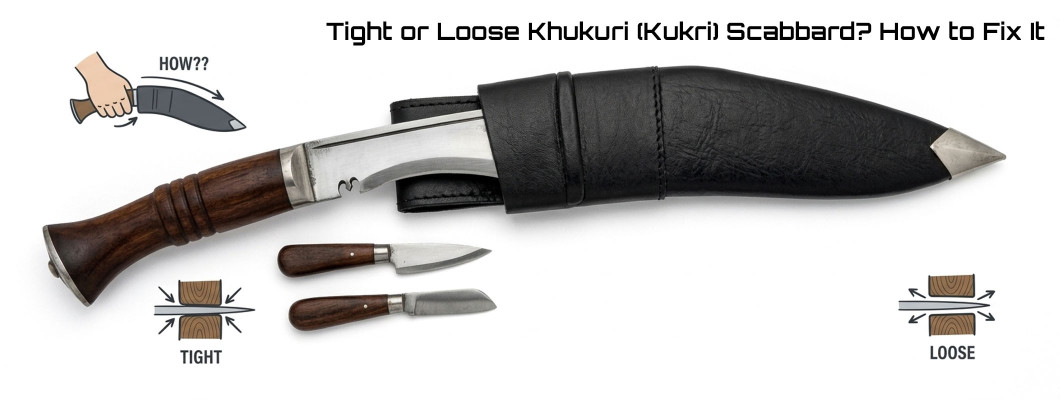
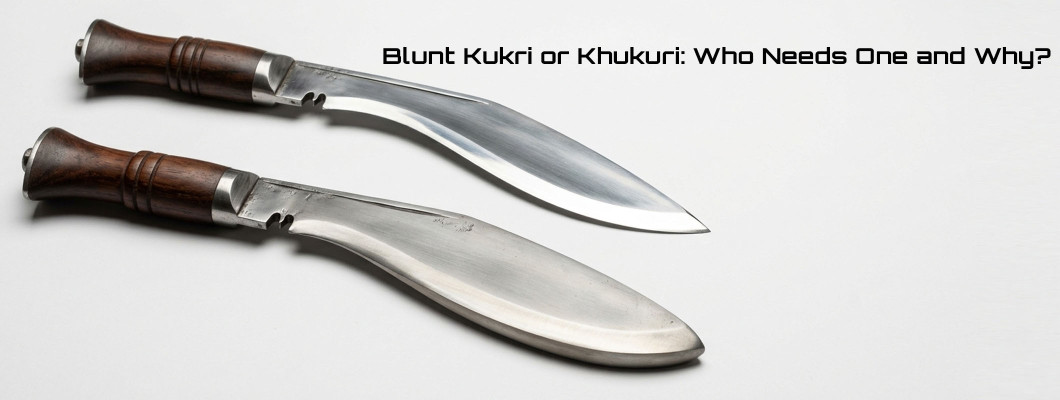
A left-handed kukri (khukuri) has the same double-bevel blade as any other; its dap (scabbard) is what gets made for a left-hander. A khukuri is ground on both sides, so it chops and slices the same whichever hand holds it. The handed parts are:
- The karda and chakmak pockets. On a traditional dap they sit on the back, against your body. Worn on the other hip, they need to be on the other face.
- The frog and belt loop. These decide which hip the khukuri hangs from and how it tilts for the draw.
- The show side. An etched or engraved kukri is decorated on the side that faces out when worn, and that side changes with the hip.
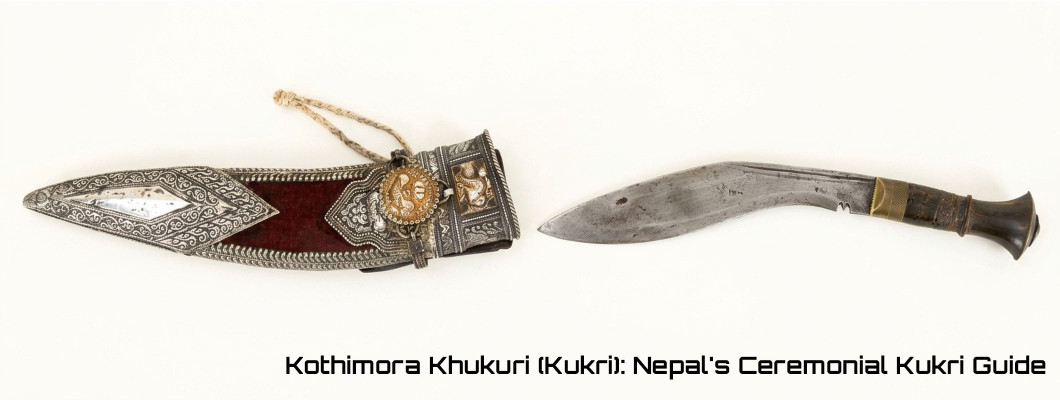
- The kothimora. On a kothimora ceremonial khukuri, the badge and decorated mounts face outward, so the carry side matters for display too.
Browse the kukri and khukuri collection, then add Left Handed to your order note.
Left-Handed Swords: What Changes?
A left-handed sword usually has the same blade as a right-handed one; the hilt fittings and the scabbard are where it changes. This matters most for curved and single-edged swords.
- Straight double-edged swords — arming swords, longswords and most ancient swords — have symmetrical blades and usually symmetrical hilts.
- Curved, single-edged swords such as sabres and scimitars sit in the scabbard with the edge facing a set direction, and the scabbard hangs on the hip opposite the drawing hand. A left-hander's scabbard hangs on the right.
- Side guards are built for one hand. A side guard sits over the back of the hand, so on a left-handed hilt it moves to the opposite side of the grip.
- Shaped grips, with a thumb groove or an angled back, can suit one hand.
- Scabbard fittings — suspension rings, frogs and belt hangers — are placed for the draw side.
Curved and single-edged swords are where a left-handed build matters most — browse scimitar swords and single-edged swords, or the custom forged swords collection. Read about what makes a sword battle ready too.
Left-Handed Daggers: What Changes?
A symmetrical, double-edged dagger works in either hand; a left-handed dagger build changes the sheath, and any one-sided guard, grip or edge. Daggers have a long left-handed history. The Renaissance main gauche — French for "left hand" — was a parrying dagger held in the left hand while the rapier was held in the right, which is why its guard and side ring were placed to protect that hand. A left-handed fencer does the opposite — sword in the left hand, parrying dagger in the right — so the side ring must be mirrored.
- Double-edged daggers — medieval, Roman, Viking and most tactical designs — have symmetrical blades and hilts, so only the sheath is handed.
- Single-edged daggers, including many curved and Middle Eastern patterns, sit in the sheath with the edge facing a set way, so the sheath must suit your draw.
- Parrying daggers with a side ring — the loop at the centre of the guard that stands out from one face of the blade — are made for one hand. For the other hand, the side ring is forged on the opposite face.
- Daggers with a side guard have the guard on one side of the grip, and it moves across for a left-handed build.
- Grips with a thumb rest or a shaped palm swell can favour one hand.
- Dagger sheaths — belt, boot or cross-draw — have a loop, a carry angle and often a retention strap or belt button, all set for one side.
Browse hand-forged daggers and traditional and historical daggers, including our Side Ring Parrying Dagger, or send a custom dagger request.
Left-Handed Knives and Knife Sheaths
A left-handed knife usually means a left-handed knife sheath; only single-bevel knives need the edge itself mirrored.
- Single-bevel and chisel-ground knives are sharpened on one side. A right-handed one steers off-line in a left hand, so the grind must be mirrored.
- Kitchen knives: Western double-bevel chef knives work either way, while single-bevel styles and D-shaped handles are made for one hand.
- Hunting, bushcraft and bowie knife sheaths have a belt loop, a carry angle and often a retention strap or a pocket for a sharpener or fire steel — all set for one side.
- Handles with finger grooves are usually symmetrical, but thumb ramps and shaped palm swells can favour one hand.
For edge care on either grind, see our knife sharpening guide.
Left-Handed Machetes and Machete Sheaths
A left-handed machete is mostly about the machete sheath; the blade itself is usually ground on both sides and works in either hand. A machete's sheath has a belt loop or frog, a carry angle and often a strap, and all of them are set for one side. A few traditional patterns, such as some parangs, are ground unevenly to chop best in one hand — for those, a left-handed build changes the grind as well.
Browse big machetes, and for keeping one sharp, see how to sharpen a machete.
What Is a Left-Handed Sheath?
A left-handed sheath is the mirror image of a right-handed one, built to draw cleanly with your left hand. A belt knife, dagger or machete sheath is worn on your left side; a sword scabbard, worn cross-draw, hangs on your right. For most kukris, swords, daggers, knives and machetes, it is the part that actually changes.
- Stitched seam — a folded leather sheath is stitched along one side only, and that seam moves to the other side on a left-handed sheath.
- Belt loop or frog — placed so the sheath hangs on the correct side.
- Carry angle — the tilt of the handle, set so your left hand meets it naturally.
- Retention strap — the snap opens toward your left thumb.
- Pockets and accessories — sharpener, fire steel, or a kukri's karda and chakmak, positioned for left-side use.
- Edge direction — on curved and single-edged blades, the edge sits the right way for a left-hand draw.
- Show side — decoration and engraving face outward when worn.
If you only need the sheath made left-handed, the order note is the same: Left Handed.
How Do You Order a Left-Handed Blade From Everest Forge?
Choose your blade, then write "Left Handed" in the order note at checkout — we take care of the rest. Every Everest Forge blade is forged after you order it, so there is no separate left-handed product to find.
- Choose your blade. Pick the kukri (khukuri), sword, dagger, knife or machete you want.
- Set your options. Choose the length, finish, handle and other options as usual.
- Write "Left Handed" in the order note. If you carry the blade in an unusual way — cross-draw, on a pack, on a drop-leg — add a few words about it.
- We confirm the build by email and start forging. Preparation takes seven to ten days.
- Your left-handed blade ships tracked and arrives a further seven to ten days later.
Combining notes. A left-handed note works alongside other build notes. For example, a left-handed stage-combat blade just needs both: Left Handed and Stage combat build — rebated edge, rounded tip. Read more about stage combat blades.
Should You Add the Note Even if the Blade Looks Symmetrical?
Yes — if you are left-handed, always add it. Even when the blade is fully symmetrical, the sheath, strap and show side still have to be set for one hand. Writing "Left Handed" takes two words and means the finished piece is right for you from the start. Changing a sewn sheath or a fixed scabbard mount afterwards is rarely neat.
What if You Want a Fully Custom Left-Handed Design?
Use our custom forge request for any left-handed design that is not in the catalogue. If you want a mirrored single-bevel grind, a one-sided guard, a special carry system or a completely new blade, describe it on the custom forge page, and we will quote and build it for your left hand. For questions before you order, contact us.
Left-Handed? Every Blade Can Be Made for You
Choose any kukri (khukuri), sword, dagger, knife or machete and write "Left Handed" in the order note. For a fully bespoke left-handed design, send us a custom forge request.
Request a Custom Forge →Explore More Guides
Frequently Asked Questions
Can I order any Everest Forge blade left-handed?
Yes. Every blade is forged to order, so you can ask for a left-handed build on any product. Choose your blade and options as usual, and write Left Handed in the order note at checkout. We take care of the rest and confirm the build by email before forging.
Is a kukri (khukuri) left-handed or right-handed?
The blade of a kukri (khukuri) is ground on both sides, so it cuts the same in either hand. What is handed is the dap (scabbard): the side the karda and chakmak pockets sit on, how it hangs from the belt, and which side of the blade shows its engraving. Add Left Handed to your order note and the khukuri is made for left-hand carry.
Are there left-handed swords?
Most straight, double-edged swords work in either hand. Handedness shows up in the hilt, when the guard has a side guard or the grip is shaped, and in the scabbard and its belt fittings, which decide which hip the sword hangs from. Curved, single-edged swords must also sit edge-up or edge-down correctly for a left-hand draw.
What is a left-handed sheath?
A left-handed sheath or scabbard is the mirror image of a right-handed one, set up for a left-hand draw: a knife, dagger or machete sheath is worn on the left side and a sword scabbard on the right, and the belt loop, carry angle, stitched seam, retention strap, accessory pockets and edge direction are all arranged for the left hand. On most kukris, swords, daggers, knives and machetes it is the main part that changes. Write Left Handed in the order note to get one.
Are there left-handed daggers?
Yes. Most double-edged daggers suit either hand, but the Renaissance main gauche was made to be held in the left hand, and parrying daggers with a side ring, single-edged daggers and dagger sheaths can all be built for a left-hander. Write Left Handed in the order note.
What is a single-bevel knife?
A single-bevel, or chisel-ground, knife is sharpened on one side only, with the other side flat. It cuts in a slight curve and is made for one hand, so a right-handed single-bevel knife is awkward for a left-hander. Most knives are double bevel and work in either hand.
Do machetes need to be left-handed?
Most machetes are ground on both sides and work in either hand. The sheath is what matters: its belt loop, carry angle and retention strap. Some traditional patterns, such as certain parangs, are ground unevenly for one hand, so a left-handed note is worth adding.
Does a left-handed build take longer?
Every blade is forged to order, so a left-handed build is made alongside every other order. Forge time is normally seven to ten days, and shipping takes a further seven to ten days. We confirm the details by email before forging.
What else should I put in the order note?
Write Left Handed first. If you carry the blade in an unusual way, such as cross-draw, on a pack or on a drop-leg, add a few words about it. If you also want another build standard, such as a stage-combat build, add that note too.
Can a right-handed sheath be switched to left-handed?
Sometimes, but it is rarely neat. Belt loops, frogs and retention straps are sewn in place, and a kothimora or traditional dap has pockets and mounts fixed to one side. It is far easier to order the blade left-handed from the start.