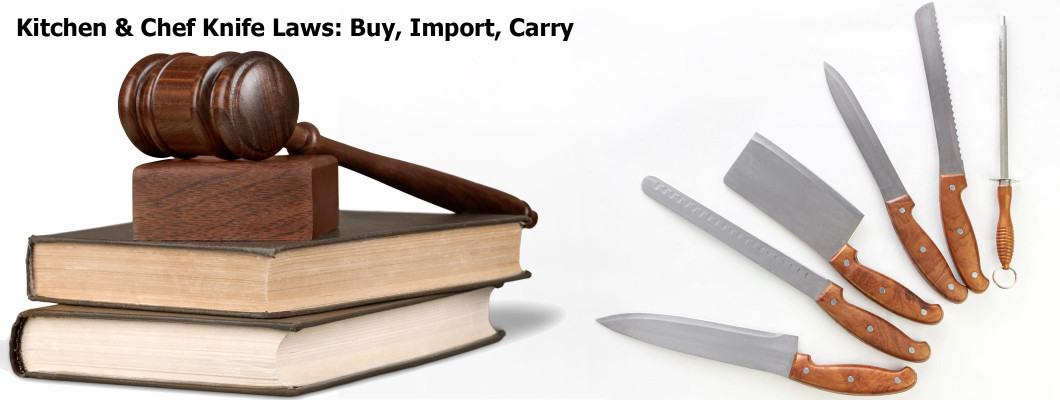
Kitchen & Chef Knife Laws: Buying, Importing and Carrying
The short answer: owning kitchen and chef's knives is legal almost everywhere in the world. No country treats an ordinary cook's knife as a prohibited weapon, and you do not need a licence to keep one in your kitchen. Where the law does apply is in three specific situations — buying one (age limits), importing one across a border (customs rules), and carrying one in public (which needs a good reason). This guide walks through all three, with the current rules for the UK, US, Australia, Germany and Japan.
Owning a Kitchen Knife Is Legal — Carrying Is the Catch
The single most important thing to understand about kitchen knife law is the gap between owning and carrying. In nearly every country, you may own as many kitchen and chef's knives as you like, of any length, with no permit. The moment you take one out of the house and into a public place, a different set of rules applies — and this is where otherwise law-abiding people get caught out.
A chef walking to work with a knife roll is acting lawfully. The same chef carrying the same knife through town at night with no reason to have it is not. The knife has not changed; the context has. Almost all kitchen knife law comes down to this distinction, so keep it in mind as you read.
Buying a Kitchen Knife — Age Limits
The most common legal rule attached to kitchen knives is a minimum age to buy one. This protects retailers and buyers alike, and it applies to ordinary cutlery just as much as to any other blade.
- United Kingdom: You must be 18 or over to buy any knife, kitchen knives included — in store and online, with no exception for cutlery. Since 2022 the law also requires age verification at the point of delivery: the courier must check photo ID and confirm the recipient is 18+. Under the Crime and Policing Act 2026, these delivery and collection-point ID checks have been reinforced. One regional exception: in Scotland, 16 and 17-year-olds may be sold domestic cutlery and kitchen knives.
- United States: There is no federal minimum age to buy a kitchen knife, but most states set 18, and most retailers require it. A handful of states and cities have their own rules, so local law governs.
- Germany: There is no age limit to own a kitchen knife, though retailers commonly apply an 18+ policy of their own.
- Australia & Canada: Purchase-age rules are set at state and provincial level; 18 is the common standard, and reputable retailers verify it.
The practical takeaway: if you are 18 or older, buying a kitchen knife is straightforward everywhere. If you are buying as a gift, the recipient — not just the purchaser — generally needs to meet the age requirement where one applies.
Importing a Kitchen Knife — Crossing Borders
Ordering a hand-forged kitchen knife from abroad is legal in the vast majority of cases, because a plain single-edged cook's knife is not a restricted weapon. But customs rules do catch specific blade features, so it is worth knowing what actually triggers a problem.
The distinction that matters most at customs is single-edged versus double-edged. A single-edged fixed blade — which is what a chef's knife, santoku, cleaver, boning knife and almost every kitchen knife is — generally imports without issue. A double-edged blade (a dagger, or any knife with a second sharpened edge) is what many countries restrict on import.
- Australia is the clearest example: most standard knives, including kitchen knives, are legal to import, but double-edged daggers and similar devices cannot be imported without a permit. A single-edged kitchen knife imports fine; this is exactly why the single-edged design of kitchen knives matters for Australian orders.
- Most other countries admit ordinary kitchen knives freely, subject to normal customs duties and declarations. The restrictions target weapons — automatics, disguised blades, double-edged daggers — not cook's knives.
- Duties and taxes are separate from legality. Even a perfectly legal knife may attract import duty or tax depending on value and destination; that is a customs-cost question, not a legal one.
Because every kitchen knife we forge is a single-edged blade, our knives are on the straightforward side of this line for almost every destination. For the full country-by-country breakdown of ownership and import across all knife types, see our country-by-country knife law guide.
Carrying a Kitchen Knife in Public — the Good-Reason Rule
This is where most people go wrong, so it deserves the most attention. Owning a kitchen knife is legal; carrying it in public without a good reason is generally not. Kitchen knives are fixed-blade knives, and fixed blades are the category most restricted for public carry.
What counts as a good reason
Across the UK, Germany and most of the US, the law recognises legitimate, work- and activity-based reasons to have a knife with you:
- Taking knives to and from work — a chef carrying their knives to the restaurant is the textbook lawful example.
- Transporting a knife you have just bought home from the shop, in its packaging.
- Carrying a knife to a class, demonstration or exhibition — a cooking class, a knife-skills course.
- Moving house or transporting kitchen equipment.
What is not a good reason, in the UK and many other places, is self-defence — carrying a knife to protect yourself is not a lawful reason, and neither is simply "having it on me." Using or threatening with even a lawfully carried knife is a serious offence regardless of the good-reason rule.
How to carry one lawfully
The safe practice, everywhere, is the same: transport a kitchen knife wrapped, boxed or in a knife roll or case — never loose or on your person — and only when you have a genuine reason to be moving it. In Germany, for instance, the law expressly permits transporting a kitchen knife in a locked container such as a bag or knife block, and recognises "legitimate interest" including professional practice. A sheathed or cased blade in transit for work reads very differently from a bare knife in a pocket.
Blade-length rules to know
- Germany: Carrying is restricted, but knives with a blade under 12 cm are among the exceptions, and transport in a closed container for a legitimate interest is permitted.
- Japan: Has some of the strictest rules — carrying a blade over 15 cm in public without a permit is restricted, and even shorter blades are controlled. Note this governs carrying inside Japan; buying a boxed kitchen knife to take home is generally fine.
- United States: Carry rules are set by state and city, and some set blade-length limits for public carry. Always check your state and local ordinances.
- UK: There is no "legal length" for a kitchen knife at home — the good-reason rule governs public carry regardless of length (the 3-inch/non-locking exception applies only to folding pocket knives, not kitchen knives).
Kitchen Knife Law at a Glance
| Country | Own | Buy age | Carry in public |
|---|---|---|---|
| UK | Legal | 18+ (16+ cutlery in Scotland); ID checked at delivery | Good reason required (work, transport) |
| US | Legal | No federal age; usually 18, varies by state | Varies by state/city; work reason recognised |
| Australia | Legal | ~18, state-set | Lawful excuse required; state-set |
| Germany | Legal | No ownership age limit | Restricted; under-12 cm blade or legitimate interest exempt |
| Japan | Legal | Retailer-set | Over 15 cm restricted without permit |
This table is a simplified summary — the detail above and your local law govern. For ownership and import across every knife type and more countries, see the full country-by-country guide.
Buying Kitchen Knives With Confidence
For the ordinary buyer, none of this is cause for worry. If you are 18 or over, buying a hand-forged kitchen knife — and having it shipped to you — is legal and routine in almost every country. The rules above matter mainly when you carry a knife out of the house, and the answer there is simple: have a reason, and transport it cased. Keep your knife in the kitchen and use it for cooking, and no law is engaged at all.
Every kitchen knife we forge is a single-edged blade in 5160 high-carbon steel, made as a cooking tool and shipped worldwide with appropriate packaging and declarations.
Hand-Forged Kitchen Knives, Shipped Worldwide
Over 30 single-edged chef knives, santokus, cleavers and more — hand-forged in Nepal from 5160 spring steel, full tang, with free personalisation. We ship worldwide with proper packaging and customs declarations. Check your local rules, then choose your blade.
Browse Chef & Kitchen Knives →Frequently Asked Questions
Are kitchen knives legal to own?
Yes, in virtually every country. An ordinary kitchen or chef's knife is not a prohibited weapon, and you do not need a licence to own one. Legal rules attach to buying (age limits), importing (customs), and carrying in public (good reason) — not to keeping and using a knife in your kitchen.
How old do you have to be to buy a kitchen knife?
In the UK you must be 18 to buy any knife, including kitchen knives, with ID checked at delivery (Scotland allows 16-17 for domestic cutlery). The US has no federal age but most states and retailers require 18. Germany sets no ownership age limit, though shops often apply their own 18+ policy. Where an age rule applies, a knife bought as a gift must go to someone who meets it.
Can I carry a kitchen knife in public?
Only with a good reason. Owning a kitchen knife is legal, but carrying a fixed-blade knife in public without lawful reason is an offence in the UK, Germany, Australia and many US jurisdictions. A chef taking knives to work, someone carrying a knife home from the shop, or transporting one to a cooking class all qualify. Self-defence does not count as a good reason. Always carry a knife cased or wrapped, never loose.
Can I legally import a kitchen knife from another country?
In almost all cases, yes. A single-edged kitchen knife is not a restricted weapon and imports freely into most countries, subject to normal customs duties. The main thing customs restricts is double-edged daggers and similar weapons — Australia, for example, requires a permit for double-edged blades but admits single-edged kitchen knives. Because kitchen knives are single-edged, they are on the straightforward side of import rules.
Is there a legal blade-length limit for kitchen knives?
Not for owning or using one at home — you can own a kitchen knife of any length. Length rules apply to public carry in some places: Germany exempts blades under 12 cm from some carry restrictions, and Japan restricts carrying blades over 15 cm without a permit. In the UK there is no legal length for a kitchen knife; the good-reason rule governs public carry regardless.
Is it legal to carry a chef's knife to work?
Yes. Taking the knives you use at work to and from your workplace is a recognised good reason in the UK, Germany and most US states. A chef's knife roll transported to a restaurant is the textbook lawful example. Keep the knives cased, carry them only for the commute, and, where practical, be ready to explain the work reason.
Can I give a kitchen knife as a gift?
Yes, where the recipient meets any applicable purchase age. In the UK it is illegal to sell, lend or give a knife to anyone under 18 (16-17 for cutlery in Scotland), so a gift knife must go to an adult. Engraved and personalised kitchen knives make popular gifts and are perfectly legal for adult recipients.
Official Sources
For the primary rules referenced above, consult the official guidance directly — these are the authoritative sources, and they are kept current by the governments that publish them:
- UK: gov.uk — Selling, buying and carrying knives
- Australia (import): Australian Border Force — Weapons
- Germany: Waffengesetz §42a (carry rules)