Why Stainless Steel Swords Break — and Where Stainless Is Actually Right
Stainless steel swords break for two reasons, and only one of them is metallurgy. The chromium that makes steel rust-resistant also costs it toughness, and toughness is exactly what a long blade needs to survive impact. But the bigger reason is simpler: almost every stainless sword ever sold was built as a decorative object — cast rather than forged, with a rod for a tang and no real heat treatment — because that is what the price point allows. This guide explains both halves honestly, including the part most sword sites leave out: stainless is an excellent choice for kitchen and pocket knives, and the reason it fails at sword length has nothing to do with it being a bad steel.
What "Stainless" Actually Means
Stainless is not one steel. It is any steel containing roughly 10.5 percent chromium or more, and there are hundreds of them with wildly different properties.
The chromium does something clever. It reacts with oxygen at the surface to form an extremely thin, transparent, tightly bonded oxide layer, and that layer is what protects the steel underneath. Scratch it and it reforms almost immediately, which is why stainless resists rust in a way carbon steel simply cannot.
It is genuinely useful. It is also not free, and the price is paid in the properties a sword cares about most.
The Metallurgy: Why Chromium Costs Toughness
Chromium does not simply dissolve into the steel and sit there. A large part of it combines with carbon to form chromium carbides — hard particles distributed through the metal.
Those carbides are why high-chromium steels resist wear so well: they are harder than the surrounding steel and they hold an edge against abrasion. In a kitchen knife that is exactly what you want.
But carbides are also hard particles sitting inside a softer matrix, and a crack travelling through steel finds them useful. The interfaces between carbide and matrix are places where a crack can start and places where it can keep going. The more carbide, and the larger it is, the less energy the steel absorbs before fracturing — which is another way of saying it is less tough.
There is a second effect. Chromium ties up carbon that would otherwise be available for hardening, so stainless formulations need more carbon overall to hit the same hardness, which produces still more carbide. The trade compounds.
None of this makes stainless fragile in absolute terms. A well-made stainless kitchen knife is not going to shatter. But toughness is the property that matters most in a sword, and it is precisely the property chromium takes away.
Why Length Makes Everything Worse
The same steel behaves very differently at eight inches and at thirty-four.
Leverage. A sword is a long lever, and the forces at the base of the blade during a hard cut or a parry are far greater than anything a knife experiences. A blade three or four times longer concentrates enormously more stress at the shoulder and the tang.
Stored energy. A swung sword carries real kinetic energy, and when it stops abruptly that energy has to go somewhere. In a tough steel it goes into elastic flex and, at the limit, into a permanent bend. In a brittle steel it goes into propagating a crack.
Flex is not optional. Every sword flexes in use — on impact, and even during the swing. A steel that will not flex without cracking is not doing the job a sword blade exists to do.
Consequences of failure. An eight-inch knife failing in your hand is bad. A thirty-four-inch blade failing mid-swing releases a large fragment moving fast, in an arc, near other people.
The Other Half: How Stainless Swords Are Actually Made
Here is the part that gets missed. Even if the metallurgy were neutral, most stainless swords would still be unsafe to use, because of how they are manufactured.
Stainless swords exist at a price point — typically under $60 — and that price dictates the construction:
- Cast, not forged. Many are poured into a mould rather than hammered, which gives none of the grain refinement forging provides and can leave internal porosity you cannot see.
- Low-grade alloys. Usually 420J2 or 440A — chosen because they are cheap and easy to machine, not because anyone assessed them for blade performance. The better stainless knife steels cost more than the whole sword sells for.
- No meaningful heat treatment. Proper hardening and tempering is hours of oven time per blade. At this price it does not happen, so the blade is soft, brittle, or unevenly both.
- Rat-tail tangs. A thin rod welded to the blade base and buried in a hollow handle, often with a screw-on pommel. Our guide to tangs explains why these fail regardless of what the blade is made from.
- Alloy fittings. Cast zinc guards and pommels that are decorative rather than structural.
So when a stainless sword breaks, blaming the chromium is only half right. It is a brittle steel, badly heat treated, in a weak construction, sold to someone who was told it was battle ready. Any one of those alone would be a problem.
How Stainless Swords Fail
The failure mode is the thing that makes this more than an academic argument.
A tough blade that exceeds its limit bends. That is a bad outcome — the sword may be finished — but it happens progressively and it happens in your hand. You feel it, and the blade stays in one piece.
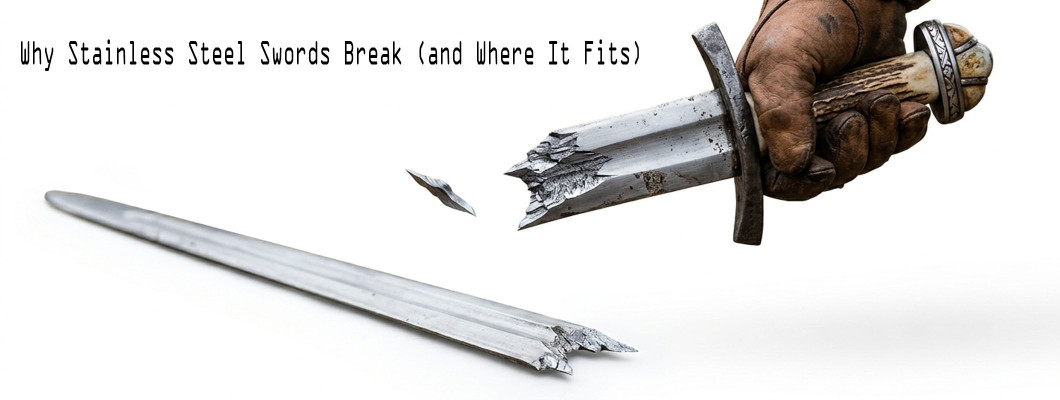
A brittle blade fractures. There is no progressive stage and no warning. The crack initiates and propagates faster than you can react, and the sword becomes two objects, one of which still has the momentum of the swing. It commonly breaks near the tang or partway down the blade, which means the fragment leaving your hand can be most of the sword.
There is also a slower version. Repeated light use develops microscopic cracking long before anything is visible, so the blade that has been fine for two years is not proof of anything. It was accumulating damage the whole time.
Where Stainless Is Genuinely the Right Choice
We forge exclusively in carbon steel, so treat this section as a concession rather than a sales pitch: stainless is the correct answer for several kinds of blade, and anyone telling you otherwise is overselling.
- Kitchen knives, if you would rather not maintain a blade. A carbon steel chef's knife takes a keener edge and is easier to sharpen, but it demands to be dried immediately and oiled occasionally. A stainless one forgives being left in a wet sink. That is a real trade and plenty of good cooks choose stainless deliberately.
- Marine and dive knives. Saltwater destroys carbon steel. This is the clearest case for stainless anywhere.
- Everyday-carry folders. A pocket knife lives against a warm damp body all day and gets used and put away without ceremony. Modern stainless knife steels are excellent here.
- Medical, food-processing and laboratory blades, where corrosion resistance and cleanability are the entire specification.
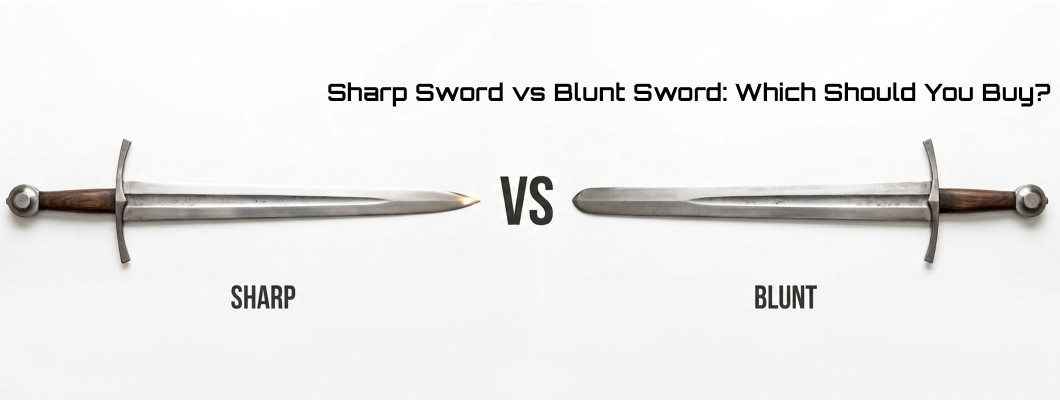
- Display swords, honestly. If a sword is going on a wall and will never be swung, stainless will look bright for decades with no maintenance. There is nothing wrong with buying one for that — only with being told it is functional.
At knife scale, high-grade stainless steels are also far better than the alloys used in cheap swords. The gap between 440A in a $40 sword and a modern powder stainless in a good folder is enormous, and lumping them together as "stainless" is exactly the kind of imprecision this article is arguing against.
Is My Sword Stainless? How to Tell
Several of the tests people recommend do not work. Here is what actually helps.
The magnet test does not work. This one circulates constantly and it is wrong. The stainless steels used in blades are martensitic — 420 and 440 families — and they are magnetic. Only austenitic stainless such as 304, which is not used for blades, is non-magnetic. A magnet sticking to your sword tells you almost nothing.
Has it ever shown any rust or patina? This is the most reliable everyday indicator. Carbon steel darkens, spots and develops patina if left alone even briefly. A blade that has sat for years in a humid house looking exactly as bright as the day it arrived is stainless.
What did it cost, and what does the listing say? Under about $60, assume stainless unless the seller names a carbon steel specifically. Listings that say "surgical steel", "440 steel" with no further detail, or simply do not mention steel at all are almost always stainless.
Look at the fittings and the tang. A screw-on pommel, a hollow-sounding handle, or a guard that looks cast rather than fitted all point the same way. These usually travel together with a stainless blade.
A spark test, if you have the means. Touched to a grinding wheel, carbon steel throws bright branching sparks; stainless throws shorter, duller, straighter ones. This removes metal, so only do it on a blade you have already written off, and never on anything you intend to use.
The Comparison
| Stainless (blade grades) | Carbon / spring steel | |
|---|---|---|
| Corrosion resistance | Excellent | Poor — needs oiling |
| Toughness | Lower | High, especially spring steels |
| Failure mode | Fractures, no warning | Bends, takes a set |
| Flex | Limited | Flexes and returns |
| Ease of sharpening | Harder | Easier, takes a keener edge |
| Right for a sword | Display only | Yes |
| Right for a kitchen knife | Yes, if low maintenance matters | Yes, if you will care for it |
I Already Own a Stainless Sword — Now What?
Keep it, and enjoy it for what it is. A wall-mounted sword that is never swung is doing no harm to anyone, and stainless will keep it looking bright with no work at all.
What not to do: do not swing it, do not strike anything with it, do not test cut, and do not have it sharpened on the theory that a sharp edge makes it functional. The edge was never the problem. Do not lend it to someone who does not know what it is, and if it is displayed within reach of children, mount it securely.
And if it was sold to you as battle ready, that was not true, and it is worth knowing so you can buy the next one properly. Our guides to sword steel and what swords actually cost cover what to look for, and the battle ready standard sets out what the phrase should mean.
5160 Spring Steel, Every Blade
Everything we forge is high-carbon 5160 spring steel — the steel used in vehicle leaf springs because it flexes under repeated load instead of cracking. Full-length tangs, heat treated by hand in Kathmandu. It needs a wipe of oil now and then, and it will not let go mid-swing.
Browse Hand-Forged Swords →Frequently Asked Questions
Why do stainless steel swords break?
Two reasons combine. The chromium that makes steel stainless forms hard carbides that reduce toughness, and toughness is the property a long blade needs most to survive impact. On top of that, almost all stainless swords are built to a low price point — often cast rather than forged, in low-grade alloys, with little or no real heat treatment and a thin rat-tail tang. Either problem alone would be serious; together they make the blade unsafe to swing.
Are stainless steel swords good for anything?
Yes — display. A stainless sword mounted on a wall will look bright for decades with no maintenance at all, and there is nothing wrong with buying one for that purpose. The problem is not that stainless swords exist; it is that they are frequently sold with language implying they are functional. Never use one for cutting, training, reenactment or stage combat.
Is stainless steel bad for knives too?
No, and this is where the argument gets misapplied. Stainless is an excellent choice for kitchen knives if you would rather not maintain a blade, for marine and dive knives where saltwater would destroy carbon steel, and for everyday-carry folders. Modern stainless knife steels are very good. The problem is specific to sword length, where toughness matters more than corrosion resistance and where the consequences of a brittle failure are far greater.
How can I tell if my sword is stainless steel?
The most reliable everyday sign is that it has never shown any rust, spotting or patina — carbon steel darkens if left alone even briefly. Price is a strong indicator too: under about $60, assume stainless unless a carbon steel is named specifically. Listings saying "surgical steel" or "440 steel" with no further detail are almost always stainless. Note that the magnet test does not work, because blade-grade stainless steels are magnetic.
Does a magnet stick to a stainless steel sword?
Yes, usually — which is why the magnet test is unreliable and should be ignored. The stainless steels used for blades are martensitic, from the 420 and 440 families, and those are magnetic. Only austenitic stainless such as 304, which is not used for blades, is non-magnetic. A magnet sticking to your sword tells you essentially nothing about whether it is stainless or carbon steel.
What happens when a stainless sword fails?
It fractures rather than bending, and there is no warning stage. A tough blade that exceeds its limit takes a permanent bend, which you feel and which leaves the sword in one piece. A brittle blade cracks and the crack propagates faster than you can react, commonly near the tang or partway down the blade, releasing a fragment that still carries the momentum of the swing.
My stainless sword has been fine for years — is it safe?
Not necessarily. Repeated light use develops microscopic cracking long before anything becomes visible, so a blade that has held up so far is not evidence that it will continue to. Fatigue accumulates invisibly and each loading cycle makes the next one worse, which is why this kind of failure feels sudden when it has actually been building for a long time.
Can a stainless sword be made functional by sharpening it?
No. The edge was never the problem. A stainless sword's limitations are in the toughness of the steel, the heat treatment it did not receive and the tang construction holding it together, none of which change when you sharpen it. Sharpening a display sword produces a sharp display sword, which is more dangerous than the blunt one you started with.