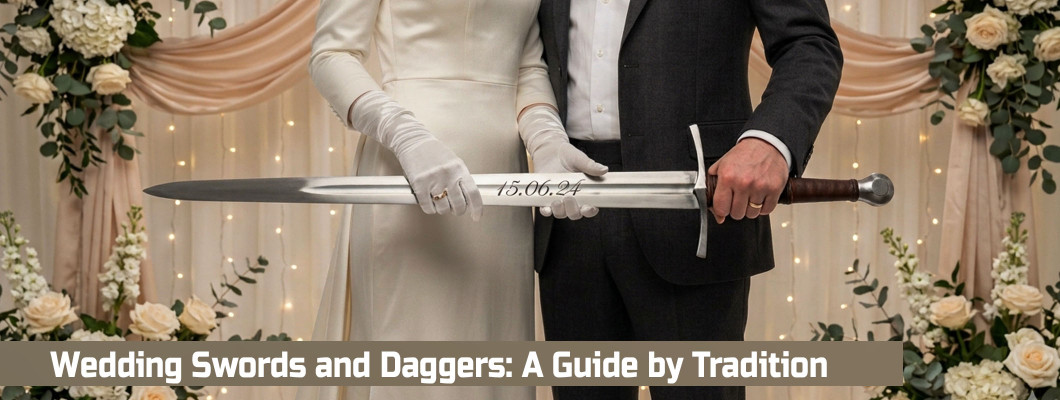
Wedding Swords and Daggers: A Guide by Tradition
The bride stands on the groom's left because his right hand had to stay free for his blade. That is the origin, and almost every wedding in the West still arranges itself that way without knowing why. Blades are older in wedding ceremony than most of what we think of as traditional, and several living traditions still put one at the centre of the day.
This guide covers the wedding traditions where a wedding sword or wedding dagger has a real role — Scottish, military, South Asian, Norse, medieval and modern themed ceremonies — what each one actually involves, and the practical matters that decide whether it works: venue rules, protocol, who is permitted to carry what, and what a ceremonial blade needs to be. If what you are after is the symbolism rather than the planning — why a groom carries a blade at all, and what it has meant across cultures — that is covered separately in Why Grooms Carry Swords.
The Traditions at a Glance
| Tradition | The blade's role | Who can take part |
|---|---|---|
| Scottish Highland | Sgian-dubh and dirk worn as part of Highland dress | Anyone wearing Highland dress. A living tradition |
| Military | Sabre or saber arch after the ceremony; cutting the cake | Restricted. A privilege of service, with authorised bearers |
| South Asian and Sikh | Kirpan or talwar worn by the groom as part of wedding dress | The kirpan is an article of faith for initiated Sikhs. A ceremonial talwar is worn more widely |
| Norse and Viking | Sword exchange between bride and groom | Anyone. A reconstructed ceremony |
| Medieval and Renaissance | Cake cutting; ceremonial display; period dress | Anyone. Popular at faires and themed venues |
| Fantasy and themed | Whatever the couple design it to be | Anyone. No protocol to breach |
| Gift and commemorative | Engraved blades for the couple, groomsmen or family | Anyone. No ceremony required |
The important column is the third one. Five of these are open to anybody and two are not — the military sabre arch is a privilege of service, and the Sikh kirpan is an article of faith rather than an accessory. Getting that distinction wrong is the commonest mistake couples make when planning a blade into their day.
Scottish Highland: The Blade Almost Everyone Can Wear
This is the most accessible of the traditions and the only one on this list that never stopped being practised.
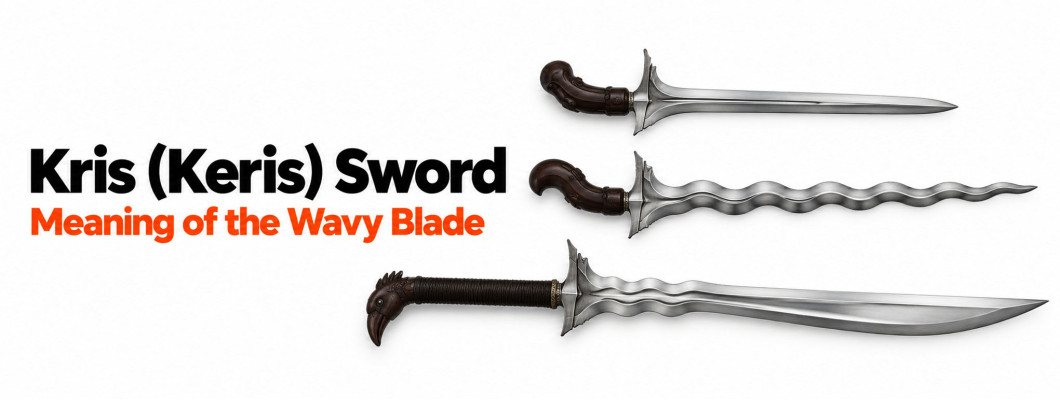
The sgian-dubh — the "black knife", pronounced roughly skee-an-doo — is worn tucked into the hose with only the pommel showing, and it is a standard part of modern Highland dress. Grooms wear one, and increasingly so do fathers, best men and guests in kilts.
Its origin is the detail worth knowing. Highlanders carried a concealed dagger, the sgian-achlais, in the armpit. On arriving at a friendly house, weapons were left at the door and that hidden blade was moved to the stocking top where it could be seen. The visibility was the point. Wearing it openly said you were not concealing anything, and that gesture of trust is where the modern sgian-dubh comes from.
For a wedding that reads rather well: a blade worn in plain sight as a declaration of good faith among people you are joining as family.
The dirk is the larger blade, historically used when fighting had closed to too short a range for a sword, and its sheath often carried a smaller by-knife. Full dirks are less commonly worn today, partly because of knife law, and a sgian-dubh or a sword-shaped kilt pin is the usual choice. If you want a dirk at a wedding, check the position where you are and speak to the venue first.
And the bride on the left. The custom of the bride standing to the groom's left is usually explained as protecting her, or as tradition without a reason. The Scottish explanation is more specific: the groom kept his right hand free for his dirk, historically to fend off objecting kin. Nobody expects that now, and the arrangement outlived the reason by several centuries.
Military: The Sabre or Saber Arch, and Who May Actually Do It
The most photographed wedding blade tradition in the world, and the one most often misunderstood by people planning to imitate it.
What it is. An honour guard forms an arch of raised sabres — spelled saber in American usage, and often called a sword arch — usually outside the venue immediately after the ceremony, and the couple passes beneath. It originated in the Royal Navy and is now used worldwide. The meaning is a pledge of loyalty to the couple from the service member's military family.
Who may take part, and this is the part that matters. The sabre arch is a privilege accorded to members of the service, not a decoration available to any wedding. Bearers are normally officers or NCOs, in formal dress uniform, wearing white gloves. Nobody carries a sabre unless in formal dress uniform, and civilian ushers stand at attention rather than joining the arch. If the wedding party is not made up of personnel authorised to carry, the advice from within the tradition is straightforward: omit it, because it will not mean what it is supposed to mean.
Protocol varies by branch. In the United States the Air Force generally follows Army procedure, while the Navy and Coast Guard follow the Marine Corps drill manual. If you are planning one, ask your own service rather than a wedding blog.
Weapons in a place of worship. A sabre is never unsheathed inside a church or other sanctuary. If bad weather forces the arch indoors it requires the explicit permission of the officiant, and many will decline. Plan the outdoor version as the default and have a non-blade alternative ready.
Cutting the cake with a sword is the other military blade custom and is far less restricted, though the same courtesy applies: ask the venue, and use a blade you can clean properly afterwards.
South Asian and Sikh: The Kirpan and the Groom's Talwar
The living tradition with the largest number of weddings behind it, and the one most often left out of English-language guides.
The kirpan is worn by initiated Sikhs as one of the five articles of faith, carried at all times rather than brought out for occasions. A Sikh groom wearing one at his Anand Karaj is not adding a wedding accessory, he is wearing what he already wears. That distinction cuts both ways: it is not something a guest borrows for the photographs, and it usually holds a different legal position from an ordinary knife — which is worth confirming with the venue in advance rather than leaving to a doorman's judgement on the day.
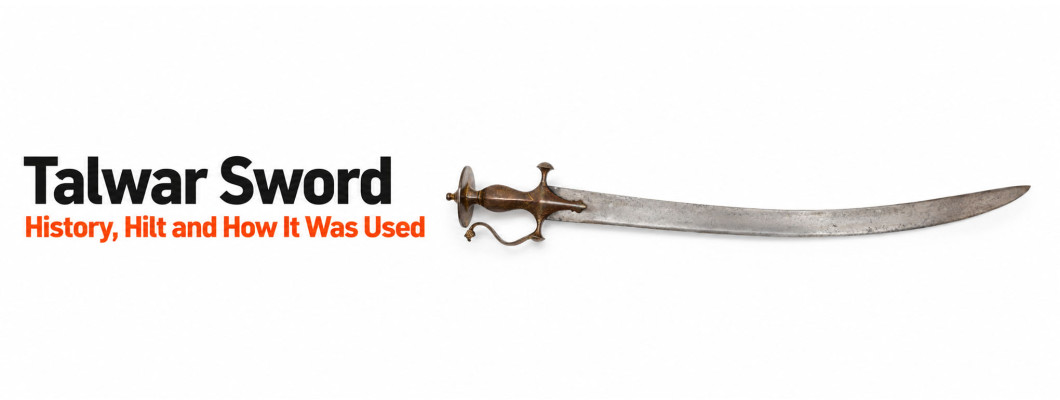
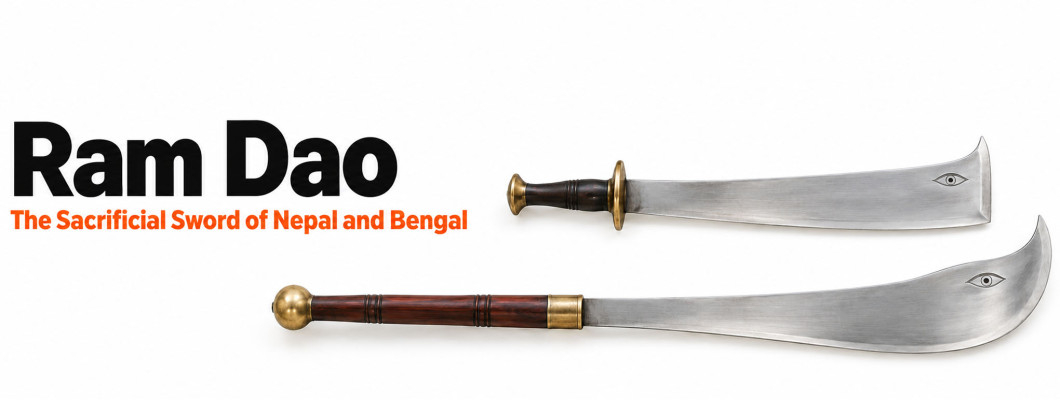
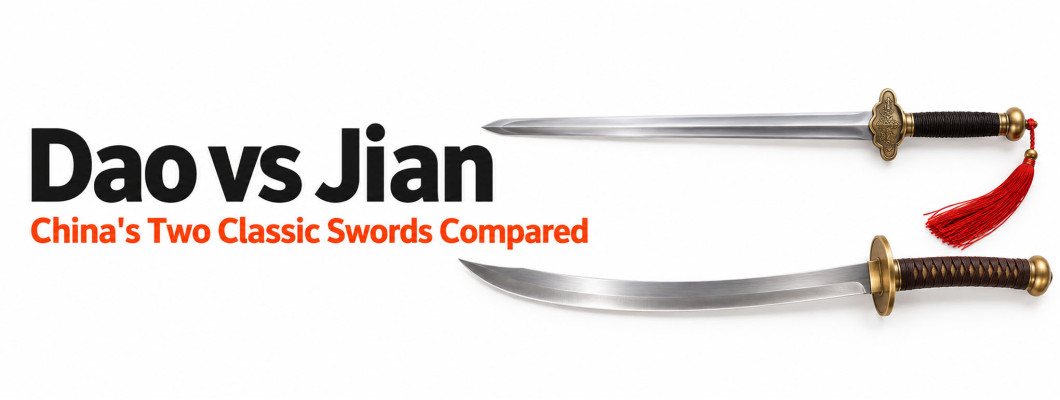
The talwar — the curved sword of the subcontinent — is worn more broadly, in Punjabi, Rajput and other North Indian ceremonies, usually over a sherwani and often a family piece rather than a bought one. Where it is worn it reads as lineage and responsibility rather than ornament, which is why an inherited blade is preferred to a new one wherever a family has one to give. Our Nepalese swords and talwars are forged for the households that do not.
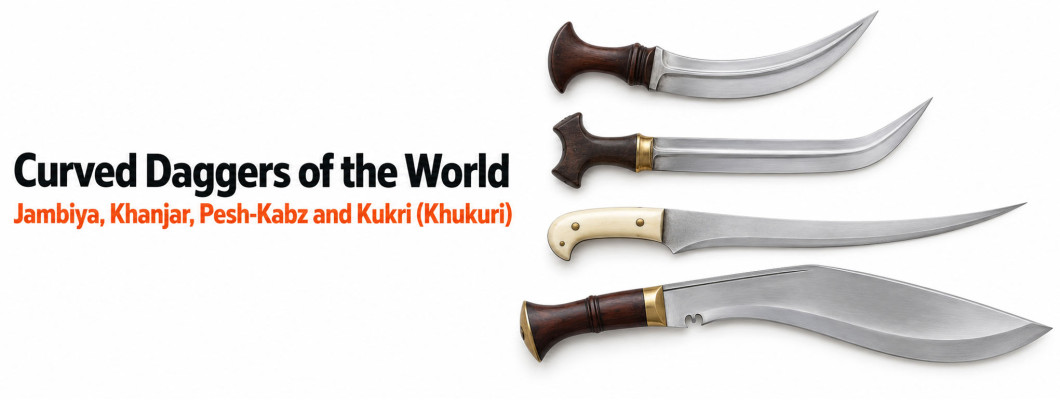
Beyond the ceremony itself, blades appear in the celebration: sword dances at Gulf weddings, ceremonial swords in parts of Africa, and in Nepal both swords and the kukri/khukuri in festive and ritual settings.
The symbolism running underneath all of this — why a groom carries a blade at all, what it has meant from Sikh Punjab to medieval Europe, and how a wedding blade becomes an heirloom — is set out in full in Why Grooms Carry Swords.
Norse and Viking: The Sword Exchange
The best known of the reconstructed traditions and the one couples most often ask us for.
The groom gives a blade to the bride and the bride gives one to the groom, representing the transfer of protection between two families rather than romance between two people. It has the strongest foundation of any Viking wedding element, and it works in a modern ceremony because two families formally accepting responsibility for one another is still a legible idea.
One correction worth carrying into your planning: handfasting, which is the centrepiece of most self-described Viking weddings, is a Celtic tradition rather than a Norse one, and the widely repeated story about the groom robbing an ancestor's grave to retrieve a sword has no source at all. The sword exchange is the Norse element; the cord binding is the borrowed one.
Our full guide to Viking wedding swords and blades sets out what the sources actually support, what was invented recently, and how to build a ceremony either way.
Medieval, Renaissance and Themed Weddings
No protocol to breach and no tradition to misrepresent, which makes this the most flexible category.
Cutting the cake with a sword is the single most popular blade moment at themed weddings, and it works because it is a real action with a real object rather than a prop being held. Two practical notes: use a blade long enough to reach the base of the cake in one pass, and clean it immediately afterwards, because sugar and fruit acid on high-carbon steel will mark it within hours.
Ceremonial display. Crossed blades behind the couple, a sword laid across a table during vows, or a blade carried by a member of the party. All of these read well in photographs and none requires anyone to swing anything.
Renaissance faire and living history weddings often happen at venues that already understand blades, which removes the hardest practical obstacle. If your ceremony is at a faire, ask about their weapons policy early — most have one, and peace-tying is common.
Fantasy and cosplay weddings are their own growing category, and the only real constraint is that the piece should be a real object rather than a costume prop. A forged blade with the couple's names on it survives the day and becomes something kept; a resin prop does not.
Blades as Wedding Gifts
The largest use by volume, and it requires no ceremony at all.
Groomsmen gifts are the most common single request we receive in this category. A small engraved blade — a dagger, a sgian-dubh, a bowie — with each man's name and the wedding date is a gift that is still in a drawer or on a wall twenty years later, which is more than can be said for most. Ordering a set together also means they match, which matters more than people expect in the photographs.
A gift between the couple. Steel has no traditional anniversary year of its own, but a wedding sword or wedding dagger engraved with the date works as a marker in a way a consumable gift does not.
Fathers and family. An engraved piece given to a father of the bride or groom is an unusually well-received gift, particularly where there is a service background or a family connection to a tradition on this page.
Engraving is free on every blade we make and you can supply your own text or artwork, which is what turns any of these from a purchase into a keepsake.
What a Ceremonial Blade Needs
This is the section only a forge writes, and it changes what you should order.
Blunt, unless you have a specific reason otherwise. It will be handled by guests who have never held a blade, passed along a table and photographed. A blunt or rebated edge removes the risk entirely, costs no more, and nobody at a ceremony can tell by looking. This is the single most important specification for any wedding blade. The exception is a cake-cutting sword, which needs an edge — but that one stays in one pair of hands.
It will be held horizontally, by the middle, for a long time. Ceremonial handling is different from anything a blade is designed for. A sword that balances beautifully in the hand can be awkward held out flat across two palms, which is exactly how it is presented. Tell us it is for a ceremony and we account for it.
It has to photograph. Every guest will take a picture and those images outlive the day. A satin or polished finish reads better under marquee lighting than a rough forge finish, and engraving shows far more clearly on a smooth surface.
Matched pieces must be forged together. For a pair of swords, a set of groomsmen daggers, or two sgian-dubhs, say so at the start. Matching a second piece to one already made is considerably harder than forging both to one specification.
It has to live somewhere afterwards. A ceremonial blade that ends up in a wardrobe has failed. Consider length against wall space, and treat a stand or mount as part of the commission rather than an afterthought.
Venue, Law and the Conversations to Have Early
Three practical matters that decide whether any of this happens, and all three are easier to settle months out than weeks out.
Ask the venue in writing. Many hotels, licensed venues and places of worship have policies on weapons, and a verbal yes from a junior member of staff is not a policy. Ask early, get it in writing, and ask specifically about sheathed versus unsheathed.
Check the law where you are. Blade laws differ enormously between countries and often between regions, and rules on carrying in public are separate from rules on owning. Transport to and from the venue is usually the part people forget. Highland dress and religious articles such as the kirpan have particular positions in some jurisdictions, and those are worth confirming rather than assuming.
Tell your photographer. A blade moment happens once and lasts seconds. Photographers who know it is coming get it; photographers who do not, frequently miss it.
Timing: Commission Earlier Than You Think
We hold no stock. Every blade is forged after the order is placed, and a wedding has a date that does not move.
Work backwards from the ceremony, not forwards from today. A commissioned piece needs a design conversation, then forging, then engraving, then international shipping — and engraving adds a step before forging rather than after, because we confirm the artwork with you first.
Build in slack for approval. Names get spelled two ways and dates written in two formats. Each is quick on its own and slow the week before a wedding.
Sets take longer than singles. Eight matching groomsmen daggers is not eight times one dagger, but it is not the same as one either. Order sets first.
Engraved blades cannot be returned unless faulty, because they are specific to you and cannot be resold. We send the engraving for approval before any work begins — read the proof twice.
Hand-Forged Blades for the Day, and the Fifty Years After It
Swords, daggers, sgian-dubhs, talwars and matched sets in 5160 spring steel, full tang, with free engraving on every piece. Blunt ceremonial edges at no extra cost, sets forged together to one specification, and an honest answer about whether your date is achievable. Send us the ceremony date rather than a deadline.
Frequently Asked Questions
Why does the bride stand on the groom's left?
Because his right hand had to stay free for his blade. The Scottish explanation is the most specific: the groom kept his sword or dirk hand clear, historically to fend off objecting kin. Nobody expects that now, but the arrangement outlived the reason by several centuries and almost every wedding in the West still follows it without knowing why.
Can anyone have a sabre or saber arch at their wedding?
No. The sabre arch, spelled saber in American usage, is a privilege accorded to members of the service rather than a decoration available to any wedding. Bearers are normally officers or NCOs in formal dress uniform wearing white gloves, and nobody carries a sabre out of uniform. If the party is not made up of authorised personnel, the advice from within the tradition is to omit it, because it will not mean what it is meant to mean.
Can we have a sword arch inside a church?
Only with the explicit permission of the officiant, and many will decline. A sabre is never unsheathed inside a place of worship as a matter of course; the arch normally happens outside, on the steps or the walk, immediately after the ceremony. If weather is a risk, plan the outdoor version as the default and have a non-blade alternative ready rather than assuming you can move indoors.
What is a sgian-dubh and who can wear one?
The small "black knife" worn tucked into the hose as part of modern Scottish Highland dress, with only the pommel showing. Anyone wearing Highland dress can wear one — grooms, fathers, best men and guests in kilts. It descends from a concealed armpit dagger that was moved to the stocking top on entering a friendly house, where being visible was the point: it showed you were concealing nothing.
What is a kirpan, and can anyone wear one at a wedding?
The kirpan is one of the five articles of faith worn by initiated Sikhs and is carried at all times rather than brought out for occasions, so a Sikh groom wearing one at his Anand Karaj is wearing what he already wears. It is not an accessory for a guest to borrow for the photographs. It also tends to hold a different legal position from an ordinary knife, so confirm it with your venue in advance rather than leaving it to a doorman on the day.
Should a wedding sword be sharp or blunt?
Blunt, unless you have a specific reason otherwise. It will be handled by guests who have never held a blade, passed along a table and photographed. A blunt or rebated edge removes the risk entirely, costs no more, and nobody at a ceremony can tell by looking. The exception is a cake-cutting sword, which needs an edge but stays in one pair of hands.
Can you cut a wedding cake with a sword?
Yes, and it is the most popular blade moment at themed and military weddings. Two practical points: use a blade long enough to reach the base of the cake in one pass, and clean it immediately afterwards, because sugar and fruit acid on high-carbon steel will mark it within hours. Ask the venue first — many have a policy and most will say yes if asked in advance.
Is handfasting a Viking tradition?
No. Binding the hands with a cord is Celtic, and its modern ceremonial form is recent. The Norse element is the sword exchange between bride and groom, which represents the transfer of protection between two families. That does not mean avoid handfasting — it is a good ritual and guests understand it — but it is the borrowed part of most Viking-themed ceremonies rather than the authentic one.
What blade makes a good groomsmen gift?
A small engraved piece — a dagger, a sgian-dubh or a bowie — with each man's name and the wedding date. It is the most common request we receive in this category, and unlike most groomsmen gifts it is still on a wall or in a drawer twenty years later. Order the set together rather than individually so the pieces actually match, which matters more than people expect in photographs.
Will our venue allow a blade at the ceremony?
Ask early and get it in writing. Many hotels, licensed venues and places of worship have weapons policies, and a verbal yes from a junior staff member is not one. Ask specifically about sheathed versus unsheathed, since those are often treated differently. Also check the law where you are — rules on carrying in public are separate from rules on owning, and transport to and from the venue is the part people forget.
How far ahead should we order a wedding blade?
Earlier than you expect, and work backwards from the ceremony date rather than forwards from today. A commissioned piece needs a design conversation, forging, engraving and international shipping, and engraving adds a step before forging because we confirm artwork first. Sets take longer than singles, so order those first. Tell us the date rather than asking how long it takes.
Can an engraved wedding blade be returned?
No, unless the blade itself is faulty. An engraved piece is specific to you and cannot be resold, so it falls outside our standard returns window. We send the engraving for approval before any work begins on the blade — read the proof twice, checking name spellings and the date format carefully, because after cutting there is no undoing it.