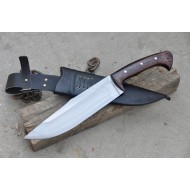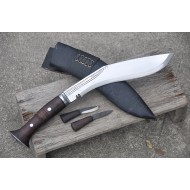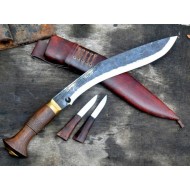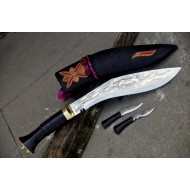
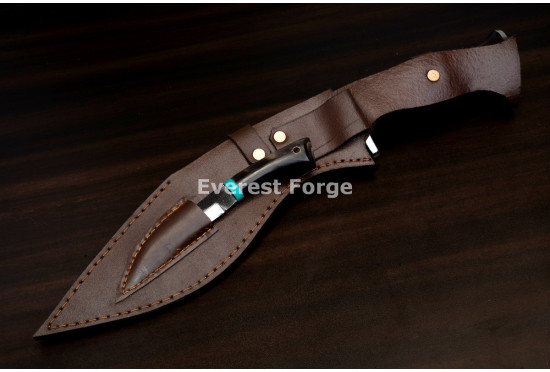


- Model: Working Kukri
- Product Code: Workingkukri045
- Location: Kathmandu,Nepal
Available Options
A Kukri That Comes With Its Karda
Almost every kukri we sell ships as a single blade, and almost every page on this site says so plainly. This one is the exception. It comes with a karda — the small companion knife that belongs to the kukri tradition — and that is the main reason to choose it over anything else in the range.
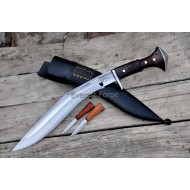
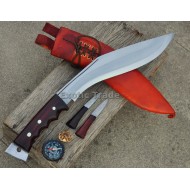
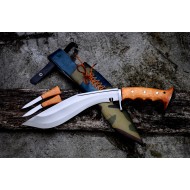
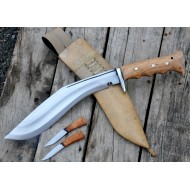
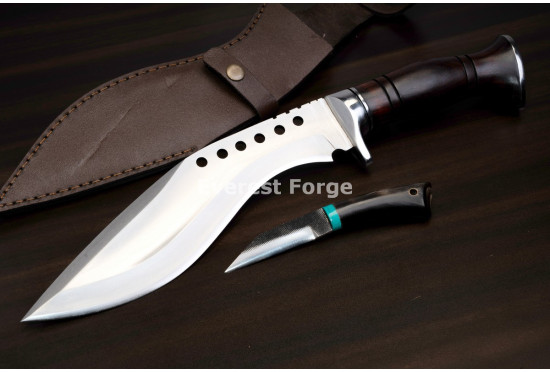
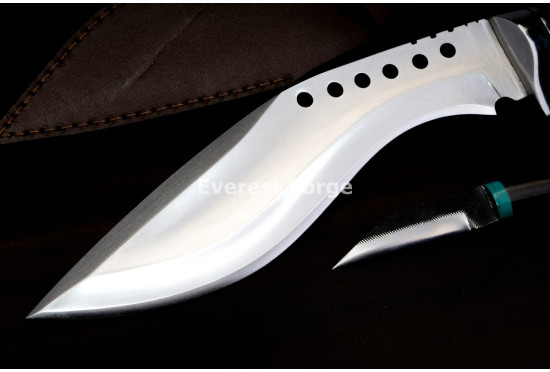
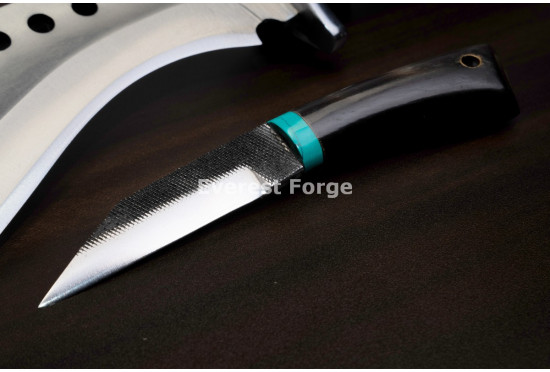
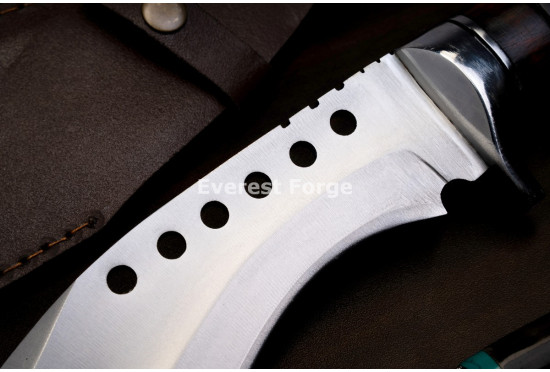
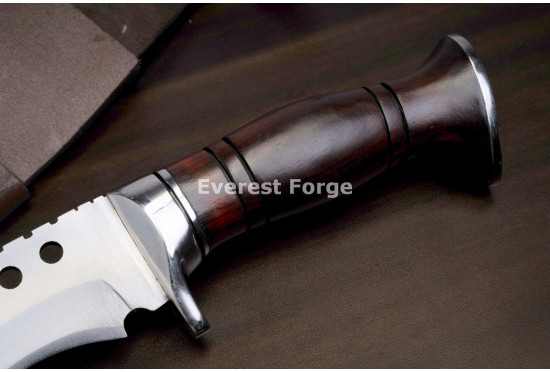
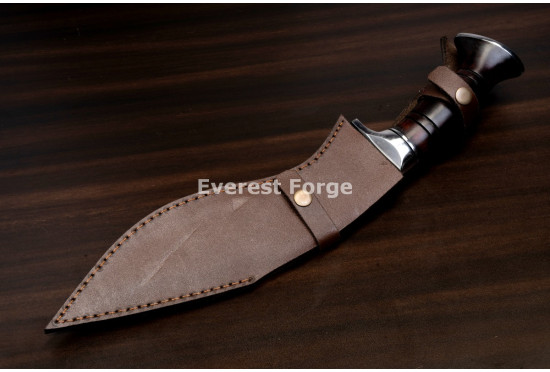
The kukri is a 10.5 inch forward-curved blade hand-forged from 5160 high-carbon steel, oil-quenched and tempered, with a deep belly, a hand-cut cho at the base, a row of six drilled holes near the spine, jimping filed into the spine at the forte, and a small steel spur projecting below the ricasso as a hand stop. The hilt is 5.5 inches of turned rosewood with cut rings and a flared butt, behind a fitted steel bolster. The karda has a broken-back seax profile, a black horn grip with a turquoise spacer, and its flats left in a rasp texture with the bevel brought bright. Both ship in a brown leather sheath with a studded retaining strap.
An honest note. This is a traditional hilt on a modernised blade, and it is worth being precise about which is which. The turned rings, the flared butt and the fitted bolster are village work, made the way they are made in Nepal. The drilled holes, the jimped spine and the steel spur under the bolster are not — those are modern detailing, and a village smith a century ago would not have put any of them on a working blade. The karda is traditional in role but not in shape: a seax profile is a European form, and a Nepali karda is normally a plain drop-point. None of that is a fault. It is just not what the word traditional means, and we would rather say so than let you assume.
Want This Set Built Your Way?
A plain blade without the holes or jimping, a traditional drop-point karda, a chakmak to complete the set, a wooden-cored dap with fitted pockets, or your own drawing entirely. Our smiths in Kathmandu forge to specification and quote before any work begins.
Start a Custom BuildWhat You Get With This One
Standard Build and Specifications
Blade length, blade finish, grip material and blade detailing are all selectable, so the figures above describe the standard build rather than every version of this kukri. Weights given are for the kukri itself. Because each piece is forged, ground and fitted by hand, weights and dimensions vary slightly between examples.
Build Options
Is This the Right Kukri for You?
Choose This One If
- You want a companion knife included rather than sold separately
- You want one package that handles both chopping and the small cutting a chopper cannot do
- You want a traditional turned hilt with modern blade detailing
- You want a manageable size — 16 inches overall carries far more easily than a 19 inch piece
- You like the seax karda as an object in its own right
Look Elsewhere If
- You want a purely traditional piece — the holes, the jimping, the spur and the seax karda are all modern, and our bhojpure is the authentic village article
- You want maximum chopping mass — a longer, heavier blade does more work per stroke
- You want the full traditional set as supplied — the chakmak is not included, though we will make one
- You only want the kukri — you are paying for two blades here
How to Order
Who This Kukri Is For
- Campers and woodsmen who want one purchase covering both the heavy cutting and the fine work
- First kukri buyers — a manageable size, a companion knife included, and nothing that needs explaining before it can be used
- Collectors of kukri variants who want a piece where the companion is part of the design rather than an afterthought
- Anyone who has owned a big kukri and found themselves reaching for a pocket knife every ten minutes
- Buyers drawn to the karda itself — the seax profile and horn grip make it a genuinely interesting small knife
What Is Included
- One hand-forged kukri, sharpened and ready to use
- One karda companion knife with horn grip, sharpened
- Brown leather sheath with studded retaining strap
- Everest Forge manufacturer warranty
- Care instructions
The chakmak is not included. That is the third piece of the traditional arrangement — a blunt steel burnisher used to true an edge in the field rather than to cut — and we make it to order. If you want the complete traditional set with a wooden-cored dap carrying both companions in fitted pockets, ask and we will quote it with the kukri.
More From the Everest Forge Collection
Shipping, Returns and Care
Stock builds dispatch from our workshop within 2-3 business days. Custom and made-to-order builds take 4-6 weeks from confirmation, and we photograph the finished pieces before they leave us. We ship worldwide with DHL and FedEx, fully tracked, typically 7-14 business days in transit. Every blade carries the Everest Forge manufacturer warranty against defects in forging and construction.
Blade laws vary by country, state and province and it is the buyer's responsibility to check local restrictions before ordering. Note that this package contains two knives. We cannot advise on your jurisdiction and we cannot refund a blade seized in transit.
5160 is a high-carbon steel and it will rust if you let it. Wipe both blades dry after use, keep them lightly oiled, and do not store them in the sheath for long periods in a damp climate, because leather holds moisture against steel. Two places need more than a wipe along the flat: the inside walls of the drilled holes, and the notches of the jimping, both of which trap water where you cannot see it. Run an oiled cloth corner or a cotton bud through both. The karda's rasp-textured flats hold oil well but also hold residue, so brush rather than wipe them. Sharpen with a stone or a file rather than a powered grinder, which will draw the temper out of an edge faster than you expect.
Forged by Hand, Not Assembled
Every blade we sell is forged, ground, heat-treated and fitted by our own smiths in Kathmandu. If you want something we do not list, we will make it.
Talk to Our SmithsFrequently Asked Questions
What is a karda and what do I actually use it for?
The karda is the small companion knife that traditionally rides alongside a kukri, and its job is everything the kukri is too big for. A kukri is a chopping tool: it is heavy, it is curved, and its edge is ground to survive impact rather than to slice thin. Ask it to whittle a tent peg, dress a rabbit, cut cord, sharpen a pencil or open a parcel and you will find yourself choking up on a blade that does not want to be held that way. The karda does all of it comfortably. In Nepal the pairing is not a novelty or an upsell — a kukri without its companions is an incomplete tool, and the karda is the one you actually reach for most days. It is worth saying that this is the only kukri in our range that includes one as standard.
Why is the karda shaped like a seax?
Because the shape suits the job, though we should be clear that it is not the Nepali form. A traditional karda is a plain drop-point: a curved edge running up to a point somewhere near the middle of the blade's height. This one is a broken-back seax, the early medieval northern European pattern where the edge runs dead straight and the spine drops at an angle to meet it at the tip. What that gives you is a long straight edge, which is better for cutting against a board or a flat surface, and a point sitting low and forward where you can see exactly what it is doing. It is a genuinely good geometry for a small utility knife, which is why it survived for several centuries. If you want the traditional Nepali drop-point instead, we make it and it costs no more.
Why is the karda blade left with a file texture?
It is a finish choice, and we would rather call it that than dress it up. The flats of the karda are left with the rasp texture from working the steel, with the bevel ground and polished bright, so the blade reads as two surfaces rather than one. It is a look that has become popular on small custom knives, and it has one modest practical side effect: a textured surface holds a film of oil better than a mirror polish does, which is not nothing on carbon steel. What it does not do is improve cutting or release food, and any listing telling you a textured flat stops things sticking is overselling it. If you want the karda fully polished to match the kukri, we will do that instead.
What is the small steel spur under the bolster?
A hand stop, and it is worth distinguishing from a guard. It is a short steel projection dropping below the ricasso, sitting just where your index finger falls when you take a normal grip. What it gives you is something positive to index against, so your hand finds the same place every time and has a physical stop in front of it if you are pushing rather than swinging. What it is not is a quillon: it is far too small to protect the hand under a thrust, and this blade does not have the acute point that would make that necessary. If a full guard is what you want, our guarded kukri carries a swept quillon and explains the reasoning behind it in detail. This one is a subtler solution to a smaller problem.
What are the holes in the blade for?
They are part of the modern detailing, and they take a small amount of weight out of the blade. The row sits near the spine, high up where the steel is furthest from the edge and doing the least cutting work. Being straight about the scale of it: six drilled holes remove very little material, and the practical effect on how the blade swings is close to imperceptible. They are there because they look the way they look, and that is a legitimate reason. A hole does concentrate stress at its edges, which is why they are small, evenly spaced and set well away from both the edge and the cho, and we will build the blade plain at no extra cost if you would rather have no cutwork at all.
How does this compare to your bhojpure?
Half an inch of blade apart and completely different in intent. The bhojpure is a genuine eastern Nepali village pattern: 10 inches, no detailing of any kind, a broad belly carried well forward, thick stock, and everything about it arranged to put mass into wood. It ships as a single blade. This one is 10.5 inches with a slimmer profile, drilled holes, jimping, a spurred bolster and a karda included. If you want the authentic village chopper and the best pure chopping tool at this size, take the bhojpure — it hits harder for its length than this does. If you want a package that covers both heavy and fine work, and you like modern detailing, take this. They look similar in a photograph and they are not similar in the hand.
What is the notch at the base of the blade?
That is the cho, sometimes written kaudi, and it is the diagnostic mark of a genuine kukri. It terminates the edge in a rounded cut rather than letting the edge run straight into the bolster, so a crack starting at the edge has somewhere to stop instead of running back toward the tang. It also carries religious meaning that different communities in Nepal read in different ways. Ours are cut by hand on every blade, which is why no two are exactly alike. We apply the test in both directions: a curved knife with no cho did not come from this tradition whatever a listing calls it, and we have declined to call our own pieces kukris on that basis.
What steel are they?
Both blades are 5160 high-carbon spring steel, oil-quenched and tempered. It is the family of steel used for vehicle leaf springs, which is the origin of the Nepali practice of forging kukris from them, and it is chosen for toughness rather than for maximum hardness. On the kukri that means an edge which rolls slightly rather than chipping when it meets a knot, and a rolled edge can be steeled or stoned back in a few minutes. On the karda it means a small blade you can lean on without worrying about the tip. The trade-off is that both need sharpening a little more often than a harder, more brittle steel would. Neither is stainless and both will rust if neglected.
Is this a traditional kukri?
The hilt is, the blade is not, and the karda is traditional in role but not in shape. On a kukri the question of tradition is settled mostly by the handle and the sheath, since almost every kukri blade profile in production is a traditional one, and by that test the turned rosewood grip with its cut rings, flared butt and fitted steel bolster is entirely village work. What is modern is the detailing: the drilled holes, the jimped spine and the steel spur are all twentieth-century knife-making ideas, and a smith in Bhojpur a hundred years ago would have put none of them on a working blade. The karda is the traditional companion, but in a European seax profile rather than the Nepali drop-point. We call it a modernised kukri because that is what it is.
Are both blades sharp, and how do I sharpen them?
Both leave us sharpened and ready to work. They want different treatment. The kukri has a convex edge, which is stronger at the edge and better suited to impact, so work it with a stone in small circles or with a file rather than dragging it through a fixed-angle pull-through sharpener, which grinds a flat bevel into a convex edge and undoes it. The karda has a flat bevel and a straight edge, which makes it one of the easiest blades to sharpen well: lay the bevel flat on a stone and push, keeping the angle constant, and the straight edge means you never have to roll the blade through a curve as you go. If you have struggled to sharpen curved knives freehand, the seax profile is a good place to learn.
How do I look after two blades in one sheath?
Dry both properly before either goes away, because moisture trapped between two pieces of steel in leather is the fastest route to rust either of them will ever find. Beyond that, the kukri has two features that need more than a wipe along the flat: the inside walls of the drilled holes and the notches of the jimping, both of which hold water where you cannot see it. Run an oiled cotton bud or cloth corner through both. The karda's rasp-textured flats hold oil well, which is a genuine benefit, but they also hold residue, so brush them rather than wiping. And do not store the set sheathed for long periods in a damp climate — leather holds moisture against steel, and that applies twice over when there are two blades in there.
Can I change what comes in the set?
Yes, in both directions. Add a chakmak, the blunt steel burnisher used to true an edge in the field, and you have the complete traditional arrangement of kukri, karda and chakmak. Add a wooden-cored dap with fitted pockets and it is carried the traditional way rather than in a modern belt sheath. Or go the other direction: a traditional Nepali drop-point karda instead of the seax, or a plain kukri blade without the holes and jimping. On size, we forge this profile from belt-sized blades up to two-handed choppers, and the karda scales with it. Tell us what you want and we will quote before any work begins.
| Specification | |
| Blade: | 10.5 inches. Hand forged from 5160 carbon steel. Six drilled holes near the spine, jimping at the forte |
| Total Length: | 16 inches |
| Handle: | 5.5 inches, turned rosewood with cut rings and flared butt, fitted steel bolster with spur below the ricasso |
| Weight: | Approx. 690 g blade, approx. 930 g total (kukri only) |
| Note: | As each piece is forged, ground and fitted by hand, slight variation in weight, dimensions and finish may occur. Dry both blades before sheathing. |