The Ram Dao Is a Blade Made for One Moment: The Single Stroke of the Offering
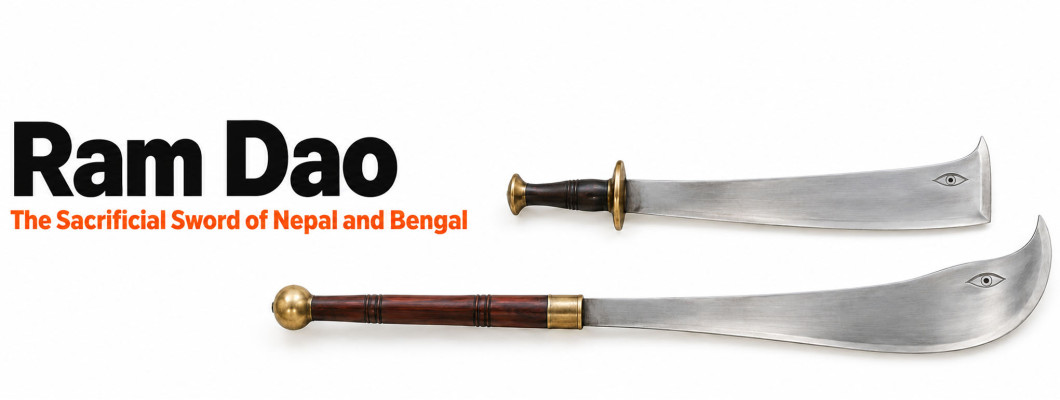
The ram dao (also written ramdao or ram da) is the heavy, forward-weighted sacrificial sword of Bengal, Assam, Odisha and Nepal. It is narrow near the hilt and swells into a broad head with an upturned or hooked point, and many examples have an eye engraved near the tip. It was never a battle sword. It was made for the bali, the offering to the goddess Durga or Kali at Durga Puja, Kali Puja and Dashain, when the cut must be made in one clean stroke. Everything about its shape, from the long two-hand grip to the weight sitting in the head, serves that single moment. This guide covers the form, the festivals it is used in, how the Bengal and Nepal versions differ, what the eye and the god-figure hilts mean, and where the ram dao sits beside the khunda, the kora and the maar kukri (khukuri).
The ram dao belongs to a family of Himalayan and eastern Indian ceremonial blades, and the best place to see that family as a whole is our guide to the kora sword and Nepalese heritage. If you already know the kora and want the two set side by side, read ram dao sword vs kora sword. This post is the history and form of the ram dao on its own.
What Is a Ram Dao?
In Bengali and Assamese, da or dao is a chopping blade: the everyday bill or cleaver of the kitchen, field and forest. The same word names the dao of the Naga hills and the Assamese village tool, both quite different objects. The ram part of the name is explained in several ways, and no single explanation is settled. What the name refers to is not in doubt: the large ritual blade kept by temples, household shrines and puja committees for the offering.
Do not confuse it with the Chinese dao, the single-edged sabre of China, which shares the sound of the word and nothing else. For that blade, see our dao vs jian guide.
A typical ram dao has five features:
- A long grip, often long enough for two hands, sometimes all metal and sometimes wood over a full tang, ending in a round or disc pommel.
- A short guard or collar, often brass, sometimes a simple ferrule rather than a true guard.
- A narrow blade near the hilt that runs nearly straight for the first third or half of its length.
- A broad, heavy head where the blade widens sharply. The spine sweeps up into an upturned or hooked point, and some blades carry a small spur or notch on the back of the head.
- A single edge on the inner curve, the side the hooked point turns toward, like the edge of a sickle or a kukri (khukuri). The broad, rounded back of the head is the spine, and it carries both the weight and the eye.
Overall lengths vary widely. Small household blades are around 60 cm (two feet), temple blades can run to a metre or more, and the largest are almost too heavy to lift one-handed. Many are well over a kilogram, and the weight is concentrated far from the hand. That is a poor arrangement for a fighting sword, which needs to recover and parry, and an ideal one for a single downward cut.
The Ram Dao at Durga Puja and Kali Puja
Durga Puja, the great autumn festival of Bengal, falls in September or October and celebrates the goddess Durga's victory over the buffalo demon Mahishasura. In the households and temples that keep the traditional bali, the offering is made on Navami, the ninth day, and in some traditions during the Sandhi Puja, the short window where Ashtami turns into Navami. The ram dao is cleaned, marked with vermilion, garlanded and worshipped before it is used, because the blade itself is treated as an instrument of the goddess.
Kali Puja, on the new-moon night of the month of Kartik (October or November, the same night as Diwali), is the other great occasion for the blade in Bengal. Kali is the fierce form of the goddess, and in her images she holds a curved sacrificial sword. Temples dedicated to her, such as Kalighat in Kolkata and Kamakhya in Assam, are known for keeping the offering through the year, not only at festival time.
Two rules shape the rite and the blade. The offering must be made in one stroke, since a second stroke is held to be inauspicious. And the person making the stroke, often a specialist or a family member chosen for the role, has to do it with a full two-hand swing. Hence the weight in the head and the long grip.
Practice has changed a great deal. Many households and community pujas have never offered animals, and many more now offer an ash gourd, a pumpkin, sugarcane or a banana stem, cut with the same single stroke of the same ram dao. In those homes the blade is still cleaned, worshipped and used every year. Courts and state governments in India have also debated restrictions on animal sacrifice at temples in recent years, and the rules differ from state to state.
The Ram Dao in Nepal and at Dashain
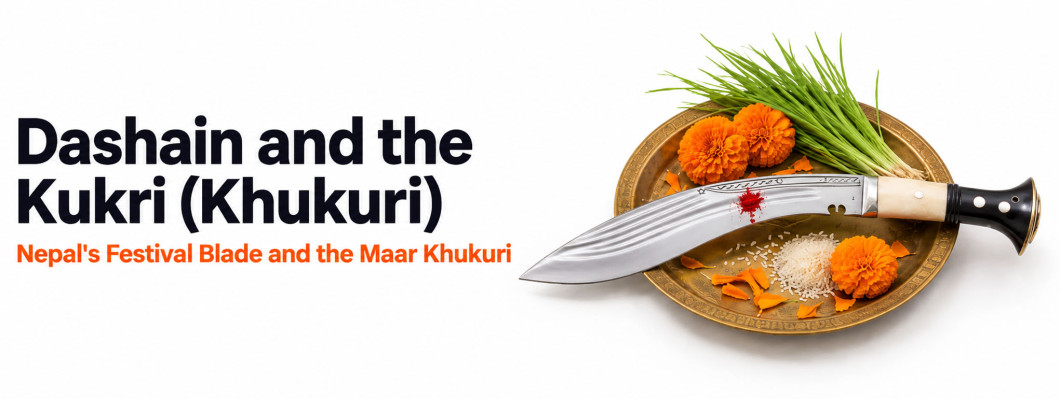
Dashain is Nepal's version of the same autumn festival of Durga, and the Nepali equivalent of the ram dao is used on Ashtami and Navami in the same way. In Nepal the heavy sacrificial blade is more often called a khunda, and the long, forward-weighted kukri (khukuri) made for the same stroke is the maar khukuri. The name "ram dao" is used for the Bengal form and, increasingly, for Nepali blades of that profile sold abroad. For the festival day by day, the Kot Puja of the Nepal Army and the maar khukuri itself, see our guide to Dashain and the kukri (khukuri).
The khunda deserves its own post, which is planned. Until it is live, the kora and Nepalese heritage guide is the place for the wider Nepali family.
Bengal, Assam and Nepal: How the Variants Differ
No two village smiths forged exactly the same blade, so treat these as tendencies rather than rules.
- Bengal. The classic ram dao: a slim, almost straight blade near the hilt, a strongly swelling head and a high, hooked point. Older blades often have a plain iron or brass hilt, a disc pommel and an engraved or punched eye.
- Assam and the northeast. Heavier, broader blades that sit closer to the working dao of the region, with a squarer head. Temple blades for large offerings can be very big.
- Odisha. Blades often close to the Bengal form, sometimes called khadga in temple use, with decorated brass hilts.
- Nepal. The khunda tends to be broader along its whole length, with a squared head, a raised spur at the tip and an eye, on a rosewood or brass hilt. Nepal-made blades sold as ram dao today usually follow the Bengal silhouette on a Nepali full-tang rosewood handle.
The Eye on the Blade
The single most recognisable mark on a ram dao is the eye, the netra or chokh, engraved, punched, inlaid in brass or cut right through the blade near the head. On many blades the eye, the hooked point and the line of the spine together read as a face or a bird's head, and the whole blade looks alive.
Explanations differ, and more than one may be true in a given place. The eye is read as the eye of the goddess, watching over the offering; as the third eye of Shiva; or as a protective eye that guards the blade and its keeper. Whatever the reading, the eye marks the ram dao as a sacred object rather than a tool, which is why it is worshipped before it is used and kept apart from the household's working blades. The khunda and some kora blades carry the same eye, which is one of the clearest signs that these blades belong to one ritual family.
Other marks found on ram daos include the sun and moon, a trident, a lotus, and lines of punched dots or brass inlay along the spine.
Ganesh and Kali Hilts
Ritual blades often carry a deity on the hilt or the blade, and two figures are especially common on the ram dao.
Ganesh, the remover of obstacles, is worshipped at the start of every puja. A Ganesh pommel or hilt places the opening blessing on the blade itself, so that the stroke goes cleanly. Our ram dao with D-guard and Ganesh pommel follows that pattern.
Kali is the goddess the offering is most often made to in Bengal, and the curved sword in her hand is the ram dao's own iconographic ancestor. A Kali figure engraved on the blade dedicates it to her. The Kāte ram dao with the goddess Kali engraving is our version.
The sacred blade in the hands of Durga and Kali is the khadga, and the link between the iconographic sword and the real one is explored in our guide to Hindu swords and the khadga. For ritual blades across other faiths, see holy daggers of the world's religions.
Choose the blade length, finish and handle for a ram dao, kukri (khukuri) or other Nepalese blade, and the forge builds that exact combination for you.
Build Your BladeRam Dao vs Khunda vs Kora vs Khadga vs Maar Khukuri
| Blade | Where | Shape | Grip | Main use |
|---|---|---|---|---|
| Ram dao | Bengal, Assam, Odisha, Nepal | Narrow near the hilt, broad hooked head, often an eye | Long, two hands | Bali at Durga Puja and Kali Puja |
| Khunda | Nepal | Broad, nearly straight cleaver, squared head with a spur, eye | Long, two hands | Temple and Dashain offerings |
| Kora | Nepal | Forward-curved, narrow waist, broad lobed tip | One hand, disc guard and pommel | Battle and ceremony |
| Khadga | India and Nepal | The sacred sword of the gods; also the name of some temple blades | Varies | Iconography and temple ritual |
| Maar khukuri | Nepal | A long, forward-weighted kukri (khukuri) with a deep belly | Long, two hands | The Dashain single stroke |
The kora is the one fighting blade in this group, and our ram dao vs kora comparison explains why the two are often confused: both flare toward the tip, but the kora is a one-hand sword balanced for battle and the ram dao is a two-hand ritual blade balanced for one cut.
Ram Daos in Museums and Collections
Ram daos and their Nepali cousins are well represented in museum collections in India, Nepal, Britain and the United States, most from the eighteenth and nineteenth centuries. They are often catalogued simply as "sacrificial sword" or "ceremonial sword" with a region of Bengal, Assam or Nepal, and the same profile appears again and again: the slim blade, the swollen head, the hooked point and the eye. Some carry dedicatory inscriptions naming a temple or a donor; others are plain iron and were clearly used for generations.
For collectors, the honest signs of an old working ram dao are an even dark patina, a hilt worn by hands, a slightly reworked edge from repeated sharpening, and an eye that has softened with cleaning. Bright, sharply engraved blades are almost always recent.
Hand-Forged Ram Dao Swords From Everest Forge
All of these are in the ram dao swords collection, forged on demand in our Kathmandu workshop from mono-steel 5160 spring steel, with full-tang rosewood handles and a leather scabbard. Nothing is held in stock; every blade is forged after the order is placed.
- The Ram Dao Nepalese sword: the classic profile, with traditional engravings along the spine.
- The ram dao with D-guard and Ganesh pommel: a protected hand and the opening blessing on the hilt.
- The Kāte ram dao with the goddess Kali engraving: the blade dedicated to the goddess of the offering.
- The largest ram dao sword: the full temple-scale blade, with a long two-hand handle.
Any of these can be ordered left-handed by writing "Left Handed" in the order note, or with a blunt edge and rounded tip for display and stage use the same way. Catalogue builds dispatch in 2 to 3 business days; custom builds take 4 to 6 weeks at the forge; shipping is DHL or FedEx, tracked, 7 to 14 business days worldwide. If you need a blade for Durga Puja, Kali Puja or Dashain, order early, because international transit needs its full window.
An honest note on the steel. Everest Forge forges mono-steel 5160 only. We do not make Damascus, pattern-welded, folded or laminated steel. Historic ram daos were forged by village smiths from iron and plain carbon steel, sometimes with brass or silver fittings, and were not pattern-welded either.
Related Guides
Commission a Ram Dao for Your Temple or Puja
A ram dao to your family's or temple's traditional pattern, with the eye, a deity on the hilt or blade, a dedicatory inscription, or an unusual length. Tell us the pattern and the occasion; the forge quotes it, builds it in 4 to 6 weeks, and ships it tracked worldwide.
Start a Custom Forge RequestFrequently Asked Questions
What is a ram dao used for?
The ram dao is a ritual sacrificial blade. It is used for the bali, the offering to the goddess Durga or Kali at Durga Puja, Kali Puja and Dashain, where the cut must be made in a single stroke. Many households now offer an ash gourd or pumpkin instead, cut with the same blade.
Was the ram dao used in battle?
No. Its weight sits far out in the head, which suits a single two-hand cut but makes it slow to recover and parry. It was made for ritual. The kora is the Nepali blade of similar outline that was carried in battle.
Where does the ram dao come from?
Eastern India and Nepal: Bengal, Assam, Odisha and the Nepali hills. The Bengal form, with a slim blade and a high hooked head, is the one most people picture.
What does "dao" mean in ram dao?
In Bengali and Assamese, da or dao means a chopping blade. It is unrelated to the Chinese dao, the single-edged sabre, apart from the sound of the word.
Why does a ram dao have an eye on the blade?
The eye marks the blade as sacred. It is read as the eye of the goddess watching over the offering, as the third eye of Shiva, or as a protective eye. The Nepali khunda and some kora blades carry the same mark.
What is the difference between a ram dao and a khunda?
Both are heavy, two-hand sacrificial blades. The ram dao is usually slim near the hilt with a strongly swelling, hooked head; the Nepali khunda is broader along its whole length, with a squarer head and a raised spur at the tip.
What is the difference between a ram dao and a kora?
The kora is a one-hand Nepali sword with a disc guard and pommel, a forward curve and a broad lobed tip, made for battle and ceremony. The ram dao is a longer-gripped, two-hand ritual blade made for one cut.
How heavy is a ram dao?
It varies with size. Household blades are often around a kilogram, while temple blades can be considerably heavier. Our ram daos run from roughly 1.1 to 1.8 kg depending on the model and the blade length chosen.
Can I order a ram dao left-handed or blunt for display?
Yes. Write "Left Handed" in the order note for a left-hand grind, or ask in the order note for a blunt edge and rounded tip for display or stage use.
How long does a ram dao take to arrive?
Catalogue builds dispatch in 2 to 3 business days and ship by DHL or FedEx, tracked, in 7 to 14 business days. Custom builds take 4 to 6 weeks at the forge before shipping.