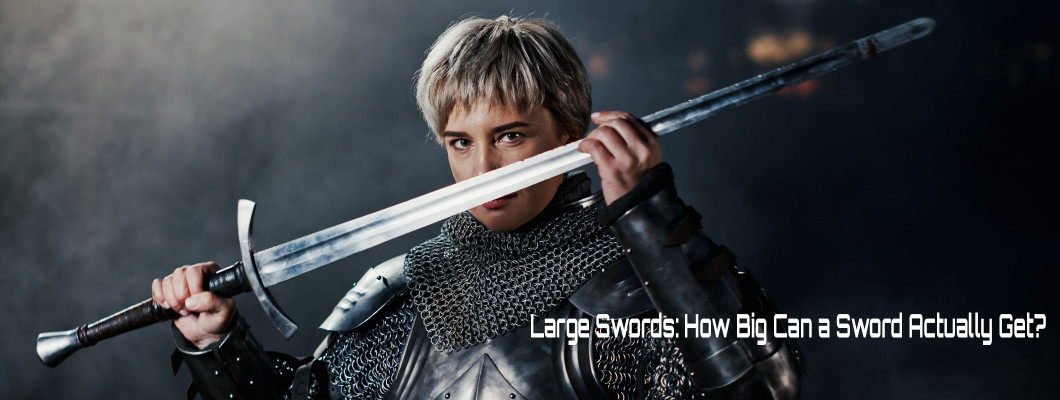
Large Swords: How Big Can a Sword Actually Get?
The largest sword anyone ever fought with was about 1.8 metres. The largest real sword ever forged is 3.77 metres, and it was never meant to be lifted. Everything bigger than that is either a monument or a drawing. If you are looking for a large sword — a greatsword, a two-hander, something with genuine presence on a wall — the useful question is not what the record is. It is where the practical ceiling sits, why it sits there, and what changes as a blade gets longer. This guide covers the real size tiers, the physics that stops swords getting bigger, what happens at the forge when you try anyway, and how to commission one past the catalogue.
What Counts as a Large Sword?
"Large" is used loosely, so here is a working scale in overall length, which is the number that actually decides how a sword feels and where it can live.
| Overall length | What it is | Practical reality |
|---|---|---|
| Under 90 cm / 36" | Arming sword, most single-handers | Normal sword. Not large. |
| 90–115 cm / 36–45" | Longsword, bastard sword | Big in the hand, easy to live with |
| 115–140 cm / 45–55" | Greatsword, large two-hander | Genuinely large. Needs space to swing. |
| 140–180 cm / 55–70" | Zweihänder, Highland claymore, ōdachi | The historical ceiling for use |
| 180–250 cm / 70–100" | Parade and ceremonial two-handers | Carried, not swung |
| 250 cm+ / 100"+ | Votive and monumental blades | Objects, not weapons |
Most people searching for a "large sword" or "massive sword" turn out to want something in the third or fourth band — a blade with real presence that a person can still pick up and hold. That is a well-defined target, and it is the range historical greatswords occupy.
The Largest Swords Ever Made
The Norimitsu Ōdachi is the usual answer for the largest real sword: a Japanese blade dated to the fifteenth century, around 3.77 metres overall and roughly 14.5 kilograms. It is genuinely astonishing, and it was almost certainly never a weapon. Ōdachi of that scale were made as offerings to kami and kept at Shinto shrines, where their impossible size was the point — a display of what a smith could do, dedicated to a god rather than carried into a battle.
European parade swords reach two metres and beyond, surviving in Swiss, German and Italian armouries. They belonged to civic guards and processions. The blades are often thin, the edges frequently blunt, and the proportions are wrong for fighting in ways that are obvious once you know what to look for.
This distinction — made large versus made to be used large — is the one thing most articles on this subject blur, and it is the thing that matters if you are buying. A sword built to be carried in a procession and a sword built to be swung are different objects even at the same length.
The Largest Swords People Actually Fought With
The zweihänder is the honest answer for the largest battlefield sword. German Landsknecht Doppelsöldner — double-pay men — used them to break pike formations, and functional examples run roughly 1.4 to 1.8 metres. They carry parrying lugs above the guard so the wielder can grip the blade itself and shorten the weapon at close quarters. We cover them properly in our guide to German swords.
The Highland claymore, the true two-handed claidheamh mòr, runs around 1.4 to 1.6 metres with its distinctive forward-sloping quillons.
The ōdachi or nodachi in its usable form is a large field sword rather than the shrine monsters — long enough to be awkward to draw from the belt, and often carried across the back or by an attendant.
The montante in Iberia and the spadone in Italy are the same idea in other traditions, both with surviving fencing treatises, which tells you they were genuinely used.
The zhanmadao and changdao in China are the long two-handed sabres, built among other things for cutting at cavalry.
Notice the pattern. Four separate traditions, no contact between several of them, and all of them stopped in the same place: somewhere between 1.4 and 1.8 metres. That is not coincidence.
Why Size Stops Working
The ceiling is physics, and it is steeper than people expect.
Resistance to turning rises faster than length. When you swing a sword you are rotating it around your hands, and the effort that takes depends not on how heavy the blade is but on how far that weight sits from the pivot — and it rises with the square of that distance. Move mass twice as far out and it fights you roughly four times as hard. A blade does not become twice as difficult when you double its length. It becomes far worse than that.
Recovery gets worse with it. The longer the blade, the longer the moment after a swing during which you cannot change what happens next. On a battlefield that interval is where things go wrong, which is why the largest swords were used by specialists working alongside other men rather than alone.
Reach stops paying. Past a point, extra length gives you nothing you could not get from a spear at a fraction of the weight and cost — and spears were what most people actually carried, for exactly that reason.
Handling depends on where the weight is, not how much there is. Two swords of the same length and weight can feel completely different depending on distal taper and point of balance, which is why a well-made greatsword feels alive and a badly made one feels like a fence post. Our guide to sword balance explains the mechanics.
The Weight Myth
Worth clearing up because it distorts what people expect when they pick a large sword up for the first time.
Historical greatswords — real, functional, battlefield zweihänders and claymores — generally weigh somewhere in the region of 2 to 4 kilograms. Not twenty. Not fifteen. A big two-hander is heavy in the way a full toolbox is heavy, not in the way a paving slab is heavy.
The exaggeration comes from two places: Victorian romanticism, and the ceremonial pieces that really are extremely heavy and really were never swung. The Norimitsu Ōdachi's 14.5 kilograms is real — and it is a shrine offering, not a counterexample.
The practical consequence for a buyer is this: if a large sword you are considering is enormously heavy for its size, that is a fault, not a feature. It means the smith did not taper the blade, and a blade without distal taper handles badly no matter how impressive the numbers sound.
What Happens at the Forge When a Blade Gets Big
This is the part you will not read anywhere else on this subject, because the people writing about large swords have generally never tried to make one.
The quench becomes the whole problem. Hardening a blade means getting it evenly to temperature and then cooling it fast. On a 70-centimetre blade that is routine. On a two-metre blade you need a forge that can heat two metres of steel evenly — no hot spots, no cold spots — and a quench tank deep enough to take it in one movement. Going in end-first means the tip is hardening seconds before the base, and those seconds are enough to matter.
Warping scales viciously. A tiny asymmetry in the grind or the heat that would produce an invisible curve on a short blade produces a visible bend on a long one, because the error is amplified along the whole length. Straightening a two-metre blade after hardening is delicate, slow work and not always possible. Our guide to heat treatment explains why.
Distal taper stops being refinement and becomes structural. On a normal sword, tapering the blade's thickness from base to point is what makes it handle well. On a very large sword it is what makes it liftable at all. Get it wrong and you have not made a bad sword, you have made an object nobody can use.
Everything takes disproportionately longer. Grinding, polishing and finishing all scale with surface area, and surface area grows fast. A blade twice as long and proportionally wider is not twice the work.
The failure rate is higher. More blades crack in the quench at this size, and each one lost represents far more forging hours than a small blade does. That is the honest reason large swords cost disproportionately more than their steel.
Fantasy Swords: What They Would Actually Weigh
Anime, film and games are where most people first meet a genuinely massive sword — Guts' Dragonslayer in Berserk, the Buster Sword, Zangetsu, Kubikiribōchō. They are wonderful designs and they are also, straightforwardly, impossible.
The arithmetic is easy enough to do yourself. Steel weighs about 7.85 grams per cubic centimetre. So take a slab-style fantasy blade at, say, 180 cm long, 30 cm wide and 5 cm thick — proportions that are actually conservative next to some depictions — and you get 27,000 cubic centimetres of steel. That is well over two hundred kilograms.
Not two hundred kilograms to swing. Two hundred kilograms to lift, held out at the end of your arms.
That is not a criticism of the designs. They are drawn to communicate something about the character carrying them, and they do it brilliantly. But it explains why a physical version always has to be reinterpreted rather than reproduced: the shape can be kept, the proportions have to change, and the thickness has to come down enormously.
It is the same reinterpretation we make on any fantasy sword or movie-inspired blade — keep the silhouette, build it so a person can hold it.
Buying a Large Sword: What Actually Matters
If you have decided you want something big, these are the things that separate a large sword you will enjoy from one that disappoints.
- Distal taper. The single most important thing. Ask whether the blade tapers in thickness from base to point. If the seller does not know, the answer is no.
- Point of balance. On a big blade this decides everything about how it feels. Closer to the hand is livelier; further out is more punishing.
- Weight, in a number. "Heavy duty" is not a specification. A functional two-hander should be measured in kilograms, not in adjectives.
- Full-length tang, peened. Leverage on the hilt increases enormously with blade length, so a large sword punishes weak construction faster than a small one. See our guide to tangs.
- Steel and heat treatment. A long blade flexes more, so toughness matters more. Never stainless at this size — see our steel guide.
- Where it will live. Measure the wall before you order. A 160 cm sword is taller than most people's mantelpiece is wide, and mounting weight goes up with it.
- Whether you will swing it. If yes, you need a room or a garden with clearance and no one nearby. Large swords need genuinely more space than people estimate.
Commissioning an Oversized Sword
Beyond a certain size, catalogues stop helping. Large blades are made to order almost everywhere, because holding stock of something that big and that specific makes no commercial sense — and because the sizes people want are personal.
Through custom forge we build oversized blades to specification. Our smiths already work at scale — the large-blade kukri range runs up to 36 inches and the oversized machete range starts at 20 — and greatswords are a natural extension of that work.
What to decide before asking:
- Overall length, measured against your own height and against the wall it will hang on
- Whether it is for display or for use. This changes the build more than the length does — a display piece can go further and heavier, a functional one needs distal taper and a manageable weight
- The pattern — zweihänder, claymore, ōdachi, a fantasy silhouette, or your own design
- Single or double edged, and whether you want a false edge
- Handle length and material, which on a two-hander is a substantial part of the whole
- Scabbard or wall mount, since a very large sword usually wants the second rather than the first
- Your country, so we can check shipping before anything is forged
Send a sketch or a reference image if you have one. We confirm every dimension in writing before a hammer touches steel, and we will tell you honestly if a design will not work at the size you want — which happens, and it is better said early. You can get an indicative budget from our custom forge price estimator first.
Have a Greatsword Built to Your Size
Zweihänder, claymore, ōdachi or your own design — forged in Kathmandu from 5160 high-carbon spring steel, full tang, tempered and finished by hand. Tell us the length, whether it is for display or use, and your country, and we will confirm every dimension and the shipping before we start.
Frequently Asked Questions
What is the largest sword ever made?
The Norimitsu Ōdachi, a Japanese blade dated to the fifteenth century, at around 3.77 metres and roughly 14.5 kilograms. It was almost certainly never a weapon — ōdachi at that scale were made as offerings to kami and kept at Shinto shrines, where the impossible size was the point. European parade swords also exceed two metres, but those belonged to civic processions rather than battlefields.
What is the largest sword people actually fought with?
The German zweihänder, at roughly 1.4 to 1.8 metres. Landsknecht Doppelsöldner used them to break pike formations, and they carry parrying lugs above the guard so the wielder can grip the blade and shorten the weapon at close quarters. The Highland claymore, the Iberian montante, the Italian spadone and the usable ōdachi all sit in the same band, which is a strong hint that the limit is real.
How heavy is a large two-handed sword?
Real functional greatswords generally weigh about 2 to 4 kilograms, not the fifteen or twenty often claimed. A big two-hander is heavy the way a full toolbox is heavy. If a large sword is enormously heavy for its size, that is a fault rather than a feature: it means the blade was not tapered in thickness from base to point, and a blade without distal taper handles badly whatever the numbers say.
Why did swords stop getting bigger?
Physics. Swinging a sword means rotating it around your hands, and the effort that takes rises with the square of how far the mass sits from the pivot — so moving weight twice as far out makes it roughly four times harder to control. Recovery after a swing gets longer too, and past a point extra reach is better bought with a spear at a fraction of the weight and cost.
Could anyone lift Guts' Dragonslayer or the Buster Sword?
No. Steel weighs about 7.85 grams per cubic centimetre, so a slab blade at 180 cm long, 30 cm wide and 5 cm thick — conservative next to some depictions — works out at over two hundred kilograms. That is the weight to lift it, held out at arm's length. The designs are excellent at communicating something about the character; a physical version has to keep the silhouette and drastically reduce the thickness.
What should I check before buying a large sword?
Distal taper first — whether the blade thins in thickness from base to point, since it is what makes a big sword liftable. Then the point of balance, the weight stated as an actual number, and a full-length peened tang, because leverage on the hilt increases sharply with blade length. Also measure where it will live: a 160 cm sword is longer than most mantelpieces are wide.
Is it harder to forge a very large sword?
Considerably. The forge has to heat two metres of steel evenly with no hot or cold spots, and the quench tank has to take the blade in one movement, since going in end-first hardens the tip seconds before the base. Warping scales viciously, because a small asymmetry that would be invisible on a short blade is amplified along the whole length. More blades crack in the quench at this size, and each loss represents far more forging hours.
Can you make a sword to a custom length?
Yes. Beyond a certain size almost all large swords are made to order, since holding stock of something that big and specific makes no commercial sense. Decide the overall length, whether it is for display or use, the pattern, the handle length and how it will be mounted, then send it through custom forge. We confirm every dimension in writing before forging, and we will say honestly if a design will not work at the size you want.
Can a very large sword be shipped internationally?
Usually, but it needs checking first. A two-metre parcel is not a standard courier item, and both shipping cost and customs handling change sharply above a certain length. Ask us about shipping to your country before settling on a length rather than after the steel is drawn — it occasionally makes sense to reduce a commission slightly to stay within a more sensible shipping band.