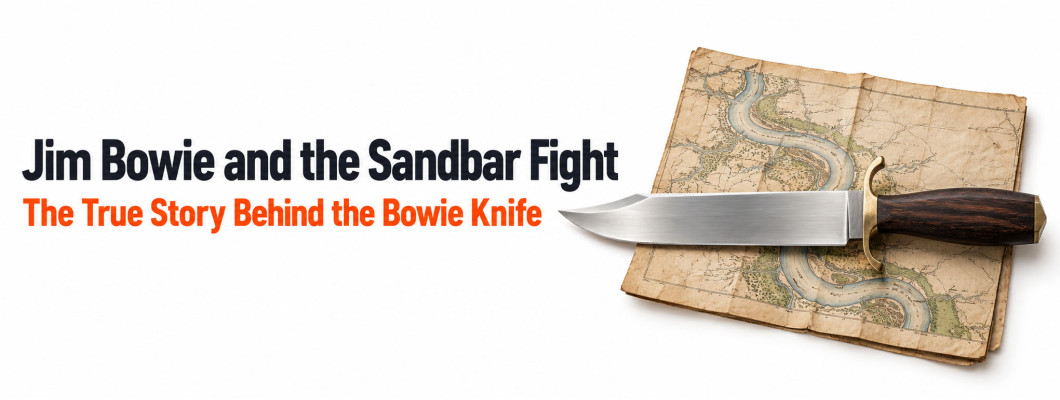
The Bowie Knife Was Made Famous by One Fight on a Mississippi Sandbar in 1827, and Almost Everything Else About Its Origin Is Argued Over
On 19 September 1827, on a sandbar in the Mississippi River opposite Natchez, a formal duel between two men who both missed turned into a brawl among their friends. James Bowie, shot twice and stabbed, killed the man who had pinned him with a large knife his brother had given him. Newspapers carried the story across the United States within weeks, and the "Bowie knife" was born. Who made that first knife, what it looked like, and how it became the broad clip-point blade everyone pictures today are three separate questions, and the honest answers are: probably a Louisiana blacksmith named Jesse Clifft; a plain straight-backed butcher-style blade; and over the following thirty years, mostly in Sheffield and Arkansas. This is the story, with the claims and the counter-claims kept apart.
If you want the design timeline rather than the story, our Bowie knife history and evolution guide covers the blade's development from the 1830s to the tactical Bowies of today; this post is the companion that tells what happened on the sandbar and who was holding what.
Who James Bowie Was Before the Fight
James Bowie was born in Kentucky in 1796 and raised in Louisiana, where he and his brothers Rezin and John made money in land speculation, sugar and, less creditably, the slave trade through Jean Lafitte. By his late twenties he had a reputation as a frontiersman and a man with enemies, chief among them Norris Wright, the sheriff of Rapides Parish and a bank director who had refused Bowie a loan. In 1826 Wright shot Bowie in Alexandria; the pistol ball was stopped or deflected, Bowie survived, and from then on he carried a large knife. According to his brother Rezin, writing in 1838, Rezin had given James that knife for exactly this reason, and it was with him a year later on the sandbar.
The Sandbar Fight, 19 September 1827
The duel was not Bowie's. Samuel Levi Wells III and Dr Thomas Harrison Maddox had quarrelled in Alexandria, and because duelling was illegal in Louisiana they met on a sandbar in the river near Vidalia, in Concordia Parish, on the Louisiana side opposite Natchez, Mississippi. Each brought seconds, a surgeon and a party of supporters. Bowie was with Wells; Norris Wright and the Blanchard brothers were with Maddox. The two principals exchanged two shots each, missed every time, shook hands, and the duel was over.
Then the supporters, who had been kept apart, came forward, and the old feuds went off at once. Robert Crain, of the Maddox party, fired at Bowie and hit him in the hip; Bowie went down, got up, and went for Crain, who broke a pistol over Bowie's head. Norris Wright then shot Bowie in the chest and, when Bowie was on the ground, drew the blade from his sword-cane and ran it into him. Wright, by most accounts, tried to pull the cane-sword free and could not, and in that moment Bowie seized him, pulled him down and drove the big knife into him. Wright died there. The Blanchard brothers shot Bowie again, and Bowie cut one of them badly before the fight ended. It was over in about ninety seconds.
Two men were dead, Wright and Samuel Cuny of the Wells party, and two were seriously wounded, Bowie among them. The surgeons who had come for the duel treated him on the sandbar. He had been shot at least twice, stabbed and beaten with a pistol, and his survival did as much for the legend as the killing of Wright.
What the Knife on the Sandbar Actually Was
The only first-hand description comes from Rezin Bowie, who wrote to the Planters' Advocate in 1838, after the Alamo had made his brother a national figure and the "Bowie knife" a commercial product, to set the record straight. The first Bowie knife, he said, was made for him, not James, by a blacksmith on his plantation in Avoyelles Parish, and it was "a hunting knife" with a blade nine and a quarter inches long and one and a half inches wide, single-edged, with a straight back. Rezin gave it to James after the 1826 shooting. The blacksmith is generally identified as Jesse Clifft, a neighbour and friend of the Bowies on Bayou Boeuf.
In other words the knife of the Sandbar Fight was close to a large butcher knife: straight spine, no clip point, no great guard, probably no coffin-shaped handle. None of the features that define a "Bowie" today were on it. What made it a Bowie knife was the man and the fight, not the shape.
There is a second claimant. James Black, a blacksmith of Washington, Arkansas, is said to have made a knife for Bowie in 1830 from Bowie's own wooden pattern, improving it with a sharpened clip on the back of the point. The story was told by Black himself in old age, in the 1870s, to Daniel Webster Jones, later governor of Arkansas, and it has been repeated ever since; Black also claimed a secret hardening process that died with him. It may well be true that Black made Bowie a knife in 1830, three years after the sandbar, and that it was a finer and more Bowie-shaped weapon than Clifft's. It cannot have been the knife of the Sandbar Fight, because the fight came first. A third name, Daniel Searles of Baton Rouge, made knives for Rezin Bowie in the early 1830s, and one survives; it is a handsome, guarded, straight-backed blade, and it tells us what the Bowies themselves thought a good knife looked like once they could commission one.
The Alamo and the Making of the Legend
Bowie went to Texas in 1830, married into a prominent San Antonio family, lost his wife and children to cholera in 1833, and in 1836 was a colonel of volunteers inside the Alamo. He was ill in his cot, probably with typhoid or pneumonia, when the Mexican army stormed the mission on 6 March, and the stories of him dying with pistols in each hand and the knife in his teeth were written afterwards by people who were not there. His death at the Alamo did what the sandbar had begun: it turned a Louisiana land speculator with a large knife into an American martyr, and the knife went with him into legend.
Demand followed. Through the 1830s American cutlers and, in far greater numbers, the cutlers of Sheffield in England stamped "Bowie knife" on everything from pocket knives to short swords and shipped them to the United States by the crate. It was Sheffield that fixed the look: a broad blade with a concave clip point, a sharpened false edge, a cross-guard, and often a coffin-shaped or pistol-grip handle. By the 1840s "Bowie knife" meant that shape, and states from Alabama to Virginia were passing laws against carrying one, which is why so many of the concealed-carry statutes in our Bowie history guide and sword-law posts still name the Bowie knife by name.
How the Shape Changed, 1827 to 1865
| Period | Blade | Point | Guard and handle | Who made it |
|---|---|---|---|---|
| 1827, the sandbar knife | About 9.25 in long, 1.5 in wide, straight back, single edge | Plain | Little or no guard; simple wood handle | Jesse Clifft for Rezin Bowie (per Rezin, 1838) |
| c. 1830, the Black knife (claimed) | Larger and better finished | Clip point with sharpened false edge | Guard; the story says Black improved Bowie's pattern | James Black, Washington, Arkansas (told in the 1870s) |
| Early 1830s, Searles knives | Straight-backed, well finished | Plain or lightly clipped | Cross-guard, often silver-mounted | Daniel Searles, Baton Rouge, for Rezin Bowie |
| 1835 to 1850s, Sheffield | Broad, 8 to 12 in, often with etched mottoes | Pronounced concave clip, false edge | Cross-guard; coffin, pistol-grip or horse-head handles | Sheffield cutlers for the American market |
| 1861 to 1865, Civil War | Heavy, often crude, up to 14 in and more | Clip or spear | D-guard knuckle-bows on Confederate side knives | Local blacksmiths across the South |
The design side of that table, the grinds, the Spanish notch, the coffin handle and the move to modern tactical Bowies, is the subject of the Bowie knife types guide. The D-guard knives of the last row will get a post of their own; until it is live, the hub covers them.
Set the blade length, finish and handle for the Bowie you want, from the sandbar's plain straight-back to the full Sheffield clip point, and the forge builds it to order.
Build Your BladeWhat a Hand-Forged Bowie Carries From the Story
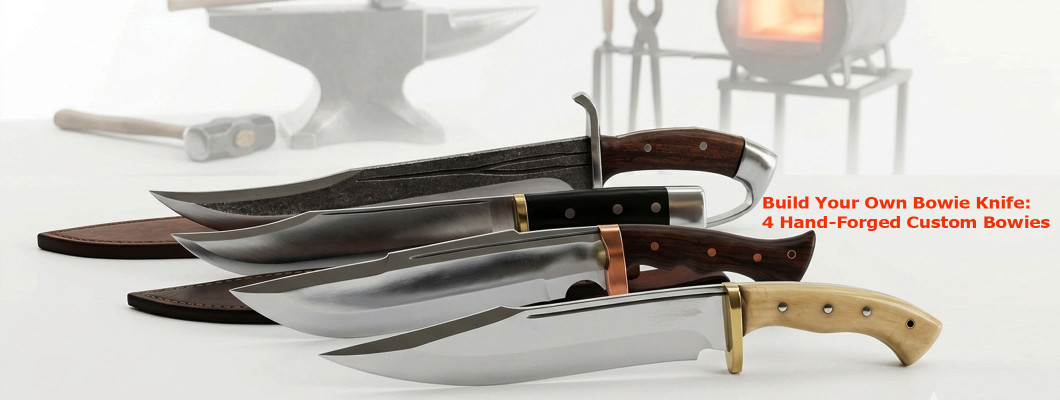
Every Bowie in the hand-forged Bowie knife collection is forged on demand from mono-steel 5160 spring steel, full tang, after the order is placed. Three of them map directly onto the history above.
- The Frontier Bowie is the closest to the sandbar knife in spirit: a straight-backed working blade with a modest guard, the knife of a man who needed a tool first and a weapon second.
- The Classic Regent Bowie is the Sheffield silhouette, the broad clip-point blade with the sharpened false edge and the cross-guard that fixed the word "Bowie" in the 1840s.
- The D-guard Bowie is the Civil War form, with the knuckle-bow that Confederate blacksmiths added when a side knife had to serve as a sword.
An honest note. The sandbar knife and the Searles knives were plain carbon steel, and James Black's "secret process" is unrecorded; nobody knows what it was. Everest Forge blades are mono-steel 5160, hardened and tempered the same way for every knife. We do not make pattern-welded, folded or laminated steel, and we make no claim to have rediscovered Black's method. What you get is a tougher and more consistent blade than any 1830s smith could produce, in the historical shape.
Any Bowie can be ordered left-handed by writing "Left Handed" in the order note, or to stage-combat specification with a blunt edge and rounded tip the same way. Catalogue builds dispatch in 2 to 3 business days; custom builds take 4 to 6 weeks at the forge; shipping is DHL or FedEx, tracked, 7 to 14 business days worldwide. Our guide to what a Bowie knife is actually for covers the working side, and how we forge ours covers the making.
Related Guides
Commission a Bowie Built to the Pattern You Want
Rezin's plain straight-back, a Searles-style guarded blade, the Sheffield clip point or a Civil War D-guard: tell us the length, the point and the handle. The forge quotes it, builds it in 4 to 6 weeks from 5160 spring steel, and ships it tracked worldwide.
Start a Custom Forge RequestFrequently Asked Questions
What was the Sandbar Fight?
A brawl on 19 September 1827 on a Mississippi River sandbar near Vidalia, Louisiana, opposite Natchez. It followed a formal duel between Samuel Wells and Thomas Maddox in which both missed; the supporters then fought, two men died, and James Bowie, badly wounded, killed Norris Wright with a large knife. Newspaper reports of the fight made the Bowie knife famous.
Who made the first Bowie knife?
According to Rezin Bowie's 1838 letter, a plantation blacksmith, usually identified as Jesse Clifft of Avoyelles Parish, made it for Rezin, who gave it to James after the 1826 shooting. James Black of Arkansas claimed to have made Bowie a knife around 1830, which cannot have been the sandbar knife.
What did Jim Bowie's knife look like?
Rezin Bowie described it as a single-edged hunting knife with a straight back, blade 9.25 inches long and 1.5 inches wide. It had none of the clip point, broad blade or large guard that later defined the Bowie knife.
Did James Black really make a Bowie knife?
Possibly. Black told the story himself in the 1870s, decades after the events, and it was written down by Daniel Webster Jones. There is no contemporary record. If he did make Bowie a knife, it was around 1830, after the Sandbar Fight, not before it.
How did Jim Bowie die?
At the Alamo on 6 March 1836, ill in his cot, when the Mexican army stormed the mission. The accounts of him fighting from his bed with pistols and knife were written later by people who were not present.
Why does a Bowie knife have a clip point?
The clip point with a sharpened false edge was added in the 1830s, possibly by James Black and certainly by the Sheffield cutlers who mass-produced Bowies for the American market. It gives a finer point for thrusting and a back-cut, while the broad belly keeps the chopping power.
Why was the Bowie knife banned in some states?
By the late 1830s the knife had become the weapon of choice in Southern brawls and duels, and states including Alabama, Georgia, Mississippi and Tennessee passed laws taxing or restricting the carry of Bowie knives. Many concealed-carry statutes in force today still name the Bowie knife.
Is a D-guard Bowie a real historical type?
Yes. Confederate blacksmiths in the Civil War added a D-shaped knuckle-bow to large side knives so they could serve as a short sword. They were made in large numbers and many survive.
Which Everest Forge Bowie is closest to the original?
The Frontier Bowie, a straight-backed working blade with a modest guard, is closest to Rezin Bowie's description of the sandbar knife. The Classic Regent Bowie is the later Sheffield clip-point form.
Can I order a Bowie left-handed or with a blunt edge?
Yes. Write "Left Handed" in the order note for a left-handed build, or ask for stage-combat specification (blunt edge, rounded tip) the same way. Both apply to any Bowie in the catalogue or a custom build.