How a Spear Is Hafted: Sockets, Tangs and Fitting a Head to a Shaft
Every spear ever made solves the same problem: how do you attach a piece of steel to a piece of wood so hard that it will never come off? Two answers emerged independently across the world — the socket and the tang — and which one a spear uses changes how it is made, how it is repaired, and how it fails. This guide explains both systems, how a head is actually fitted to a shaft, what langets and butt spikes are for, and what to do if you want a full-length spear built to your own reach.
The Two Systems
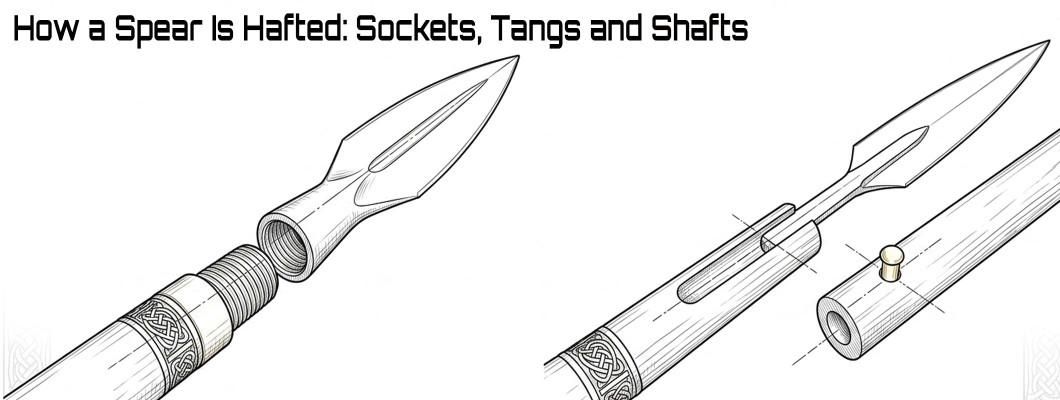
The socket
A socketed head has a hollow cone of steel below the blade. The shaft is shaped to fit inside it, driven home, and secured with a rivet or nail passing through both.
It is more work to forge. The smith takes a flat tongue of steel below the blade and wraps it around a tapered mandrel, closing it into a cone — sometimes forge-welded shut, sometimes left as an open seam. Getting the cone concentric with the blade, so the point sits true on the shaft, is the difficult part.
What it buys you is a joint where the shaft is supported from outside. The steel wraps the wood rather than being driven into it, so the wood is in compression rather than being split apart. That is why the socket dominated European spear-making from the Bronze Age onward, and why every Viking, Greek and Roman spearhead you have seen in a museum is socketed.
The tang
A tanged head has a spike below the blade that goes into the shaft rather than around it. The shaft is drilled or split, the tang driven in, and the joint secured with a binding, a metal ferrule, or both.
It is far simpler to forge — the tang is just drawn out from the same billet — and it appears everywhere that simplicity mattered, across much of Asia and Africa and in many early European forms.
Its weakness is inherent. A wedge driven into wood wants to split it, and every thrust drives it a little further. Without a ferrule or a tight binding at the mouth of the joint, a tanged spear works its shaft apart over time. Done properly, with a well-fitted ferrule, it is entirely sound. Done cheaply it is the reason tanged spears have a poor reputation.
How a Socketed Head Is Fitted
The order matters, and most of the work is in the wood rather than the steel.
Match the shaft to the socket, not the other way round. Every hand-forged socket is slightly its own shape. The shaft end is pared down to a taper that matches that specific cone, testing repeatedly, taking off very little at a time. A socket forced onto an oversized shaft splits it; a socket rattling on an undersized one will loosen no matter what you pin through it.
Dry fit until it seats hard. Pushed on by hand, the head should stop a little short of full depth. Then a few sharp taps of the shaft butt against a solid surface drive it home under its own inertia. If it goes on easily to full depth, the taper is wrong.
Pin it. A hole is drilled through socket and shaft together, and a rivet or nail driven through and peened over on both sides. This is what actually holds the head on. Friction alone will not, however tight the fit feels on the day.
Historically, adhesives were a secondary help. Pine pitch, resin, or hide glue were used to fill and seal the joint, never to carry the load. That principle has not changed with modern epoxy: the pin holds the head, the adhesive keeps water out.
How a Tanged Head Is Fitted
Fit the ferrule first. A metal collar or band goes onto the shaft end before the tang goes in, and it is what stops the wood splitting when the tang is driven home. Fitting it afterwards is much harder and often impossible.
Drill rather than split. A drilled hole slightly undersized for the tang is far better than a split shaft, which is asking the wood to fail along a line you have already started for it.
Drive it in dry and check alignment constantly. A tang that goes in a degree off will put the point a long way off centre by the time you are looking down a six-foot shaft.
Pin or bind at the mouth. Either a transverse pin through ferrule, shaft and tang, or a tight wrap of cord or wet rawhide that shrinks as it dries. Both work. Neither is optional.
Langets — the Detail Most People Miss
Look at a historical polearm and you will often see two flat metal straps running down the shaft from the head, riveted through, sometimes a foot or more long.
Those are langets, and they solve a specific problem: a shaft can be cut. A weapon meeting an axe or a sword edge-on has its shaft severed and becomes a stick. Langets armour the most vulnerable stretch just below the head, and they add a second function by spreading bending load out of the socket and along the shaft.
They matter most on weapons expected to meet other weapons, which is why halberds and bills carry long ones and hunting spears often carry none. If you are commissioning a spear for reenactment or display of a European war form, langets are what make it read as correct.
The Butt End
The end you do not think about does real work.
At minimum a shaft end wants a ferrule — a metal band or cap that stops the grain splitting when the spear is grounded, which happens constantly in use and in storage.
Beyond that, the Greek dory carried a sauroter, a bronze or iron spike at the butt. It served three purposes at once: it counterweighted the head so the balance point sat back near the hand, it let the spear be planted upright in the ground, and it gave a hoplite in the second rank a functional weapon if the head snapped off. That counterweight function is the interesting one — a spear that balances near the hand is far quicker to control than one that is all mass at the front.
Socket or Tang — Compared
| Socketed | Tanged | |
|---|---|---|
| Steel wraps or enters wood | Wraps around it | Drives into it |
| Wood is loaded in | Compression | Splitting |
| Forging difficulty | High — cone must run true | Low |
| Needs a ferrule? | No | Yes, essential |
| Field repair | Reshape a new shaft to fit | Redrill a new shaft |
| Historical range | Europe, Mediterranean, Norse | Much of Asia and Africa |
A Word on Shafts
The wood is not an afterthought. Ash was the historical default across northern Europe for good reasons: it grows long and straight, its grain runs true, and it flexes under shock rather than shattering. Norse poetry called the spear an ash for a reason.
Hickory is tougher and heavier, which suits a short heavy spear more than a long one. Oak is strong but heavy and more prone to splitting along the grain than its reputation suggests. Softwoods are not suitable for anything that will be thrust.
What matters more than species is grain direction. A shaft where the grain runs out the side partway along has a built-in break point, and no amount of good hafting fixes it. Straight grain running the full length, every time.
How Our Spears Are Built
Worth being clear, because it changes what this article means for you.
Everest Forge spears are neither socketed nor tanged in the sense above. They are full tang — the steel runs from the point right through the handle to the butt, with the handle material fitted to either side and secured through it, exactly like our knives and kukris. There is no joint between head and haft to fail, because there is no joint.
That is a deliberate choice for the kind of spear we make: complete, hand-length spears at around 8 to 16 inches of blade, built for hunting, throwing practice, bushcraft and collecting. For that role, full tang is simply the strongest construction available, and it removes the single most common spear failure entirely.
The trade is that they are finished objects. There is no socket to slide onto a shaft, and cutting the handle off a finished spear to re-haft it would waste a good blade and produce something weaker than either design.
If You Want a Full-Length Spear
Have one built that way from the start. This is exactly the kind of work our custom forge service exists for, and a full-length spear is a straightforward commission for smiths who make them.
Tell us what it is for and we will build the joint to suit it. Things worth deciding before you ask:
- Overall length, measured against your own height and what the spear is for — a boar spear, a Greek dory and a throwing javelin are three different lengths.
- Socket or tang, if you have a preference. For a historical European form, socketed is the correct answer.
- Blade pattern and length — broad leaf for cutting and thrusting, narrow for pure penetration, winged or lugged for hunting.
- Langets, if it is a war or reenactment form.
- Butt fitting — a plain ferrule, or a sauroter-style spike for balance and authenticity.
- Whether you want the shaft supplied, or the head built to fit a shaft you already have. If the latter, send us the diameter.
Shipping a long shaft internationally is expensive and it is often cheaper and safer to have the head made to your measurements and source the shaft locally. We are happy to build either way — tell us which and we will spec it accordingly.
Have a Full-Length Spear Built to Your Reach
Socketed or tanged, langets or plain, dory length or boar-spear short — we forge spears to specification in Kathmandu from 5160 spring steel. Tell us the length, the blade pattern and what it is for, and we will confirm every dimension before a hammer touches steel.
Request a Custom Spear →Frequently Asked Questions
What is the difference between a socketed and a tanged spearhead?
A socketed head has a hollow steel cone below the blade that the shaft fits inside, so the steel wraps around the wood and loads it in compression. A tanged head has a spike that is driven into the shaft instead, which loads the wood in splitting and therefore needs a ferrule at the joint. Socketed construction dominated European spear-making from the Bronze Age onward; tanged forms are common across much of Asia and Africa.
How is a spearhead attached to a shaft?
For a socketed head, the shaft end is pared to a taper matching that specific socket, dry fitted until it seats hard, then drilled through socket and shaft together and pinned with a rivet peened over both sides. The pin holds the head; friction alone will not. For a tanged head, a ferrule goes on first, the shaft is drilled slightly undersized, the tang driven in dry, and the joint pinned or bound at the mouth.
What are langets on a spear?
Langets are flat metal straps running down the shaft from the head, riveted through, sometimes a foot or more long. They exist because a shaft can be cut — a weapon meeting an axe or sword edge-on loses its head and becomes a stick. Langets armour the vulnerable stretch below the head and also spread bending load out of the socket. Common on halberds and war polearms, often absent on hunting spears.
What wood is best for a spear shaft?
Ash was the historical default across northern Europe because it grows long and straight, its grain runs true, and it flexes under shock rather than shattering. Hickory is tougher and heavier, suiting shorter spears. Oak is strong but heavy and splits along the grain more readily than its reputation suggests. Softwoods are unsuitable. Grain direction matters more than species: a shaft with grain running out the side has a built-in break point.
What is a sauroter?
The bronze or iron butt spike on a Greek dory. It did three jobs at once: counterweighting the head so the balance point sat back near the hand, allowing the spear to be planted upright in the ground, and giving a hoplite a working weapon if the head snapped off. The counterweight function is the significant one, since a spear balancing near the hand is far quicker to control than one carrying all its mass forward.
Can I mount an Everest Forge spear on a long shaft?
No — our spears are built full tang, with the steel running from the point through the handle to the butt, so there is no socket or tang joint to fit a shaft to. They are complete short spears for hunting, throwing, bushcraft and collecting. If you want a full-length spear, we build those to commission through the custom forge service, and having one made that way from the start is far better than modifying a finished piece.
Should glue be used when hafting a spear?
Only as a secondary measure. Historically pine pitch, resin or hide glue filled and sealed the joint, but the load was always carried by a rivet or a binding. The same holds with modern epoxy: the pin holds the head on and the adhesive keeps water out of the joint. An adhesive-only joint will fail, and it will fail without warning at the worst possible moment.
How long should a spear be?
It depends entirely on the role. A boar spear is short enough to control in dense cover and at close quarters. A Greek dory ran well over two metres for use in formation. A throwing javelin is shorter and lighter with balance set forward. Measure against your own height and the intended use rather than to a general rule, and decide it before commissioning rather than after.