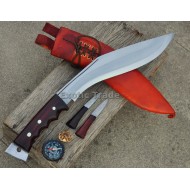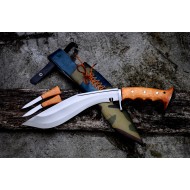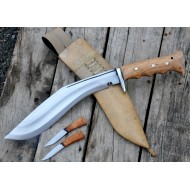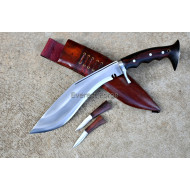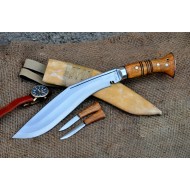
- Model: Signature Kukri/Khukuri
- Product Code: SingnatureBlade054
- Location: Kathmandu, Nepal
Available Options
Hand-Forged Bhojpure Kukri Knife — Angkhola Blade with Bone and Horn Handle
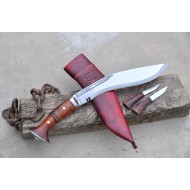
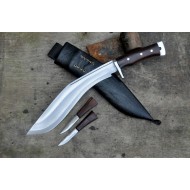
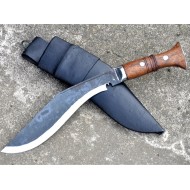
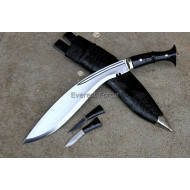
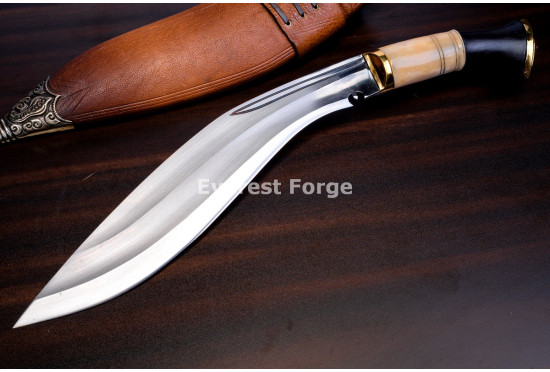
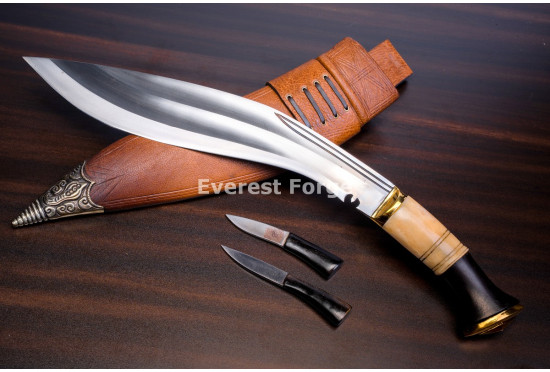
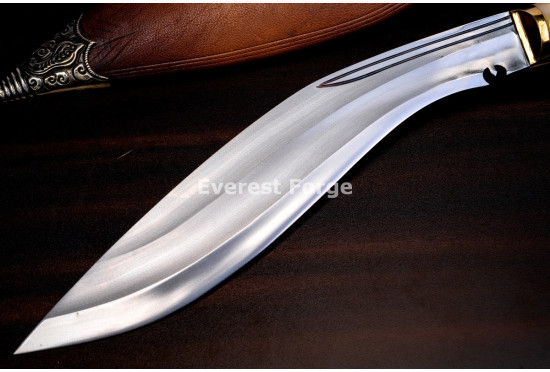
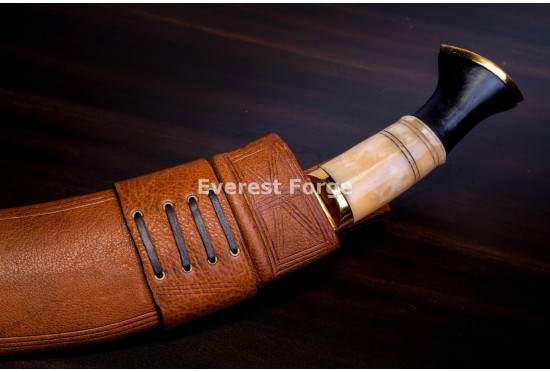
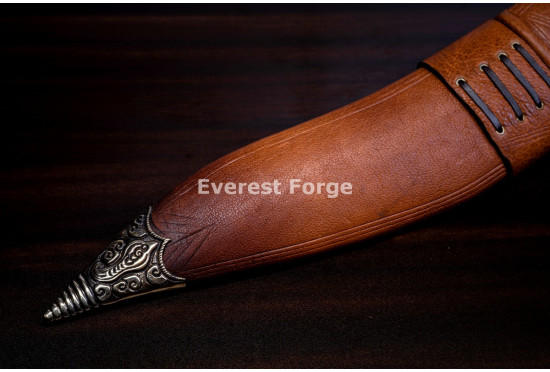
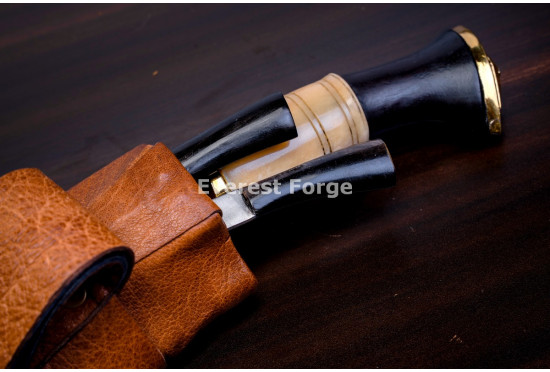
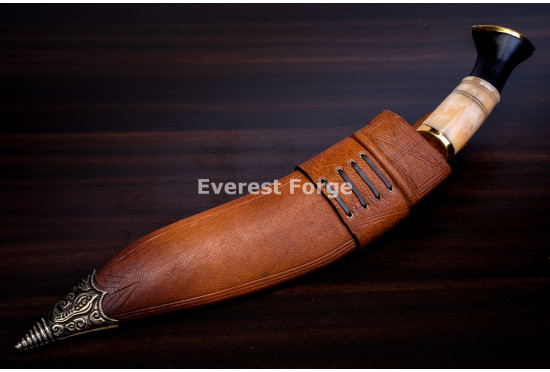
This is a hand-forged, fully functional Bhojpure kukri — the broad, heavy-bellied pattern of eastern Nepal, forged at our workshop in Kathmandu from 5160 high-carbon spring steel, oil-tempered, full tang, and sharpened to a true edge. The blade is an angkhola build with two fullers, what Nepali smiths call dui chirra, and carries the traditional cho notch at its root. The handle is a jointed bone and horn grip, ringed and shaped, with brass ferrule and butt cap. It ships as a complete traditional set: a dap scabbard with a cast decorative chape, and both companion blades, the karda and the chakmak.
The standard blade is 14 inches on a 6-inch handle, for an overall length around 20 inches at about 1.1 kg. Those are traditional working proportions rather than display sizing — a Bhojpure of this size is what a farmer or a soldier would actually have carried, heavy enough through the belly to chop properly and short enough to wear on a belt all day.
An honest note. This is the most traditional kukri we make, and we would rather say what that does and does not mean. What is genuine: the Bhojpure profile, the angkhola blade with its thick spine and two fullers, the cho at the root, the ringed bone and horn handle, the dap scabbard with both companion blades, and the fact that it is forged in Nepal by Nepali smiths. What we are not claiming is that it reproduces a specific antique — the dimensions are ours and the finish is brighter than a village blade would carry. It is also worth knowing that bone and horn are natural materials: the colour, grain and translucency of every handle differ, and small variations are the material rather than a defect.
Bespoke Service
Forge a Kukri to Your Own Design
Want a service size, a different chirra count, a sirupate profile, or a rosewood handle instead of bone and horn? Our Custom Forge service builds to your spec, by hand in Kathmandu.
Request a Custom Forge →What Makes This a Bhojpure
Bhojpur is a district in eastern Nepal, and the kukri pattern that carries its name is the broad, deep-bellied one: more weight forward, a fuller sweep through the belly, and a blade built to chop rather than to look elegant. It is the working farmer's kukri as much as the soldier's. This one is built as an angkhola — literally body-hollowed — which means a thick spine with material taken out of the flats, giving a blade that is exceptionally stiff for its weight. The two fullers running along it are what Nepali smiths call dui chirra. Add the traditional ringed bone and horn handle, the brass fittings, and a dap carrying the karda and chakmak, and you have a kukri built the way they are still built in Nepali villages rather than the way they are built for export.
Specifications
Customize Your Kukri
Every kukri is forged to order. Set your options before you add to cart:
Hand-Forged, Not a Souvenir Kukri
This Kukri
- Hand-forged 5160 high-carbon spring steel
- Oil-tempered, hard edge and flexible spine
- Full tang, traditional Nepali construction
- Cho cut properly, fullers ground into a thick angkhola spine
- Complete with karda and chakmak, as a kukri should ship
A Souvenir Kukri
- Unhardened mild steel or stainless
- No real heat treatment, edge rolls on first use
- Stick tang glued into a hollow handle
- Grooves stamped in cold, cho decorative or missing
- Companion blades blunt, or absent entirely
How It Is Made
Who It Is For
- Collectors of Nepali and Gurkha blades who want the traditional article rather than an export pattern
- Anyone who wants a kukri complete with both companion blades and a proper dap
- Buyers drawn to the Bhojpure profile specifically rather than a generic kukri
- Outdoor users who want a working size they can actually wear on a belt
- Gift buyers — the bone and horn handle and cast chape make it a presentation piece
- Not for anyone wanting a modern grip or a tactical build — our bushcraft kukri suits that better
What Is Included
- One hand-forged Bhojpure kukri, built to your chosen spec
- Karda companion knife and chakmak burnisher, both with matching handles
- Traditional leather dap with cast decorative chape and pockets for both companion blades
- Jointed bone and horn handle with brass ferrule and butt cap
- An angkhola blade with two fullers and a traditional cho
- Everest Forge manufacturer warranty
Explore More Hand-Forged Blades
Shipping, Returns & Care
Shipping
In-stock specs dispatch within 2 to 3 business days; fully custom builds take roughly 4 to 6 weeks to forge before dispatch. We ship worldwide by DHL or FedEx in 7 to 14 business days, tracked. Import and blade laws vary by country, so please check your local rules before ordering.
Returns & Warranty
Every blade is backed by the Everest Forge warranty against forging and material defects. If something is wrong with your order, we will repair, replace, or refund it. Personalized and custom-engraved blades are made to order, so please confirm your spec carefully before purchase.
Care
Wipe the blade clean and dry after use and keep a light film of oil on it — 5160 is carbon steel and sap from green wood is acidic enough to mark it overnight. Pay attention to the fullers, which hold moisture more readily than a flat surface. The bone and horn handle needs its own attention: keep it away from radiators and out of prolonged direct sun, and wipe it every few months with a drop of mineral or neatsfoot oil, because both materials dry and can crack if they lose moisture too fast. Do not store the kukri inside its dap for long periods.
From The Forge
Build a Kukri That Is Yours Alone
Beyond the options here, our Custom Forge service will build a service-size Bhojpure, a slender sirupate, a tin chirra with three fullers, or a kukri matched to an antique you send us photographs of. Roughly 4 to 6 weeks from order.
Start a Custom Forge →Frequently Asked Questions
What is a Bhojpure kukri?
Bhojpure is the broad, heavy-bellied kukri pattern named after Bhojpur, a district in the eastern hills of Nepal. What distinguishes it is the width and depth of the belly — more steel carried forward than on a slender pattern, which puts the mass where a chopping stroke lands and makes it one of the harder-hitting traditional profiles. It is a working knife more than a dress one: the Bhojpure is what gets used on a farm, in a forest and on a march, and it is one of the patterns Nepali households have relied on for generations. If you want something quicker and lighter in the hand, the slender sirupate is the pattern to look at instead, and we build those too.
Why are kukri patterns named after districts?
Because Nepal's blade-making grew up village by village rather than in factories, and geography shaped what each place produced. A kami — a smith — worked in a particular valley, using the materials available there, making blades for people who used them for the specific work that landscape demanded. Over generations each area's output settled into a recognisable shape, and the pattern took the district's name: Bhojpure from Bhojpur in the east, Sirupate from the eastern hills where the siru grass grows, Chainpure from Chainpur, Dhankute from Dhankuta, each with its own profile, its own proportions and its own conventions of decoration. The terms are not marketing categories invented for export; they are how kukris have been described in Nepal for a very long time, and a Nepali buyer would use them the way a European collector uses Oakeshott types. It is also why a kukri made in Nepal by Nepali smiths is a different object from one made to a Nepali outline somewhere else.
What is an angkhola, and what does dui chirra mean?
Two separate terms describing this blade, and both are worth knowing. Angkhola means roughly "body hollowed": it is a build where the spine is left very thick and material is taken out of the flats below it, so you get a blade that is extremely stiff and strong for its weight, with the mass concentrated where it does the most good. Angkhola kukris have a reputation in Nepal as the toughest of the traditional builds, and they are what you want if the knife is going to be worked hard rather than displayed. Chirra is the Nepali word for a fuller ground into the blade, and smiths count them: ek chirra is one, dui chirra two, tin chirra three. This blade is a dui chirra angkhola — a thick hollowed spine with two fullers running along it. The fullers take out weight the stiffness does not need, so you keep the angkhola's strength without the whole thing becoming a club.
How does this differ from your other kukris?
This is the traditional one. It is the only kukri we make that ships as a complete set with both the karda and the chakmak in a proper dap, and the only one with a jointed bone and horn handle and brass fittings. It is also the only one built to a named regional pattern. Our bushcraft kukri is a modern build with a contoured slab handle and a flat belt sheath, made to carry and use rather than to be authentic. Our battle kukri is the heaviest, with a blackened blade and sculpted steel fittings. Our tiger-etched kukri is larger at 16.5 inches with an etched blade and a karda only. Our fullered fantasy kukri has a nine-inch two-hand grip and a steel guard. Buy this one if you want a kukri the way Nepal makes them.
What are the karda and chakmak for?
They are the two small blades that ride in pockets on the dap, and a traditional kukri is not complete without them. The karda is a small utility knife — sharpened, and used for everything the big blade is hopeless at: cutting cord, food preparation, fine carving, skinning. The chakmak is blunt, and it does two jobs. Run along the edge it trues and realigns the working edge without removing metal, the way a butcher's steel does, which is how a kukri edge is maintained in the field where there is no stone. And historically the hardened spine of a chakmak was struck against flint to make sparks for fire. Both are included here with handles matched to the kukri.
Is this a real, functional kukri?
Yes. It is hand-forged from 5160 high-carbon spring steel, oil-tempered, sharpened, and built on a full tang. The angkhola section makes it particularly stiff for its weight, which is exactly what you want in a chopper. It will take down green wood, clear brush and handle the work a kukri is meant for. Do not use it on stone, metal, nails hidden in old timber, or seasoned hardwood knots, and check the edge and the handle fittings after heavy use.
What steel is it, and is it oil-tempered?
The blade is forged from 5160 high-carbon spring steel, the same alloy used in heavy-duty truck leaf springs, prized for toughness and edge retention. It is oil-tempered for a hard cutting edge backed by a flexible, shock-absorbent spine. Nepali smiths have forged kukris from vehicle leaf spring for generations, long before anyone in Nepal was quoting an alloy number — it became the traditional material because it was available and because a chopping blade needs to absorb shock without chipping far more than it needs extreme hardness.
How is the bone and horn handle made?
It is a jointed handle: sections of bone and dark horn cut, drilled and fitted together over the tang, then turned and shaped as one piece with rings cut into the profile, and finished with a brass ferrule at the blade and a brass cap at the butt. The rings are not decoration alone — they give the hand something to register against, which matters on a kukri because the forward bend generates a twisting load with every strike. Because bone and horn are natural, no two handles come out the same: colour, grain and translucency all vary, and small differences between sections are the material rather than a fault. Both materials want a little care, which is covered in the care notes.
What is the dap, and what is the decorated tip?
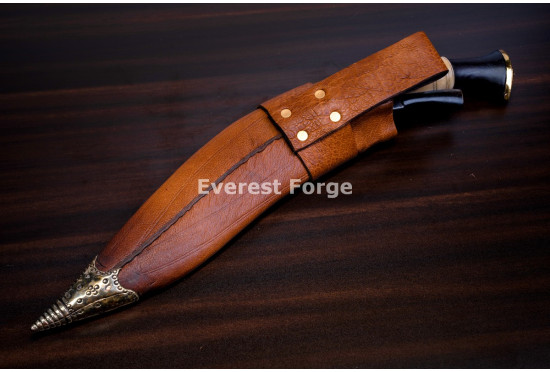
The dap is the traditional kukri scabbard: built around a fitted wooden core covered in leather, with pockets on the back for the karda and chakmak. The wooden core is what holds the blade securely and stops the edge cutting its way out — a flat leather sleeve cannot do either. The decorated piece at the tip is the chape, a cast metal fitting that protects the point of the scabbard from wear and, on a good kukri, carries traditional Nepali scrollwork. It is the part that shows when the kukri hangs at the belt, which is why it gets the decoration. Keep the kukri out of the dap for long-term storage: leather is tanned with acids and holds damp against carbon steel.
Does it arrive sharpened?
Yes, sharpened to a working edge along the belly, finished by hand, and the karda is sharpened too. The chakmak is blunt by design — that is what it is for. The area of the edge near the cho and back toward the bolster is traditionally left unsharpened, which is normal and not an oversight. If you need the kukri blunt for display or to satisfy import rules where you live, choose the display-blunt option or tell us in your order notes, at no extra charge.
Can I order a different pattern, size, or fuller count?
Yes to all three, and this is where the regional vocabulary becomes useful rather than decorative. Tell us the pattern you want — Bhojpure for chopping weight, sirupate for a slender quick blade — and the fuller count, from a plain angkhola with none through ek chirra, dui chirra and tin chirra. Blade length runs from a service size around eleven inches upward. Handle material and fittings are adjustable too. If you have an antique kukri you would like matched, send photographs and measurements and our smiths will tell you honestly how close they can get before quoting.
Do you ship worldwide, and how long does it take?
Yes. We ship worldwide from Nepal by DHL or FedEx in 7 to 14 business days with tracking. In-stock specs dispatch within 2 to 3 business days; fully custom builds take roughly 4 to 6 weeks to forge first. Import and blade laws vary by country, so please check your local rules before ordering.
| Specification | |
| Blade: | 14 inches. Hand forged from 5160 carbon steel |
| Total Length: | 20 inches |
| Handle: | 6 inches. Full tang, jointed bone and horn with ringed profile, brass ferrule and butt cap |
| Weight: | Approx 1100 grams total (blade approx 750 grams) |
| Note: | As every piece is forged by hand, slight variation in weight, dimensions and finish may occur. Bone and horn are natural materials, so colour, grain and translucency differ in every handle and no two are alike. Supplied complete with karda and chakmak in a traditional dap. Keep the blade lightly oiled when not in use. |