Guts' Dragon Slayer vs Cloud's Buster Sword
Two giant swords, two franchises, one argument that has run for nearly thirty years. Cloud Strife's Buster Sword from Final Fantasy VII and Guts' Dragon Slayer from Berserk are the two most famous oversized blades in Japanese pop culture, they are constantly confused with each other, and one of them came first. This post settles what can be settled — dates, designs, what each would weigh in real steel — and tells you which one you are actually looking for before you buy either.
We write this as a forge, not a fan site: Everest Forge is one of the few forges in the world that forge real, functional Guts swords, and the Buster Sword, in hand-forged 5160 steel. We have made both, so the differences below are the ones you feel in your hands, not just the ones you see on screen.
Everest Forge's swords are independent hand-forged interpretations and are not official or licensed products. Berserk, Guts and the Dragon Slayer belong to Kentaro Miura, Studio Gaga and Hakusensha; Final Fantasy, Cloud Strife and the Buster Sword belong to Square Enix.
Is the Buster Sword Based on Berserk? Which Came First
Berserk began serialisation in 1989, and Guts is carrying the Dragon Slayer from the very first chapter — the manga opens in the Black Swordsman arc, after the Eclipse, with the slab already on his back. Final Fantasy VII was released in January 1997, eight years later, with the Buster Sword designed by Tetsuya Nomura. So the Dragon Slayer is older by a clear margin.
Was the Buster Sword based on it? Nomura and Square Enix have never said so, and fans have argued both ways ever since: the resemblance is obvious, Berserk was enormously popular in Japan in the mid-1990s, and oversized blades were already a visual language in manga by then. The fair answer is that the Dragon Slayer made the giant slab sword iconic, and the Buster Sword is its most famous descendant, whether or not anyone at Square was thinking of Guts in 1996. What is certain is that they are not the same sword and were never meant to be.
Design: Two Slabs, Nothing Else in Common
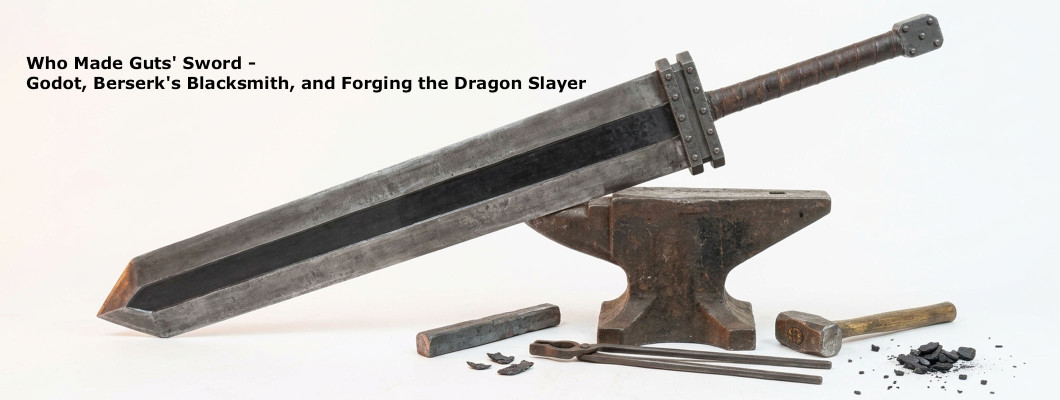
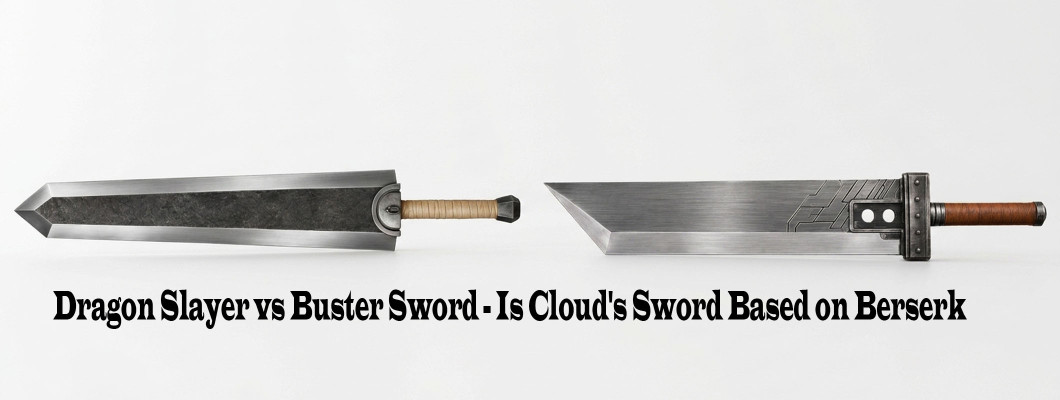
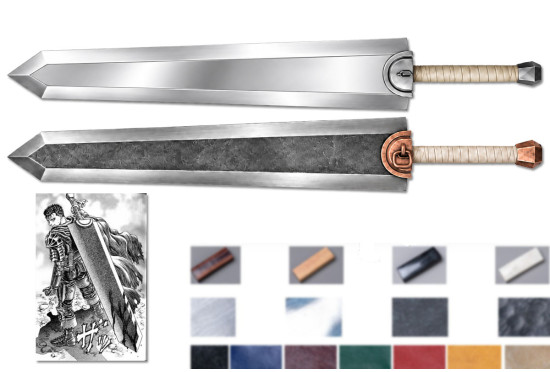
The Dragon Slayer is a double-edged wedge: very wide at the base, tapering straight to a short point, with bevels on both edges, no fuller and no cross-guard — just a slotted disc collar, a long wrapped two-hand grip and a faceted cap. It is crude on purpose; in the story it was forged as an insult. Guts carries it on his back in a leather harness.
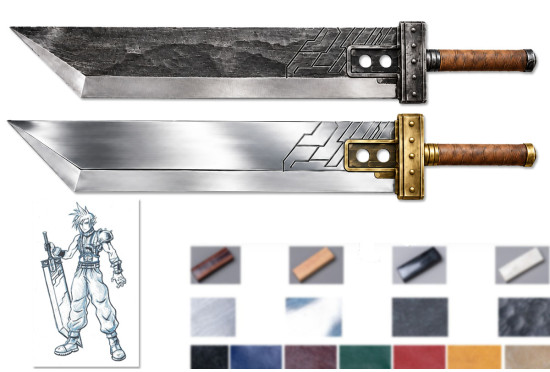
The Buster Sword is a single-edged chopper: parallel-sided, with a flat spine, one sharpened edge, and the point clipped on a long diagonal. Two round holes near the guard held materia in the game. The guard is a thick riveted rectangular block, the grip is short, and the whole thing is tidier and more mechanical than Guts' sword — a weapon somebody designed, not one somebody hammered out in anger. Cloud carries it on a magnetic back-harness.
Side by side, the tells are the point (tapered and symmetrical on the Dragon Slayer, clipped and one-sided on the Buster), the edges (two against one), the holes (Buster only) and the guard (disc collar against riveted block). If a listing calls a two-holed clipped blade a "Guts sword," it is wrong.
Size and Weight: In Fiction and in Steel
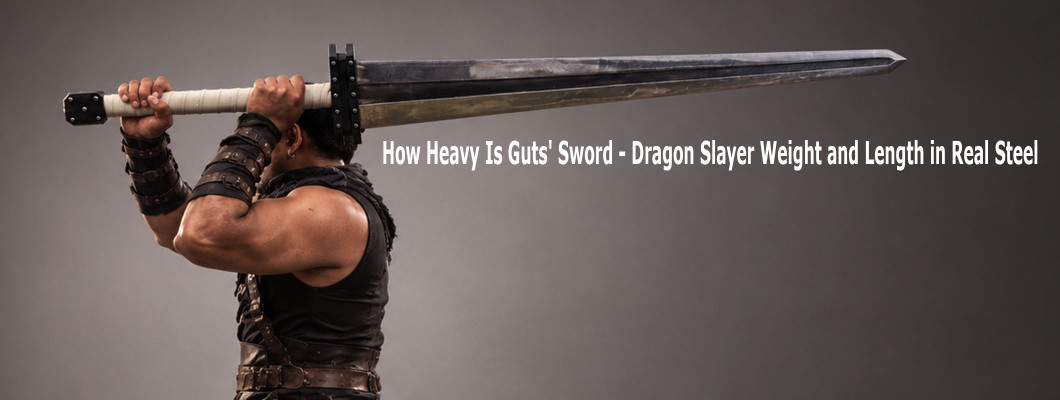
Neither franchise gives official dimensions. Fans put the Dragon Slayer at about 6.5 feet overall and 45 cm wide; Square Enix's own full-size Buster Sword prop for the Remake measured about 185 cm, and scaled against Cloud the blade is roughly a foot wide. In fiction both would weigh somewhere between 30 kg and well over 100 kg depending on the thickness you assume, and neither could be lifted.
In real steel, at a size you can own, they come out close. Our Dragon Slayer is forged 174 mm wide at a 9 mm spine and weighs about 8.1 kg with a 36-inch blade (13.2 kg at 45); our Buster Sword is 178 mm wide at an 8 mm spine and weighs about 8.7 kg at 36 inches (14.2 kg at 45), a little heavier because the parallel blade carries more steel toward the point. Both ship with an open-back leather-and-wood cover and a shoulder harness rather than an enclosed scabbard, because a scabbard for a blade that wide would weigh more than most swords. The full table by length is in How Heavy Is Guts' Sword?.
Character: Why Each Sword Matters
The Dragon Slayer is Guts — crude, too heavy, rejected by the man it was made for, and useful only because its owner refuses to put it down. It is a burden he chooses. The Buster Sword is an inheritance: made for Angeal's family, carried by Angeal, given to Zack with the instruction to protect his honour, left in Cloud's hands on a cliff outside Midgar, and finally planted in the ground as a grave marker until Cloud sets it right. One sword is about will; the other is about the people who held it before you. That is the real difference, and it is why people who love one are rarely satisfied with the other.
Shipping a Sword This Wide
Both swords leave the forge in a wooden box built for them — a timber crate cut to the sword's length and width, with the blade and cover padded and braced so nothing moves — and ship worldwide with FedEx Express, tracked, seven to ten days after the forge is done. On a standard shipment your country may charge import duties and taxes on delivery; choose our DDP (Delivered Duty Paid) service and we handle the duties, import taxes and customs clearance ourselves before the parcel moves, so there is nothing to pay at the door. Import rules on large edged blades vary by country and are the buyer's responsibility to check; ask us before ordering if you are unsure about yours.
Which One Should You Buy?
If the sword in your head has two holes and a diagonal point, it is the Buster Sword, and it is a Final Fantasy sword, not a Berserk one. If it is a plain tapered slab with a round collar, it is the Dragon Slayer. If you are buying for a Berserk reader, remember Guts also carries a different sword for the whole Golden Age arc — the Raider / Hundred-Man Slayer — and many readers want that one more. If you are buying for a gamer who grew up on the PlayStation, it is the Buster, and the Remake-era polish (polished blade, brass fittings) is the version they will recognise.
The post-Eclipse slab — 174 mm wide, slotted disc collar, back harness
Approx 8.1 kg at 36 in · five blade lengths · forged to order
View Sword
Final Fantasy VII-inspired — not a Berserk sword, but the other giant blade
Approx 8.7 kg at 36 in · five blade lengths · forged to order
View SwordBoth are forged to order in Kathmandu from 5160 spring steel on a riveted full tang, in five blade lengths, with the weight published for every size and the finished sword photographed on the scale before it ships. See the whole Guts Sword collection.
Can't Decide? Get Both Quoted
The Dragon Slayer and the Buster Sword share a forge, a steel and a harness. Order both from the collection, or send us your own reference for a different giant blade and we will quote it individually.
Browse the Guts Sword Collection Request Custom ForgeFrequently Asked Questions (FAQ)
Is the Buster Sword based on Berserk?
Square Enix and designer Tetsuya Nomura have never said so. The Dragon Slayer appeared in Berserk from 1989 and Final Fantasy VII was released in 1997, so the Dragon Slayer came first and made the giant slab sword iconic; whether the Buster Sword was directly inspired by it is unconfirmed.
Is the Buster Sword a Guts sword?
No. The Buster Sword is Cloud Strife's weapon from Final Fantasy VII. Guts' swords are the Dragon Slayer and his Golden Age greatsword. Listings that call a two-holed, clipped-point blade a Guts sword are mislabelled.
What is the difference between the Dragon Slayer and the Buster Sword?
The Dragon Slayer is a double-edged tapered wedge with a slotted disc collar and a long grip; the Buster Sword is a single-edged parallel blade with a clipped diagonal point, two holes near the guard, a riveted block guard and a short grip.
Which is bigger, the Dragon Slayer or the Buster Sword?
In fiction, roughly the same: both are drawn at around six to six and a half feet overall and about a foot or more wide, with no official figures. In our forged versions at the same blade length the Buster is slightly heavier because its blade stays wide to the point.
How heavy is a real Buster Sword?
Forged in 5160 steel at the game's proportions, ours weighs about 8.7 kg with a 36-inch blade and about 14.2 kg at 45 inches. Full-size steel builds at near-canon width weigh 20 kg or more and live on stands; stainless-sheet replicas weigh 4 to 6 kg and flex.
How are they shipped, and do I pay import duties?
In a wooden crate built to the sword, by FedEx Express, tracked, seven to ten days after the forge is done. On a standard shipment your country may charge duties and taxes on delivery; choose our DDP (Delivered Duty Paid) service and we handle duties, import taxes and customs clearance for you, with nothing to pay at the door.
Can I buy a real Dragon Slayer or Buster Sword?
Yes, hand-forged to order from Everest Forge's Guts Sword collection: five blade lengths each, in 5160 spring steel on a riveted full tang, with an open-back cover and shoulder harness.