The Bollock Dagger: Why It's Called That, and Why Victorians Renamed It
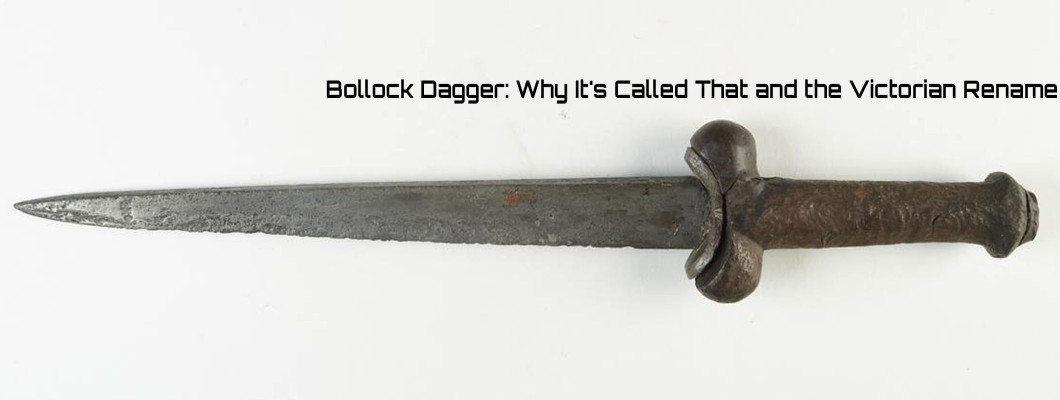
The bollock dagger is named for the two rounded lobes at the base of its grip, which resemble male testes. That is the whole explanation, it was never a euphemism, and medieval Europeans called it that without embarrassment for four hundred years. In the nineteenth century, arms historians decided the name was indecent and renamed it the "kidney dagger" — on the reasoning that the lobes could also be seen as kidney-shaped.
The Victorian name stuck in museum catalogues and is still used today, which is why you will see the same object under two names. Underneath the naming argument sits a genuinely important weapon: one of the five main medieval dagger types, with the longest continuous run of any of them, and the direct ancestor of the Scottish dirk.
The Shape, and the Name
A bollock dagger has no crossguard. Instead the base of the grip swells into two rounded lobes, one on each side, and those lobes do the work a guard would otherwise do: they stop your hand sliding forward onto the blade and give you something to index against in the dark.
The lobes are usually carved in one piece with the wooden grip rather than fitted as a separate component, and the top of the assembly is reinforced with a shaped metal washer where the blade meets the hilt. Most surviving hilts are simple carved wood. Metal, bone and ivory examples exist, and there are occasional survivals in exotic materials such as agate.
The resemblance to male anatomy is obvious, and it was obvious then. It was reinforced by how the dagger was carried: front and centre on the belt, grip pointing straight up. Medieval Europe found this funny and named the object accordingly. There is no evidence anyone was troubled by it.
The Victorian Renaming
In the nineteenth century, weapon historians cataloguing collections introduced the term "kidney dagger". The stated justification was that the two lobes could be read as kidney-shaped. The actual reason was that the existing name could not comfortably be printed in a museum catalogue or spoken in a lecture hall.
It is a small thing and it tells you something useful about how arms history reaches us. The objects come down unchanged; the vocabulary describing them is filtered through whoever was writing at the time. A weapon that Tudor Englishmen discussed without difficulty acquired a euphemism three centuries later, and that euphemism is still in circulation.
Where this matters practically: if you are researching one of these and finding nothing, search the other name. Auction records, museum databases and academic papers split roughly along this line, with older and more institutional sources favouring "kidney" and modern scholarship and the reenactment community using "bollock" or "ballock".
There is a third name too. In the sixteenth and seventeenth centuries the hilts were frequently made of box root, known as dudgeon, and the weapon was sometimes called a dudgeon dagger or a dudgeon-hafted dagger. That name has fallen out of use entirely.
Where It Sits Among Medieval Daggers
The bollock is one of the five main dagger types of medieval Europe, and the differences between them are almost entirely in the hilt rather than the blade.
| Type | What defines it | Roughly when |
|---|---|---|
| Bollock | Two rounded lobes at the base of the grip, no crossguard | c. 1300 to the 1700s |
| Rondel | Flat discs above and below the grip | 14th to 16th century |
| Quillon | Sword furniture in miniature — a straight crossguard and pommel | Throughout the medieval period |
| Baselard | An H-shaped hilt, capital I in profile | 14th to 16th century |
| Ear dagger | Two flat discs splayed at the pommel like ears | 15th to 16th century |
Every one of those five is answering the same question — how do you stop the hand sliding forward without a full crossguard getting in the way of daily wear — and each arrives somewhere different. Our guides to the quillon dagger and the baselard cover two of the others.
The bollock's distinction is longevity. It has one of the longest usage periods of any of the five, appearing on continental effigies around 1300 to 1350 and still being worn in the Netherlands, Scandinavia and the British Isles into the eighteenth century. Four hundred years is a long time for a design not to be improved upon.
The Blade
Two patterns dominate, and the choice tells you what the owner expected to do with it.
Double-edged with a flattened rhomboid section. Symmetrical, stiff through the middle, and it thrusts and cuts on both sides. This is the version that reads most obviously as a weapon.
Single-edged with a triangular section. One edge sharpened the full length, and the back edge sharpened only for the last quarter or third toward the tip. That back bevel is the interesting part: it gives you a point that cuts on the withdrawal while leaving a thick unsharpened spine along most of the blade, which makes the dagger far stiffer and lets you put a thumb or the heel of your other hand on the back for a heavy thrust.
The second pattern is the more practical object, and it explains how a dagger stayed in daily use for four centuries. It works as a tool.
Who Actually Carried One
Everyone, more or less, which is the point.
The bollock dagger was popular across Scandinavia, Flanders, England, Wales, Scotland and Bohemia, and it was carried by soldiers and civilians alike. In Bohemia, finds from Prague, Čáslav, Brno and Hradišťko confirm its use from the second quarter of the fourteenth century through the Hussite wars and beyond. In the English and Scottish borders it was standard among the Border Reivers, carried as a backup to the lance and the sword.
The single most telling body of evidence is the Mary Rose. When Henry VIII's warship was raised, a large number of bollock daggers came up with it — not one or two curiosities but a quantity consistent with this being the ordinary sidearm of ordinary men. In the British Isles the type first appears on effigial monuments, including those of Sir William de Aldeburgh and Robert Parys, within about fifty years of its appearance on the continent.
That spread is the reason the name survived. A weapon carried by a few specialists gets a technical name. A weapon carried by everybody gets a nickname.
How the Dirk Came Out of It
The Scottish dirk is a direct descendant, and once you know to look for it the connection is obvious.
Take a bollock dagger, lengthen the blade, and let the two lobes shrink and flatten into the shoulders of the hilt. That is a dirk. The characteristic haunches on a Highland dirk hilt are the bollock's lobes after three centuries of stylisation, and the interlaced carving on later dirk hilts descends from decoration on bollock grips.
The differences are real, though. A dirk is longer — a long thrusting dagger rather than a dagger proper — and Scottish dirks were sometimes built from cut-down sword blades rather than knife blades. Dirks are usually single-edged. And the dirk went on to become a living object of Highland dress, still worn ceremonially today with a by-knife and fork set into the scabbard, while the bollock dagger stopped being made and became purely historical.
Our post on the evolution of the Scottish dirk covers what happened after the split.
What a Lobed Hilt Asks of the Maker
This is the part that matters at the bench, and it is why a bollock dagger is not simply a knife with a decorative handle.
On a conventional dagger the guard is a separate component. It slots onto the tang, seats hard against the blade shoulders, and forms part of a stack locked together by peening or a nut. On a bollock dagger there is no such component. The lobes are carved as part of the grip itself, so the grip is doing two jobs at once: it is the handle and it is the guard.
That places every demand on the shape. Retention comes from the swell of the lobes and how well the whole thing fills a closed fist, with nothing to stop against at the front except those two rounded forms. If the lobes are undersized or badly placed, a wet or tired hand travels forward — and on a dagger with no crossguard, a hand travelling forward has somewhere unpleasant to go. The metal washer at the top of the hilt is not decoration either; it takes the load where the wood meets the blade and stops the grip splitting.
The practical consequence for anyone commissioning one: send a hand measurement. On a lobed hilt the fit is a safety matter rather than a comfort one, and it cannot be corrected after the piece is made.
Bollock Daggers, Hand-Forged in 5160
We hold no stock — every blade is forged after the order is placed, so blade length, section, hilt material and lobe form are yours to specify. Twin fuller, steel lobed and fluted pommel variants are in the range, and a specific historical example can be quoted through custom forge.
Frequently Asked Questions
Why is it called a bollock dagger?
Because of the two rounded lobes at the base of the grip, which resemble male testes. The resemblance was reinforced by how it was worn — front and centre on the belt with the grip pointing straight up. The name was used plainly across medieval Europe for around four hundred years and was never a euphemism or a joke term.
What is a kidney dagger?
The same weapon. Nineteenth-century arms historians introduced "kidney dagger" to avoid the sexual connotation of the original name, on the reasoning that the two lobes could also be read as kidney-shaped. The Victorian term persists in museum catalogues and older reference works, while modern scholarship and the reenactment community use bollock or ballock dagger.
What is the difference between a bollock dagger and a dirk?
The dirk descends from the bollock dagger rather than competing with it. A bollock dagger has two pronounced rounded lobes at the base of the grip; on a dirk those lobes have shrunk and flattened into the haunches of the hilt. Dirks are also longer, usually single-edged, and were sometimes made from cut-down sword blades. The dirk survives today as Highland ceremonial dress; the bollock dagger does not.
When was the bollock dagger used?
From around 1300 to the 1700s, which is one of the longest runs of any of the five main medieval dagger types. It appears on continental effigies between about 1300 and 1350, reaches the British Isles within roughly fifty years of that, is especially associated with the Tudor period, and was still being worn in the Netherlands, Scandinavia and the British Isles into the eighteenth century.
Is a bollock dagger single or double edged?
Both patterns exist. One is double-edged with a flattened rhomboid cross-section. The other is single-edged with a triangular section, sharpened along its full length on one side and on the back only for the last quarter to third toward the tip. The second is the more practical object, because the thick unsharpened spine adds stiffness and lets you brace a thumb on the back for a heavy thrust.
What is a dudgeon dagger?
Another name for the same weapon, used in the sixteenth and seventeenth centuries when the hilts were frequently made of box root, which was known as dudgeon. You will see the terms dudgeon dagger and dudgeon-hafted dagger in period sources. It has fallen out of use completely and you are unlikely to meet it outside older documents.
Who carried bollock daggers?
Soldiers and civilians across Scandinavia, Flanders, England, Wales, Scotland and Bohemia. Border Reivers carried them as backup to the lance and sword. The clearest evidence of how ordinary they were is the Mary Rose: when Henry VIII's warship was raised, bollock daggers came up in quantity rather than as isolated curiosities.
Does a bollock dagger have a guard?
Not a crossguard. The two lobes do the guard's job — stopping the hand sliding forward onto the blade — and they are usually carved in one piece with the wooden grip rather than fitted as a separate component. A shaped metal washer reinforces the top of the hilt where it meets the blade. That means the grip is handle and guard at once, so its shape matters more than on a guarded dagger.
Can you forge a custom bollock dagger?
Yes. We hold no stock and forge after the order is placed, so blade length, cross-section, hilt material and lobe form are all specification rather than selection. If you are working from a specific find or museum example, send the reference and we will confirm the details before forging. Include a hand measurement — on a lobed hilt the fit is a safety matter and cannot be adjusted afterwards.