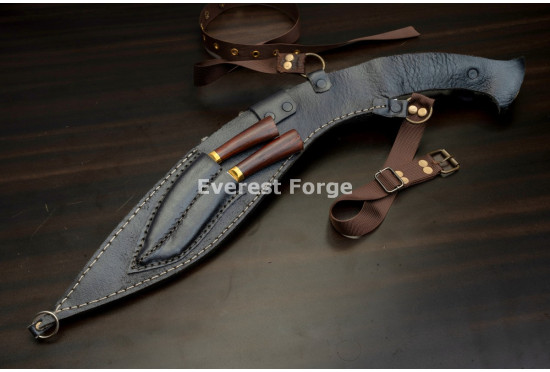


- Model: Signature Kukri/Khukuri
- Product Code: FLOWERANGKHOLA
- Location: Kathmandu, Nepal
Available Options
What Is an Angkhola Khukuri?
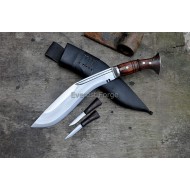
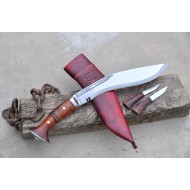
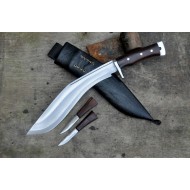
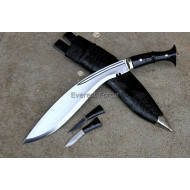
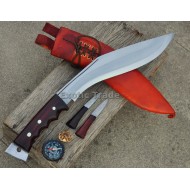
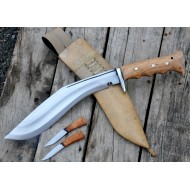
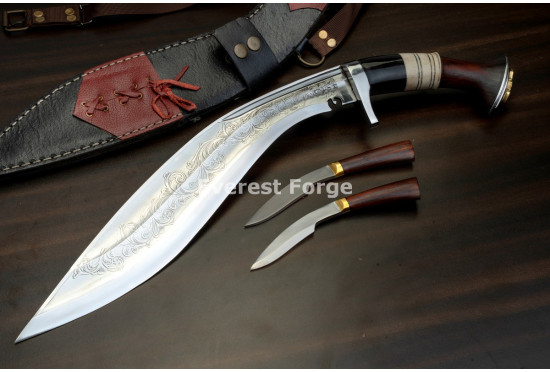
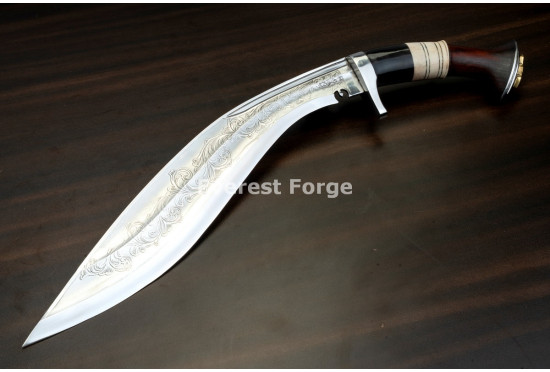
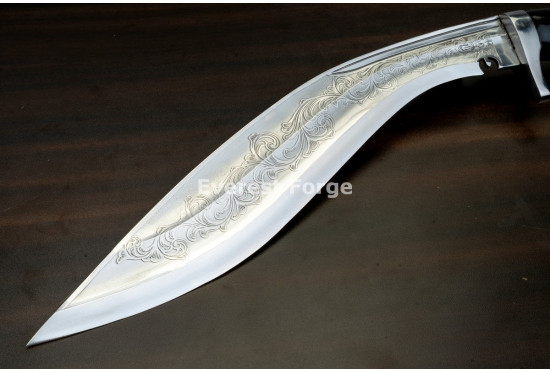
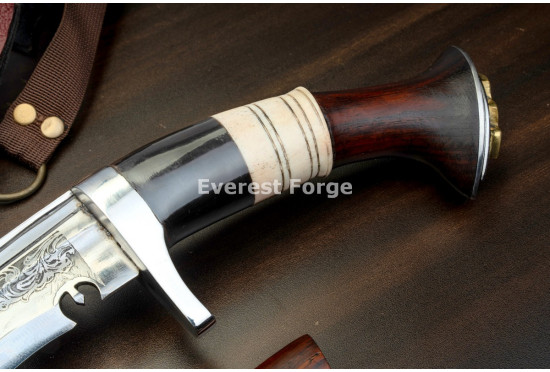
Angkhola means body groove, and it names the heaviest-duty khukuri pattern Nepal makes. The defining feature is not the groove itself but what the groove allows: a spine left unusually thick, with a hollow ground into the body of the blade to take weight out of the middle while leaving the back full. The result is a blade that carries far more steel than a normal khukuri without being unliftable. This one is 15 inches of blade at 900 grams, 21.5 inches overall, hand-forged in Kathmandu from 5160 high-carbon spring steel, with a full-face floral etch, a sectioned horn, bone and rosewood handle, and karda and chakmak in a black leather scabbard with a webbing shoulder harness.
At 60 grams per inch of blade this is the heaviest khukuri we build, and that number is the whole point of the pattern rather than an accident of it. Everything below is written around what that weight buys you and what it costs you.
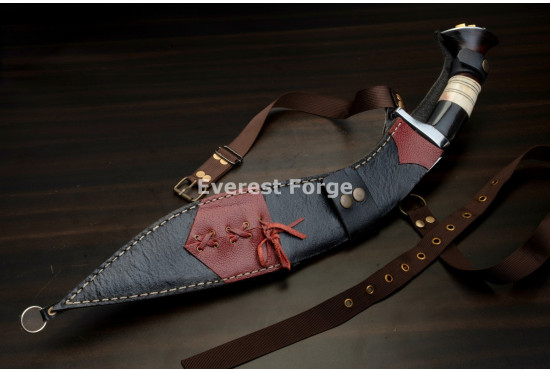
An honest note on the harness. The scabbard comes with a modern webbing shoulder strap and buckle rather than a traditional belt frog. That is a practical choice on a piece this heavy, because 1350 grams on a belt drags in a way it does not across the shoulders, but it is not period and it will look wrong beside a historical display. We will build it with a traditional frog instead at no extra cost.
An honest note on the etching. The floral work covering the blade face is acid etched, not hand engraved. Both are legitimate and etching is what almost every decorated khukuri in this price range carries, but they are different processes producing different results, and the difference is visible if you know what to look for. Our etched chirra kukri page sets out how to tell them apart on any decorated blade.
Please check your local law before ordering. At 15 inches this blade is above the everyday carry allowance almost everywhere, and the khukuri's distinctive shape draws customs attention in some countries. Rules for owning one at home, carrying one in the field and importing one across a border are frequently three separate questions with three different answers.
Want It Plain, or Traditionally Carried?
An undecorated blade, a single-material handle and a traditional belt frog will give you a serious working angkhola rather than a display piece. All three cost nothing extra.
Specify a Working Build →Why This Khukuri Is Built the Way It Is
Full Specifications
Blade length, blade finish, decoration and handle material are selectable on this listing. The figures above describe the standard build as photographed; what you receive will match the options you choose at checkout. Small variations in weight, dimension and finish are normal in hand-forged work.
Build It Your Way
What This Khukuri Does Well, and What It Does Not
What It Is Good At
- Heavy chopping. This is the pattern for it and 900 grams is the reason
- Splitting and felling small timber, where mass does more work than edge geometry
- Display. A full-face etch on a blade this size is genuinely striking
- Carrying comfortably despite the weight, thanks to the shoulder harness
- Being a complete set, with the karda for small jobs and the chakmak for edge maintenance
What It Is Not Good At
- Extended use. At 900 grams your forearm will tire well before the blade does
- Anything precise. It is the least controllable khukuri we make, which is why the karda is included
- Staying decorated. Real use will scratch through an etch; order it plain if you will work it
- Low-maintenance ownership. Three handle materials and carbon steel all want attention
- Discreet carry. At 21.5 inches with a shoulder rig it is about as conspicuous as a knife gets
How to Order a Custom Khukuri
Angkhola or Chirra?
Angkhola keeps the spine thick and chops harder. Chirra cuts multiple fullers and stays lighter and quicker. They are opposite answers to the same problem and we build both.
See the Full Khukuri Range →Who This Khukuri Is For
- Buyers who want maximum chopping from a single blade and understand what the weight costs
- Display and collection buyers, since a full-face etch on a 15 inch blade has real presence
- Anyone comparing khukuri patterns, because angkhola and chirra are the two opposite solutions
- Gift buyers, as a three-piece set with a decorated blade and a harness presents very well
- Collectors of Nepali handle work, since sectioned horn, bone and rosewood is becoming uncommon
It is not for you if you want a khukuri you can swing all afternoon, in which case our chirra khukuri is lighter and quicker, or if you want something that stays looking new, in which case order it plain.
What Is Included
- The hand-forged angkhola khukuri, sharpened and ready to use
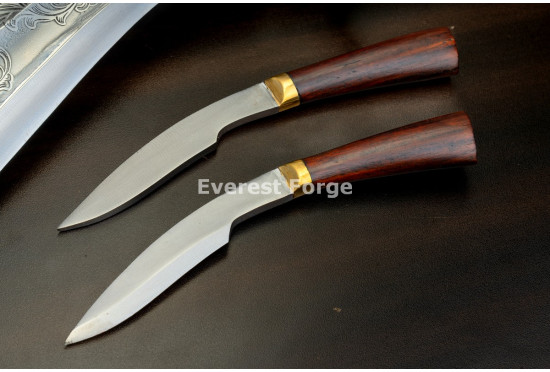
- A karda companion utility knife and a chakmak companion burnisher
- A black leather scabbard over a rigid core, with fitted pockets and a webbing shoulder harness
- A certificate of authenticity, care instructions, and the Everest Forge manufacturer warranty
Other Blades From the Everest Forge Workshop
Shipping, Returns and Care
Dispatch. Stock pieces leave the workshop within 2-3 business days. Custom builds take 4-6 weeks depending on the queue, and an etched blade sits at the longer end because the masking and etching happen after the blade is finished and polished.
Shipping. Tracked worldwide by DHL or FedEx, typically 7-14 business days in transit from Kathmandu. Customs paperwork is completed accurately and in full. The khukuri is a recognisable shape and attracts more import scrutiny than a plain knife; please check your own country's rules before ordering.
Returns and warranty. Covered by the Everest Forge manufacturer warranty against defects in forging and materials. Custom builds made to your own specification cannot be returned for a change of mind, which is why we confirm everything in writing first.
Care. This piece asks more of an owner than most, because the handle is three materials that behave differently. Wipe the blade dry after use and keep a light film of oil on it, running a cloth along the body groove specifically since a hollow holds moisture that a general wipe skips. For the handle: oil the rosewood once or twice a year, and treat the horn and bone with a wax rather than an oil, because oils can darken bone unevenly over time. The critical rule is avoid sudden changes in humidity, which is covered properly in the handle question below. Feed the scabbard leather, keep conditioner off the steel, and store the knife out of the scabbard.
Questions Answered
What does angkhola actually mean, and why is it the heavy pattern?
Angkhola translates roughly as body groove, and the name describes a hollow ground into the body of the blade. But the groove is the method rather than the point. What defines an angkhola is a spine left unusually thick, far heavier than a standard khukuri, with material taken out of the middle of the blade instead so the whole thing does not become unliftable. You end up with a blade carrying much more steel along its back, which is where chopping force comes from, and a manageable overall weight. This one runs 900 grams for 15 inches, which is 60 grams per inch of blade and the heaviest we make; a normal khukuri of the same length sits nearer 40 to 48. That difference is entirely spine. It is the pattern Nepali households choose when the knife will spend its life on wood rather than on vegetation.
Angkhola or chirra: which should I buy?
They are opposite answers to the same problem, which is that a khukuri heavy enough to chop well is heavy enough to tire you. Angkhola solves it by keeping the spine thick and accepting the weight, taking a little out of the body so the balance stays usable. Chirra solves it by cutting multiple fullers and accepting less mass, gaining speed and endurance. So: buy angkhola if you are felling and splitting, where every gram helps and you take breaks anyway. Buy chirra if you are clearing brush and moving, where you will swing it a thousand times in an afternoon. Our chirra page explains the fuller counting in detail. If you genuinely cannot decide, the chirra is the more forgiving purchase, because a blade that is too light is merely slower while a blade that is too heavy simply stops getting used.
Why is the handle made in sections?
Partly tradition, partly economics, partly decoration. Nepali workshops have historically built handles from what was to hand, and horn, bone and hardwood all arrive in short pieces rather than in blocks long enough for a whole grip. Assembling a handle in bands makes use of offcuts that would otherwise be wasted, and the contrast between black horn, white bone and red rosewood became a decorative language in its own right. There is a practical dimension too: horn is warm in the hand and grips well when damp, bone is hard and takes a polish, and rosewood is stable and hard-wearing, so a sectioned handle gets a little of each. The cost, and it is a real one, is that three materials with different expansion rates are locked together on one tang, which is covered in the next answer.
Does a sectioned handle need special care?
Yes, more than a single-material one, and this is the thing most likely to cause you trouble years from now. Horn, bone and rosewood all take up and give off moisture at different rates and swell by different amounts. In a stable environment that is irrelevant. In a rapidly changing one, the sections move against each other, and over enough cycles you can get slight ridging at the joints or, in bad cases, a fine crack in the horn, which is the most reactive of the three. The rules are simple and worth following. Do not leave the knife in a hot car, next to a radiator, or in direct sun. Do not take it from a cold shed into a heated room repeatedly. Wax the horn and bone once or twice a year rather than oiling them, since oils can darken bone unevenly. If you want a handle you never have to think about, order it in a single material; we will build all-horn or all-rosewood at no extra cost.
What is the bone, and will it cause problems at customs?
It is domestic livestock bone, ordinarily buffalo or cattle, which is a by-product of the meat trade and completely unremarkable. It is not ivory, it is not from any protected species, and it carries no CITES implications. We mention it because knife buyers have learned to be wary of organic handle materials for good reason, and because customs officers occasionally ask. The same applies to the buffalo horn: water buffalo is domestic livestock, unrestricted, and it is the traditional khukuri handle material for exactly that reason. Our paperwork describes both accurately. If you would still rather avoid organic materials entirely, whether for import certainty or personal preference, an all-rosewood handle is available at no extra cost and looks very good on this pattern.
Why a shoulder harness rather than a belt frog?
Because 1350 grams on a belt is genuinely unpleasant. A traditional khukuri frog hangs the scabbard from a waistbelt, which works perfectly well up to a point; past about a kilo it drags the belt down on one side, swings when you walk, and needs constant adjustment. A webbing harness across the shoulder distributes that load over a much larger area and keeps the scabbard against the body, which is why almost every heavy blade in modern use is carried that way. The trade is that it is unmistakably modern and will look wrong next to a historical piece. If the knife is going on a wall rather than into a wood, order the traditional frog instead; it costs nothing extra and it is the right choice for a display.
Will the etching wear off if I use it?
Not off, but through. An acid etch bites into the surface of the steel rather than sitting on top of it, so it will not flake or peel the way a printed or coated finish does. What happens instead is abrasion: cutting through bark, scraping against stone, and above all the ordinary business of sharpening and polishing will slowly take down the surface around the etch, and after a few years of genuine work the pattern will look softer and less crisp. Rust does the same thing faster, since the etched surface is slightly rougher and holds moisture. None of this matters at all if the knife lives on a wall. If you are buying it to use, order the plain blade, which costs nothing less but will look better in a decade. Our etched chirra kukri page explains how to tell etching from hand engraving on any decorated blade.
Does it come with the karda and chakmak?
Yes, both, in fitted pockets on the scabbard. The karda is the small sharpened utility knife for the jobs a 15 inch blade cannot manage, which on a khukuri this heavy is most of them. The chakmak is a burnisher for truing the main edge between sharpenings and for striking sparks from flint; it is meant to be blunt and that is not a fault. Our kukri with karda and chakmak page explains what both tools do and how to use the chakmak properly.
Is 900 grams too heavy to use?
It depends entirely on what you are doing and for how long. For felling saplings, splitting kindling and working seasoned wood, the weight is the feature: every gram behind the edge arrives at the cut and does work you would otherwise supply with your arm. For an hour of brush clearing it is too much, and you will feel it in the forearm and the wrist long before the edge needs attention. Be honest with yourself about the job. If most of your cutting is light and repetitive, a lighter pattern will serve you far better and you will actually reach for it. If you want one blade that will get through anything and you do not mind resting, this is that blade. The lighter grind option takes a couple of hundred grams out if you want the pattern without the full weight.
Is a khukuri this size legal where I live?
We cannot answer that for you and you should be careful of any seller who claims they can. At 15 inches this blade is above the everyday carry allowance in nearly every jurisdiction, and the khukuri's distinctive shape means it is sometimes named or recognised specifically where a plain knife of the same size would pass without comment. Rules for owning one at home, carrying one while working outdoors and importing one across a border are frequently three separate matters with three different answers. Check all three for your own address before ordering. If length is the obstacle, a 12 or 13 inch build costs no more and takes a good deal of weight out as well.
What steel is it, and how is it heat treated?
5160 high-carbon spring steel, forged down from leaf spring in the Nepali tradition, which is the same stock and the same method our smiths use for khukuris that go to working households in Nepal. It is oil-quenched and then tempered back. On a chopper this heavy, toughness matters far more than outright hardness: the blade will meet knots, nails and stone, and a properly tempered edge rolls and can be trued back with the chakmak where a harder, more brittle one would chip out and need regrinding. It is not stainless: it will take a patina with use and it will rust if left wet.
Will my khukuri look exactly like the photographs?
Less so than most, because almost every element here is individual. The curve is drawn out by eye and hammered rather than cut from a template. The body groove is ground by hand to follow that particular curve. The etch is masked and applied by hand, so the pattern sits slightly differently on every blade and the coverage varies. And the handle is the most variable part of all: horn, bone and rosewood each differ piece to piece in colour and figure, and the proportions of the three sections are set at the bench. Two of these from the same week will be recognisably the same design and visibly different objects. What does not vary is the specification: length, steel, construction, heat treatment and sharpness are held to the same standard on every piece.
| Specification | |
| Blade: | 15 inches. Hand forged from 5160 carbon steel |
| Total Length: | 21.5 inches |
| Handle: | 6.5 inches. Sectioned horn, bone and rosewood with steel bolster |
| Weight: | 900 grams the khukuri, 1350 grams with the scabbard |
| Note: | Handmade variation in weight, dimensions and finish may occur. Keep blade lightly oiled when not in use. |