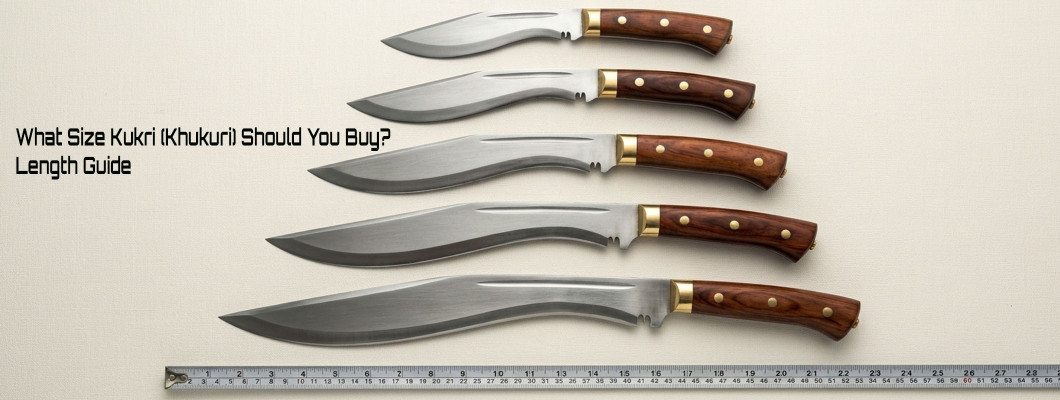
What Size Kukri (Khukuri) Should You Buy? Blade Length by Job
For most people the answer is a blade between 10 and 12 inches. That is the traditional service size, it has barely moved in over a century of military and village use, and it remains the most useful single blade we make. Drop to 7 to 9 inches if you want something you will genuinely carry every day. Go to 13 to 16 if the main job is chopping wood. Above roughly 18 inches the kukri stops being a tool and becomes a sword.
The kukri — spelled khukuri in Nepali, and the spelling we use at the forge — does not buy chopping power the way a straight blade does. Length is not the lever here — the forward cant is. That single fact changes the whole sizing decision, and it is why kukri buyers so often need less blade than they expect.
Get Your Length in Under a Minute
The Blade Size Finder asks what the kukri is for, then returns a length range in inches and centimetres, a handle length, the reasoning behind the number, and a physical check you can run before you spend anything.
Khukuri and Kukri Length by Job
Blade length on a kukri is measured along the spine from the bolster to the tip, which is worth stating because the curve means a tape laid along the edge gives a longer number. How we measure each part is set out on our measurements page.
| Blade length | What it is | What it does well | What it gives up |
|---|---|---|---|
| 7 to 9 in | Small and EDC kukris (mini khukuri) | Actually gets carried; light chores, food, cordage, utility | Almost no chopping authority — the mass that chops has been removed |
| 10 to 12 in | Service and traditional working size | The all-rounder. Chops usefully, still controllable for detail work | Nothing badly; excels at nothing in particular |
| 13 to 16 in | Large working and bushcraft khukuris | Genuine chopping tool; processes wood and thick brush | Slower recovery, tiring over a long session, harder to carry |
| 18 to 30 in and beyond | Kukri swords and long narrow khukuri blades | Reach, presence, display, ceremonial and collection pieces | Stops behaving like a tool; too much mass forward for casual use |
If you are buying one kukri and only one, the 10 to 12 inch band is the answer and the rest of this page is confirmation rather than decision. The people who should look outside it are those with a specific job: daily carry at the short end, firewood at the long end.
Why the Forward Cant Beats Length on a Khukuri
This is the argument that makes kukri sizing different from every other blade, and it is the one a reseller cannot make convincingly because it argues against selling you more steel.
On a straight blade — a machete, a bowie, a sword — you increase chopping power mainly by adding length, because that is how you get more mass moving faster at the point of contact. On a kukri you do not need to, because the forward angle already places the weight ahead of your wrist. The blade arrives at the target the way an axe head does, with the mass leading, rather than the way a straight blade does, with the mass distributed behind the impact.
The practical consequence is that a 12-inch kukri out-chops an 18-inch machete on anything thicker than your thumb. It is not doing it with length. It is doing it with geometry. Which means that when you are tempted to add two inches to get more chopping power, the honest answer is usually that you do not need them, and those two inches will cost you carry comfort and recovery time every single day in exchange for a gain you will barely notice.
Add length to a kukri when you want reach — a longer arc, working further from your body, splitting larger rounds. Do not add it to buy cutting power you already have.
Why 11 Inches Keeps Winning
The service khukuri has hovered around 10 to 12 inches for well over a century, across British Gurkha issue patterns, village working blades and household tools, in places with quite different work to do. When a dimension survives that long across that many independent users, it is worth asking why rather than assuming it is tradition.
The answer is that it sits at the meeting point of three separate limits. It is long enough that the belly carries real chopping mass. It is short enough to stay controllable in one hand when your grip is tired and wet. And it rides on a belt without fouling your leg when you sit or climb, which matters enormously to anyone who has to walk to the work rather than drive to it.
No single one of those three would fix the length on its own. All three together produce a narrow window, and the window has not moved because human arms, human hands and the material people cut have not moved either.
Fullers Let You Keep Length Without the Weight
Here is the option most buyers do not know exists, and it changes the sizing conversation for anyone caught between two bands.
A fuller is a groove forged along the blade — chirra in Nepali, and you will see kukris described as one, three or five chirra depending on how many grooves run down each side. Fullering removes steel from the middle of the cross-section, where it contributes least to stiffness, while leaving the spine and edge intact. The result is a blade that keeps its length and its stiffness while losing a meaningful part of its weight.
This matters for sizing because the usual reason to size down is weight rather than length. If you want a 14-inch blade but find a plain 14-inch kukri too heavy after twenty swings, a fullered one at the same length may solve the problem without you giving up any reach at all. That is a real alternative to buying shorter, and it is the reason our chirra kukris exist as their own category rather than as decoration.
The honest limit: fullering is more work at the forge and it does not make a heavy blade light. It shifts you part of a band, not a whole one.
Handle Length and the Fit Problem
Khukuri handles are where the most quiet disappointment lives, because traditional Nepali handles were sized for the hands that used them and those are often smaller than a Western buyer's.
A kukri handle should take your whole hand with no overhang and no crowding against the bolster or the flared butt. For most adults that is 4.5 to 5.5 inches, and larger hands want 5.5 to 6. On the long working blades a slightly longer handle also gives you the option of choking back for extra leverage on a heavy stroke.
Measure yours rather than guessing. Wrap your hand around a broom handle in the grip you will use, mark either side, and measure the gap. Compare that number to the handle length on the product page rather than the total length. If you have large hands, say so when you order — handle length is one of the easiest things to adjust when the blade has not been forged yet.
Spine Thickness Changes What a Length Feels Like
Two khukuris of the same blade length can differ in weight by a surprising margin, and the reason is usually the spine rather than the profile. A kukri spine is thickest at the bolster and tapers toward the tip, and how quickly it tapers decides where the mass sits and how the blade behaves in the hand.
A thick spine with a slow taper puts weight forward and makes the blade chop harder for its length. It also makes it slower to stop and return, which is the fatigue you feel at swing forty rather than swing four. A thinner spine with a faster taper produces a blade that feels alive and quick, cuts vegetation beautifully and bites less deeply into seasoned wood.
The reason this belongs in a sizing guide is that people frequently solve the wrong problem. Someone finds a kukri tiring and concludes they need a shorter one, when what they actually needed was the same length with a faster taper. Because we forge to order rather than picking from stock, that is a specification you can ask for. It is also why two 12-inch kukris from different makers can leave you with opposite opinions about whether 12 inches is right for you.
Carry Decides More Than Buyers Expect
Nobody buys a kukri for how it sits on a belt, and a great many people stop carrying one for exactly that reason.
A khukuri sheath sits differently from a straight-blade sheath because the curve pushes the tip outward and the widest part of the blade sits low. The practical effect is that a kukri feels longer on the hip than its blade length suggests, and the point at which it starts fouling your leg arrives earlier than it would with a straight knife of the same size. For most people that limit lands somewhere in the 12 to 13 inch range for all-day carry with normal movement — sitting, driving, climbing, kneeling.
Above that, plan the carry before you order rather than after. A baldric or shoulder rig, lashing the scabbard to a pack, or accepting that the blade lives at camp rather than on your hip are all reasonable answers. The unreasonable answer is buying 15 inches and hoping.
Three Checks Before You Order
All three take five minutes and are worth more than any specification, ours included.
The twenty-swing test
Cut a broom handle to the total length you are considering, weight the end if you can, and make twenty chopping motions in the space you will actually work in. Fatigue at twenty tells you more about the right size than any specification does. Watch where the tip travels on the follow-through, particularly in relation to your own shin.
The sit-down test
Hold the mock-up along your hip as it would ride in a sheath, and sit down. If the tip fouls the back of your knee, you have found the reason that kukri would eventually stay home. This is the check that decides the EDC band.
The grip test
Measure your hand as described above and compare it to the handle length rather than the total. A handle an inch too short is more annoying, every single time you pick the blade up, than a blade an inch too long.
Where a Smaller Khukuri Is the Wrong Answer
We should be even-handed about this, because the rest of this page argues downward and that is not always right.
If your actual job is processing firewood — splitting rounds, limbing, reducing standing deadwood to stove length — a 10-inch kukri will do it and will make you work harder than you need to. The 13 to 16 inch band exists because that work genuinely rewards mass and arc, and choosing a service kukri for it out of caution means more strokes, more time and more fatigue for the same pile of wood.
Equally, if the blade is going on a wall, buy for the wall. A kukri sword is not a failed tool, it is a different object, and judging it by how it carries on a belt misses the point of it entirely.
The rule that survives both cases: size for the job you will actually do, not for the job you might do, and not for caution either.
Any Length, Because Nothing Is Pre-Made
Settle the size first, then build it. We hold no stock at all, so the blade length, handle length and fuller configuration that suit your hand are things we forge rather than things you have to find.
Frequently Asked Questions
What size kukri should I buy?
Ten to twelve inches of blade for general use. That is the traditional service size and the most versatile kukri made. Choose 7 to 9 inches if you want something you will carry daily, and 13 to 16 inches if the main job is chopping wood. Above roughly 18 inches the kukri becomes a sword rather than a tool.
Is a 12 inch kukri too big?
No — 12 inches sits at the top of the traditional service band and is a comfortable all-round working size for most adults. It carries on a belt, chops usefully and still handles detail work. It is only too big if you intend to carry it daily in an urban setting, where 7 to 9 inches is more realistic, or if local law restricts the length you can carry in public.
What size khukuri did the Gurkhas use?
Service kukris have sat in the 10 to 12 inch range across issue patterns for well over a century. The length has stayed there because it is long enough for the belly to carry chopping mass, short enough to control one-handed when tired, and short enough to ride on a belt without fouling the leg on a march. All three limits together produce a narrow window.
Does a longer kukri chop better?
Less than you would expect. A kukri gets its chopping power from the forward cant, which puts the mass ahead of your wrist, rather than from length. That is why a 12-inch kukri out-chops an 18-inch machete on anything thicker than a thumb. Add length to a kukri for reach and for splitting larger rounds, not to buy cutting power you already have.
What size khukuri is best for bushcraft and camping?
Eleven to thirteen inches. That is long enough to process wood and clear brush properly, while remaining controllable for the camp tasks that need precision — carving, food, cordage. If wood is the dominant job rather than one job among several, go to 14 or 15 inches and accept the extra weight on your belt.
What is the smallest useful kukri?
Around 7 inches. Below that the forward-weighted belly has too little mass to do what makes a kukri a kukri, and you have a curved utility knife instead. At 7 to 9 inches you keep some genuine cutting authority while getting a blade that fits a belt or pack and gets carried every day, which is worth more than power you leave at home.
How long should a kukri handle be?
Four and a half to five and a half inches for most adults, and 5.5 to 6 for large hands. It should take your whole hand with no overhang and no crowding against the bolster or the flared butt. Traditional Nepali handles are often sized for smaller hands than many Western buyers have, so measure your own around a broom handle and compare it to the handle length rather than the total length.
Can a fullered khukuri (chirra) be lighter at the same length?
Yes. A fuller — chirra in Nepali — is a groove forged along the blade that removes steel from the middle of the cross-section, where it contributes least to stiffness, while leaving the spine and edge intact. A fullered blade keeps its length and stiffness while losing meaningful weight. If you want a longer kukri but find the weight tiring, this is a real alternative to sizing down.
Can I order a kukri in a length you do not list?
Yes. We hold no stock and forge every blade after the order is placed, so length is a build decision rather than a stock lookup. Blade length, handle length and fuller configuration can all be specified, and anything outside the listed ranges is quoted as a custom piece. Tell us the length and what the kukri is for, and we will tell you honestly whether it is the right call.