A Deep Symbolic Study of Gurkha Identity in Military Heraldry
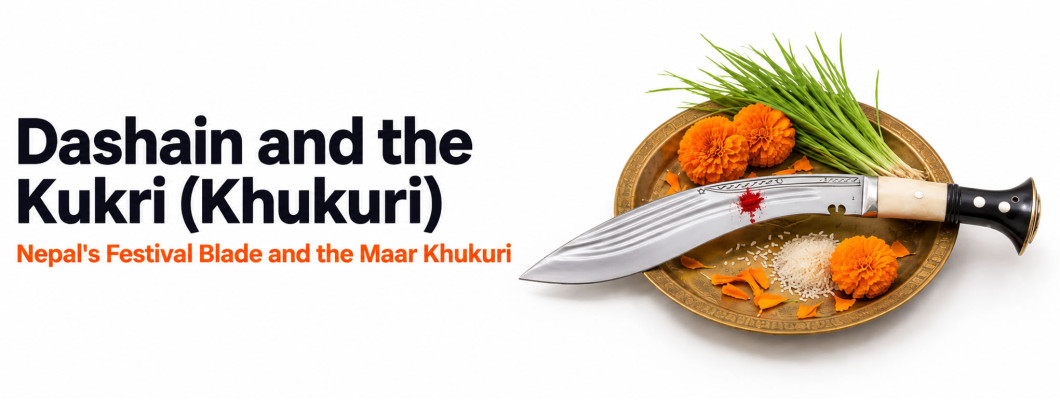
At Everest Forge, we recognize that the blade known internationally as the kukri is, in its homeland, the khukuri. Both names describe the same iconic form, yet each reflects a different aspect of its journey — from village tool to global military symbol.
Military and paramilitary badges preserve this journey in metal, cloth, and tradition. They do not simply depict the kukri or khukuri; they encode meaning, memory, and identity. Below, we examine these badges in depth — not as collectors’ curiosities, but as living symbols of service.

The Crossed Kukris / Khukuris: A Universal Gurkha Language
The crossed kukris motif appears with remarkable consistency across British, Indian, Nepalese, and Commonwealth forces. This is not coincidence.
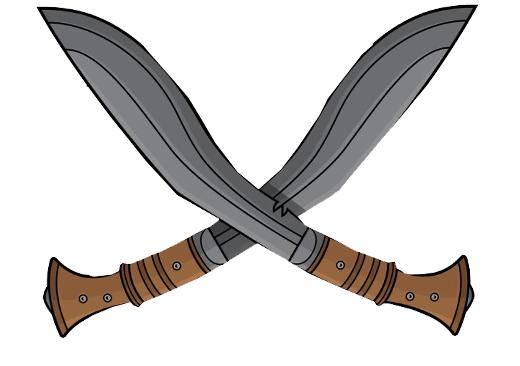
In heraldry, crossed weapons signify readiness without aggression. When those weapons are kukris — blades historically used for work before war — the message becomes uniquely Gurkha: discipline before violence, capability before display.
The khukuri’s curved profile, inward weight, and utilitarian origin separate it from ceremonial swords. When crossed in a badge, it represents a warrior who builds, clears, protects, and defends — often in that order.
The British Army – Brigade of Gurkhas
The Brigade of Gurkhas is not a single regiment, but a collective identity formed after 1947. Its badges maintain a shared visual grammar, centered on crossed kukris, while allowing each unit to express its operational role.
In British heraldry, the crown often appears above the blades. This placement is deliberate: authority above, identity below. The kukris are never replaced, never minimized, and never ornamental.
Royal Gurkha Rifles (RGR)
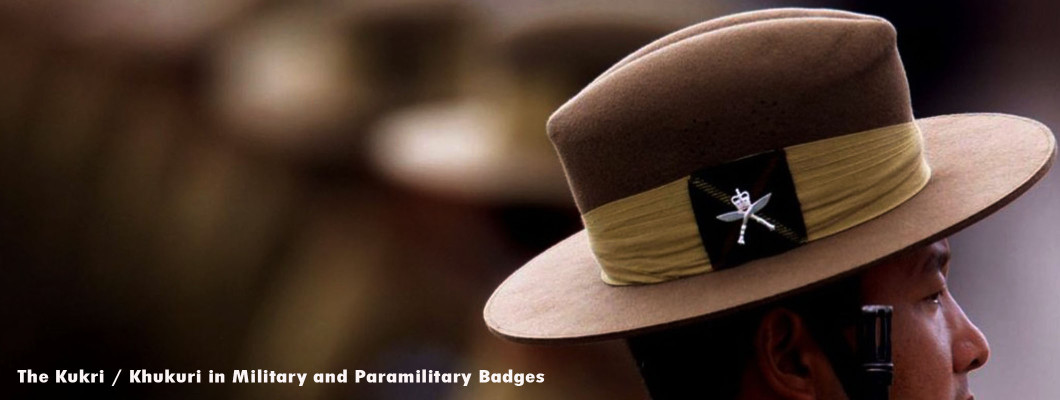
The badge of the Royal Gurkha Rifles is among the purest expressions of Gurkha military symbolism. Two kukris are crossed cleanly beneath a crown, with no additional imagery competing for attention.
This simplicity reflects infantry reality. The rifleman depends on discipline, endurance, and close cooperation. The kukri — historically carried alongside the rifle — symbolizes the soldier when ammunition is gone, when terrain is unforgiving, and when resolve matters more than firepower.
For Gurkhas serving today, the RGR badge is not historical decoration. It is continuity — linking modern battalions to generations who carried the khukuri through jungles, mountains, deserts, and cities.
King’s Gurkha Artillery (KGA)
The King’s Gurkha Artillery, established in 2024/2025, presents one of the most symbolically layered Gurkha badges. Crossed kukris are placed directly over a Royal Artillery field gun.
This arrangement matters. The artillery gun represents distance, power, and modern warfare. The kukris assert that behind every calculated strike stands a Gurkha soldier shaped by the khukuri tradition.
Rather than diminishing the blade, the gun elevates it. The badge states clearly that technology may define the battlefield, but identity defines the warrior.
Queen’s Gurkha Engineers (QGE)
In the Queen’s Gurkha Engineers badge, the kukri integrates seamlessly with traditional engineering symbols. This reflects the engineer’s dual role as builder and soldier.
Historically, the khukuri has always been a tool of creation before conflict. It clears paths, shapes timber, and prepares ground. In the engineering context, the kukri symbolizes precision, adaptability, and quiet competence.
The badge communicates that Gurkha engineers are not separate from warrior tradition — they are its craftsmen.
Queen’s Gurkha Signals (QGS)
Signals units rely on communication, coordination, and technological systems. Yet the kukri remains central in their insignia.
This inclusion reinforces a core Gurkha principle: specialization does not replace soldiering. The khukuri reminds every signaler that behind the equipment stands a disciplined warrior, trained to operate under pressure, isolation, and risk.
The badge quietly asserts that technology serves the soldier, not the other way around.
King’s Royal Hussars (KRH)
The King’s Royal Hussars are a British armoured regiment, not a Gurkha unit. Their use of crossed kukris as an arm badge is therefore especially significant.
This symbol commemorates historic wartime association with Gurkha soldiers. It is not borrowed identity, but acknowledged respect — earned through shared hardship and mutual reliance.
In this context, the kukri transcends ethnicity. It becomes a universal emblem of courage recognized by those who fought alongside it.
28 Squadron RAF
The inclusion of crossed kukris in the badge of 28 Squadron RAF demonstrates the reach of Gurkha symbolism beyond ground forces.
Aviation represents speed, elevation, and modern reach. The kukri anchors that modernity to tradition, reminding all ranks that the squadron’s legacy includes Gurkha service.
The badge confirms that the khukuri tradition adapts without losing meaning.
The Indian Army – Gorkha Regiments
Following independence, India standardized the spelling “Gorkha,” but retained the kukri as the defining regimental symbol.
Indian Gorkha badges are intentionally restrained: crossed kukris paired with a numeral. There are no crowns, no excess ornamentation. Identity is communicated through service alone.
Regimental Numerals and Shared Heritage
Each regiment’s number identifies lineage, while the crossed kukris unify all ranks under a shared warrior tradition rooted in the khukuri.
Whether displayed above, below, or between the blades, the numeral never dominates the kukris. This reinforces a core principle: rank exists within tradition, not above it.
Nepal Army and Paramilitary Forces
In Nepal, the khukuri is not symbolic heritage — it is living practice. Its presence in military and police insignia reflects national identity rather than regimental branding.
Nepal Army
The Nepal Army’s use of the khukuri reflects the concept of the citizen-soldier. The blade is part of daily life, culture, and responsibility.
In insignia, the khukuri does not glorify conquest. It represents guardianship, resilience, and service to the nation.
Armed Police Force of Nepal
The Armed Police Force incorporates khukuri imagery to bridge military discipline and civil protection.
Here, the blade symbolizes readiness tempered by restraint — authority exercised with responsibility.
Singapore Police Force – Gurkha Contingent
The Gurkha Contingent of Singapore is known globally for neutrality and elite discipline. Its kukri insignia communicates trust rather than intimidation.
Even far from Nepal, the khukuri remains instantly recognizable as a symbol of controlled strength and integrity.
Assam Rifles
As one of India’s oldest paramilitary forces, Assam Rifles use kukri imagery to reflect frontier service, jungle operations, and endurance.
The kukri here represents survival, adaptability, and regional identity forged through difficult terrain.
Why the Kukri / Khukuri Endures in Military Heraldry
Across empires, republics, and modern states, the kukri endures because it represents the working warrior — not a figure of ceremony, but of responsibility.
As a khukuri, it belongs to daily life. As a kukri, it is recognized worldwide. Together, they form a single, unbroken legacy.
That is why the blade appears crossed, balanced, and central in badges — never raised in threat, never reduced to ornament.
The Everest Forge Perspective
At Everest Forge, every kukri we hand forge is rooted in the khukuri tradition reflected in these badges. We forge blades shaped by use, history, and respect — not display alone.
Military badges are not fashion. They are memory.
Wherever Gurkhas have served, the kukri has followed — not raised in anger, but crossed in resolve.
That is why the symbol endures.
And that is why we forge it.
Request a Fully Custom Forge Kukri
Commission a completely custom-forged kukri or khukuri built to your exact specifications. From blade length and profile to steel choice, finish, and handle material, our custom forge service allows you to create a blade rooted in authentic Gurkha tradition.
This option is ideal if you want a one-of-a-kind kukri inspired by military heritage, historical designs, or personal requirements.
Request Fully Custom KukriPersonalize a Kukri with Badge or Logo Engraving
Already have a kukri style in mind? Personalize an authentic Everest Forge kukri by engraving a military, regimental, or unit badge directly onto the blade.
You may upload the badge or insignia image you wish to engrave, including designs from our existing khukuri collection, and request placement as part of your personalization.
Personalize with Badge Engraving