The Question Nobody Fully Answers
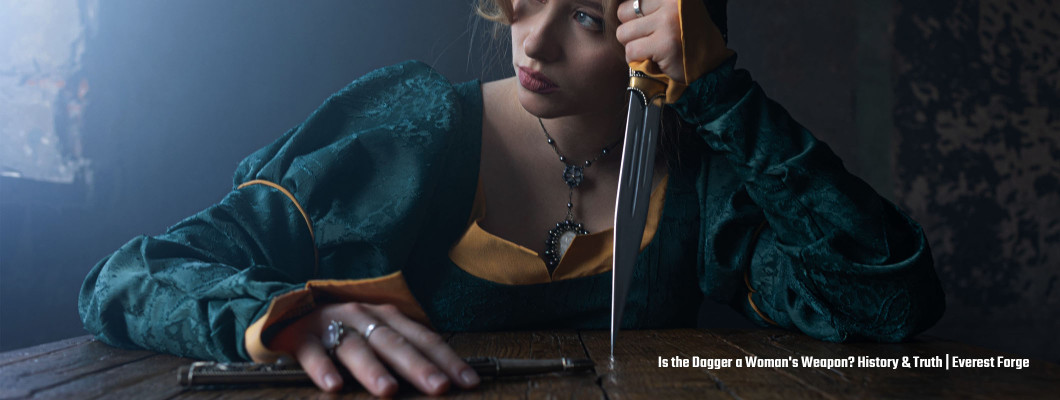
Ask whether the dagger is a woman's weapon and you will get one of two responses. Some people laugh it off as absurd. Others assume the dagger is simply a smaller, weaker version of a real weapon — something for people who cannot handle a sword. Both answers miss the point entirely, and the historical record makes that clear.
The dagger was carried by women across at least six distinct civilizations, on four continents, over a span of more than two thousand years. Not as a symbol. Not as jewelry. As a functional weapon that women trained with, concealed in their clothing, received as wedding gifts, and in some cultures were legally expected to carry. The kaiken dagger of feudal Japan was designed specifically for samurai-class women. The sgian-achlais of Highland Scotland was documented as a blade women hid in the folds of their skirts. Rajput women of India trained with weapons including the double-bladed haladie. Ottoman noblewomen wore the jambiya at formal court occasions as both a status symbol and real personal protection.
None of this is obscure history. It is simply underreported. This article covers the real story — culture by culture, blade by blade — and gives a direct answer to the question.
"The dagger does not care who holds it. Only how well."
Further Reading
Types of Daggers from Around the World — 30 Blades from Every Culture
Why the Dagger Was Always the Great Equalizer
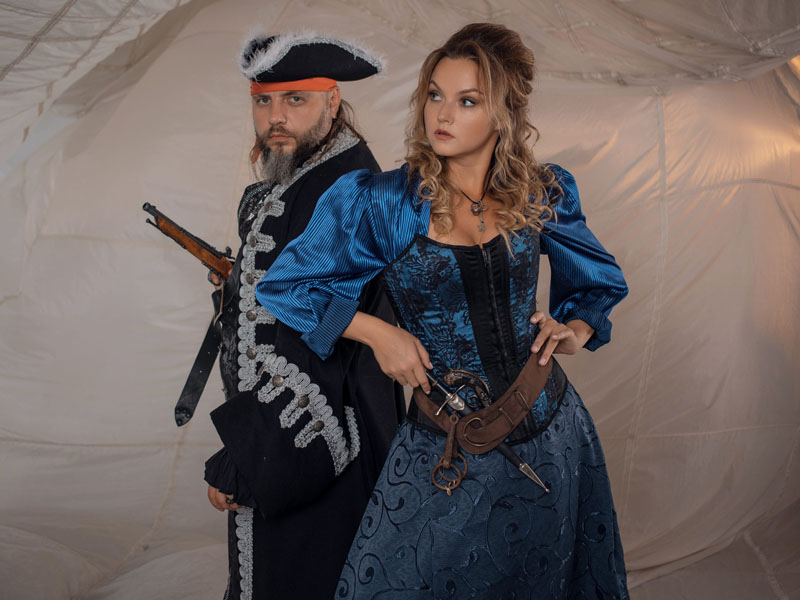
Before looking at specific cultures, it helps to understand why the dagger kept appearing in women's hands across completely unrelated civilizations separated by thousands of miles and hundreds of years. The answer is not complicated.
A longsword requires significant upper body strength to swing effectively. A polearm requires reach and the ability to control a long shaft under sustained pressure. The hand forged dagger requires neither. It requires a trained grip, quick reflexes, and the ability to close or create distance at precisely the right moment. A fighter weighing 55 kilograms can use a dagger just as lethally as one weighing 90 kilograms — provided both have trained to the same level. That is simply not true of most other weapons, and every culture that thought seriously about personal defense eventually arrived at the same conclusion.
This is why the historical dagger appears in women's hands across so many different societies. In cultures where women were excluded from battlefield training with larger weapons, the dagger remained accessible — it could be concealed in clothing, drawn in seconds, and used at close range without requiring years of physical conditioning. In cultures where women did train seriously — onna-bugeisha in Japan, women of the Highland clans, Rajput warrior families — the dagger was simply part of that training alongside everything else. The blade did not discriminate. The only question was always whether the person holding it had trained to use it well.
Japan — The Kaiken: A Blade Designed Specifically for Women
The most historically documented example of a dagger created specifically for women comes from feudal Japan. The kaiken (懐剣) — also called futokoro-gatana meaning "pocket sword" or mamori-gatana meaning "protection blade" — was a tanto-style dagger with a blade measuring between 20 and 25 centimetres. It was sized and balanced specifically for the body and clothing of samurai-class women, designed to be carried concealed in the futokoro (the interior pocket of the kimono) or the tamoto (the sleeve pouch), where it could be drawn in a single motion without telegraphing the intention to an opponent.
The kaiken emerged during the Muromachi period (1336–1573), an era of prolonged civil war across Japan that created genuine demand for effective indoor defense weapons. The katana and wakizashi were impractical inside the close quarters of a castle home or narrow corridor — too long to draw cleanly in confined spaces. The kaiken solved that problem directly. It was forged to perform in exactly the environments where samurai households spent most of their time.
What makes the kaiken historically significant beyond its design is that carrying it was not optional. When a samurai woman married, she was expected to carry a kaiken into her husband's household as a formal part of the wedding gift set. It was handed from mother to daughter — a blade that remained with a woman for her entire life, carrying not just steel but the expectation of capability and self-reliance. Noble samurai women trained in private sessions with experienced female instructors, learning quick defensive techniques specifically compatible with kimono movement — preparation for a real possibility that samurai women were expected to handle without assistance.
The kaiken was, in every sense, a serious weapon carried by serious people for serious purposes. It is also the clearest single piece of evidence that the dagger was considered appropriate for women not as a concession but as a deliberate design choice — a blade made for a specific person and a specific set of circumstances, refined over centuries of use.
Scotland — A Blade That Belonged to Everyone in the Highlands
In Highland Scotland the relationship between women and blades was less ceremonial and more simply practical. The sgian-achlais — a concealed knife originally carried under the armpit or in the sleeve lining — was documented as being carried by Scots women hidden in the folds of their gathered skirts. Research into Highland dress history makes clear that virtually every adult in the Highlands, regardless of gender, would have carried some form of personal blade as a matter of course. A knife was an eating utensil, a work tool, and a last line of defense, and those roles were not divided by gender.
The Scottish Dirk — Gaelic biodag — developed into a formal weapon during the 17th century, with blades typically measuring 25 to 40 centimetres. It became the sidearm of Highland clansmen and the ceremonial weapon of officers and pipers in Scottish Highland regiments. Among the Gael, oaths of profound consequence were sworn on the steel of the dirk. After the Jacobite defeat at Culloden in 1746, the English used this custom deliberately — requiring Highlanders to swear disarmament oaths on the steel of their own dirk as a calculated act of cultural humiliation. A weapon that central to identity and ceremony was not an exclusively male object in any household that understood its meaning.
The hand forged Scottish Dirk at Everest Forge is built from that same 17th century Highland design — 5160 high-carbon steel, full tang construction with ribbed spine, leather scabbard. The same blade Highlanders of every kind carried for three hundred years because it worked.
Hand Forged in Nepal — Historical Collection
Scottish Dirk — 17th Century Highland Dagger
Built on the same form Highland warriors carried for three centuries. Hand-forged 5160 high-carbon steel, full tang ribbed spine, leather scabbard. A working blade built to carry, not to display.
Shop the Scottish Dirk Browse All DaggersThe Arabian Peninsula and Ottoman Empire — The Jambiya as Identity
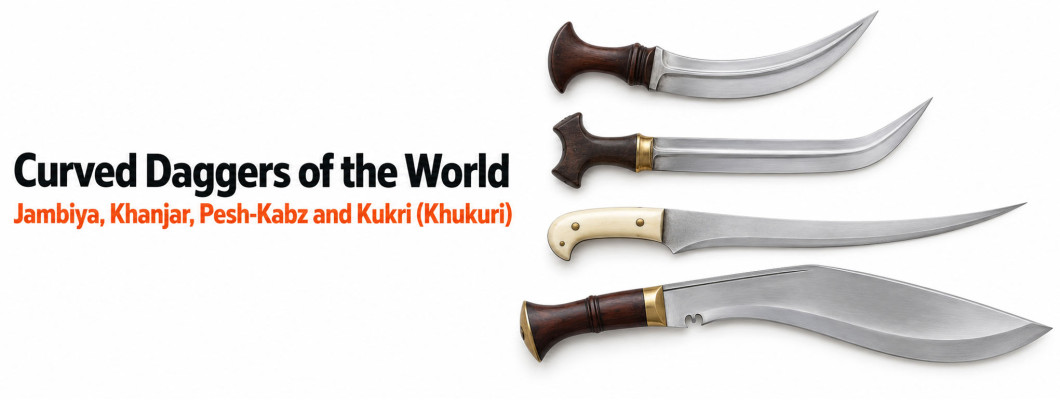
The jambiya (Arabic: جنبية) is one of the most recognizable traditional daggers in the world — a short curved blade with a pronounced medial ridge, worn in a decorated scabbard at the lower abdomen. The name comes from the Arabic janb, meaning "side," because it is worn at the side of the body. It originated in the Hadhramaut region of Yemen and spread throughout the Arabian Peninsula, the Ottoman Empire, Persia, and into India and North Africa between the 15th and 17th centuries through the extraordinary trade networks of that era. A first-century BC statue of the Himyarite king Madi Karb depicts what researchers believe is the earliest known jambiya — two thousand years of continuous blade tradition.
The jambiya's forward curve is not decorative. A blade curved forward concentrates force at the tip, delivers powerful slashing strikes on the draw, and hooks opponents' weapons and limbs in close quarters — a genuinely effective combat geometry for the rapid, close-range encounters the blade was carried for. The handle material communicated the social status of the owner — rhinoceros horn for the very wealthy, hardwood for practical users, silver and inlaid stone for formal court dress.
In the courts of the Ottoman Empire and Persia, women of rank carried ornate jambiyas at formal occasions as markers of status, authority, and genuine self-sufficiency. These were functional blades made to the same standard as any other jambiya, with finer decoration on the handle and scabbard. A woman of rank wearing a fine jambiya in an Ottoman court made the same statement as a man wearing one: this person has standing, and the means to protect herself.
The Persian Fighter Jambiya Dagger at Everest Forge carries that exact forward-curve geometry — carbon steel, oil tempered, full tang rosewood handle, traditional leather scabbard. The same geometry that defined its effectiveness for two thousand years, built into every blade we forge.
Hand Forged in Nepal — Historical Collection
Persian Fighter Jambiya Dagger — Traditional Curved Blade
Hand-forged carbon steel with authentic forward-curve geometry. Oil tempered for strength and edge retention, full tang rosewood handle, traditional leather scabbard included. Two thousand years of blade design in a functional form.
Shop the Jambiya Dagger All Historical DaggersRenaissance Europe — The Noble Right to an Open Blade
In Renaissance Italy and Spain the social expectation was unambiguous: a noblewoman carried a dagger. Not hidden. Not as a last resort. Worn openly at the waist as part of formal dress, visible to everyone in the room, signaling status, self-reliance, and the clear message that this person was not defenseless.
The Rondel Dagger — named for its distinctive circular disc guard and pommel — was one of the most widely carried personal daggers in 14th and 15th century Europe. Its round guard design gave exceptional close-in control, allowing powerful thrusting attacks in the confined spaces of a hall or corridor where sword fighting was impractical. The Baselard, developed in the same period and characterized by its H-shaped crossguard, appeared so consistently across social classes — merchants, scholars, women of rank, soldiers, travelers — that it became one of the defining everyday blades of the late medieval period.
What is significant about Renaissance dagger culture is that personal defense was explicitly a personal responsibility. A woman who traveled, moved through public spaces, or lived in a politically volatile environment had the same practical need for a personal blade as anyone else. The dagger was the practical answer — and wearing it openly was not remarkable. It was expected.
Both the Rondel Dagger and the Baselard are available in our historical collection, hand forged in Nepal from 5160 high-carbon steel. The full history of how these blades evolved in terms of design and combat application is covered in our guide to medieval arming daggers.
Further Reading
Medieval Arming Daggers — History, Types and Combat Use
Hand Forged in Nepal — Historical Collection
Rondel, Baselard, Celtic Warrior Dagger and More
Every blade built from a documented historical form. Hand-forged in Nepal from 5160 high-carbon steel. Ideal for collectors, reenactors, and anyone who wants a dagger with genuine historical depth behind it.
Browse Historical DaggersViking Age — Everyone Carried a Blade Because Everyone Needed One
Viking-age burial archaeology has made this point clearly and repeatedly: women were buried with knives and short blades, and the wear patterns on those blades show real daily use. These are not weapons placed in graves as symbolic objects. The cutting edges and grip surfaces show genuine marks of work — food preparation, leathercraft, rope cutting, everyday tasks that required a sharp blade at hand throughout the day.
In 8th to 11th century Scandinavia, a blade was simply a tool that every adult needed. The distinction between a working knife and a defensive knife barely existed, because the same blade served both purposes depending on the situation. Women who managed households, processed food, crafted leatherwork, and lived in a society where personal violence was an ever-present background risk carried blades as naturally as they wore clothing. The personal knife was not a gendered object in Norse culture. It was simply part of existing.
The Viking Dagger in our historical collection reflects exactly that tradition — forged for function, compact enough to carry every day, with none of the ceremonial excess that came later. The Norse approach to personal blades was purely practical, and our blade is built the same way.
India — The Haladie: Intelligence Over Strength
The Haladie is one of the most unusual weapons ever forged — a double-bladed dagger from the Indian subcontinent, originating in Rajasthan and the Deccan Plateau, where two curved blades each approximately 22 centimetres in length extend from a single central handle. It was used by warriors of the Rajput clans, where female fighters are historically documented as part of Rajput martial tradition. Some Haladie had spikes on the handle in the style of a knuckle guard, and in some versions a third short blade extended from the hilt itself.
The Haladie cannot be used through brute force. Its geometry simply does not function that way. Using it effectively requires speed, spatial awareness, the ability to control two striking surfaces simultaneously, and clear thinking under pressure. It rewards the most skilled fighter in the room — not the strongest one. That is exactly why it appears in the hands of Rajput women in historical accounts: it was a weapon that put skill above all physical advantages, and it was used by anyone trained enough to handle it.
Elaborately decorated Haladies were worn by Rajput nobility as symbols of martial status and expertise — ornate weapons passed down as family heirlooms that represented generations of warrior identity. Our Traditional Haladie Dagger is hand forged in Nepal with the authentic double-blade configuration, both blades of equal length extending from the central handle exactly as the original design specifies.
Hand Forged in Nepal — Historical Collection
Traditional Haladie Dagger — Indian Double-Bladed Design
One of the rarest and most unusual dagger forms in history. Hand-forged in Nepal with the authentic double-blade configuration — two equal curved blades from a single central handle. A serious collector's piece with genuinely documented historical roots.
Shop the Haladie DaggerFantasy and Film — Why the Dagger Always Goes to the Smartest Fighter in the Room
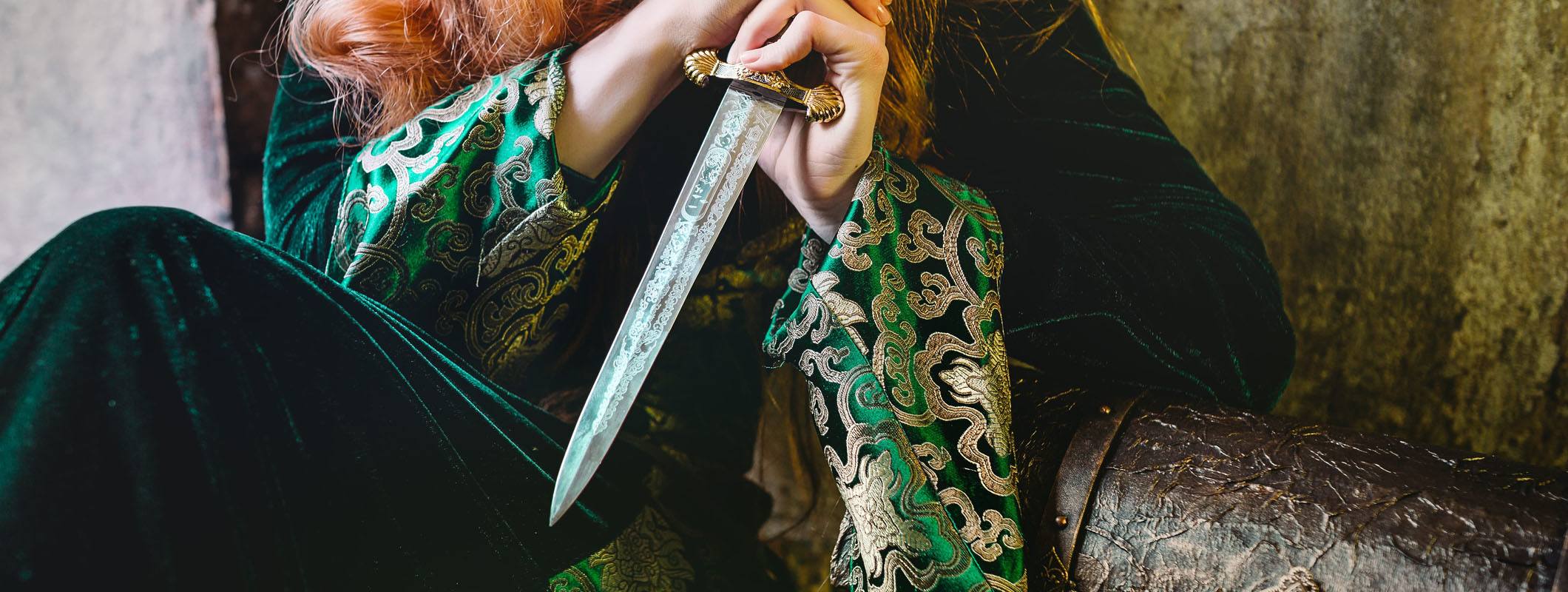
The historical connection between women and daggers runs so deep that it became one of fantasy storytelling's defining patterns — and filmmakers and writers use it deliberately. Tauriel in The Hobbit carries twin Elven daggers as her primary weapons, not a bow or a sword. Arya Stark in Game of Thrones never fights with a longsword. Her blade is always a dagger. Catwoman, Black Widow, Violet Parr — when a female character is written as genuinely dangerous, the dagger appears.
This is not a modern invention. It is a pattern that writers reach for because it communicates something precise: this character fights with intelligence and precision rather than physical power. The dagger signals skill over strength, speed over size, the most dangerous person in the room is not necessarily the largest. That signal exists because the history behind it is real. Audiences understand it instinctively because the logic is correct.
The Tauriel Dagger in our fantasy collection is hand forged in Nepal from 5160 high-carbon steel — a 10-inch water-tempered blade with a full tang rosewood handle and hand-stitched leather scabbard, built to real functional standards. Browse the full range of tactical and fantasy daggers for collector pieces across every style and influence.
Hand Forged in Nepal — Fantasy and Collector Blades
Tauriel Dagger — Hand-Forged Elven Blade from The Hobbit and LOTR
10-inch 5160 high-carbon blade, water-tempered and sharpened, full tang rosewood handle with ergonomic shaping. Hand-stitched leather scabbard included. Built to real functional standards — not display quality.
Shop the Tauriel Dagger All Fantasy DaggersSo — Is the Dagger a Woman's Weapon?
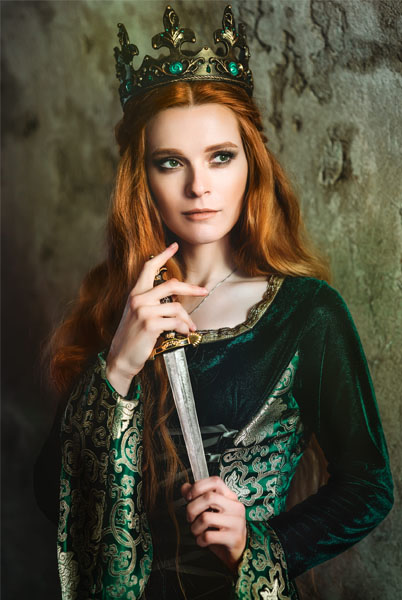
No. And yes. The more accurate answer is that the dagger was never about gender at all — and that turns out to be precisely why it kept appearing in women's hands across history. It was the personal weapon: intimate, concealable, and effective for whoever carried it regardless of size, rank, or background. The kaiken in Japan was designed for women specifically because its qualities made it the right tool for the situation samurai women were actually in. The jambiya was worn by Ottoman women because its design made it effective regardless of who used it. The Haladie was used by Rajput female fighters because it rewarded intelligence over physical strength and that standard had nothing to do with gender.
What made the hand forged dagger universal across every culture and every century is what makes it compelling to collectors today. It belongs to the person who carries it in a way that a longsword or great sword never can. It requires no physical advantage over an opponent — only the right blade, properly made, and the skill to use it.
If you want to understand the design difference between a dagger and a knife — why they are not the same thing and why that distinction matters for collectors and buyers — our guide on knife vs dagger covers everything you need to know.
Further Reading
Knife vs Dagger — What Really Sets Them Apart?
Hand-Forged in Kathmandu, Nepal — Ships Worldwide
100+ Hand-Forged Daggers. Every Culture. Every Era.
From the curved Jambiya of Arabia to the double-bladed Haladie of India. From Highland Dirks to Elven fantasy blades. Every dagger hand-forged in Nepal and shipped worldwide with a leather scabbard.
Shop All Daggers Historical CollectionHave a Specific Dagger in Mind?
A historical design you want recreated. A fantasy blade from a sketch. A cultural dagger with specific dimensions, steel, or handle materials. Our blacksmiths in Kathmandu build to your exact specification — custom forged, one of a kind, made entirely by hand and shipped worldwide.
Submit a Custom Forge RequestFrequently Asked Questions
Did women historically carry daggers?
Yes — across multiple cultures and centuries. Samurai-class women in Japan carried the kaiken dagger as a formal expectation, trained with it, and received it as a wedding gift. Highland Scots women carried knives hidden in their gathered skirts as a matter of daily practicality. Ottoman and Persian noblewomen wore the jambiya at formal court occasions as status symbols and genuine personal protection. Rajput women in India trained with weapons including the double-bladed haladie. Viking-age burial archaeology shows women interred with bladed tools bearing real use wear patterns. The history is consistent and well documented across all of these traditions.
What is the kaiken dagger?
The kaiken (懐剣) is a Japanese dagger with a blade of 20 to 25 centimetres, specifically designed for women of the samurai class. It was carried concealed inside the kimono — in the sleeve pouch or the interior pocket — and used for self-defense in enclosed spaces where the katana and wakizashi were impractical. Samurai women were formally expected to carry one when they married, and trained in specific techniques designed for its use in close quarters. The kaiken was also called the futokoro-gatana (pocket sword) and the mamori-gatana (protection blade).
Why was the dagger considered an equalizer weapon?
Because the dagger does not reward physical size or strength. It rewards skill, speed, and precision — qualities available to any well-trained fighter regardless of body weight or reach. A smaller person with good training is just as dangerous with a dagger as a larger one — which is not true of a longsword, a polearm, or most other weapons. This is the core reason the dagger kept appearing in women's hands across cultures that had nothing else in common: the weapon itself did not care who held it.
What is the difference between a dagger and a knife?
A dagger is a double-edged blade with a central ridge, designed specifically for thrusting and close combat. A knife is typically single-edged and built for utility tasks — cutting, slicing, carving. The distinction matters in terms of design, geometry, and historical purpose. Read the full breakdown in our guide: Knife vs Dagger — What Sets Them Apart.
What types of historical daggers does Everest Forge carry?
Everest Forge carries over 100 hand-forged daggers across the historical, tactical, and fantasy categories. The historical range includes the Jambiya, Scottish Dirk, Rondel Dagger, Baselard, Haladie, Kindjal, Celtic Warrior Dagger, Viking Dagger, Kaiken-inspired tanto, Fairbairn-Sykes, and many more. Browse the full dagger collection here.
Can I get a custom dagger made at Everest Forge?
Yes. The Custom Forge service allows you to submit any dagger concept — historical recreation, fantasy blade, cultural dagger with specific dimensions, or completely original design — and have it hand-forged in Nepal by master blacksmiths using 5160 high-carbon steel and traditional techniques. Submit your request through the Custom Forge page.
What steel are Everest Forge daggers made from?
All Everest Forge daggers are hand-forged from 5160 high-carbon spring steel recycled from truck leaf springs — a material chosen for its toughness, shock resistance, and long-term edge retention. Every blade is water or oil tempered, full tang, and ships with a leather scabbard. Damascus steel is available on request for custom orders.