Why Stage Combat Swords Fail — and What to Check Before You Buy
Stage combat swords almost never fail at the blade. They fail at the pommel, at the tang, and at the temper. A blade that snaps in half makes a dramatic story, but the failure that actually happens in theatres is quieter and far more common: a threaded pommel works itself loose over a run of performances and comes off mid-fight. This guide covers the four ways a stage combat sword really fails, what causes each one, and the questions to put to any maker before you spend money.
Failure One: The Pommel Comes Off
Ask anyone who has worked backstage long enough and they will have a version of this story. A pommel separates during a fight and travels — into the wings, into the pit, occasionally into the first few rows. Nobody was cutting anything. Nobody swung particularly hard. The sword simply came apart.
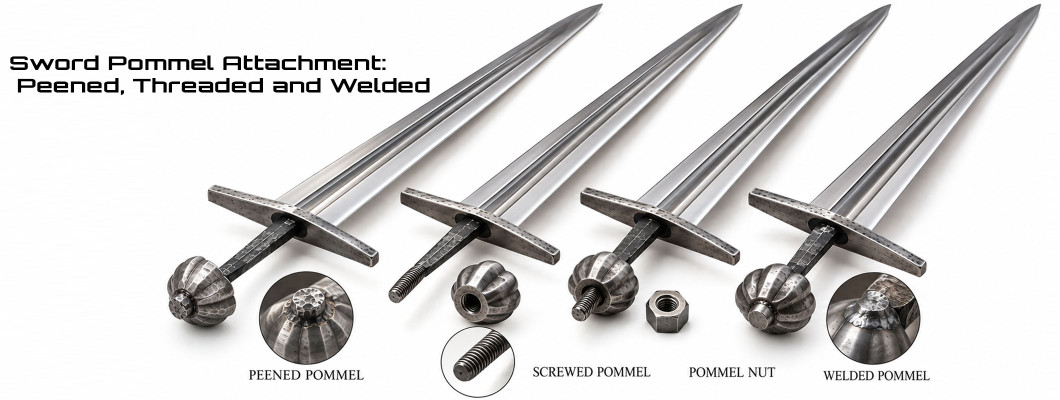
The cause is almost always a threaded pommel. In that construction the tang is threaded at the end and the pommel screws onto it, sometimes with a nut concealed inside. It is quick to assemble and it is fine on a wall hanger. It is not fine on a blade that takes percussive contact eight times a week.
Every impact in a choreographed fight sends a small rotational shock down the blade into the hilt. One impact does nothing. Two hundred impacts across a rehearsal period and a run will walk a threaded assembly loose, in exactly the way a bolt on a vibrating machine backs itself out. By the time anyone notices the grip has developed a slight rattle, the assembly has already been loosening for a fortnight.
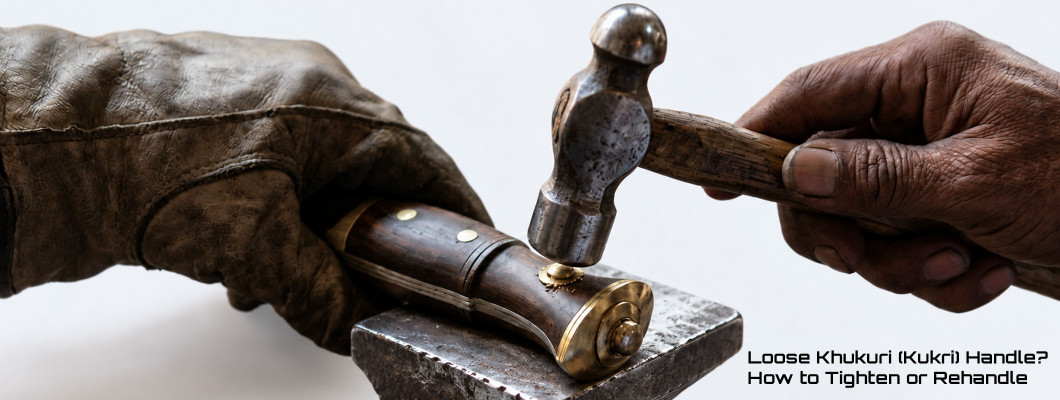
The alternative is a peened pommel. The tang passes all the way through the pommel and the protruding end is hammered over cold, spreading it into a rivet head that cannot unscrew because there is no screw. It takes a smith longer and it cannot be flat-packed, which is precisely why cheap imported stage props do not use it.
The great majority of blades we forge at Everest Forge are peened rather than threaded. If you are ordering for a production, ask us to confirm it for the specific piece you want — we would rather answer that question than have you assume.
What to check
- Ask the seller directly: is the pommel peened or threaded? A maker who peens will say so immediately. Hesitation, or an answer about the pommel being "securely fitted", means threaded.
- Look at photographs of the pommel end. A peened pommel shows a small hammered dome of steel where the tang was spread. A threaded one shows a smooth cap, a visible nut, or a decorative finial.
- If a blade is already in your hands, hold the grip in one hand and the blade in the other and try to twist them against each other. Any movement at all is a problem.
Failure Two: The Blade Was Tempered Too Hard
The second failure is a blade that chips at the edge, or in the worst case cracks and separates. This is a heat treatment problem, and it comes from a blade that was tempered for cutting when it needed to be tempered for impact.
Steel hardness is a trade. Harder steel holds a finer edge for longer and resists deformation. Softer steel is tougher — it bends, absorbs shock, and takes a permanent set rather than fracturing. A sword built to cut tatami wants to sit toward the hard end. A sword built to be struck by another sword wants to sit meaningfully softer.
The reason is what engineers call failure mode. A hard blade that exceeds its limit fails suddenly and completely — it chips, or it cracks, and the crack propagates without warning. A softer blade that exceeds its limit bends. A bent blade is a bad night and a blade you retire. A cracked blade is an emergency.
What a stage temper should be
For stage work the blade wants a genuine spring temper — hard enough to hold its geometry and return to straight after flexing, soft enough that percussive contact is absorbed rather than resisted. In practical terms that means drawing the temper back a good deal further than you would for a cutting blade, into roughly the high forties on the Rockwell C scale rather than the mid to high fifties a cutter would run.
This is also why the steel matters. 5160 spring steel is unusually well suited to stage blades for the same reason it is used in vehicle leaf springs — it will flex under repeated load, absorb shock, and come back straight. Stainless is the opposite and is the single worst choice for a blade that will be struck. It cannot be heat-treated for impact at sword lengths, and when it fails it does so without warning and in pieces.
What to check
- Never buy stainless for stage combat. If the listing says stainless, or says "surgical steel", or does not name the steel at all, walk away.
- Ask what hardness the blade is tempered to and whether it differs from the maker's cutting blades. A maker who cannot answer is not heat-treating deliberately.
- Ask what happens to the blade if it is struck hard — the honest answer is that it should take a set, not chip.
Failure Three: The Tang You Cannot See
The third failure is the one buyers have no way of inspecting, which is exactly why sellers get away with it. The tang is the part of the blade that runs into the handle. In a full tang the steel runs the whole length of the grip and is riveted or peened through. In a rat-tail tang a thin rod is welded or threaded to the base of the blade and buried in a hollow handle, often glued.
Rat-tails fail. Not always immediately, but always eventually, and they fail at the weld — which sits right at the point of maximum leverage. On a decorative sword hanging on a wall this never matters. Under stage percussion it becomes a countdown.
Glued stick tangs are the other version of the same problem. The glue is doing structural work it was never designed for, and stage lighting is warm, and warm glue creeps.
What to check
- Ask whether the tang is full length and riveted or peened through. Vague answers mean rat-tail.
- Ask whether there is any adhesive in the handle assembly.
- Weight distribution is a hint. A sword that feels oddly blade-heavy and hollow in the hand often has very little steel in the grip.
Failure Four: Burrs, Nicks and the Edge You Thought Was Blunt
This is the failure that injures people, and it is the least dramatic of the four.
An unsharpened blade is not a safe blade. Straight off the grinder, an unsharpened edge is still thin, still hard, and still carries burrs — tiny ragged flags of steel left by the abrasive. A burr will open a hand during a bind, and it will do it without anyone noticing until the fight is over.
A properly rebated edge is a different thing entirely. The edge is deliberately taken back to a rounded, even profile along the full length of the blade and then dressed smooth by hand until nothing catches. The test is not visual. You run a bare hand along the blade, and if anything snags, it is not finished. This distinction — rebated versus merely unsharpened — is the single most useful thing a stage combat buyer can understand, and it is covered in full on our stage combat build standard.
Nicks are the ongoing version of the same problem. Every edge-on-edge contact has the potential to raise one, and a nick is both a cutting hazard and a stress riser — the place a blade will eventually crack. They accumulate across a run, which is why a blade that was safe at the technical rehearsal is not automatically safe in week four.
What to check
- Ask whether the edge is rebated and dressed or simply left unsharpened. They are not the same and the difference is skin.
- Ask whether the tip is rounded. On a stage blade there is no acceptable point, ever.
- When the blade arrives, run a bare hand carefully along both edges and over the tip before it goes anywhere near a rehearsal room.
The Four Failures at a Glance
| Failure | Cause | What to ask the maker |
|---|---|---|
| Pommel separates | Threaded assembly walks loose under repeated percussion | Is the pommel peened or threaded? |
| Blade chips or cracks | Tempered too hard — built for cutting, not impact | What hardness, and does it differ from your cutting blades? |
| Handle separates | Rat-tail tang failing at the weld, or glue creep | Is the tang full length and peened or riveted through? |
| Hands get cut | Burrs on an unsharpened edge, or accumulated nicks | Is the edge rebated and dressed, or just unsharpened? |
Carbon Steel Needs Care — and Nobody Tells You That
There is a fifth problem that is not a failure of the sword so much as a failure of the production to look after it, and it catches people who have only ever handled stainless props.
A real stage combat blade is high-carbon steel, and high-carbon steel rusts. It rusts in a damp dressing room, it rusts from the salt in a performer's hands, and it rusts fastest in exactly the conditions a theatre creates — warm, humid, and stored in the dark between calls. Rust on a rebated edge is not just cosmetic. Pitting roughens a surface that was carefully dressed smooth, and a pitted edge catches skin.
The routine is short and it needs to be somebody's actual job, usually the stage manager or the fight captain rather than the performer.
- Wipe the blade down after every call. Hands leave salt and moisture on the steel and it starts working within hours.
- Keep a light film of oil on it. Mineral oil or a dedicated blade oil is fine — anything food-safe and non-gumming. A wiped-on film, not a coating.
- Do not store a blade in a leather scabbard long term. Leather holds moisture against steel and the tanning chemicals are acidic. Scabbards are for carrying, not for storing.
- Store flat or hung in dry air, not in a sealed case where condensation can form, and not against a cold exterior wall.
- Deal with light rust immediately with oil and a non-abrasive pad. Once it has become pitting, the surface has to be re-dressed.
Every blade we forge is high-carbon steel, so this applies to all of them. It is not a defect and it is not a reason to buy stainless — it is simply what real steel asks of you in return for being tough enough to trust. The pre-show inspection routine that sits alongside this care schedule is set out on the stage combat standard page.
The Questions to Ask Before You Buy
Whether you are buying from us or from anyone else, put these to the maker before you order. Every one of them has a correct answer, and a seller who cannot give it clearly is telling you something.
- Is the pommel peened or threaded? Peened, for stage work.
- Is the tang full length, and is it peened or riveted through? Yes, and yes.
- What steel is it? A specific number — 5160, 1075, 1095. Never stainless.
- What hardness is it tempered to, and is that different from your cutting blades? It should be softer.
- Is the edge rebated and dressed, or unsharpened? Rebated and dressed by hand.
- Is the tip rounded? Always.
- Can you match weight and balance across two blades? It matters if two performers fight.
- What is the lead time from order to delivery? Measure it against your first rehearsal, not your opening night.
- What happens if a blade fails? A real maker replaces it.
The last point is worth dwelling on. A blade for stage combat is a piece of equipment carrying a safety load, not a decorative object, and it should come from someone who will stand behind it and who can tell you exactly how it was made. That is the argument we make about every blade we forge, at length, in our honest guide to battle ready swords.
Any Blade We Make, Built for the Stage
Swords, spears, machetes, kukris and daggers can all be built to stage combat specification — rebated edge, rounded tip, and balance set for control rather than cutting. Hand-forged in Kathmandu from 5160 spring steel. Send us your fight director's spec and we will confirm every dimension before forging.
Read the Stage Combat Standard →Frequently Asked Questions
What is the most common way a stage combat sword fails?
A threaded pommel working loose and separating during a fight. Every impact in choreographed combat sends a small rotational shock into the hilt, and over a rehearsal period and a run that repeated shock walks a threaded assembly out, in the same way a bolt backs off a vibrating machine. A peened pommel, where the tang is hammered over into a rivet head, cannot unscrew because there is no screw.
Why do stage combat blades break or chip?
Because they were tempered for cutting rather than for impact. Harder steel holds a finer edge but fails suddenly when it exceeds its limit — it chips or cracks. Softer steel bends and takes a permanent set instead, which is a blade you retire rather than an emergency mid-performance. A stage blade should be drawn back to a spring temper, meaningfully softer than the same maker's cutting blades.
Can a stainless steel sword be used for stage combat?
No. Stainless cannot be properly heat-treated for impact at sword lengths, and when it fails it fails without warning and in pieces rather than bending. It is the single worst choice for any blade that will be struck by another blade. If a listing says stainless, says "surgical steel", or does not name the steel at all, do not use it for stage work.
What is the difference between a rebated and an unsharpened blade?
An unsharpened blade still carries a thin, hard edge and burrs left by the grinder, and a burr will open a hand during a bind. A rebated edge is deliberately taken back to a rounded, even profile along the full blade and then dressed smooth by hand until nothing catches. The test is to run a bare hand along the steel — if anything snags, it is not finished.
How can I tell if a sword has a rat-tail tang before buying?
You usually cannot see it, which is why you have to ask. Put it directly to the seller: is the tang full length, and is it peened or riveted through the pommel? A vague answer means rat-tail. Weight distribution is a secondary hint — a sword that feels oddly blade-heavy and hollow in the grip often has very little steel in the handle.
Do stage combat swords need to be maintained during a run?
Yes, and it should be someone's defined responsibility rather than left to the performers. High-carbon steel rusts in the warm, humid conditions of a theatre, and rust pitting roughens an edge that was carefully dressed smooth. Wipe the blade down after every call, keep a light film of oil on it, do not store it in a leather scabbard long term, and check for new nicks before each call.
Why does the tip of a stage combat sword have to be rounded?
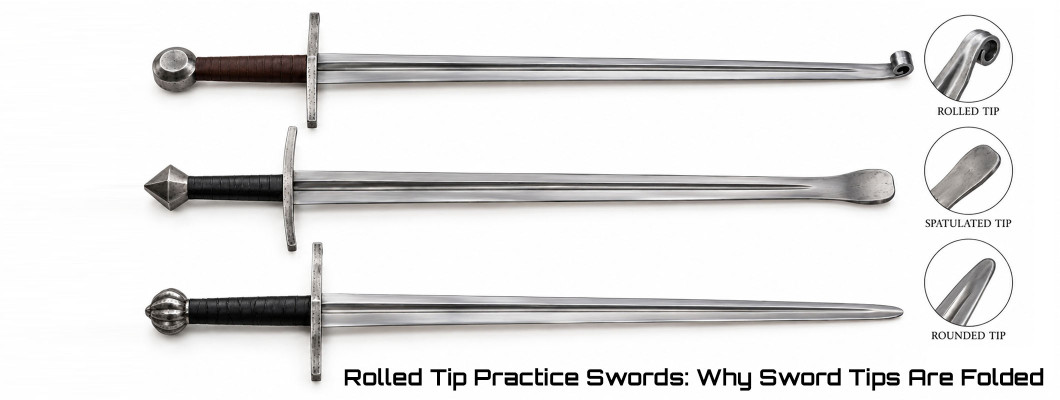
Because thrusts in choreographed combat land close to the body, and the margin for error is small enough that a point is not acceptable under any circumstances. A stage tip is finished as a rounded, spatulate profile with the same dressed, burr-free surface as the edges. Some fight directors require a ball or button termination instead, which we can build to specification.
How long does a stage combat sword last?
There is no fixed lifespan — a stage blade is a piece of equipment in service and it is retired on condition, not on age. Small nicks can be dressed out with a file and the blade returned to use. A deep nick, a permanent bend, or any movement between the blade and the grip means the blade comes out of service. Productions should budget for at least one spare of each principal weapon.