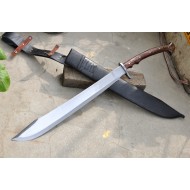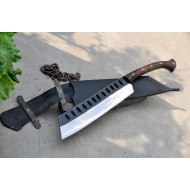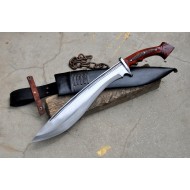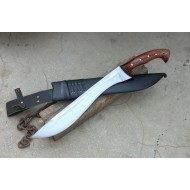
- Model: SINGLE EDGED SWORD
- Product Code: SINGLEEDGE028
- Location: Kathmandu, Nepal
Available Options
Hand-Forged German Messer Sword — Hooked Pommel and Pinned Rosewood Grip
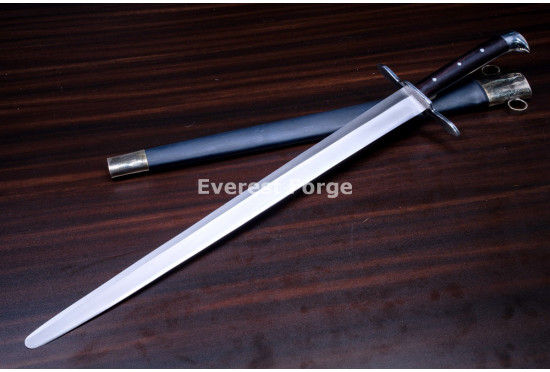
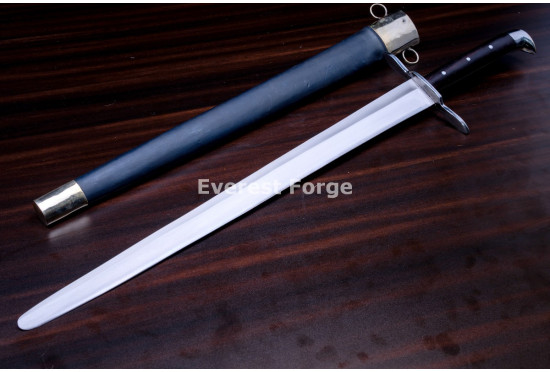
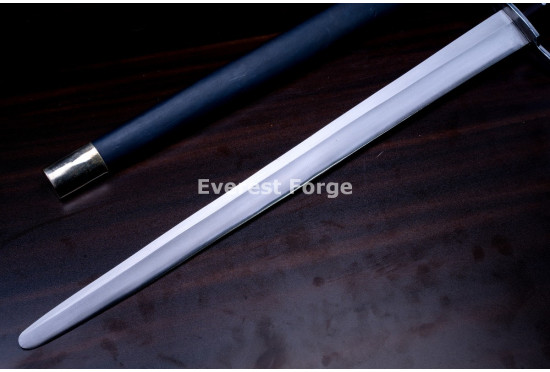
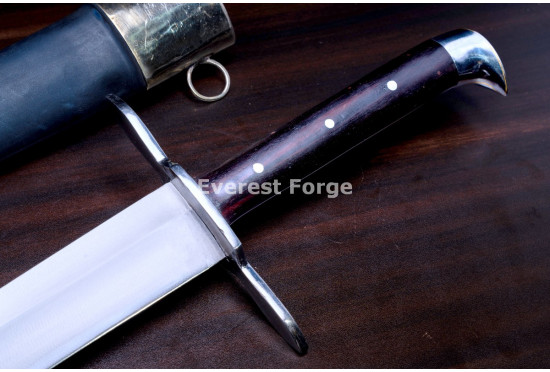
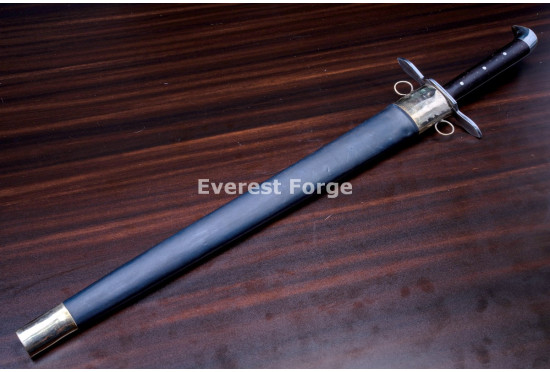
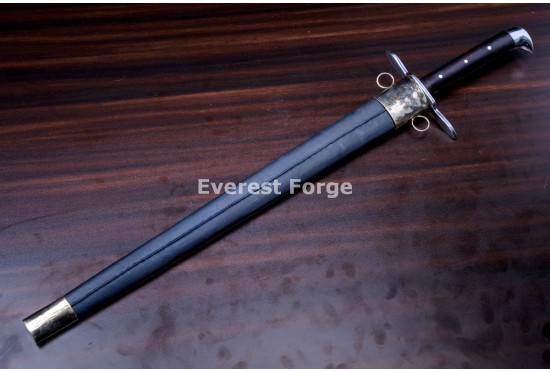
This is a hand-forged, fully functional German messer — the single-edged sword of late medieval Central Europe, forged in Nepal from 5160 high-carbon spring steel, oil-tempered, full tang, and sharpened to a true edge. The blade is straight-backed with a long clip toward the point, finished satin. The hilt follows knife construction rather than sword construction: rosewood scales pinned through the tang, a steel cross, and a hooked steel cap that curves back over the butt. It ships with a black leather scabbard with steel throat, chape and suspension rings. Every sword is made to order in your chosen length, finish, and engraving.
The standard blade is 24 inches on an 8-inch handle, for an overall length around 32 inches at about 1.4 kg. That handle length puts it between our two other historical messers — long enough to bring a second hand onto the butt for leverage, short enough to fence with in one hand as the manuals describe. The oil-tempered 5160 steel makes it a working sword, not a cast wall-hanger.
An honest note. Two things. First, this is not a Kriegsmesser, whatever similar swords are sometimes labelled. The Kriegsmesser is the war messer — the largest of the family, generally well over thirty inches of blade and used in two hands. At twenty-four inches this is a langes messer, and we would rather name it correctly than reach for the more dramatic term. Second, it is a modern build in the historical form rather than a reproduction of a documented original: the dimensions are ours, and the satin finish is brighter than a period working sword would have carried. What it does get right is the construction — pinned scales rather than a sword pommel, which is how a messer was actually made.
Bespoke Service
Forge a Messer to Your Own Design
Want a genuine Kriegsmesser length, a Nagel on the guard, a shorter bauernwehr, or a fencing blunt? Our Custom Forge service builds to your spec, by hand in Kathmandu.
Request a Custom Forge →What Makes This a Messer
Messer is German for knife, and the family it names is defined by hilt construction rather than blade shape. A sword has a narrow tang running through a grip and peened over a pommel. A messer is built like an oversized knife instead: the tang is a flat plate the width of the handle, and the grip scales are pinned or riveted through it from either side, exactly as they are on a kitchen knife. That is the distinction that separates a messer from a falchion, which carries a very similar blade on conventional sword furniture. This one follows the knife construction, with rosewood scales pinned through the tang and a hooked steel cap closing the butt rather than a pommel. The blade is a straightforward messer profile: single-edged, straight through the back, with a long clip cutting the spine away toward the point.
Specifications
Customize Your Messer
Every sword is forged to order. Set your options before you add to cart:
Hand-Forged, Not a Wall-Hanger
This Messer
- Hand-forged 5160 high-carbon spring steel
- Oil-tempered, hard edge and flexible spine
- Full tang with scales pinned through it
- Knife-style construction, as a messer actually used
- Sharpened, balanced, made to your spec
A Wall-Hanger
- Cast stainless, brittle under load
- No real heat treatment
- Rat-tail tang that snaps at the guard
- Sword furniture on a messer blade, sold as a messer
- Blunt, display-only
How It Is Made
Who It Is For
- Collectors of German and Central European arms who want the construction right, not just the blade shape
- Historical fencing practitioners working from the German messer sources
- Reenactors portraying late medieval townsfolk, tradesmen or common soldiers
- Buyers who want a single-edged sword that works in one hand or two
- Gift buyers personalizing a blade with a name, date, or engraving
- Not for anyone wanting a true Kriegsmesser — that is a longer sword, and we build it to order
What Is Included
- One hand-forged German messer, built to your chosen spec
- Black leather scabbard with steel throat, chape and suspension rings
- Rosewood scales pinned through the tang, with steel cross and hooked pommel cap
- Any personalization or engraving you ordered
- A satin-finished, sharpened blade
- Everest Forge manufacturer warranty
Explore More Hand-Forged Swords
Shipping, Returns & Care
Shipping
In-stock specs dispatch within 2 to 3 business days; fully custom builds take roughly 4 to 6 weeks to forge before dispatch. We ship worldwide by DHL or FedEx in 7 to 14 business days, tracked. Import and blade laws vary by country, so please check your local rules before ordering.
Returns & Warranty
Every blade is backed by the Everest Forge warranty against forging and material defects. If something is wrong with your order, we will repair, replace, or refund it. Personalized and custom-engraved blades are made to order, so please confirm your spec carefully before purchase.
Care
Wipe the blade clean and dry after handling, and apply a light coat of oil before storage to protect the high-carbon steel from moisture. Check the pins through the scales occasionally, particularly after any hard use — on a pinned hilt they are what holds everything together. Give the rosewood an occasional wipe with oil, and store the sword outside its scabbard rather than in it.
From The Forge
Build a Messer That Is Yours Alone
Beyond the options here, our Custom Forge service will build a full Kriegsmesser, fit a Nagel to the guard, or match a documented original you send us. Roughly 4 to 6 weeks from order.
Start a Custom Forge →Frequently Asked Questions
How is a messer hilt built, and why does it matter?
A messer is built like a knife, not like a sword, and that is the definition of the type rather than a detail. On a sword, the tang is a narrow bar that runs up through a hollow grip and is peened over a pommel at the top — the grip is squeezed between guard and pommel and the pommel holds everything together. On a messer, the tang is a flat plate the full width of the handle, and the scales are laid against it from either side and pinned or riveted straight through, exactly as on a kitchen knife. There is no pommel doing structural work; the cap at the butt is a finishing piece. The practical consequences are real. A pinned hilt cannot loosen the way a peened assembly can if the peen settles, and if a scale is ever damaged it can be replaced without dismantling the whole sword. It is also slightly heavier in the hand than a hollow grip, which is part of why messers balance the way they do. This sword follows that construction.
What is the hooked pommel for?
The steel cap at the butt curves back over the end of the grip rather than sitting flat, which is a shape that appears repeatedly on late medieval messers and long knives. It does two things. It stops the hand slipping off the back of the grip under a hard pull, which matters on a knife-construction hilt where there is no heavy pommel acting as a stop. And it gives the off hand something to catch when you bring it onto the butt for extra leverage — a use the German sources show repeatedly. It is not a counterweight in the way a sword pommel is; a messer balances through blade geometry and the mass of the tang rather than through a heavy lump behind the hand, which is one reason messers feel different from swords of similar size.
Is this a Kriegsmesser?
No, and it is worth saying plainly because the term gets applied loosely. The Kriegsmesser — the war messer — is the largest member of the family: a heavy blade generally well over thirty inches, mounted on a long grip and used in two hands, built for the battlefield rather than for carrying. At twenty-four inches of blade on an eight-inch handle this is a langes messer, the sword-length everyday form. The family runs bauernwehr at the small end, then langes messer, then grosse messer, then Kriegsmesser at the top. We build genuine Kriegsmesser blades to order if that is what you want — tell us the length and we will quote it.
How does this differ from your other messers?
Construction and proportions. This one has pinned rosewood scales over a flat tang — knife construction, the historically correct messer build — with a hooked cap and an 8-inch handle that takes one hand comfortably and two at a push. Our langes messer with the Nagel guard is the same blade length on a shorter 5.5-inch one-hand grip and carries a Nagel, the projecting hand guard, which this one does not. Our long messer is longer and lighter at 27 inches and 1.4 kg with a fullered blade and a red scabbard, built as a light fencing sword. Our fantasy messer is the heavy one at 1.85 kg with a scalloped winged guard. In short: this for the construction, the Nagel messer for the guard, the long messer for reach, the fantasy messer for mass.
Is this a historically accurate messer?
In construction, yes — and that is the part most reproductions get wrong. Pinned scales over a flat tang is how messers were actually built, where nearly every modern messer on the market uses sword construction with a pommel. The blade profile, the clipped point and the proportions are all right for a langes messer. What it lacks is a Nagel, the stud projecting from the cross that most historical messers carried, and it is not a copy of a documented original — the dimensions are ours and the finish is brighter than a period working sword. A Nagel can be fitted to order, which would make it complete.
Is it one-handed or two-handed?
Primarily one-handed, with room for a second. The 8-inch handle is longer than the 5.5 inches the fencing manuals show for the classic langes messer, so you can bring the off hand onto the butt behind the first for a heavier cut or better control in a bind — the hooked cap gives it something to catch. At 1.4 kg it is comfortable one-handed for extended use. It is not a true two-hander; if you want that, ask for a Kriegsmesser length.
Is this a real, functional sword?
Yes. It is hand-forged from 5160 high-carbon spring steel, full tang, oil-tempered, and sharpened to a true cutting edge before it ships. The cross and cap are steel and the scales are pinned straight through the tang. It handles tatami mats, water bottles and light green targets well. Do not use it on bone, metal, seasoned hardwood, or anything you would not put a good knife through.
What steel is it, and is it oil-tempered?
The blade is forged from 5160 high-carbon spring steel, the same alloy used in heavy-duty truck leaf springs, prized for toughness and edge retention. It is oil-tempered for a hard cutting edge backed by a flexible, shock-absorbent spine. On a single-edged blade the thick back carries much of the structural load, but the edge still has to survive contact, and 5160 gives you an edge that rolls rather than chips.
Is it full tang?
Yes, and on this sword that means something more specific than usual. The tang is a flat plate running the full length and width of the handle, with the rosewood scales pinned through it from either side. There is no narrow tang inside a hollow grip and nothing held together by a peened pommel. This is the construction a historical messer used, and it is more robust than it looks: the load spreads across the whole width of the handle rather than concentrating at a single peen.
What is the scabbard like?
Black leather with a steel throat at the mouth, a steel chape at the tip and suspension rings for belt carry, made by hand to fit the blade size you order. The rings let you rig it to a belt or baldric with your own straps rather than committing you to one carry position. A custom blade length means a custom scabbard, which is part of why bespoke builds take longer. Store the sword outside it for the long term: leather is tanned with acids and holds damp against carbon steel.
Does it arrive sharpened, and can I add a Nagel?
It arrives sharpened as standard along the full edge, finished by hand; the clip at the point is left unsharpened. Three edge options are available — sharpened, a display blunt, or a fencing blunt built for contact with a thicker edge and rolled tip. And yes, we will fit a Nagel to the cross on a custom build, which would make this the most complete historical messer we make: pinned scale construction and a Nagel together. Say so when you order and we will quote it.
Do you ship worldwide, and how long does it take?
Yes. We ship worldwide from Nepal by DHL or FedEx in 7 to 14 business days with tracking. In-stock specs dispatch within 2 to 3 business days; fully custom builds take roughly 4 to 6 weeks to forge first. Import and blade laws vary by country, so please check your local rules before ordering.
| Specification | |
| Blade: | 24 inches. Hand forged from 5160 carbon steel |
| Total Length: | 32 inches |
| Handle: | 8 inches. Full tang with rosewood scales pinned through it, steel cross and hooked pommel cap |
| Weight: | Approx 1400 grams total (blade approx 1090 grams) |
| Note: | As every piece is forged by hand, slight variation in weight, dimensions and finish may occur. Rosewood grain varies between pieces. Keep the blade lightly oiled when not in use. |