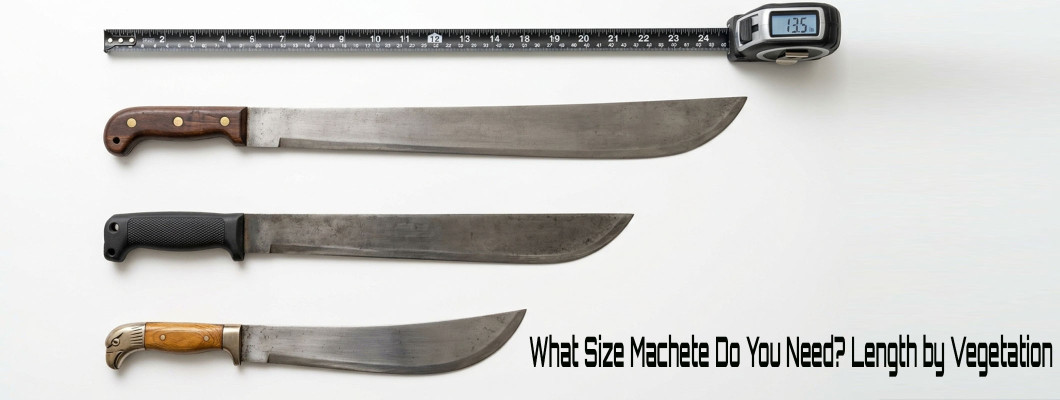
What Size Machete Do You Need? Length by Vegetation, Not by Photograph
For most people the answer is a blade between 14 and 18 inches. Dense tangled growth wants 12 to 15 inches, mixed general clearing wants 16 to 18, and only open standing vegetation like grass and cane rewards 20 inches or more. The 18-inch machete has been the default issue length for armies and agricultural workers for a century, and there is a practical reason for it that has nothing to do with cutting: 18 inches of blade is about the limit for carrying comfortably in a belt sheath.
There is a second factor that matters more than most buyers realise, and it is the one that decides whether our advice differs from the advice you will read on a forum. A hand-forged 5160 machete is thicker and stiffer than a mass-produced stamped one. If you are used to a thin hardware-store machete, you should size down about one band when buying a forged blade. This guide explains why.
Get Your Length in Under a Minute
The Blade Size Finder asks what you are cutting, returns a length range in inches and centimetres, a handle length, the reasoning behind the number, and a physical check you can run before you spend anything.
Match the Blade to the Vegetation
Machetes are the one category where the wrong size does not just feel awkward, it actively works against you. A long blade in tangled growth catches on the very material you are trying to cut, and every snag costs you a stroke and some energy. A short blade in open grass leaves reach on the table and makes you take three swings where one would do.
| What you are cutting | Blade length | Why | What it costs you |
|---|---|---|---|
| Dense tangled undergrowth, vines, brambles, trail work | 12 to 15 in | Works close to the body, does not snag, controllable in confined space | Little reach; you must get near what you are cutting |
| Mixed brush, saplings, general camp and property work | 16 to 18 in | Enough momentum to bite, short enough to control on the return | Compromise at both ends rather than excellent at either |
| Open standing grass, cane, light crops | 20 to 24 in | Nothing snags, so reach and momentum do real work | Dangerous and slow in tight cover; hard to carry |
| Hardwood, thick limbs, seasoned timber | Wrong tool | Mass ahead of the wrist beats blade length on hard material | Use a kukri or an axe — see below |
The last row matters. People buy long machetes for wood and are then disappointed, because a machete is a thin fast slicer and wood asks for mass in the right place. A 12-inch kukri will out-chop an 18-inch machete on anything thicker than your thumb, because the forward curve puts the weight ahead of your wrist. That is not a machete failing — it is the wrong blade for the job.
Why a Forged Machete Should Be Shorter Than a Stamped One
This is the part that separates our advice from the general answer, and it comes from the stock we start with rather than from any opinion about design.
Mass-produced machetes are stamped or ground from thin sheet, often around 2 to 3 mm, and they are intentionally light and whippy. That thinness is why an 18-inch factory machete is comfortable all day in grass. It is also why it flexes when it meets anything hard, and why the shock travels back into your hand.
We forge from leaf spring. The stock is thicker to begin with, and a forged 5160 blade at the same length carries noticeably more mass and considerably more stiffness. That is a real advantage on woody material, where a thin blade bounces and a stiff one bites. It is also a real cost in reach work, because that extra mass sits at the far end of a long lever and your forearm pays for it on every stroke.
The practical rule: if you are used to a thin factory machete, buy a forged one about one band shorter. Someone happy with an 18-inch stamped machete is usually happier with a 16-inch forged one. Someone who swears by a 24-inch cane machete will find a 20-inch forged blade does the same work. This is the recommendation we give most often, and it costs us money on every order, which is exactly why you should trust it.
Pattern Changes More Than Length Does
Two machetes of identical length can behave completely differently depending on where the weight sits along the blade. If you are choosing between sizes and cannot decide, the honest answer is often that you are asking the wrong question — pattern is the bigger variable.
Latin or straight pattern
Even width, weight distributed along the blade, fast and predictable. The default for grass and light brush, and the pattern most people picture when they hear the word machete. Works best at the longer end.
Parang
A forward curve that moves the weight toward the front third and angles the edge into the cut. It splits the difference between slicing and chopping and handles denser growth than a Latin blade of the same length. Our parang pattern is the one we sell most of, and 16 inches is where it sits best.
Bolo and panga
Weight concentrated near the tip through a widened belly. More chopping authority than a straight blade, at the cost of a slower recovery. Good on stems and small limbs, less pleasant on a long day in grass.
Kukri machete
The forward-cranked profile taken to its conclusion. Chops closer to a hatchet than a knife while still slicing on the draw. If your material is more woody than green, this pattern lets you drop several inches of length and gain cutting power at the same time.
The 18-Inch Carry Ceiling
There is a reason the 18-inch machete became the standard issue length in so many places independently, and it is not primarily about cutting. It is the longest blade that rides comfortably in a belt sheath for most adults. Past that, the tip fouls the back of your knee when you sit, catches when you climb, and becomes something you carry in your hand or leave behind.
This matters more than it sounds. The machete you actually have with you does more work than the better machete in the shed. If your use case involves walking any distance before you start cutting, treat 18 inches as a hard ceiling and choose within it.
Above 18 inches, plan the carry before you order. A shoulder rig, a scabbard lashed to a pack, or accepting that it lives in a vehicle are all fine answers. Not thinking about it until the blade arrives is not.
Where the Standard Lengths Came From
The three bands are not arbitrary. Each one was arrived at independently by people who cut vegetation for a living, in places with different plants, and the fact that they converged is the strongest argument for taking them seriously.
The long Latin machete came out of cane and grass country. Across Latin America the dominant crops are tall, soft and standing — sugar cane, elephant grass, maize stalks. Nothing snags, the material offers almost no resistance, and the limiting factor is how much you can cut per swing. That rewards a long, thin, fast blade, and it is why 20 to 24 inches remains normal for agricultural work there while looking absurd to someone clearing woodland in a temperate country.
The parang came out of jungle. Southeast Asian growth is tangled, layered and full of woody vines that a thin blade bounces off. The pattern that survived there is shorter, thicker and curved forward, because the problems are snagging and hard material rather than volume. A Malaysian parang and a Salvadoran cane machete are both machetes and they solve almost opposite problems.
The 18-inch service machete came out of carrying. Armies and forestry services across several continents settled on roughly 18 inches without coordinating, because that is the compromise between a blade long enough to be worth issuing and short enough that a person can walk all day with it on a belt. It is the length chosen by people whose main constraint was the march rather than the cut.
The useful takeaway is not which tradition is right. It is that you can diagnose your own ground by asking which of those three problems you actually have. If your material is soft and standing, you have the Latin problem and should go long. If it is tangled and woody, you have the jungle problem and should go short and forward-weighted. If your real constraint is walking there and back with it, you have the service problem, and 18 inches is your ceiling regardless of what you are cutting.
Handle Length and the Thing Nobody Checks
Handle length gets almost no attention and causes a surprising amount of quiet regret. A machete handle should take your whole hand with no overhang, which for most adults is 5 to 6 inches. At the longer end, or if you want the option of a second hand for heavy strokes, 6.5 inches and up.
Wrap your hand around a broom handle in the grip you will actually use, mark either side, and measure the space your hand occupies. Compare that number to the handle length on the product page rather than to the total length. Then check the lanyard hole. On any machete over about 16 inches a lanyard is not an accessory, it is what stops a sweaty grip becoming a thrown blade.
Three Checks Before You Order
All three take five minutes and are worth more than any specification, ours included.
The walk-through test
Take a broom handle cut to the total length you are considering and walk the ground you actually intend to clear. Count how many times it catches on something in twenty paces. If it catches more than once or twice, you are looking at too much blade for that terrain.
The twenty-swing test
Twenty chopping motions at the intended total length, in the space you will use it. Fatigue at twenty tells you more about the right size than any specification does — and watch where the tip travels on the follow-through, particularly in relation to your own shin.
The carry test
Sit down with the mock-up along your hip as it would ride in a sheath. If the tip fouls the back of your knee, you will stop carrying it within a month.
Where a Hardware-Store Machete Beats Ours
We should concede this plainly, because it is true and pretending otherwise would make the rest of this page less believable.
If you need a machete for one weekend of clearing grass and you want it tomorrow for twenty dollars, buy a thin stamped Latin machete from a hardware store. It will do that job perfectly well. Thin machetes are genuinely better at high-volume light vegetation than heavy forged ones, and they are cheap enough to treat as consumable when the edge meets a rock. We hold no stock and forge after you order, so we cannot compete on either speed or price for that use.
What a forged 5160 blade gives you is a different trade. It holds up on woody material where a thin blade flexes and rattles your hand, it takes and keeps a working edge through repeated sharpening rather than thinning out to nothing, and it is built to be re-handled and re-ground for decades rather than replaced. If the machete is a tool you will own for twenty years, that is the case for forging. If it is for one weekend, it honestly is not.
Any Length, Because Nothing Is Pre-Made
Settle the size first, then build it. We hold no stock at all, so the length that suits your ground is something we forge rather than something you have to find on a shelf.
Frequently Asked Questions
What size machete do I need?
Match it to your vegetation. Dense tangled growth wants 12 to 15 inches, mixed general clearing wants 16 to 18, and open standing grass or cane rewards 20 inches and up. If you are buying one machete for varied ground, 16 to 18 inches is the safest single choice. If you are used to a thin factory machete, buy a forged one about two inches shorter than what you are used to.
Is an 18-inch machete too big?
For most general work, no — 18 inches is the classic all-round length and has been standard issue in many armies and agricultural regions for a century. It is also roughly the longest blade that carries comfortably in a belt sheath. It is too big for dense tangled undergrowth, where it snags, and it is too big for a hand-forged blade if you are coming from a thin stamped one, because forged stock is heavier at the same length.
What length machete is best for clearing brush?
It depends on how tangled the brush is. Open standing brush rewards 18 to 20 inches, where reach and momentum do the work. Dense tangled brush with vines and brambles is faster with 14 to 16 inches, because a long blade catches on the material you are cutting and each snag costs you a stroke. Walk the ground with a broom handle at full length and count the catches before deciding.
What size machete is best for a beginner?
Sixteen inches with a parang or Latin profile. It is long enough to be useful across most vegetation, short enough to stay controllable when your technique is still forming, and it carries on a belt without fouling your leg. Most people who start longer end up wishing they had not, and almost nobody who starts at 16 inches finds it too small.
Can a machete chop wood?
Green and soft wood, yes. Seasoned hardwood, not well. A machete is a thin fast slicer and wood asks for mass concentrated where the blade meets the target. A 12-inch kukri will out-chop an 18-inch machete on anything thicker than your thumb, because the forward curve places the weight ahead of your wrist. If your material is mostly woody, buy for that rather than adding machete length.
What is the difference between a parang and a machete?
A parang is a machete pattern rather than a separate tool. It has a forward curve that moves weight toward the front third and angles the edge into the cut, which makes it better in denser growth than a straight Latin blade of the same length. Straight machetes are faster in grass; parangs handle mixed material better. Pattern usually changes performance more than a couple of inches of length does.
How long should a machete handle be?
Five to six inches for most adults, measured to take the whole hand with no overhang, and 6.5 inches or more if you want the option of a second hand on longer blades. Measure your own hand around a broom handle rather than guessing. On anything over about 16 inches, check there is a lanyard hole as well — on a long blade a lanyard is a safety feature, not an accessory.
Machete or kukri — which should I buy?
Soft green growth favours the machete, hardwood and mixed work favour the kukri. A machete is a long thin slicer that wins on light vegetation where blade speed matters more than mass. A kukri cants the blade forward so the weight lands ahead of your wrist, chopping closer to a hatchet while still slicing on the draw. If your ground is grass and vines, machete. If it is branches and camp wood, kukri.
Can I order a machete in a length you do not list?
Yes. We hold no stock and forge every blade after the order is placed, so length is a build decision rather than a stock lookup. Most patterns carry a length option, the configurator prices your chosen length live, and anything outside those ranges is quoted as a custom piece. Tell us the length and the ground you are clearing and we will tell you honestly whether it is the right call.