What Size Knife Do You Need? Blade Length by Use
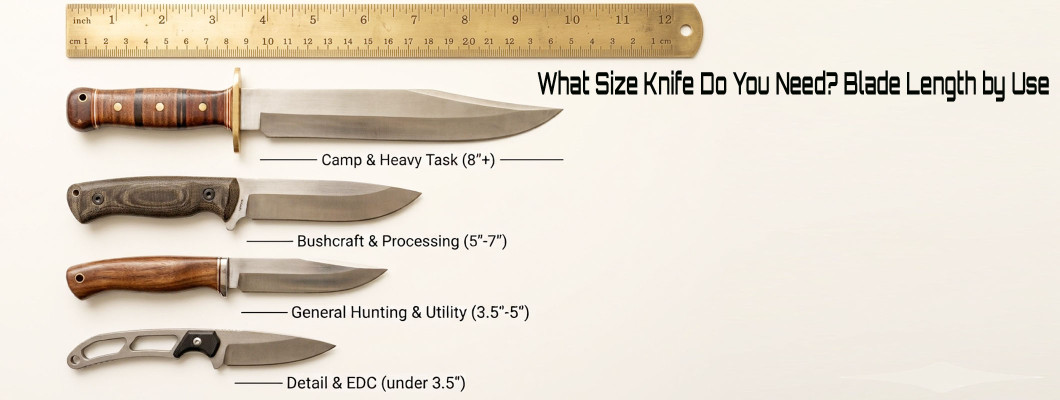
Almost everyone needs a shorter knife than they think. Everyday carry is 2.5 to 4 inches, hunting and field dressing 3.5 to 5, bushcraft and camp 4 to 6, and a bowie or camp chopper 8 to 12. Past 6 inches a knife stops doing knife work and starts doing an axe's job badly. The single most common buying mistake is choosing for the heaviest task you might one day do rather than the task you will do weekly.
Knife size is decided by use, not by height and not by how impressive it looks in a photograph. This guide gives the length for each job, explains the two measurements that matter more than blade length, and is honest about where a thin factory knife beats a forged one.
Get Your Length in Under a Minute
The Blade Size Finder asks what the knife is for, then returns a length range in inches and centimetres, a handle length, the reasoning behind the number, and a physical check you can run before you spend anything.
Blade Length by Job
Blade length is measured from the guard or the front of the handle to the tip. Handle length is separate and matters more than most buyers check. How we measure each part is set out on our measurements page.
| Use | Blade | Handle | Why that length | What it gives up |
|---|---|---|---|---|
| Everyday carry, general utility | 2.5 to 4 in | 4 to 4.5 in | Long enough for real work, short enough that it actually stays on you | No chopping ability at all |
| Hunting and field dressing | 3.5 to 5 in | 4.5 to 5 in | Tip and first inches do the work; short blades control better inside a cavity | Poor at camp chores and wood |
| Bushcraft and camp | 4 to 6 in | 4.5 to 5.5 in | Carves fine and splits coarse; the one-knife compromise | Never the best at either extreme |
| Camp cleaver and food prep | 6 to 8 in | 5 to 6 in | Weight forward of the hand for repetitive cutting on a board | Clumsy for detail work, awkward to carry |
| Bowie and large chopper | 8 to 12 in | 5 to 6 in | Enough mass to chop; the largest useful fixed-blade knife | Fouls the leg on a belt; poor at fine work |
Read the second and fifth rows against each other. A hunting knife and a bowie are both fixed-blade knives and they share almost nothing else. If one knife has to do both jobs, it will do neither well, and the honest answer for most people is two knives rather than one long compromise.
Why Bigger Is Worse for Knives Specifically
With swords and machetes, extra length buys reach and costs control. With knives the trade is harsher, because almost all knife work happens in the first two inches of edge and at the tip.
The tip does the thinking. Field dressing, carving a feather stick, opening packaging, trimming cordage, food prep — all of it happens at the front of the blade with your hand close to the work. Adding length adds leverage against you: the further the tip sits from your grip, the less precisely you can place it, and the more small errors get amplified.
Batoning is not a reason to buy long. The most common justification for a big knife is splitting wood by hammering the spine. It works, but the limit is the diameter of the wood, not the length of the blade, and a 6-inch blade splits everything a person actually needs at a camp. Buying nine inches for batoning means carrying three unnecessary inches every day for a task you do occasionally.
A knife you do not carry does no work. This is the one that decides it. The knife in your pocket outperforms the better knife at home every single time. Anything that annoys you on day one gets left behind by day ten, and blade length is the most common source of that annoyance.
Thickness Matters as Much as Length
Here is the part that comes from the forge rather than the catalogue, and it is the reason two knives with identical blade lengths can perform completely differently.
A blade has to part material and then let it move past. A thin blade slices because there is little steel to push aside once the edge has opened the cut. A thick blade wedges — it opens the cut well but then binds, which is why a thick knife feels like it stops halfway through a carrot and a thin one falls through.
We forge from 5160 leaf spring, which starts as thick stock. That is a genuine advantage on anything involving impact — batoning, chopping, prying you should not be doing anyway — because a thick forged blade takes shock a thin one would not survive. It is a genuine disadvantage in slicing. If you want the best possible food-prep or skinning slicer, you want thin stock and a high grind, and that is not what leaf spring is for.
The practical consequence for sizing: because our blades carry more mass at a given length, a forged 5-inch knife feels closer to a factory 6-inch one in the hand. If you are coming from thin production knives, size down slightly rather than matching numbers.
Handle Length Is the Measurement Nobody Checks
Blade length gets all the attention. Handle length is what you notice every time you pick the knife up, and it is where cheap knives cut corners because handle material is cheaper to shorten than steel.
The handle should take your whole hand with no overhang and no pinching, which for most adults is 4.5 to 5 inches on a working knife. Large hands need 5 to 5.5. This does not change much with blade length — a 4-inch bushcraft knife and a 6-inch one want nearly the same handle, because your hand does not change size.
Measure it properly. Wrap your hand around a broom handle in the grip you actually use, mark either side of your hand, and measure the gap. Compare that to the handle length on the product page rather than the total length. Then think about grip security when your hands are wet or cold, which is when handle shape stops being a comfort question and becomes a safety one.
The Bowie Is a Different Category
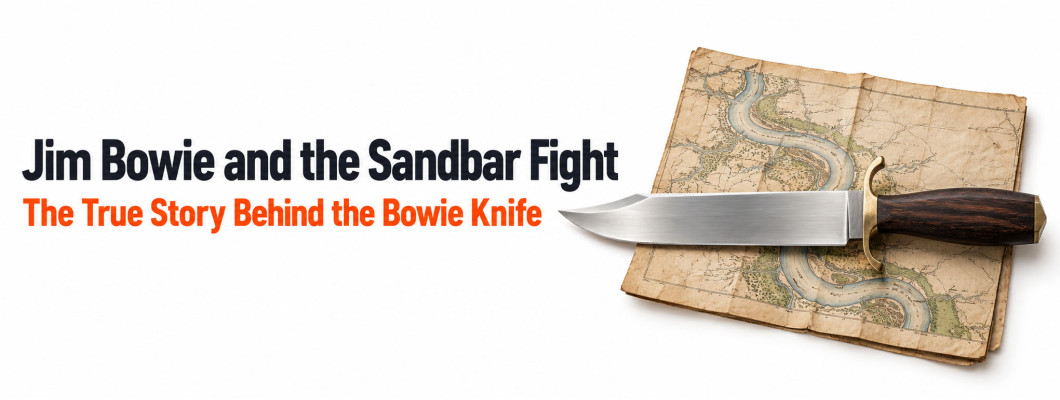
Classic bowies run roughly 8 to 12 inches of blade, and it is worth being clear that this is not simply a big knife. At that length the blade has enough mass to chop, which changes how it must be built and how it must be carried.
Under 8 inches you have a large hunting knife wearing a bowie profile. It looks the part and handles like a knife. Over 12 inches you have a chopper that competes directly with a kukri or a small axe, and generally loses to both, because a straight blade puts less mass ahead of the wrist than a forward-curved one does.
The thing to settle before ordering is the carry. A 12-inch blade on a belt sheath fouls your leg when you sit, drive or climb. That is what sends big bowies into cupboards, and it is entirely predictable before you buy. Browse bowie knives with the sheath in mind, not just the blade.
One Knife or Two?
Most of the sizing arguments people have with themselves are really this question in disguise. Someone wants a knife that dresses game, carves kindling, splits wood and prepares food, and they try to solve it with length. It cannot be solved with length, because the jobs pull in opposite directions.
The honest one-knife answer is 4 to 5 inches. It carves acceptably, dresses game acceptably, prepares food acceptably and splits small wood acceptably. Nothing on that list is done excellently, and that is the price of one knife. If you genuinely carry one blade and want the fewest regrets, this is it.
The two-knife answer is better and usually cheaper than people expect. A 3.5 to 4 inch knife that lives on you permanently, plus a dedicated chopper — a kukri, a hatchet, or a bowie at the 9 to 10 inch mark — that comes out when the work needs it. Each tool does its own job properly, and the small one gets carried every day rather than left behind because the big one was inconvenient.
The reason this matters for sizing is that people trying to build one knife for everything consistently oversize the small one. They add an inch for wood, then another for batoning, and end up with a 7-inch blade that is too big to carry casually and still worse at chopping than a proper chopper. If you find yourself adding length for a task that happens monthly, you are looking at a two-knife problem.
Grind and Edge Change What a Length Can Do
Two knives of the same length and thickness still behave differently depending on how the bevel is shaped, and this is worth knowing before you conclude a length was wrong.
A flat grind thins steadily from spine to edge and slices cleanly. A convex grind rolls the bevel outward, putting more steel behind the edge — it slices less freely but survives impact far better, which is why axes and heavy choppers use it. A scandi grind exposes a single wide bevel that bites into wood predictably and is easy to sharpen in the field, which is why bushcraft knives favour it.
The practical point for sizing: if a knife at the right length still feels like it binds or bounces, the grind is usually the culprit rather than the inches. A 5-inch scandi and a 5-inch convex are different tools. Getting the grind right often removes the temptation to change length at all.
Three Checks Before You Order
All three take five minutes and are worth more than any specification, ours included.
The carry test
Make a mock-up at the total length and put it where the knife will live — pocket, belt, pack — then go about a normal day. Sit down, get in a car, climb something. Anything that irritates you on day one will have the knife left at home by day ten.
The grip test
Measure your hand as described above and compare it to the handle length rather than the total. Then try the grips you actually use — pinch grip for detail, chest lever and thumb push for carving — and check your thumb reaches the spine comfortably. If it cannot, the blade is too long for your hand.
The honest-week test
Write down every cutting job you did in the last seven days. Not the imagined ones — the real ones. Most people find the list is opening boxes, cutting cord, food, and one wood task. Size for that list and buy the chopper separately if the list genuinely needs one.
Where a Thin Factory Knife Beats a Forged One
We should concede this plainly. For pure slicing — food prep, skinning, anything where the blade must pass through soft material cleanly — a thin, hard, high-ground production knife will outperform a thick forged 5160 blade, and no amount of hand work changes the geometry. If slicing is the whole job, buy for slicing.
The same applies at the small end. If you want a 3-inch folding pocket knife with a pocket clip, that is a manufacturing problem rather than a forging one, and a factory does it better and cheaper than we can.
What forged 5160 gives you is a different trade: a blade that survives impact, takes a working edge through decades of sharpening rather than thinning to nothing, and can be re-handled and re-ground rather than replaced. If the knife is a tool you will own for twenty years and use hard, that is the case for forging. If it is a kitchen slicer, it honestly is not — though we do forge kitchen and chef knives for people who want the durability trade in that form too.
Any Length, Because Nothing Is Pre-Made
Settle the size first, then build it. We hold no stock at all, so the length and handle that fit your hand are something we forge rather than something you have to find on a shelf.
Frequently Asked Questions
What size knife do I need?
Match it to the job. Everyday carry is 2.5 to 4 inches of blade, hunting and field dressing 3.5 to 5, bushcraft and camp 4 to 6, camp cleavers 6 to 8, and bowies or large choppers 8 to 12. If you want one knife for general outdoor use, 4 to 5 inches covers the widest range of real tasks without becoming awkward to carry.
Is a 4 inch blade big enough for bushcraft?
Yes, for almost everything. Four inches carves well, prepares food, processes cordage and splits any wood a camp realistically needs. The main argument for going to five or six is batoning larger rounds, and even then the limit is the diameter of the wood rather than the length of the blade. Most people who buy longer end up carrying inches they use a few times a year.
What size knife is best for hunting?
Three and a half to five inches. Field dressing is detail work done with the tip and the first inch or two of edge, so extra length adds nothing and gets in the way inside a cavity. Handle shape and grip security matter more than blade length here, because you are working with wet hands. Almost every serious hunting knife ever made lands in this range.
How long should a bowie knife be?
Eight to twelve inches of blade for a true bowie. Under 8 inches you have a large hunting knife with a bowie profile; over 12 you have a chopper that competes with a kukri or small axe and usually loses to both, because a straight blade carries less mass ahead of the wrist. Settle how you will carry it before ordering, because a 12-inch blade on a belt fouls your leg when you sit.
Does knife blade thickness matter more than length?
For cutting performance, often yes. A thin blade slices because there is little steel to push aside once the edge opens the cut; a thick blade wedges and binds. Thick forged stock is a real advantage on impact work like batoning and a real disadvantage in slicing. Two knives with identical blade lengths can perform completely differently for this reason.
How long should a knife handle be?
Four and a half to five inches for most adults, and 5 to 5.5 for large hands. It should take your whole hand with no overhang and no pinching. Handle length barely changes with blade length, because your hand does not change size — a 4-inch and a 6-inch knife want nearly the same handle. Measure yours around a broom handle rather than guessing.
What is the best all-round knife size?
Four to five inches of blade with a 4.5 to 5 inch handle. That range carves, prepares food, handles camp chores and splits small wood, while still being carryable. It is the compromise that has survived decades of argument among people who use knives daily, which is the strongest evidence available that it is roughly right.
Are there legal limits on knife blade length?
In many places, yes. Limits vary widely by country, state and territory, commonly turn on blade length, and usually govern carrying rather than owning. Many jurisdictions also treat fixed blades and folders differently regardless of size. Because the rules differ so much, check your own local law before ordering rather than relying on any general guide.
Can I order a knife in a length you do not list?
Yes. We hold no stock and forge every blade after the order is placed, so length is a build decision rather than a stock lookup. Most patterns carry a length option, the configurator prices your chosen length live, and anything outside those ranges is quoted as a custom piece. Tell us the length and what the knife is for, and we will tell you honestly whether it is the right call.