The Daab Is Thailand's Sword: A Long Grip, a Single Edge and Often a Second Blade in the Other Hand
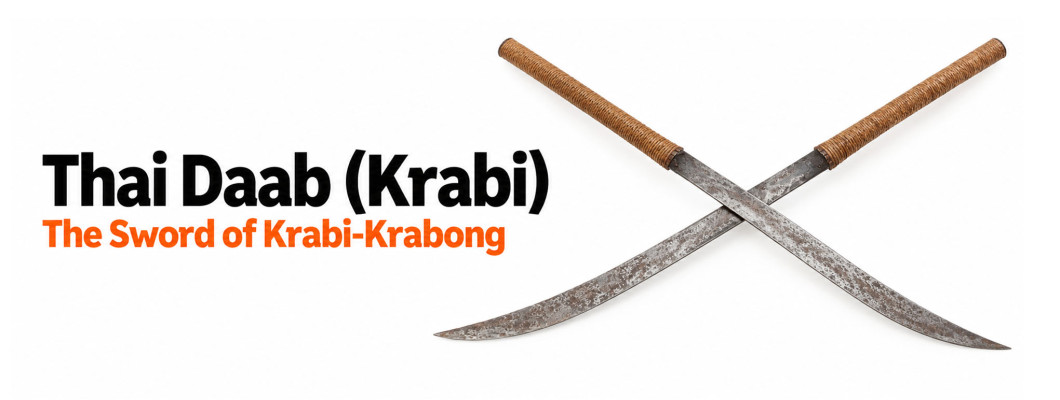
The daab (Thai dap, also written dab or darb) is the traditional sword of Thailand: a single-edged blade with a slight curve that broadens toward the point, on a long, guardless grip. It is the central weapon of krabi-krabong, the Thai weapon art that trained the soldiers of the Ayutthaya kingdom, and it is famous for being fought in pairs, one sword in each hand, a style called daab song mue. Its relatives are the Burmese dha and the long-handled swords of Laos and Cambodia. This guide explains the difference between the daab and the krabi, the form of the daab, how the paired swords are used, the daab's place in Thai history, and how our daab is forged.
The daab belongs to the wider world of Southeast Asian blades. For the Filipino side of that world, from the bolo to the kris, start with our guide to Filipino swords and machetes, which also touches on the daab's Thai influence. This post gives the daab its own space.
Daab or Krabi? Sorting Out the Names
In Thai, dap is the everyday word for a sword, and in English it is usually written daab. Krabi is a second Thai sword word, and the martial art krabi-krabong takes its name from it: krabi for the sword and krabong for the staff. Outside Thailand the two words are often used for the same blade, which causes confusion.
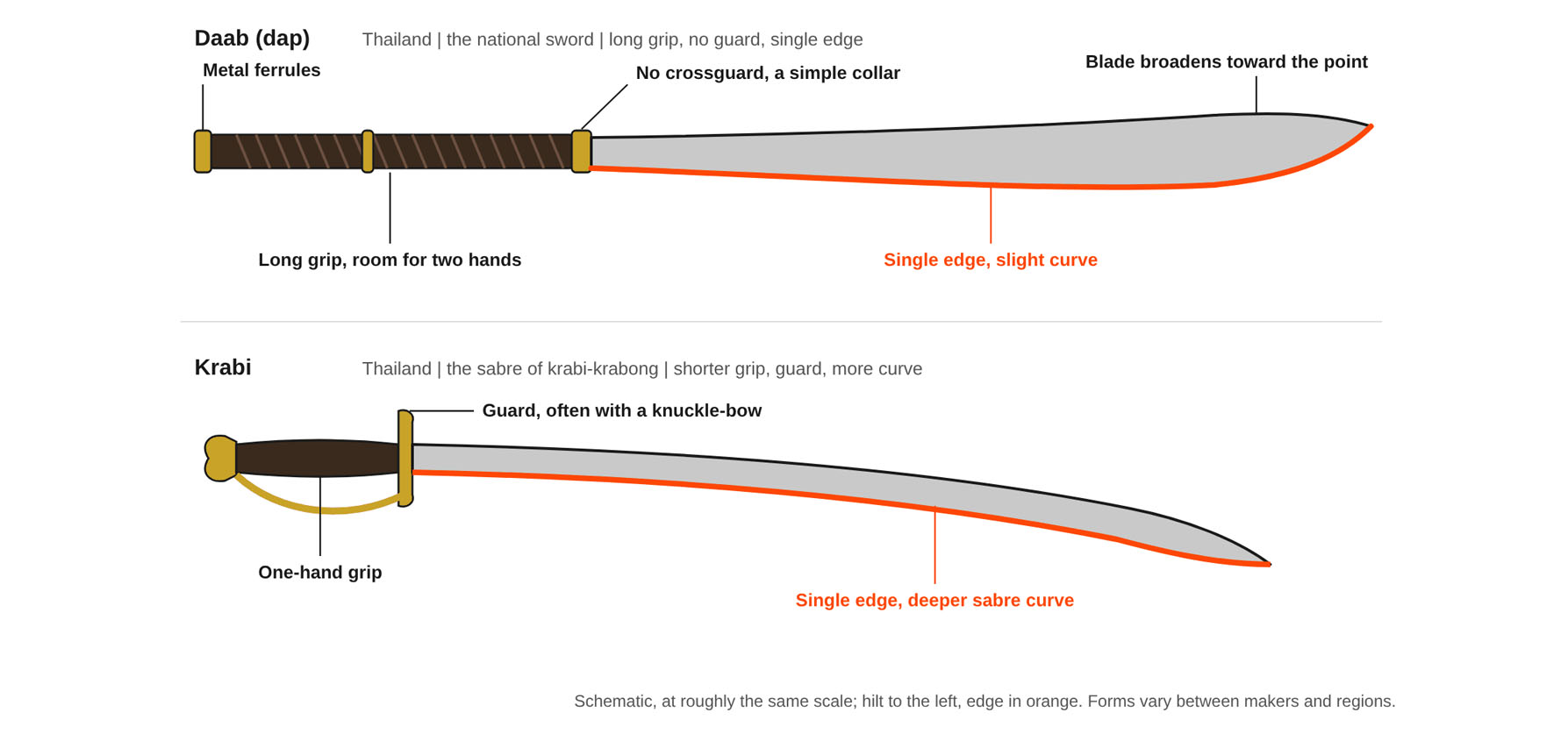
In the usage of many Thai schools and collectors, the two are different swords:
- The daab is the national sword, with a long, guardless grip and a single-edged blade that broadens toward the point. It is the sword used in pairs.
- The krabi is a sabre-like sword with a shorter one-hand grip, often a guard, and a more strongly curved blade, closer to the Indian and Persian sabres.
The line is not drawn the same way everywhere, and you will see "krabi" used for any Thai sword. In this guide, daab means the long-gripped national sword.
The Form of the Daab
- A long grip, often as long as a third of the blade or more, wrapped in cord, rattan or leather and closed by metal ferrules at each end. It leaves room for two hands, though in pairs each sword is held in one.
- No crossguard. A simple metal collar marks the junction of grip and blade. Hand protection comes from technique, not from the hilt.
- A single-edged blade, straight or slightly curved, usually 50 to 70 cm (20 to 28 in) long, that grows slightly wider toward the point. That puts weight forward for strong cuts.
- A sharp point, often formed where the spine curves down to meet a rising edge, so the daab thrusts as well as it cuts.
- A light, lively feel. Even with its forward weight, a daab is light enough to be swung fast in either hand.
Thailand's traditional smiths, including those of the village of Aranyik in Ayutthaya province, which is known for its blades, forged the daab in a range of sizes, from short swords for close fighting to long two-hand blades.
Daab Song Mue: A Sword in Each Hand
Daab song mue means "two-hand swords": one daab in each hand. It is the best-known part of krabi-krabong and one of the most distinctive sword styles anywhere. The two blades work together. One protects while the other cuts, or both cross to catch a heavy blow. Then they separate into cuts to different lines at once, high and low, inside and outside.
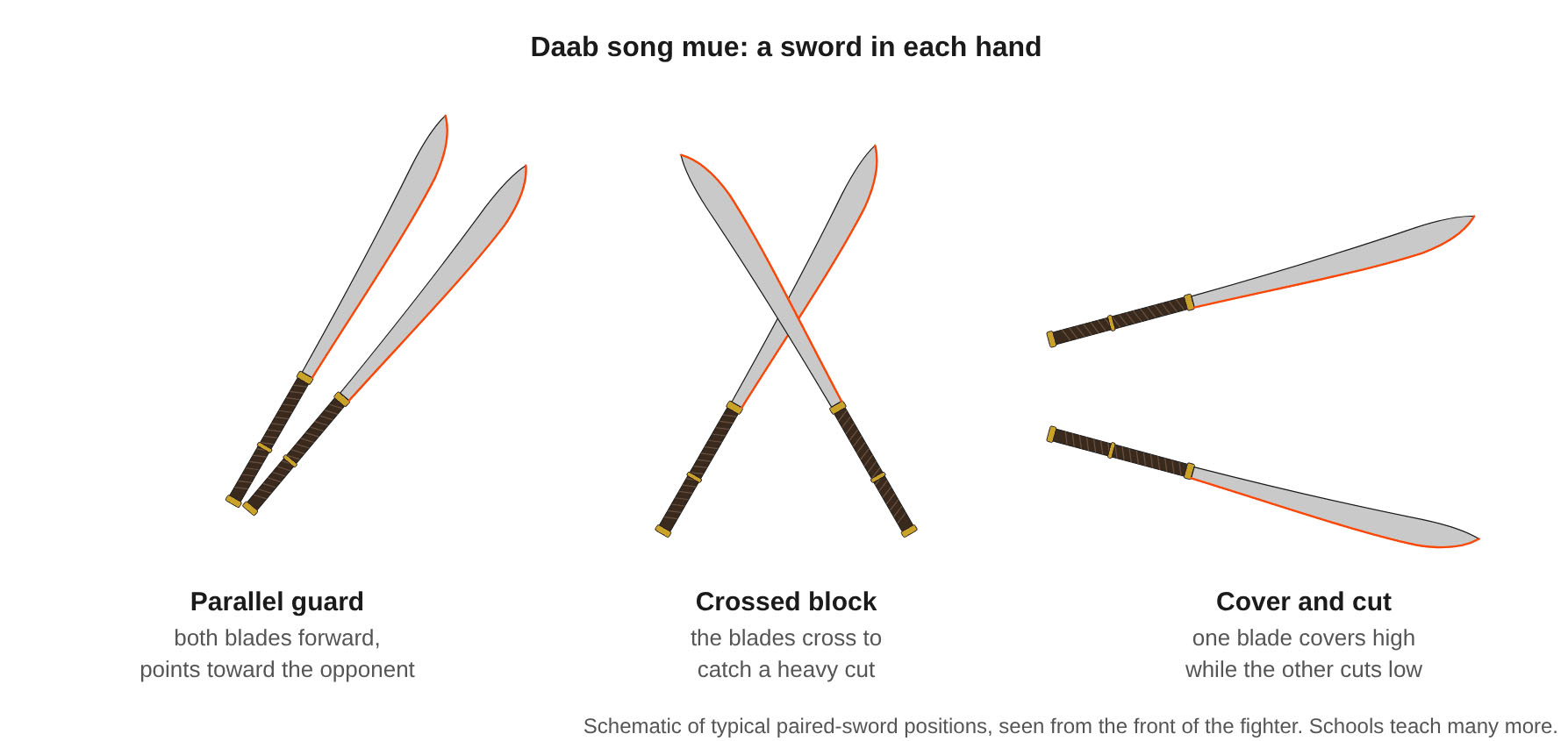
Paired swords are usually a little shorter and lighter than a single daab, so that both can be controlled at speed. Some old pairs were made to sit together in one scabbard, with the inner faces of the blades flat against each other.
Krabi-krabong itself covers far more than the daab: the krabong staff, the ngao glaive, the mai sok forearm shields, and shield-and-sword combinations, all fought with kicks, knees and throws from the same tradition as Muay Thai. Performances and bouts open with the wai khru, a ritual dance that honours the teacher.
The Daab in Thai History
The daab was the soldier's sword of the Ayutthaya kingdom (1351 to 1767), which fought long wars with its neighbours, above all Burma. Krabi-krabong was the training of its armies and its royal guards, and the daab, alone or in pairs, was their sidearm.
The most famous daab fighter in Thai history is Phraya Phichai Dap Hak, "Phraya Phichai of the broken sword". He was a general under King Taksin, who restored Siam after Ayutthaya fell. In 1773 he defended the town of Phichai against a Burmese army fighting with a sword in each hand, and fought on even when one of his swords broke. His statue in Uttaradit shows him with his two swords, one broken, and he remains a national hero.
Today krabi-krabong is kept alive by schools in Ayutthaya, Bangkok and across Thailand, by the Thai military's ceremonial units, and by performances at festivals and cultural shows. The daab remains a symbol of Thai courage and craftsmanship.
The Daab's Cousins: Burmese Dha, Lao Dab and Khmer Dav
The long-gripped, guardless, single-edged sword is shared across mainland Southeast Asia:
- The Burmese dha has a long grip, no guard and a slightly curved single-edged blade, often with a squared or clipped tip. It is the daab's closest relative and its old battlefield opponent.
- The Lao dab shares the name and much of the form of the Thai daab.
- The Khmer dav of Cambodia is another long-handled single-edged sword in the same family.
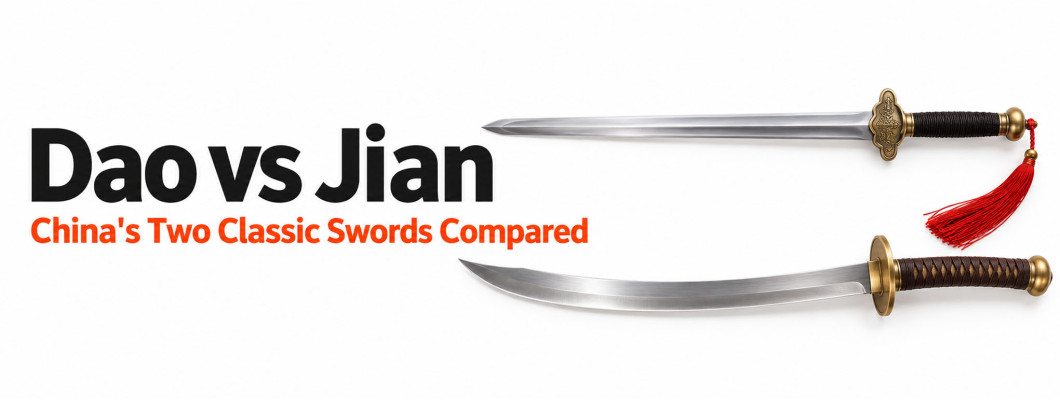
Despite the similar sound, the daab and dha are not the same as the Chinese dao, the single-edged sabre of China. For that blade, see dao vs jian. For the daab among the world's single-edged swords, read the most famous single-edge swords. For why a slight curve matters, see curved vs straight swords.
How Our Daab Is Forged
Our daab is forged on demand in our Kathmandu workshop from mono-steel 5160 spring steel. Nothing is held in stock; every blade is forged after the order is placed.
- Blade. A single-edged blade with the daab's slight curve and forward-broadening profile, differentially hardened: a hard edge for cutting and a softer, tougher spine that flexes rather than snaps.
- Grip. A long full-tang rosewood grip, wrapped in leather, with room for two hands.
- Scabbard. A wooden core covered in leather.
The Thai daab sword and the hand-forged Thai daab are our two daab listings, and both can be built to other blade lengths, finishes and handle materials on the product page. To set those yourself, start from Build Your Blade. More of our Asian blades are in the East Asian swords collection.
Any daab can be ordered left-handed by writing "Left Handed" in the order note. For training or stage use, ask the same way for a blunt edge and rounded tip. Catalogue builds dispatch in 2 to 3 business days; custom builds take 4 to 6 weeks at the forge; shipping is DHL or FedEx, tracked, 7 to 14 business days worldwide.
An honest note on the steel. Everest Forge forges mono-steel 5160 only. We do not make Damascus, pattern-welded, folded or laminated steel. Traditional Thai daab blades were forged from carbon steel, often with a hardened edge, and were not pattern-welded either.
Related Guides
Commission a Daab to Your Own Pattern
A daab sized to your hand and your school, with the grip length, blade length and curve you want, or a krabi or a Burmese-style dha to sit beside it in your collection. Send photos or measurements; the forge quotes it, builds it in 4 to 6 weeks, and ships it tracked worldwide.
Start a Custom Forge RequestFrequently Asked Questions
What is a Thai daab sword?
The traditional sword of Thailand: a single-edged, slightly curved blade that broadens toward the point, on a long, guardless grip. It is the central weapon of krabi-krabong and is often fought in pairs.
What is the difference between a daab and a krabi?
In the usage of many Thai schools, the daab is the long-gripped, guardless national sword, while the krabi is a sabre-like sword with a shorter grip, often a guard and a deeper curve. The words are often used interchangeably outside Thailand.
What does daab song mue mean?
"Two-hand swords": fighting with a daab in each hand. The two blades work together, one covering while the other cuts, or crossing to block a heavy blow.
What is krabi-krabong?
The traditional Thai weapon art, named after the krabi (sword) and krabong (staff). It covers the daab, single and paired, the staff, the glaive, forearm shields and shield-and-sword, together with unarmed techniques.
Who was Phraya Phichai Dap Hak?
A Thai general under King Taksin who, in 1773, defended the town of Phichai against a Burmese army fighting with two swords, and fought on after one broke. His name means "Phraya Phichai of the broken sword".
Is the daab the same as the Burmese dha?
They are close relatives: both have a long, guardless grip and a single-edged, slightly curved blade. The dha often has a squared or clipped tip, while the daab broadens to a sharper point.
Is the Thai daab related to the Chinese dao?
Only in sound. The Chinese dao is a single-edged sabre with a guard and a shorter grip, from a different sword tradition.
How long is a daab?
Blades are usually about 50 to 70 cm (20 to 28 in), with a long grip that brings the overall length to about 75 to 100 cm. Paired swords are often a little shorter.
Why does the daab have no crossguard?
The daab is built for speed and close work, often with a sword in each hand, and a guard would catch and get in the way. Krabi-krabong protects the hand through footwork, distance and the second blade rather than through the hilt.
Can I order a blunt daab for krabi-krabong training?
Yes. Ask for a blunt edge and rounded tip in the order note. It is forged from the same 5160 steel, so it has the weight and balance of a live blade.