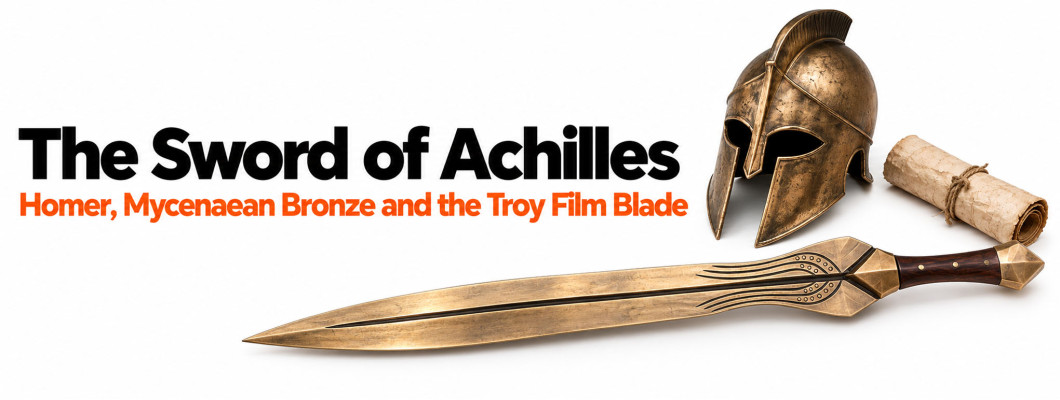
Homer Gives Achilles a Silver-Studded Bronze Sword; the Film Gave Him an Iron Age Leaf Blade. Here Is What Each One Really Was
In the Iliad, Achilles carries a bronze sword studded with silver, which he half-draws against Agamemnon in the first book and uses to kill Lycaon in the twenty-first; his famous weapon, though, is the great ash spear only he can wield. If a real Achilles fought at Troy around 1250 to 1180 BC, his sword would have been a Late Bronze Age Mycenaean blade: a horned or cruciform-hilted thrusting sword, or one of the new leaf-shaped Naue II cut-and-thrust swords. The "Achilles sword" most people picture comes from the 2004 film Troy, and its leaf-bladed design follows the later Iron Age Greek xiphos rather than anything from the Bronze Age. This guide sets out what Homer says, what the archaeology shows, how the film design differs, and what a hand-forged Achilles sword is.
Not an official prop. Troy (2004) is a Warner Bros. film. Everest Forge's Achilles swords are hand-forged interpretations inspired by the film's design and by ancient Greek originals. They are not official, licensed or endorsed by the film's makers.
The Achilles sword sits at the start of the Greek sword story; our Greek xiphos history covers the Iron Age sword that the film design draws on, and our guide to Bronze Age swords and the leaf blade covers the metallurgy of the period Achilles belongs to.
What Homer Says About Achilles' Sword
The Iliad uses three words for a sword, xiphos, phasganon and aor, often interchangeably, and repeatedly describes swords as bronze and studded with silver nails at the hilt. Achilles' sword appears at three memorable moments.
Book 1. Insulted by Agamemnon over the captive Briseis, Achilles begins to draw his great sword from its scabbard and is stopped by Athena, who pulls him back by his hair. He returns the sword to the sheath and fights with words instead. It is the most famous sword moment in the poem, and the sword is never drawn.
Book 19. Arming for his return to battle in the new armour forged by the god Hephaestus, Achilles slings his silver-studded bronze sword over his shoulder before taking up the great shield and the spear.
Book 21. At the river Scamander he kills the Trojan prince Lycaon with the sword, driving it into his neck beside the collarbone.
Achilles' signature weapon is not the sword at all but the heavy spear of Pelian ash, a gift from the centaur Chiron to his father Peleus, which no other Greek could wield. He kills Hector with it in Book 22. In the epic, as in Bronze Age warfare, the sword was a secondary weapon behind the spear.
One caution: the Iliad was composed around the eighth century BC, four or five centuries after the events it describes, and it mixes genuine memories of the Bronze Age with details from the poet's own Iron Age world. Its swords are a poetic composite, not a catalogue.
What a Mycenaean Sword at Troy Looked Like
Archaeologists usually sort Mycenaean swords by Nancy Sandars' typology. The earliest, Types A and B, are long, narrow bronze rapiers, made for thrusting and up to a metre long, from the shaft graves of Mycenae and the sixteenth and fifteenth centuries BC. They were followed by the horned (Type C) and cruciform (Type D) swords, shorter and sturdier, with hilt shoulders that project into horns or a cross. These could cut as well as thrust, and are the classic swords of the Mycenaean palaces.
Toward the end of the thirteenth century BC a new type spread across the eastern Mediterranean: the Naue II sword, a bronze cut-and-thrust blade with parallel or leaf-shaped edges and a hilt cast in one piece with the blade, its grip plates riveted on. It is associated with the upheavals at the end of the Bronze Age and with the "Sea Peoples", and it is the ancestor of most European swords for the next five hundred years. If the Trojan War has a historical core, conventionally placed around 1250 to 1180 BC, a Mycenaean warrior there would have carried either a late Type C or D sword or one of the first Naue II blades, in bronze, with a silver-riveted grip of wood or ivory that matches Homer's "silver-studded" description surprisingly well.
The Troy Film Sword
The Achilles sword most collectors know is the one designed for Troy (2004), in which Brad Pitt played Achilles. The film's designers did not try to reproduce a Mycenaean sword. They gave the Greek heroes swords in the shape of the later Greek xiphos, the leaf-bladed, double-edged short sword of the Archaic and Classical hoplite, centuries after any Trojan War. Dramatically it works: the leaf blade reads instantly as "ancient Greek" on screen, and it is a handsome, balanced shape. Historically it is an anachronism, as are the film's Classical-style armour and helmets.
That is why collectors are drawn to it. It is not an accurate Bronze Age reproduction, but it is the image of Achilles that a generation remembers, set on a sword shape that is itself genuinely Greek and genuinely effective. Our guide to iconic movie swords puts it alongside the other film blades collectors most want.
| Feature | Homer's Achilles | Mycenaean sword, c. 1250 BC | Troy (2004) film style |
|---|---|---|---|
| Metal | Bronze | Bronze | Steel, in the form of an Iron Age blade |
| Blade shape | Not described in detail | Narrow thrusting blade (Types C, D) or parallel-to-leaf cut-and-thrust (Naue II) | Leaf-shaped xiphos blade, widest near the point |
| Hilt | Silver-studded | Horned or cross shoulders, or Naue II flanged grip with riveted plates | Short cross-guard, grip and pommel in the Classical style |
| Length | Not given | Roughly 50 to 80 cm overall depending on type | A short sword, in the xiphos range |
| Main use | Secondary to the spear | Secondary to the spear; thrust and later cut | Cut and thrust in screen combat |
| Historical date of the form | Composed c. 8th century BC | c. 1450 to 1000 BC | Xiphos form c. 800 to 300 BC |
How a Hand-Forged Achilles Sword Is Made
Everest Forge forges its Achilles swords on demand, in the ancient and classical swords collection, from mono-steel 5160 spring steel with a full tang. Nothing is held in stock; every sword is forged after the order is placed. There are four builds:
- The museum-reproduction Achilles sword, the closest to the film-style leaf blade and hilt.
- The hand-forged Greek Achilles sword, a more historically Greek interpretation of the same leaf form.
- The forged Greek Achilles short sword, a compact build in the hoplite xiphos tradition.
- The custom Achilles sword, where blade length, finish and handle are selectable; the blade configurator shows the combination before you order.
Any of these can be ordered left-handed by writing "Left Handed" in the order note, or to stage-combat specification with a blunt edge and rounded tip the same way, which suits cosplay and re-enactment. Catalogue builds dispatch in 2 to 3 business days; custom builds take 4 to 6 weeks at the forge; shipping is DHL or FedEx, tracked, 7 to 14 business days worldwide.
An honest note. A real Achilles, and every sword in Homer, was bronze. Everest Forge does not cast bronze, and does not make Damascus, pattern-welded, folded or laminated steel. Our Achilles swords are 5160 steel, which is what the Iron Age xiphos they are shaped after was made from in spirit, and far tougher than bronze. If you want a true Mycenaean Type C, D or Naue II shape in steel, that is a custom forge commission from a museum reference; we will forge the shape honestly, but it will still be steel, not bronze.
Related Guides
Commission an Achilles Sword, Film-Style or Mycenaean
The leaf-bladed film-style sword in your blade length, or a steel interpretation of a Mycenaean horned, cruciform or Naue II sword from a museum reference. The forge quotes it, builds it in 4 to 6 weeks from 5160 spring steel, and ships it tracked worldwide.
Start a Custom Forge RequestFrequently Asked Questions
What sword did Achilles use?
In the Iliad, a bronze sword studded with silver. Historically, a Mycenaean warrior of the Trojan War period, around 1250 to 1180 BC, would have carried a bronze horned or cruciform sword or an early Naue II cut-and-thrust sword. Achilles' signature weapon in Homer is his ash spear, not his sword.
Did Achilles kill Hector with a sword?
No. In Book 22 of the Iliad, Achilles kills Hector with his spear, striking him in the neck where his armour left a gap.
Is the Troy movie sword historically accurate?
No. The film gives Achilles a leaf-bladed sword in the shape of the Iron Age Greek xiphos, several centuries later than any Trojan War. It is a genuine Greek sword shape, but not a Bronze Age one.
Was Achilles' sword bronze or iron?
Bronze. Homer describes it as bronze, and the Trojan War is set in the Late Bronze Age, before iron weapons were common in Greece.
What is a Naue II sword?
A bronze cut-and-thrust sword type that spread across Europe and the eastern Mediterranean from about the thirteenth century BC, with a hilt cast in one piece with the blade and riveted grip plates. It is the ancestor of most later European swords.
What was Achilles' spear made of?
According to the Iliad, ash wood from Mount Pelion, given by the centaur Chiron to Achilles' father Peleus. No other Greek could wield it.
Is the Everest Forge Achilles sword an official Troy prop?
No. It is a hand-forged interpretation inspired by the film's design and by Greek originals. It is not official, licensed or endorsed by the makers of Troy.
Can I get a historically accurate Mycenaean sword?
In shape, yes, as a custom forge commission from a museum reference. It will be forged in 5160 steel, not cast in bronze, so it is a steel interpretation of the Bronze Age form.
Can I order an Achilles sword blunt for cosplay?
Yes. Write it in the order note for a blunt edge and rounded tip. Left-handed builds are ordered the same way.
How long does an Achilles sword take to arrive?
Catalogue builds dispatch in 2 to 3 business days; custom builds take 4 to 6 weeks at the forge. Shipping is DHL or FedEx, tracked, 7 to 14 business days worldwide.