Heat Treatment Explained — Why Tempering Decides if a Sword Survives
Heat treatment is where a piece of steel becomes a blade, and it is the stage most often skipped. A sword is forged, then normalised, then quenched, then tempered — and if any one of those is done badly the finished blade will underperform whatever steel it was made from. The last stage is the one that costs time and therefore money, which is exactly why cheap blades so often arrive hard, brittle and untempered. This guide explains what happens inside the steel at each stage, what goes wrong, and how a buyer can tell.
Quenching and Tempering Are Not the Same Thing
Start here, because the terms get used interchangeably and they describe opposite operations.
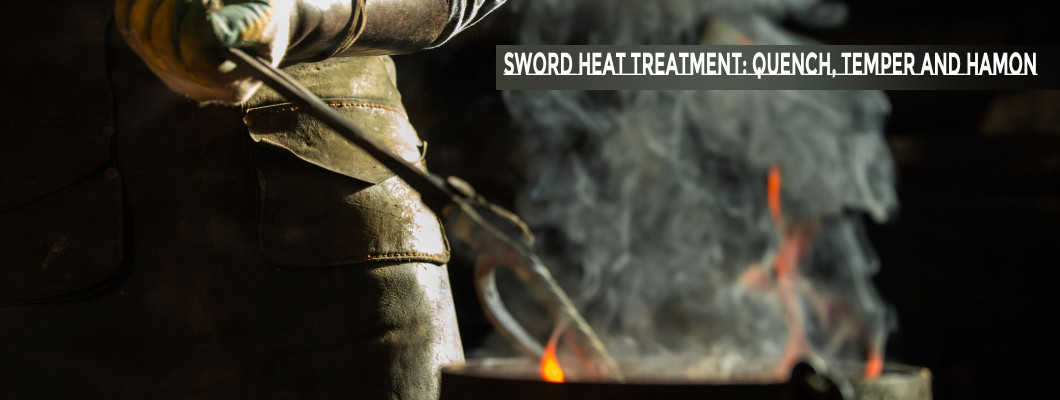
Quenching is cooling hot steel rapidly, in oil or water, to make it hard. Tempering is reheating that hardened steel to a much lower temperature to make it slightly softer and far tougher. You quench in a liquid. You temper in an oven or a forge, in air.
So there is no such thing as water-tempering. There is water-quenching, followed by tempering. It sounds pedantic and it is not, because the confusion hides the fact that a blade can be quenched and never tempered at all — and an untempered blade is the single most dangerous thing in this article.
What Actually Changes Inside the Steel
Steel is iron with carbon dissolved in it, and its properties depend on how the carbon and the iron are arranged. Heating and cooling rearranges them.
Heat carbon steel past a certain point — its critical temperature, somewhere around 800 degrees Celsius for most blade steels — and the internal structure changes to a phase called austenite, in which the carbon is evenly dissolved. What happens next depends entirely on how fast you cool it.
Cool it slowly and the carbon has time to migrate into orderly layers. The result, pearlite, is soft and tough and easy to file. This is annealing, and it is what you do when you want to work the steel.
Cool it fast and the carbon has nowhere to go. It gets trapped in a strained, distorted structure called martensite. Martensite is extremely hard and extremely brittle — hard enough to hold a razor edge, brittle enough to shatter like glass.
That is the quench. And that brittle, glass-hard blade is the reason tempering exists.
Stage One: Normalising
Forging a blade means heating it repeatedly and hammering it, and that leaves the internal grain of the steel uneven — coarse in places that got hottest, stressed in places that got worked hardest.
Normalising fixes it. The blade is brought up to critical temperature and allowed to cool in still air, and the cycle is repeated two or three times at slightly lower temperatures each time. Each cycle refines the grain structure a little further, and finer grain means a tougher finished blade.
It is invisible in the finished product, adds an hour to the work, and is the first thing dropped when a workshop is producing to a price. A blade that skips normalising can still be quenched and tempered and will still look right. It will simply be less tough than it should have been, and nobody will ever know why.
Stage Two: The Quench
The blade is heated evenly to critical temperature and plunged into the quenchant. Three things decide whether it works.
Knowing when the steel is ready. Colour is unreliable — it shifts with the light in the workshop, which is why forges are traditionally kept dim. The practical test is magnetism. Carbon steel loses its magnetism at a temperature just below critical, so a smith touches a magnet to the blade, and when it no longer attracts, a little more heat brings it to the right point. A skilled smith reads the colour and confirms with the magnet.
Choosing the quenchant. Water and brine pull heat out fastest. Oil is slower and gentler. Faster is not better — it is more aggressive, and aggression cracks blades. Which one you need depends on the steel: plain carbon steels such as 1060 and 1095 generally need a fast quench to harden fully, while alloy steels like 5160 harden readily in oil because the chromium in them increases hardenability. Quenching an oil-hardening steel in water invites cracks for no benefit.
How the blade goes in. Edge first and straight down, in one movement, held still. A blade entering at an angle cools unevenly, and uneven cooling means the steel on one side transforms and expands before the other. That is how blades come out of the quench with a curve nobody wanted.
The quench is the moment of highest risk in making a blade. Steel that has been forged for hours can crack in two seconds, and a quench crack is terminal — there is no repair. Every forge loses blades at this stage. A forge that claims it never does is not quenching hard enough to fully harden the steel.
Stage Three: The Temper
Straight out of the quench the blade is at maximum hardness and effectively useless. Drop it on a stone floor and it can break. It has to be tempered, and it has to be tempered soon — hardened steel left sitting can crack on its own from internal stress.
Tempering means reheating the blade to a modest temperature, typically somewhere between about 180 and 320 degrees Celsius depending on the steel and the intended use, holding it there, and letting it cool. The heat allows some of the trapped carbon to move a little, relieving the internal strain. Hardness drops slightly. Toughness rises enormously.
Higher tempering temperature means a softer, tougher blade. This is the single control that decides what kind of blade you end up with. A knife tempered low stays hard and holds a fine edge. A sword tempered higher gives up some edge retention and gains the ability to bend rather than break. A blade for stage combat is tempered higher still, because it will be struck by other steel and must take a set rather than chipping.
Tempering colours
On clean steel, tempering announces itself. A thin oxide layer forms on the surface and its colour tracks the temperature — pale straw first, then darker straw and bronze, then purple, then blue. Smiths have used those colours as a temperature gauge for centuries and they still work, though an oven with a thermocouple is more repeatable and most serious workshops use both.
Why it is done more than once
Good practice is two or three tempering cycles rather than one long soak. Each cycle catches steel that did not fully transform in the previous one, and the result is more consistent through the thickness of the blade. It also doubles or triples the oven time, which is precisely why it gets cut.
Differential Hardening and Clay Tempering
Everything above hardens the whole blade to the same degree. There is an older approach that hardens different parts differently, and it is where the Japanese sword gets its reputation.
Before quenching, a clay slurry is applied to the blade — thick along the spine, thin or absent along the edge. In the quench the bare edge cools fast and becomes hard martensite, while the clay-covered spine cools slowly and stays softer. The result is a blade with a hard cutting edge and a resilient back, and a visible wavy line, the hamon, where the two structures meet.
There is a second consequence that surprises people. The hardened edge expands slightly as it transforms, and on a blade that went into the quench straight this pulls it into a curve. The distinctive sori of a katana is partly a product of the quench itself, not only of the smith's shaping.
It is genuinely clever and it was a brilliant solution for the steel available in medieval Japan. It is not automatically better. A differentially hardened blade has a boundary inside it between two different structures, and boundaries are where things start. A through-hardened spring steel blade, tempered to a sensible hardness, is more forgiving under lateral stress — which is why European swords were not made this way and why we do not use it either.
Worth knowing as a buyer: a real hamon is a structural feature of the steel with a grainy, cloudy transition. Many blades sold with a "hamon" have an acid-etched or wire-brushed line that imitates the look with none of the metallurgy behind it. A suspiciously crisp, uniform line is usually cosmetic.
What Goes Wrong
| Mistake | What happens | Visible? |
|---|---|---|
| Skipped normalising | Coarse, uneven grain; reduced toughness | No |
| Overheated before quench | Grain grows; blade becomes brittle | No |
| Held too hot too long | Carbon burns out of the surface; soft skin on the blade | Only in use |
| Wrong quenchant for the steel | Quench cracks, or incomplete hardening | Cracks yes, soft blade no |
| Blade entered the quench crooked | Warping; a curve nobody intended | Yes |
| Tempered too little, or not at all | Glass-hard blade; chips and cracks in use | No, until it fails |
| Tempered too much | Soft blade; edge rolls and dulls quickly | Only in use |
Look at the third column. Almost nothing on that list is visible on a finished, polished blade. That is the whole problem with heat treatment as a buying consideration — it is the most important thing about a blade and the least inspectable.
How We Do It
Every Everest Forge blade is forged from 5160 spring steel and heat-treated by hand in our workshop in Tokha, Kathmandu, by kami smiths who learned the process from the previous generation the way that generation learned it from the one before.
The blade is normalised after forging, brought to temperature and quenched, then tempered — with the tempering pitched to what the blade is for, higher for blades that will be struck and lower where edge retention matters more. Nothing is sent out hardened but untempered, because a hardened untempered blade is not a product, it is an unfinished one.
We do not clay-temper, for the reason given above: a through-hardened spring steel blade is the more forgiving construction, and it suits both the steel we use and the way our blades get used. Where a customer specifically wants a differentially hardened blade, that is a custom forge conversation rather than something we do as standard.
How to Tell if a Blade Was Properly Treated
You cannot see heat treatment, so you work from what the seller can tell you.
- Ask what hardness it is tempered to. A maker who controls the process gives you a figure or a range. A seller who has never asked their supplier will change the subject.
- Ask what it was quenched in, and why that quenchant for that steel. The "why" is the revealing part.
- Ask whether it was normalised, and how many tempering cycles it had. Very few sellers can answer this. The ones who can are makers.
- Ask whether a hamon is structural or applied. An honest seller will tell you which, and an applied one is not a defect provided it is described accurately.
- Treat "heat treated" with no detail as no answer. Every piece of steel that has been near a forge has been heat treated in some sense.
Heat treatment is one of four things that separate a functional blade from a decorative one. The other three — steel, tang and geometry — are set out on our battle ready standard, and the steel itself is covered in the sword steel guide.
Normalised, Quenched and Tempered by Hand
Every blade we make is forged from 5160 spring steel, normalised after forging, quenched, and tempered to suit what the blade is for. No untempered blades, no shortcuts on the stage that costs time. Swords, kukris, machetes, spears, daggers and knives.
Browse Hand-Forged Swords →Frequently Asked Questions
What is the difference between quenching and tempering?
Quenching is cooling hot steel rapidly in oil or water to make it hard. Tempering is reheating that hardened steel to a much lower temperature to make it slightly softer and far tougher. They are opposite operations and both are necessary. A blade that has been quenched but never tempered is glass-hard and will chip or crack in use, which is why "water-tempered" is a confusion of terms — you quench in water, then temper separately.
What happens if a sword is not tempered?
It stays at maximum hardness, which sounds desirable and is not. Untempered martensite is extremely brittle. The blade may crack from its own internal stress while simply sitting, and in use it will chip or fracture rather than flex. Tempering costs oven time and therefore money, which is why it is the stage most often skipped on cheap blades — and the failure it causes is invisible until the blade breaks.
What temperature is a sword tempered at?
Typically somewhere between about 180 and 320 degrees Celsius, depending on the steel and what the blade is for. Higher tempering temperature gives a softer, tougher blade. A knife tempered low stays hard and holds a fine edge; a sword is tempered higher so it bends rather than breaking; a stage combat blade is tempered higher still because it will be struck by other steel.
What is normalising and why does it matter?
Forging leaves the internal grain of the steel uneven — coarse where it got hottest, stressed where it was worked hardest. Normalising means heating the blade to critical temperature and letting it cool in still air, repeated two or three times, which progressively refines the grain. Finer grain means a tougher blade. It is invisible in the finished piece and it is the first thing dropped when producing to a price.
Should a blade be quenched in oil or water?
It depends on the steel. Water and brine pull heat out fastest and plain carbon steels such as 1060 and 1095 generally need that speed to harden fully. Alloy steels like 5160 harden readily in oil because the chromium increases hardenability, and quenching them in water invites cracking for no benefit. Faster is not better; it is more aggressive, and aggression cracks blades.
What is a hamon and is a real one better?
A hamon is the visible line on a differentially hardened blade where the hard quenched edge meets the softer spine, produced by coating the spine in clay before quenching so it cools more slowly. A genuine hamon is a structural feature with a grainy, cloudy transition; many blades carry an acid-etched or wire-brushed imitation instead, usually recognisable by being suspiciously crisp and uniform. Differential hardening is not automatically better than a through-hardened spring steel blade, which handles lateral stress more forgivingly.
Why do katana curve?
Partly because of the quench. In clay tempering the bare edge cools fast and transforms to martensite, which expands slightly, while the clay-covered spine cools slowly and does not. That differential expansion pulls a blade that entered the quench straight into a curve. The smith shapes the blade with this in mind, so the final sori is a combination of deliberate forging and what the quench does on its own.
How can I tell if a blade was heat treated properly?
You cannot see it, so you have to ask. Request the tempered hardness as a figure or range, what it was quenched in and why that quenchant suits that steel, whether it was normalised, and how many tempering cycles it had. Very few sellers can answer those questions, and the ones who can are makers rather than resellers. Treat "heat treated" with no further detail as no answer at all.