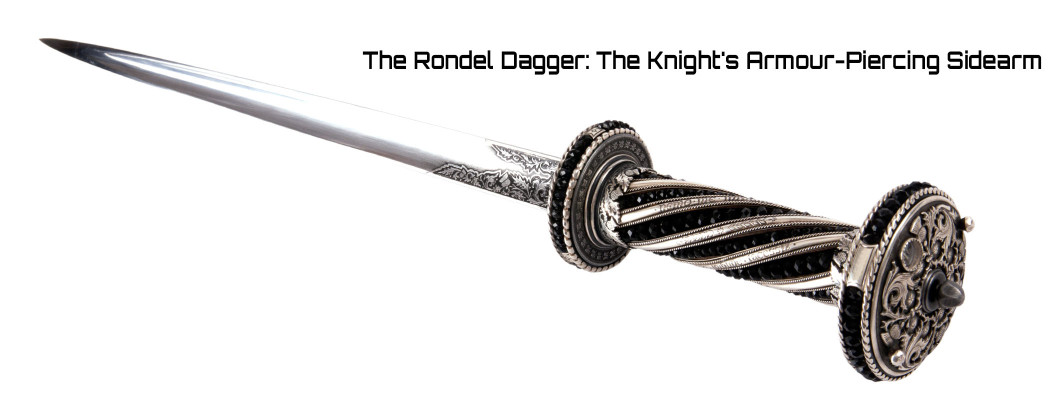
The Rondel Dagger: The Knight's Armour-Piercing Sidearm
A rondel dagger is not really a knife. It is a stiff spike with a handle, built for one job: getting through armour that a sword could not cut. The two flat discs that give it its name — one at the guard, one at the pommel — exist so you can put your palm on the end and drive the point home with the weight of your shoulder behind it.
Everything about the type follows from that. The blade is long, slim and needle-pointed, often 12 inches or more with the whole dagger reaching 20. Some have four edges in a cruciform section. Some have no cutting edge worth the name at all. By the late Middle Ages, when plate armour had made cutting largely futile, puncturing was one of the only ways left to breach the harness of a man-at-arms — and this is the tool that did it.
What the Discs Actually Do
Most explanations stop at "the discs are the guard and the pommel", which is true and misses the point.
The disc at the guard does the ordinary job: it stops your hand sliding forward onto the blade, and it will turn a blade sliding down toward your fingers. Nothing unusual there. The disc at the pommel is the interesting one, because no other dagger has it and it is not there for balance.
It is there so you can push against it. Put the heel of your palm flat on that disc, wrap your fingers around the grip, and you can drive the point forward with your arm locked and your whole body behind it — the way you would push a chisel, not the way you would stab with a knife. A round pommel with a wide flat face gives you a surface to bear on. A conventional dagger pommel does not, and trying the same push on one drives the pommel into your palm.
That single feature explains the whole weapon. It is a design for putting maximum force behind a small point, which is exactly what defeating armour requires.
The Problem It Was Built to Solve
Through the fourteenth and fifteenth centuries, European armour got very good. Mail was reinforced and then increasingly replaced by plate, and a man in a full harness became genuinely difficult to injure with a cutting weapon. You can strike good plate with a sharp sword as hard as you like and achieve very little.
What remains is the gaps. Every suit of armour has them, because a body has to bend: the armpits, the inside of the elbows, the back of the knees, the visor and eyeholes, the joints where plates overlap. Those openings are small, they move, and they are covered by mail or padding rather than plate.
Reaching them requires a stiff point driven hard and placed precisely, usually at grappling distance with the fight already on the ground. That is the rondel's entire purpose. Against mail it punctures and bursts the links; against plate it goes where the plate is not.
Our post on sword guard types covers the same era from the other end — as armour improved, swords grew two-handed grips for the same reason daggers grew stiff spikes. Both are answers to plate.
The Misericorde Question
The rondel is often described as the misericorde, and the relationship is worth getting right because the two words are not synonyms.
Misericorde means mercy, and it describes a use rather than a shape: the blade used to deliver a swift end to a mortally wounded opponent, pushed through the visor or eyeholes of a helm, or through a gap under the arm. It was known from the twelfth century and appears in the armaments of England, Germany and Persia.
A rondel could serve as a misericorde and frequently did. So could a bollock dagger, a quillon dagger, or anything else stiff enough and narrow enough. So every misericorde was some type of dagger, but not every rondel was used that way, and the terms describe different things — one a form, the other a function.
The name carries a genuine idea rather than a euphemism. It reflects a period view that ending the suffering of a man who could not be saved was an act of mercy rather than of cruelty. Our post on sacred and ritual daggers covers that thread further.
The Blade
Rondel blades vary more than the hilts do, and the variation tells you what a given example was for.
The needle point is the classic: long, slim, tapering steadily to a fine point, stiff through the section. Twelve inches or more of blade is normal and the complete dagger can reach twenty. This is the armour-defeating form.
The cruciform, four-edged blade is the extreme version. Instead of two edges and two flats, the cross-section is a cross — four narrow faces meeting at a spine that runs the length of the blade. It has almost no cutting ability at all and is enormously stiff for its weight. A blade like this is not a knife by any useful definition. It is an armour-piercing implement that happens to be worn on a belt.
The sharpened, flatter blade exists too, and it is the version most people actually want to own. Rondels were carried at the waist by merchants and clerks as well as knights, and a great many were genuinely used as utility tools — cutting food, cord, leather. A sharpened rondel is not a compromise or a modern invention; it is a period answer to the question of what you do with the thing for the other twenty-three hours of the day.
Who Carried One
Almost everybody, which surprises people who know it as a knightly weapon.
Rondel daggers were worn from the fourteenth century onwards across Europe by a very broad range of people — merchants, officials and craftsmen as well as knights and men-at-arms. It was worn at the waist, used as a utility tool, and carried into battle or into a jousting tournament as a sidearm. The same design served as an everyday knife and as an armour-piercing weapon of last resort.
The most famous piece of evidence for the second role comes from a car park in Leicester. When the remains of Richard III were examined after their rediscovery, the post-mortem recorded injuries consistent with the close-quarters violence of Bosworth in 1485 — the kind of fight in which a rondel was the relevant weapon, once a man was down and his helmet was off.
What a Stiff Spike Asks of the Maker
This is where a rondel differs from every other dagger we forge, and it is not obvious from the outside.
On most blades, the geometry that matters is the edge: the grind, the bevel angle, how thin you can go behind the edge without losing durability. On a rondel, the edge is close to irrelevant and the cross-section is everything. A long slim blade that has to stay rigid under a hard thrust needs mass in the middle — a thick spine, a diamond section, or in the cruciform version four faces meeting at a central ridge. Thin it for cutting and it flexes when you need it most.
That changes the heat treatment brief too. A cutting blade is heat treated toward edge retention. A rondel is heat treated toward toughness and rigidity, because the failure that matters is bending or snapping under compression, not going blunt. It is closer in spirit to a crowbar than a kitchen knife.
The pommel is structural rather than decorative for the same reason. It has to take repeated force from the heel of a hand and transmit it into the tang, which means the tang has to run through and be properly peened or nutted over the disc. A rondel with a glued or pinned pommel is missing the one component the design is built around.
Sharpened or Not: Decide Before You Order
We should be plain about a choice most sellers do not offer, because it changes what you are buying.
Our catalogue rondel is a 12-inch hand-forged blade in 5160 spring steel, oil quenched and tempered, with a rosewood grip. It is sharpened, which makes it a usable dagger and a good utility piece — and which puts it in the tradition of the many rondels that were carried as tools.
What it is not is the unsharpened armour-piercing spike with a thick diamond or cruciform section. That version is stiffer, heavier in the middle, useless for cutting, and historically the more specialised object. We can forge either, but they are different builds and it has to be decided before the steel is drawn out, not afterwards.
So tell us which you want. If the appeal is the medieval knight's armour-defeating sidearm, ask for the stiff section and accept that it will not cut. If you want something you can also use, the sharpened version is the honest answer and equally period-correct. Neither is a compromise. They are two different weapons that share a hilt.
Rondel Daggers, Sharpened or Stiff-Sectioned
We hold no stock — every blade is forged after the order is placed, so blade length, cross-section, disc diameter and grip are yours to specify. The catalogue rondel is a sharpened 12-inch blade; a heavier unsharpened armour-piercing section can be quoted through custom forge.
Frequently Asked Questions
What is a rondel dagger?
A stiff-bladed medieval dagger with flat round discs at both the guard and the pommel, used in Europe from the fourteenth century onwards. The blade is typically long and slim with a tapering needle point, 12 inches or more, with the whole dagger reaching up to 20. It was built to puncture mail and to reach the gaps in plate armour.
Why does a rondel dagger have discs?
The disc at the guard stops the hand sliding forward, as any guard does. The disc at the pommel is the unusual one: it gives you a flat surface to press the heel of your palm against, so you can drive the point home with your arm locked and your body weight behind it rather than stabbing with the wrist. No other dagger hilt lets you do that.
Could a rondel dagger really pierce armour?
It could puncture and burst the links of mail, and it could reach the weak points of plate — the gaps and joints at the armpit, elbow and knee, the visor and eyeholes, and areas of thinner plate. It was not punching through the breastplate. As armour improved through the late Middle Ages, going through the gaps became one of the only ways left to injure a fully armoured man.
Is a rondel dagger the same as a misericorde?
No. Misericorde, meaning mercy, describes a use rather than a shape — the blade used to give a swift end to a mortally wounded opponent through the visor or a gap in the armour. A rondel could serve that purpose and often did, but so could a bollock or quillon dagger. One word names a form, the other names a function.
How long is a rondel dagger?
The blade is typically 12 inches or more, and the complete dagger can reach around 20 inches. That is long for a dagger, and it is deliberate: reaching a gap in armour on a struggling opponent needs length as well as stiffness. Our catalogue piece is a 12-inch blade, which is at the practical end of the range for carrying.
Are rondel daggers sharpened?
Both versions are period-correct. Many rondels were sharpened and genuinely used as utility knives by merchants and craftsmen as well as soldiers. The specialised armour-piercing examples are stiff spikes with a thick diamond or four-sided cruciform section and almost no cutting ability. Decide which you want before ordering, because they are different builds.
What is a four-edged rondel dagger?
A version with a cruciform cross-section — four narrow faces meeting at a central spine rather than two edges and two flats. It is enormously stiff for its weight and has essentially no cutting ability. This is the most specialised form of the type: an armour-piercing implement that happens to be worn on a belt rather than a knife in any useful sense.
Who carried rondel daggers?
A very broad range of people from the fourteenth century onwards — merchants, officials and craftsmen as well as knights and men-at-arms. It was worn at the waist, used as a utility tool, and carried into battle or into a jousting tournament as a sidearm. The same design served as an everyday knife and as a weapon of last resort.
Can you forge a custom rondel dagger?
Yes. We hold no stock and forge after the order is placed, so blade length, cross-section, disc diameter and grip material are all specification rather than selection. If you want the stiff unsharpened armour-piercing section rather than the sharpened catalogue version, say so at enquiry — it is a different build and has to be decided before the steel is drawn out.