Rolled Tip Practice Swords: Why Training Sword Points Are Folded Over
Look closely at the point of a sparring sword and you will often find that it is not a point at all. The end of the blade has been folded back on itself into a small rounded roll. That is not damage and it is not a shortcut. It is a safety feature, and on a sword that will be thrust at another person, it is one of the most important details on the whole blade.
This guide explains what a rolled tip is, why practice swords use one, how it is made, what the alternatives are, and what to check before you train with one.
What a Rolled Tip Is
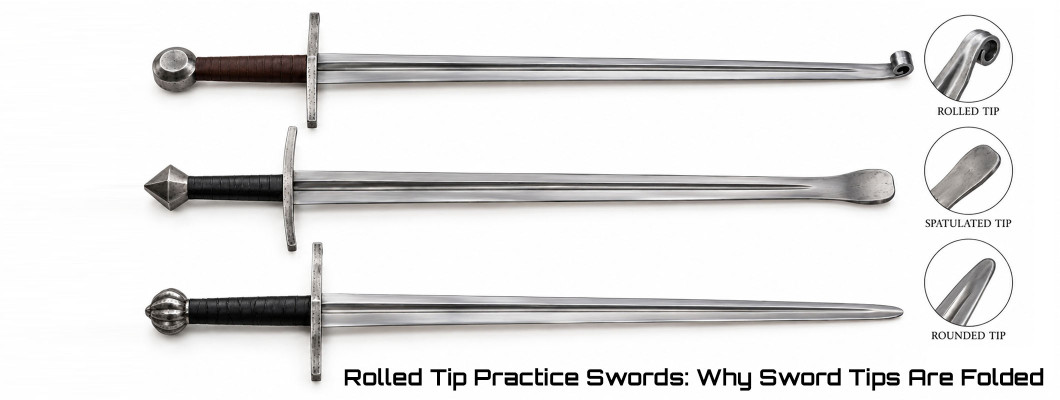
A rolled tip, also called a folded tip, is the thin end of a training blade curled back over the flat of the blade into a small, closed loop of steel. Look at the blade from its edge and you can see the loop. Look at it from the flat and the end simply appears rounded and a little thicker. Either way, instead of narrowing to a point, the blade ends in a rounded roll.
You will see it most often on steel sparring swords used in historical European martial arts (HEMA) — longsword feders, sabres, rapiers and arming swords built for training rather than cutting. It also turns up on some stage and demonstration blades.
It looks odd on a sword for a reason. A training sword is not trying to look like a real one. It is trying to behave like one in the hand while being as safe as possible to hit someone with.
Why Practice Swords Have a Folded Tip
The point is the most dangerous part of any sword. An edge spreads force along its length. A point concentrates the whole weight and speed of a thrust into a tiny area. Even a completely blunt point can go through fabric, catch in a mask or cause serious injury, because blunt does not mean wide.
A rolled tip spreads that force out. By turning the point into a rounded end many times wider, the roll spreads the impact over a larger area. A thrust that lands becomes a push rather than a puncture.
It is too big to go through a mask. Fencing masks protect the face with a steel mesh. A narrow blunt point can, in the worst case, push into or through the gaps. A rolled tip is designed to be larger than those openings, so it stays on the outside of the mesh.
It is part of the steel. Because the roll is formed from the blade itself, it cannot fall off, slip or be forgotten in the kit bag the way a separate cap can.
It works together with flex. A sparring blade is usually made to bend on a thrust so that the force does not all go straight into the opponent. The rolled tip and the flexible blade do the same job from two directions: one spreads the force, the other absorbs it.
How a Rolled Tip Is Made
The last part of the blade is drawn out thin, then heated and curled back over the flat of the blade, usually around a small former, until it closes into a tight loop. It is then dressed so that there are no sharp corners or burrs, and the blade is heat treated so the tip area is tough rather than brittle.
Doing it well takes care. Steel that is too hard at the tip can crack at the fold. A roll that is not fully closed leaves an open edge that can snag. A roll that is too small does not spread the force enough. On a well-made training blade, the loop is smooth, fully closed and noticeably thicker than the blade just behind it.
Rolled, Spatulated or Rounded: The Three Steel Tip Types
Steel training blades are usually offered with one of three tip finishes. All three remove the sharp point. They differ in how much they spread the force of a thrust.
1. Rolled tip. The thin end is curled back over the flat into a closed loop, as described above. It gives the widest, most rounded end of the three, which is why it is so common on sparring blades. The one thing to watch is the fold itself, which can crack if the steel there is too hard.
2. Spatulated tip. Instead of being curled, the end of the blade is forged out into a flattened pad that is broader than the blade's thickness, then rounded off. The thrust lands on a small flat face rather than a point. There is no fold to crack, and the tip keeps a neater look than a roll.
3. Rounded tip. The point is simply tapered and rounded off, with no extra width added. It is the simplest and the closest to a real sword's profile, but it is also the narrowest of the three, so it is usually used with a rubber blunt for free sparring.
| Rolled | Spatulated | Rounded | |
|---|---|---|---|
| How it is formed | End curled into a closed loop | End forged into a flat pad | Point tapered and rounded |
| Width at the tip | Widest | Wide | Narrowest |
| Spreads a thrust | Most | Well | Least |
| Weak point | The fold can crack | Few | Too narrow on its own |
| Looks like a real sword | Least | Somewhat | Most |
| Rubber blunt needed | Often optional | Depends on club rules | Usually yes |
Add-ons and Alternatives
Rubber or plastic blunt. A separate cap pushed or taped over the tip. Cheap, easy to replace and adds cushioning. It can come off during a bout, so it needs checking and usually taping in place. Many clubs require one whatever the steel tip.
Button tip. A small ball formed on the end of the blade, as on many modern fencing weapons. It rounds the point but is usually smaller than a rolled or spatulated tip.
Tape or leather over the point. A temporary fix used for drills. Fine for light work, not a replacement for a proper safety tip in free sparring.
Rolled Tip or Rubber Blunt?
| Rolled tip | Rubber blunt | |
|---|---|---|
| Part of the blade | Yes, formed from the steel | No, a separate cap |
| Can come off | No | Yes, needs checking and taping |
| Spreads the force | Well, if the roll is wide enough | Well, and adds some cushioning |
| Wears out | Rarely, but can crack or open | Yes, splits and needs replacing |
| Changes the feel | Slightly more weight at the tip | Slightly more weight at the tip |
| Can be changed | No | Yes, in seconds |
| Best for | Steel sparring swords, free sparring | Drills, rapiers, sabres, clubs that require it |
Many fighters use both. A rubber blunt over a rolled tip adds cushioning, and some clubs and events require a blunt regardless of the tip. Check the rules before you buy.
The Tip Is Only Half the Safety
A rolled tip makes the point safe. It does nothing for the rest of the sword.
Rebated edges. A training blade should have edges that are thick and rounded rather than sharp or thin, so they do not cut and do not chip into burrs that can.
Flex. A sparring blade needs to bend on a thrust and come back straight. A stiff cutting sword with a rolled tip is still a stiff cutting sword.
A secure hilt. Training swords take repeated impact, so the tang and pommel must be solid. A pommel that works loose during sparring is a hazard of its own — see our guides to sword tang types and sword pommel attachment.
Protective gear. Mask, gloves, jacket and the rest. No safety tip replaces them.
What to Check Before Every Session
Look at the fold. Check the rolled tip for cracks, especially where the steel bends. A crack at the fold means the tip can open or break. Stop using the blade.
Check the roll is closed. Run a gloved finger over the tip. It should be smooth and fully closed, with no open edge or sharp corner.
Check the edges for burrs. Contact nicks rebated edges. File burrs smooth before they catch skin or gear.
Check the hilt. Twist the grip and pommel against the blade. No movement, no click.
Check any rubber blunt. No splits, firmly seated, taped if your club requires it.
Our guide on how to test a sword covers inspection in more detail.
Rolled Tips on Stage and Display Swords
Stage combat is a different discipline. Choreographed fights rarely use real thrusts at a partner, so stage blades usually rely on rounded, rebated points and edges and on a very secure hilt rather than on a rolled tip. Our guide to why stage combat swords fail covers what matters there.
A rolled tip on a display sword is simply inaccurate. Historical swords did not have them. If you want a sword to look like a real one on a wall, it should have a real point.
Training Blades From Everest Forge
We forge training blades as well as sharp ones. If you need a particular safety tip, edge thickness or flex for your club, send the specification through custom forge and we will tell you plainly what we can build — and ask your club or event for its equipment rules before you order.
Blunt Training Blades, Forged to Your Specification
Hand-forged in 5160 spring steel in our Kathmandu workshop. Tell us the discipline, the tip, the edge and the flex you need, and we will tell you honestly whether we can build it.
Frequently Asked Questions
Why do practice swords have a bent or folded tip?
It is a safety feature called a rolled tip. The end of the blade is folded back on itself into a rounded end that is much wider than a point. That spreads the force of a thrust over a larger area and keeps the tip too big to push into a fencing mask. Because it is formed from the steel, it cannot fall off like a rubber cap.
What is a rolled tip on a sword?
The thin end of a training blade that has been heated and curled back over the flat into a small closed loop of steel. Seen from the edge you can see the loop; from the flat, the end looks rounded. It replaces the point with a much wider rounded end. It is common on steel sparring swords used in historical European martial arts.
What is the difference between rolled, spatulated and rounded tips?
All three remove the sharp point. A rolled tip curls the end of the blade into a closed loop and gives the widest end. A spatulated tip forges the end into a small flat pad. A rounded tip simply tapers and rounds the point, which keeps the look of a real sword but is the narrowest, so it is usually used with a rubber blunt.
Is a blunt point safe enough without a rolled tip?
Not on its own for free sparring. Blunt does not mean wide, and a narrow blunt point still concentrates force into a small area and can catch in a mask. It needs either a rolled or widened tip, or a rubber blunt, and your club's approval.
Rolled tip or rubber blunt — which is better?
A rolled tip cannot come off and rarely wears out. A rubber blunt adds cushioning and is easy to replace, but can come loose and split. Many fighters use a blunt over a rolled tip, and some clubs require a blunt regardless. Follow your club or event rules.
Can a rolled tip break?
Yes, if the steel at the fold is too hard or the tip is badly made. The usual sign is a crack at the bend, or the roll starting to open. Inspect the tip before every session and stop using the blade if you find either.
Does a rolled tip change how the sword handles?
Slightly. It adds a little weight right at the end of the blade, which moves the balance forward a touch. On a well-designed trainer the rest of the blade is shaped to allow for it, so it still handles close to the sword it imitates.
Do stage combat swords have rolled tips?
Not usually. Stage fights rarely use real thrusts at a partner, so stage blades rely on rounded, rebated points and edges and a very secure hilt instead. Choreography and blade choice are the fight director's call.
Did historical swords have rolled tips?
Sharp swords did not. The rolled tip is a feature of training weapons. Historical practice weapons existed and some had blunted or widened points, but a rolled tip on a sword meant to look historically accurate is out of place.
What else makes a training sword safe?
Thick, rounded rebated edges that will not cut or burr, a blade that flexes on a thrust, a solidly built hilt that will not loosen under impact, and full protective gear. The safety tip is only one part of it.