The Khopesh Is an Egyptian Bronze Sickle-Sword; the Kopis Is a Greek Iron Chopper. They Share Four Letters and Nothing Else
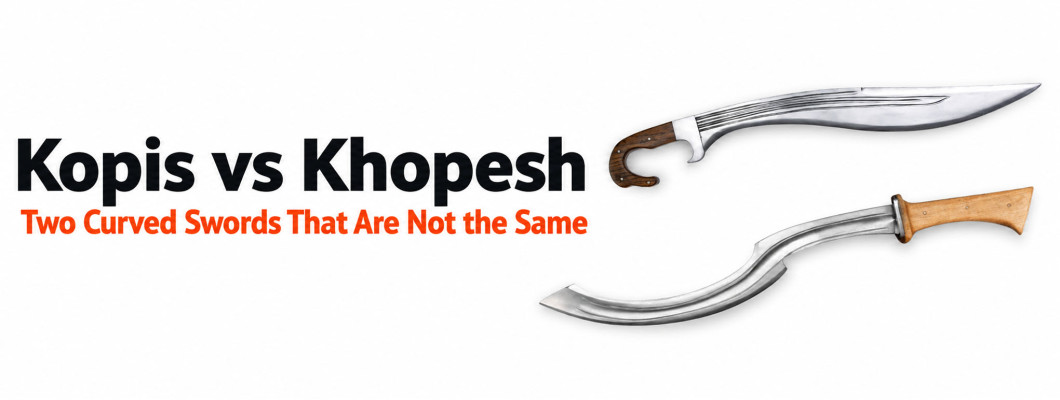
The khopesh and the kopis are two different swords from two different civilisations, a thousand years and a sea apart, and the only reason they get confused is that the names sound alike. The khopesh (also spelled khepesh, often misspelled "kopesh") is the Egyptian sickle-sword of the Bronze Age, c. 1600 to 1100 BC: a crescent blade with the cutting edge on the outside of the curve, designed to hook and slash. The kopis is the Greek single-edged iron sword of c. 600 BC to the Roman period: a forward-curving blade with the edge on the inside of the curve and the weight at the tip, designed to chop like an axe. This guide sets them side by side, explains where the edge sits on each and why that changes everything about how they cut, deals with the naming confusion and the "Greek borrowed it from Egypt" theory, and tells you which Everest Forge page to buy each from.
For the Egyptian blade on its own, start with our khopesh history and design guide; for the Greek one, the kopis sword guide. This post is the comparison those two could not be.
Where the Edge Sits: The One Difference That Explains the Rest
Every other difference between them follows from where the edge is. On the khopesh the sharpened edge runs along the convex, outer side of the crescent, like a sickle. That geometry pulls the edge across the target as the arm comes round, a drawing cut, and it lets the hook of the blade catch the rim of a shield or the back of a leg. The inside of the curve is blunt. On the kopis the edge runs along the concave, inner side of a blade that curves forward and widens toward the point, so the heaviest part of the blade is furthest from the hand and arrives first. That is a chopping geometry, the same principle as an axe or a kukri (khukuri), and it is why the Greek writers describe the kopis as the sword for a cut from above.
Kopis vs Khopesh at a Glance
| Feature | Khopesh | Kopis |
|---|---|---|
| Civilisation | Egypt (via Canaan and Mesopotamia) | Greece, then the wider Hellenistic world |
| Period of use | c. 1600 to 1100 BC in Egypt; sickle-sword ancestors from c. 2500 BC | c. 600 BC to the 1st century BC; survives as the Iberian falcata and in Roman cavalry use |
| Material | Cast bronze; a few ceremonial examples in iron or gold-plated | Forged iron, later steel |
| Blade shape | Straight tang-section from the grip, then a crescent or sickle curve | Single continuous forward curve (recurve), widening toward the point |
| Edge placement | Outside (convex) of the curve; inside blunt | Inside (concave) of the curve; thick spine on the outside |
| Typical length | 50 to 60 cm overall | 50 to 65 cm blade; shorter cavalry and longer infantry forms |
| Point | Rounded or hooked; not a thrusting weapon | Pointed; a thrust is possible but secondary |
| Cutting mechanics | Drawing cut and hook; weight near the hand | Chopping cut; weight at the tip, like an axe or kukri (khukuri) |
| Who carried it | Pharaohs in art and burial (two in Tutankhamun's tomb), New Kingdom infantry and chariot crews | Hoplites as a sidearm, and especially cavalry; Xenophon recommends it for horsemen |
| Name origin | Egyptian ḫpš, "foreleg of an ox", from the shape | Greek koptō, "to cut, to chop" |
| Nearest relatives | Mesopotamian and Canaanite sickle-swords; the later Ethiopian shotel is a separate development | Greek makhaira, Iberian falcata, and in form the Nepali kukri (khukuri) |
| Everest Forge page | Hand-forged khopesh sword | Hand-forged kopis sword |
The Khopesh: Egypt's Sickle-Sword
The khopesh did not begin in Egypt. Sickle-swords appear in Mesopotamia in the third millennium BC, on the Stele of the Vultures from Lagash and in the royal tombs of Ur, and they travel west through Canaan; the finest early examples come from Byblos and Shechem. Egypt adopted the form in the Second Intermediate Period, probably from the Hyksos, and made it its own in the New Kingdom, when pharaohs from Ahmose to Ramesses III are shown with a khopesh raised over kneeling enemies. The weapon in the art is as much a symbol of royal power as a tool: the god Amun hands the khopesh to the king in temple reliefs, and the two gold-trimmed examples buried with Tutankhamun were never meant to be swung.
As a working weapon it was cast in bronze, 50 to 60 cm long, with a straight section from the grip, a sharp outward bend, and a crescent that carries the edge on its convex side. That edge placement gives a slicing cut that works well against unarmoured or lightly armoured men and lets the inner hook pull an opponent's shield aside or catch a leg. It is not a thrusting weapon and it does not chop well; the mass sits near the hand, not at the point. By the end of the New Kingdom, around 1100 BC, it had gone out of use, replaced by straight bronze and then iron swords. Our khopesh vs shotel comparison covers the other sickle-sword people confuse it with, which is Ethiopian and two thousand years younger.
The Kopis: Greece's Forward-Curved Chopper
The kopis is an iron sword, which already puts it in a different technological world. It appears in Greece in the sixth century BC and is common from the fifth: a single-edged blade that curves forward, with a thick spine on the outside of the curve and the edge on the inside, swelling toward the point so the mass is far from the hand. The Greeks had a straight double-edged sword, the xiphos, as their standard sidearm, and the kopis was the alternative for people who wanted to cut rather than thrust. Xenophon, in his treatise on horsemanship, tells the cavalryman to prefer the kopis to the xiphos because a cut from the height of a horse is more effective than a thrust, and vase paintings bear him out: the kopis is the sword of riders and of heroes shown mid-swing.
Greek writers also use the word makhaira for the same or a closely related sword, and the two terms overlap enough that typologists generally treat them together; our kopis vs falcata post looks at the Iberian cousin that Rome's enemies carried and the Romans learned to fear. Length ran from about 50 cm for a cavalry sword to 65 cm or more for an infantry one. Unlike the khopesh, the kopis has a real point and can thrust in a pinch, but the blade is built for the chop, and the chop is why it worked: the forward weight does the job that a straight blade needs edge alignment and wrist strength to do.
Why the Names Get Mixed Up, and the Borrowing Theory
The confusion is mostly spelling. "Kopesh" is a common misspelling of khopesh that happens to look like "kopis", and search engines and catalogue listings have blended the two for years. Add that both are "ancient curved swords" and the mix-up is understandable. It is also wrong: the Egyptian word is ḫpš, the foreleg of an ox, named for the shape; the Greek word is from koptō, to chop. They are unrelated words from unrelated languages that happen to transliterate into similar letters.
There is a more serious version of the question: did the Greek kopis descend from the Near Eastern sickle-sword? The idea has been around since the nineteenth century and it is not impossible, because Greece traded with the Levant and iron-working itself arrived from the east. But the two blades curve in opposite senses and carry the edge on opposite sides, which is not what you would expect from a copy. Most modern typologists prefer a different line: the kopis grew out of single-edged Iron Age knives and the Italic and Etruscan curved swords of the seventh century BC, the same stock that produced the falcata in Iberia. Whether the Greeks ever saw a khopesh is beside the point; the kopis was not built from one.
An honest note. The original khopesh was cast bronze and the original kopis was bloomery iron. Everest Forge forges both as mono-steel 5160 spring steel, hardened and tempered, with a full tang. A 5160 khopesh is a stronger, lighter blade than any Bronze Age original could be, and it will not take the greenish patina of bronze; it is a steel interpretation of the form, not a metallurgical reconstruction. We do not make pattern-welded, folded or laminated steel.
How Each One Cuts
Khopesh. The arm comes round in an arc and the convex edge is drawn across the target, slicing. The blade's hook can catch a shield rim and pull it down, which opens the man behind it for the next cut. Against bone or heavy wood the khopesh is poor, because there is little mass behind the edge; it is a weapon for soft targets and for crowd fighting from a chariot, which is exactly what New Kingdom Egypt used it for.
Kopis. The cut comes from above, the tip-heavy blade accelerates on the way down, and the concave edge bites and keeps biting as the curve carries it through. A kopis will split a shield and go through a helmet rim where a khopesh would skate off. It cuts badly on the backswing and it is slow to recover, so Greek cavalry used it for a single downward blow at the gallop, which is Xenophon's whole argument.
If you want to cut with one of them today, the kopis is the one to choose. It is the better cutter by a wide margin, it handles like a long kukri (khukuri), and it holds up to backyard tatami and water bottles. The khopesh is a collector's and re-enactor's blade: beautiful, historically loaded, and best displayed or used for light cutting.
Which Everest Forge Page to Buy From
Both blades are in the ancient and classical swords collection, forged on demand from mono-steel 5160 spring steel after the order is placed; nothing is held in stock.
- Kopis. The hand-forged kopis is the Greek chopper: forward-curved, edge inside, full tang. There is also the kopis listed under its older "ancient Greek sword" name, which is the same Greek blade type despite the word khopesh in the page name; if you want a kopis, either page is the right one.
- Khopesh. The hand-forged khopesh follows the New Kingdom form with the straight tang section and the outward crescent, and the Egyptian khopesh sword is the heavier, display-oriented build.
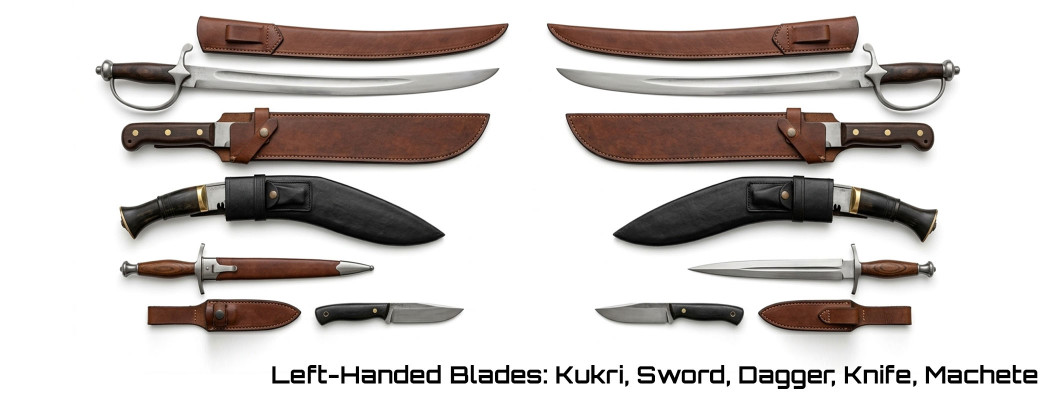
Blade length, finish and handle are selectable on each; the blade configurator shows the combination before you order. Either sword can be ordered left-handed by writing "Left Handed" in the order note, or to stage-combat specification with a blunt edge and rounded tip the same way. Catalogue builds dispatch in 2 to 3 business days; custom builds take 4 to 6 weeks at the forge; shipping is DHL or FedEx, tracked, 7 to 14 business days worldwide.
Related Guides
Commission a Kopis or Khopesh to Your Own Specification
Blade length, curve, edge geometry, handle and finish, sharp or stage-combat. The forge quotes it, builds it in 4 to 6 weeks from 5160 spring steel, and ships it tracked worldwide.
Start a Custom Forge RequestFrequently Asked Questions
Is a kopis the same as a khopesh?
No. The khopesh is an Egyptian Bronze Age sickle-sword with the edge on the outside of its crescent. The kopis is a Greek Iron Age sword with a forward curve and the edge on the inside. They come from different civilisations, different centuries and different metals.
Is "kopesh" a real sword?
"Kopesh" is a misspelling of khopesh, the Egyptian sickle-sword. Because it looks like "kopis", the Greek sword, the misspelling is the main reason the two get confused online.
Did the Greek kopis come from the Egyptian khopesh?
Probably not. The two blades curve in opposite senses and carry the edge on opposite sides. Most typologists trace the kopis to single-edged Iron Age knives and Italic and Etruscan curved swords, the same line that produced the Iberian falcata.
Which cuts better, kopis or khopesh?
The kopis, by a wide margin. Its tip-heavy forward curve chops like an axe and will go through shields and helmet rims. The khopesh slices soft targets and hooks shields but has little mass behind the edge.
What does khopesh mean?
It comes from the Egyptian word for the foreleg of an ox, which the blade's bent shape was thought to resemble. The Greek word kopis comes from a verb meaning to cut or chop.
Was the khopesh bronze or iron?
Bronze. It was cast, not forged, and went out of use around 1100 BC as iron swords arrived. The kopis was always an iron sword. Everest Forge makes both from 5160 spring steel, so the modern khopesh is a steel interpretation of a bronze form.
Is the kopis related to the kukri (khukuri)?
In form, yes: both are forward-curved, single-edged, tip-heavy choppers with the edge on the inside of the curve. Whether there is a historical link through Alexander's campaigns in the East is debated; the mechanical similarity is not.
What is the difference between a kopis and a makhaira?
Greek writers used both words for forward-curved single-edged swords and the terms overlap. Some scholars reserve makhaira for the broader family and kopis for the strongly recurved form; in practice a kopis is a type of makhaira.
Which Everest Forge page sells the kopis?
The hand-forged kopis sword page, and the older listing titled "The Kopis, ancient Greek sword Khopesh", which is the same Greek blade type despite the word khopesh in its name. The khopesh pages sell the Egyptian sickle-sword.
Can I order either sword blunt for stage combat or left-handed?
Yes. Write "Left Handed" in the order note for a left-handed build, or ask for stage-combat specification (blunt edge, rounded tip) the same way. Both apply to the kopis and the khopesh.