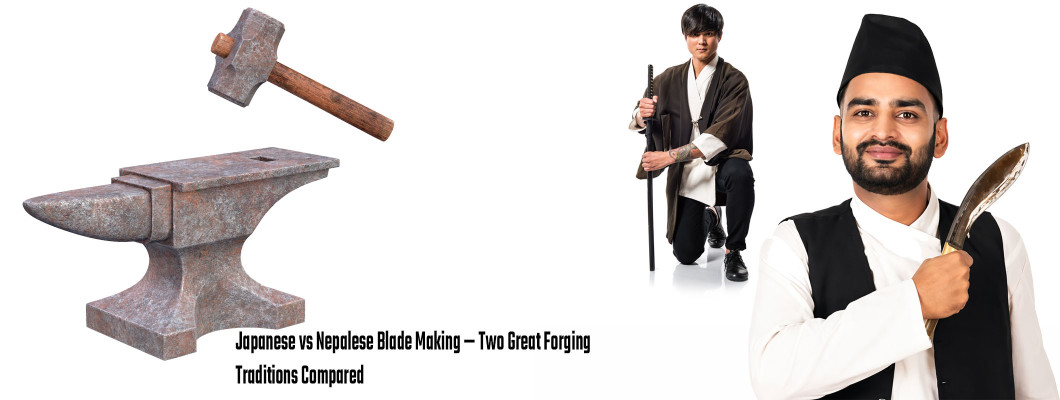
Two Traditions, One Purpose: The Art of Forging a Blade
Steel, fire, and the hands of a skilled craftsman. At their core, Japanese and Nepalese blade-making traditions share the same starting point. But the paths they took from that point — shaped by geography, warfare, culture, and centuries of refinement — led to two of the most distinct forging philosophies the world has ever produced.
Both traditions are genuinely great. Neither is better than the other. What they are is different, in ways that go far deeper than how the finished blade looks. Understanding those differences gives you a much clearer picture of what you're really holding when you pick up a katana or a kukri — and why each blade behaves the way it does.
Where Each Tradition Was Born
Japanese blade-making has its roots in the Heian period, around the 8th and 9th centuries AD. Early Japanese smiths worked with tamahagane — a smelted steel produced from iron sand in a clay furnace called a tatara. The material was inconsistent by nature, mixing high and low carbon steel in the same bloom. Rather than fighting that inconsistency, Japanese smiths turned it into a strength: they learned to fold and layer the steel, driving out impurities and creating a blade with different properties at the edge and the spine.
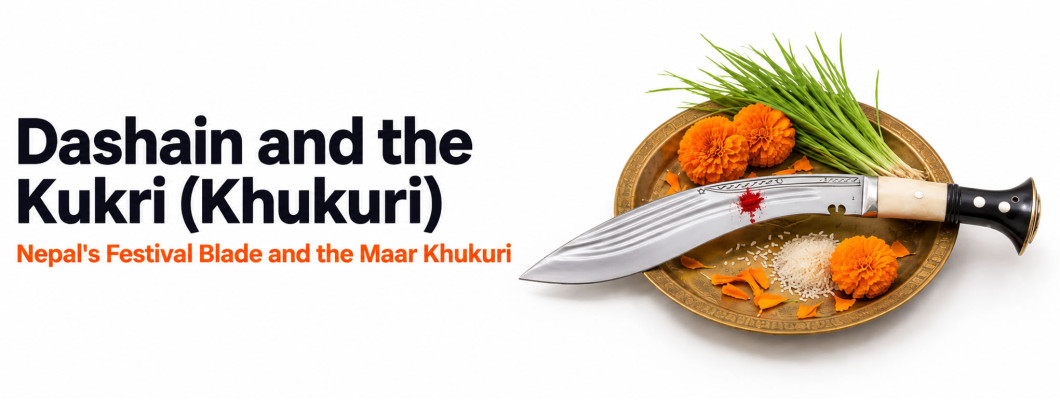
Nepalese blade-making grew from an older, more utilitarian urgency. The kukri — the iconic curved blade of the Himalayas — has been documented in use since at least the 7th century BC, with some historians tracing its lineage even further. In Nepal, blades were not ceremonial objects reserved for the warrior class. They were everyday tools used for farming, building, cooking, hunting, and combat in equal measure. The smiths who made them, known as kamis, belonged to a specific caste with forging passed down through families across generations.
These different origins matter because they shaped everything that came after — the steel chosen, the geometry of the blade, the heat treatment applied, and the philosophy behind what a blade is actually supposed to do.
The Steel: Tamahagane vs High-Carbon Spring Steel
Japanese smiths traditionally worked with tamahagane, folding the steel anywhere from 8 to 16 times to create a blade with thousands of microscopic layers. This process was not simply about tradition — it was the practical solution to variable raw material quality. The folding homogenised the carbon content, removed slag, and created a blade with a tight, consistent grain structure.
The defining technique of Japanese forging is differential hardening. By applying a thick clay coating to the spine of the blade before quenching and leaving the edge thinner or exposed, the smith creates two zones of steel with entirely different hardness in a single piece. The edge becomes extremely hard and capable of holding a razor-sharp angle. The spine stays soft and flexible, absorbing shock without cracking. The boundary between these two zones produces the famous hamon — the visible temper line running along the blade that is as much a record of the smith's skill as it is a decorative feature.
Nepalese smiths historically worked with whatever carbon steel was available — often recycled from old leaf springs or rail steel. Today, the standard across serious Nepalese forges is 5160 high-carbon spring steel, a material that suits the demands of the kukri almost perfectly. It is tough rather than brittle, meaning it resists chipping and cracking under the lateral stress that comes from chopping through dense vegetation, bone, or hardwood. It holds a working edge well and can be sharpened in the field without specialist tools.
Where Japanese forging optimises for a single, perfect cutting edge, Nepalese forging optimises for total blade integrity under real-world abuse. Both are correct choices — for their respective purposes.
Hand-Forged in Nepal
Authentic Kukris Crafted by Kami Smiths
Every blade in our kukri collection is water tempered, full tang, and forged using techniques passed down through generations. Built for real use — not display.
Shop the Kukri Collection →The Forging Process: Precision vs Power
Japanese Forging — A Study in Controlled Refinement
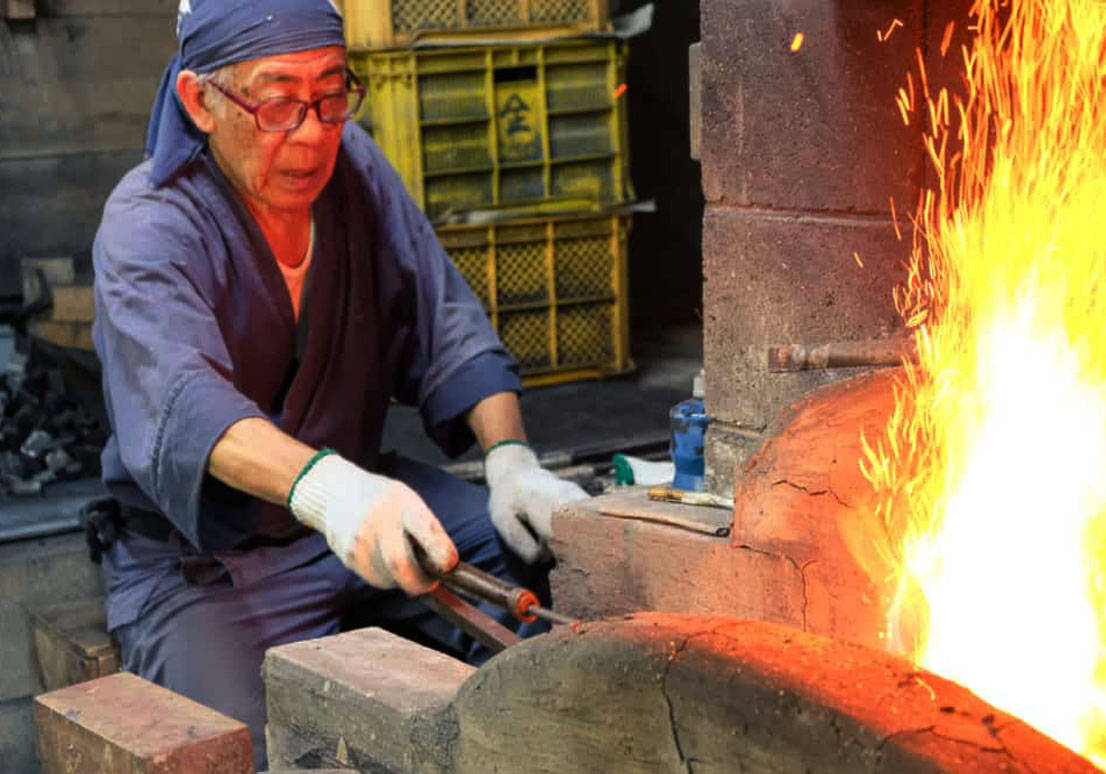
A traditional Japanese sword can take a master smith anywhere from a few weeks to several months to complete, depending on how strictly traditional methods are followed. The process begins with smelting the tamahagane itself — a two- to three-day continuous process producing a rough steel bloom. The smith then selects pieces with the right carbon content, welds them together, and begins folding.
Every fold is deliberate. Every hammer strike is placed with intention. The smith reads the temperature of the steel by eye — judging the colour of the glowing metal in the forge to know when it is ready to work. This skill alone takes years to develop. The curve of the finished katana is not hammered in directly — it emerges naturally during quenching, as the hardened edge contracts faster than the softer spine, pulling the blade into its characteristic shape.
After forging, a Japanese blade traditionally enters the hands of a specialist polisher — a separate craftsman who may spend weeks working through progressively finer stones to bring the blade to its final finish. In traditional production, the polisher's contribution is considered equal in importance to the smith's.
Nepalese Forging — Speed, Skill, and Functional Intent
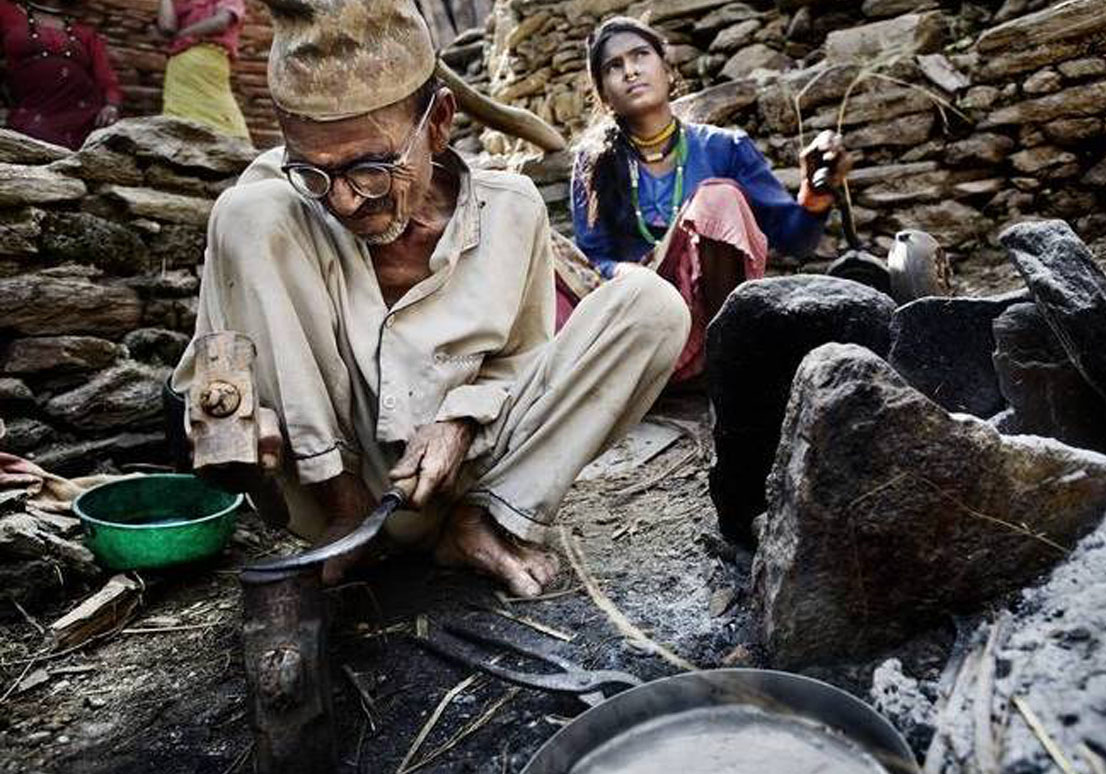
A Nepalese kami smith works differently. The forge is simpler — typically a charcoal fire with a hand or foot bellows — and the tools are few: hammer, tongs, anvil, and a trained eye. A skilled kami can forge a kukri blade in a single working day. That speed is not a compromise. It reflects a tradition that values efficiency and the ability to produce a reliable working blade with minimal equipment.
The process begins by heating the steel billet to working temperature and drawing it out into the rough profile of the blade. The distinctive forward-weighted curve of the kukri is hammered in progressively, with the smith adjusting geometry through careful controlled blows. The cho — the small notch at the base of the blade near the handle — is one of the most recognised features of the kukri, and its exact shape varies between regional styles and individual smiths, serving as a kind of maker's signature.
Once the profile is formed, the bevel is ground in and the blade is water quenched — a harder, more aggressive temper than the oil quenching common in Western forging. The handle is fitted, pinned, and finished by hand. No two kukris from the same smith are identical. That variation is not a flaw. It is exactly what hand-forged means.
Blade Geometry: Built for Different Fights
Look at a katana and a kukri side by side and the geometry tells you everything. The katana has a long, slender profile — typically 60 to 75 cm of blade — with a gentle curve and a consistent spine thickness that tapers cleanly toward the tip. It is optimised for the draw cut: a slicing motion that pulls the blade through a target as it moves. The combination of extreme edge hardness and blade length makes it a devastating cutting weapon in trained hands.
The kukri is shorter, heavier at the tip, and curved far more dramatically. The forward weight is intentional — it puts mass at the point of impact, giving each chop significantly more force than the blade's overall weight would suggest. The spine is thick and strong. This geometry makes the kukri an exceptional chopper: efficient at clearing vegetation, splitting wood, processing game, and delivering powerful blows in close combat — which is exactly the reputation the Gurkhas built around it.
A katana rewards technique and precision. A kukri rewards strength and directness. They were built to solve different problems, and both solve their respective problems very well.
The Role of the Smith in Each Culture
In Japan, the master swordsmith holds a position of profound cultural reverence. The making of a sword was — and in many circles still is — considered a near-spiritual act. Traditional smiths perform rituals before beginning a blade, and the forge itself is treated as a sacred space. The finished sword carries the smith's name, and that name is a guarantee of quality tracked across generations.
In Nepal, the kami smith holds an equally important but differently framed role. Kamis are the backbone of village life in many parts of the country — not just blademakers, but the people responsible for all metalwork the community relies on. Their craft is practical and communal rather than ceremonial. A kami's reputation is built through the tools people carry into the field every day, and the durability of those tools over years of hard use.
Both traditions demand the same depth of knowledge — metallurgy, heat treatment, geometry, materials — acquired through years of hands-on work rather than formal study. In both Japan and Nepal, that knowledge passes from smith to apprentice, often within the same family, in an unbroken line stretching back centuries.
What This Means When You're Choosing a Blade
If you're drawn to Japanese-influenced blade-making — the philosophy of a single perfectly refined edge, the layered steel, the precise geometry — you're looking for a blade that rewards careful use and careful maintenance. Japanese-style blades respond brilliantly to skill. They are precision instruments first and foremost.
If you're drawn to the Nepalese tradition — the toughness of 5160 steel, the forward-weighted chop, the no-compromise practicality — you're looking for a blade that performs under pressure in hard conditions without needing special treatment to stay functional. Nepali-forged blades are working tools in the truest sense of the phrase.
The good news is that you don't have to choose one tradition as a philosophy. You can appreciate both, collect both, and use both — because they genuinely complement each other. A hand-forged kukri and a hand-forged sword each represent the best of what their tradition has to offer, and understanding how they were made only deepens the experience of owning one.
Everest Forge — Forged in Nepal
Two Traditions. One Standard of Quality.
Browse our hand-forged sword collection, explore authentic kukris crafted by kami smiths, or design something entirely your own through our custom forge service.
Browse Swords → Browse Kukris → Request a Custom Blade →Frequently Asked Questions
What is the main difference between Japanese and Nepalese blade-making?
Japanese forging focuses on a single, precisely hardened edge using differential clay quenching and folded tamahagane steel. Nepalese forging prioritises overall blade toughness using 5160 high-carbon spring steel with water quenching, producing a blade built for hard, sustained use rather than edge precision alone.
What steel do Japanese swordsmiths use?
Traditional Japanese smiths use tamahagane — a steel produced by smelting iron sand in a clay furnace called a tatara. The resulting bloom contains varying carbon levels, which the smith manages through repeated folding and welding to create a consistent, refined blade.
What steel does Everest Forge use for kukris and swords?
Everest Forge uses 5160 high-carbon spring steel — the same material grade used in heavy-duty leaf springs. It delivers exceptional toughness, impact resistance, and edge retention, making it well-suited for both working blades and serious collectors.
Is a katana or a kukri better for real-world use?
They serve very different purposes. A katana is a precision cutting weapon optimised for draw cuts and edge sharpness — best suited to trained technique. A kukri is a multi-purpose tool optimised for powerful chopping, outdoor use, and durability under hard conditions. For real-world utility, the kukri is more versatile. For martial arts and collection, both have strong merits.
What is a hamon on a Japanese sword?
The hamon is the visible temper line along the blade created by differential hardening — a process where clay is applied to the spine before quenching, leaving the edge exposed. This produces a hard cutting edge and a softer, more flexible spine in a single piece of steel. The hamon is both a functional record of the heat treatment and a prized aesthetic feature.
What is a kami smith in Nepal?
A kami is a member of the metalworking caste in Nepal, traditionally responsible for forging all blades and metalwork within their community. Kami smiths learn their craft through direct apprenticeship, usually within their own family, and carry centuries of accumulated forging knowledge. The kukris produced by kami smiths at Everest Forge are made using these same inherited techniques.
Can I order a custom blade inspired by either tradition?
Yes. Everest Forge offers a custom forging service where you can specify your preferred blade shape, size, steel, handle material, and overall design. Whether you want something influenced by Japanese geometry, traditional Nepalese form, or something entirely original, you can submit your request through our custom forge page.